PreK Shape Poetry

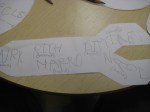
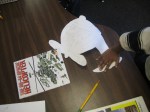
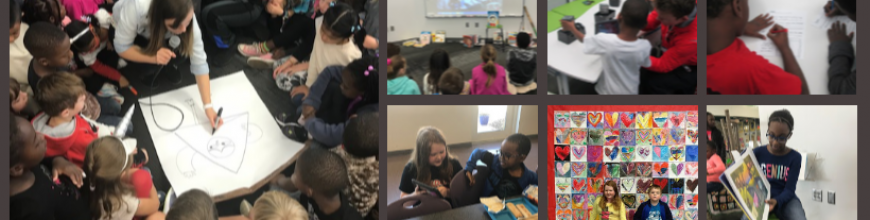
Today was lesson 2 in a 3-part collaboration with Ms. Spurgeon’s PreK class.  Last week, we read multiple examples of shape poems and wrote a model poem as a class.  Today, students focused on writing their own poems.  To prepare, Ms. Spurgeon and her parapro, Ms. Melissa, drew large shapes for each student and cut them out.  These shapes were the symbols that each student uses in class to label various belongings.  Each symbol has come to have special meaning to each student.  I pulled nonfiction and fiction books related to each symbol so that students could reference the books for words to put inside their shapes.

I opened today’s lesson by reading a poem from Joyce Sidman’s Meow, Ruff: A story in concrete poetry.  I used this as a reminder to students that the words that go inside the shape must somehow represent the shape.  Ms. Spurgeon and I found that it was a common mistake for students to want to put whatever words were in their heads instead of focusing on their shape.  She reiterated my opening by sharing a poem that she wrote about chocolate and reminding students that all of her lines were about chocolate.

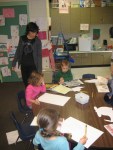
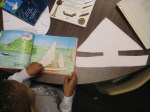
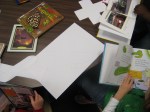
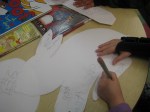
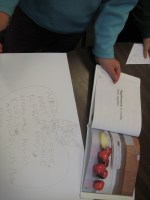
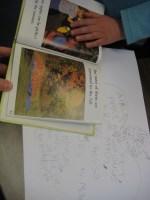
Next, students each received the books about their symbol and proceeded to 3 work spaces where the pre-cut symbols were already out at chairs.  Ms. Spurgeon, Ms. Melissa, and I each went to these areas and sat with students as they worked.  Students began by looking through their books for ideas from the pictures or reading the words with adult assistance.  As they decided on words, students sounded out words and wrote their words inside the shapes with their best handwriting and spelling.  Next, students read their lines to an adult and the adult wrote the correct spelling of each word in parentheses.

Ms. Spurgeon will continue this lesson by giving students time to finish their poem and add color to it.  They will also practice reading their poems before part 3.  The last part of this collaboration will be recording each student reading his/her poem on camera and sharing those videos on Teacher Tube.

I was surprised by how helpful having books about their symbols was for the students.  Many got ideas from the pictures and several even used direct words from the text.  For example, one girl wrote a poem about rabbits.  In the picture, she got so excited when she saw that the rabbit’s ears were going down.  This turned into a line in her poem that was actually written on the rabbit’s ear.  Another student read her books about apples with Ms. Melissa.  She took facts such as “apples can be made into applesauce” and “apples are mostly harvested in the fall” and used pieces of those lines in her apple shape.

I’ll be sharing more about our media center’s support of poetry writing in the coming days and weeks.
PreK Weather Forecasters: a teacher’s perspective

Ms. Kelly Hocking just made a page on her website about the PreK weather forecasters in her classroom.  You can find more pictures of the project and a few of her own thoughts on what a great job these students did.

Ms. Hocking’s Website

Sharing Massive Content: A Collaborative Strategy


Every year, I’m amazed at the amount of content that our 5th grade teachers have to teach in just Social Studies.  Not only do these teachers have to concern themselves with the Reading and Math CRCT scores, they also have to teach a massive time span in history with many intricate details.

This year the 5th grade team began talking with me about a project they wanted to try this year to hand over some of the content of their “Bigger, Better, Faster: The Changing Nation” unit.  Students will work in teams of 3-4 students.  The groups will be mixed across the grade level with students of varying abilities in groups.  Teachers will assign topics from the unit to the various groups.  In the media center, I’ll do a lesson on note taking and gathering information from a variety of sources.  I’ve also made a pathfinder with resources connected to each topic as well as all of the standards covered in the project.  I’ll introduce this pathfinder and how the various resources work in my introduction lesson with students.  My paraprofessional has worked to pull print resources from the library and sort them by category.  These will be checked out to the 5th grade and placed in a central location in the grade level for students to use.  The teachers have booked both computer lab and laptop cart time as well as media center time for me to assist students with their research.

Once students get going with their research, the teachers and I will share a variety of options for final products.  The teachers want to use a variety of technology along with more traditional kinds of final products such as brochures.  The tools I will share with students include Glogster Edu, Animoto, and Photo Story.

Finally, students will showcase their work in the media center.  This showcase will allow the 5th graders to learn from all of the projects in an effort to allow students to help teach and take ownership of the 5th grade GPS standards.  It will also allow students from other grade levels to see their work as a preview of what is to come in 5th grade.  Students will have an authentic audience for the work and will hopefully retain the content better as they share their learning with others.

We’re giving this a try this year, and we’ll fine tune it as we go.  I hope that this grows into future kinds of projects like this one for other 5th grade content and other grade levels as well.

Gathering Community Stories 2010 COMO Presentation

I will be presenting the Barrow Oral History Project at the Georgia Council of Media Organizations Conference in Athens, GA on Friday October 15 in Athena Room I.  Here are the resources that I will be sharing in my presentation.

Cartooning with Chuck

Ms. Hicks and Ms. Saxon’s 2nd grade spectrum class have been learning about graphic novels.  Their exploration started off in the media center where we looked at how graphic novels are created by watching a video from Capstone Publishers.  This video got students started in thinking about storyboarding, penciling, inking, and other terminology used when creating a graphic novel.  Next, we moved to our graphic novel collection in the media center and looked at multiple graphic novels under the document camera to see how reading a graphic novel might be different than reading a novel.  After exploring this together, students all chose a graphic novel to read at tables and started making noticings about what they discovered in the pictures and text.

Ms. Hicks and Ms. Saxon continued this process in their classroom by having students read multiple graphic novels and compare they writing, art, and other techniques used.  Students are also working on book reviews of all of their readings.

All of this exploration is building a foundation for students before they launch into creating their own graphic novels.  One more source of support was bringing in a cartoonist to demonstrate his art for the students.  Dr. Chuck Cunningham is the assistant principal at Colham Ferry Elementary School in Oconee County, but he is also a cartoonist.  He regularly publishes cartoons in the Oconee Enterprise and has created cartoons for other newspapers and magazines for many years.  He also shares his talents with many of the classes at his own elementary school, but we were fortunate enough to have him visit Clarke County to share with our students.

Dr. Cunningham created a cartoon with students in the moment and wove in instruction about creating panels, penciling/inking, kinds of text, drawing tips, and more.  The students were bubbling with excitement and left the media center fired-up about starting their own graphic novels.  Dr. Cunningham left all of the artwork that he created today so that students can reference the tips that he offered.

I love to connect students and teachers with expert guest speakers because it is hard for teachers to be experts in all that they teach.  If you are an individual who would love to support our students with a talent or area of expertise that you have, let me know and I would love to connect you with our students and teachers at Barrow.

This slideshow requires JavaScript.

Native Americans Collaborative Centers

Native Americans Center Rotation.

Watch what happened during our Native Americans collaborative centers with 4th grade on Thursday & Friday.  (More to come soon on the GLMA blog).

Constitution Day Lessons

Constitution Day 2.

Watch what happened during our Constitution Day collaborative centers with 5th grade on Friday.  (More to come soon on the GLMA blog).