Many Kindergarten classes have been using Storybird to create digital stories using artwork. Here are Ms. Li’s Storybirds:
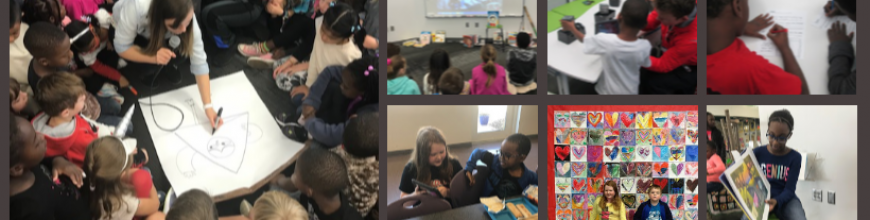
Many Kindergarten classes have been using Storybird to create digital stories using artwork. Here are Ms. Li’s Storybirds:
 A small group of five 1st graders have worked with me during their writing time to create a Google Form Choose Your Own Adventure. This year, some 4th graders tried this with some social studies standards. These 1st graders were free to write about anything that they wanted to. We met during 4 one-hour sessions that looked something like this:
Session 1: I showed a completed Google Form Choose Your Own Adventure as a model. Then, I showed the first steps of creating the story which were to create a title, a beginning, and the first 2 choices the reader had to make.
Session 2: We made new pages for each of our 2 choices and created 2 new choices for each of those choices. We linked the choices from the beginning of the story to the correct pages.
Session 3: We made 4 endings for each of our choices from the middle of the story. We also made a “The End” page. We linked each choice to its correct page.
Session 4: Students used Google to correct spelling, added details to their stories, traded computers with a friend to test their story out, chose a theme for their form, and emailed their final form to me for this post.
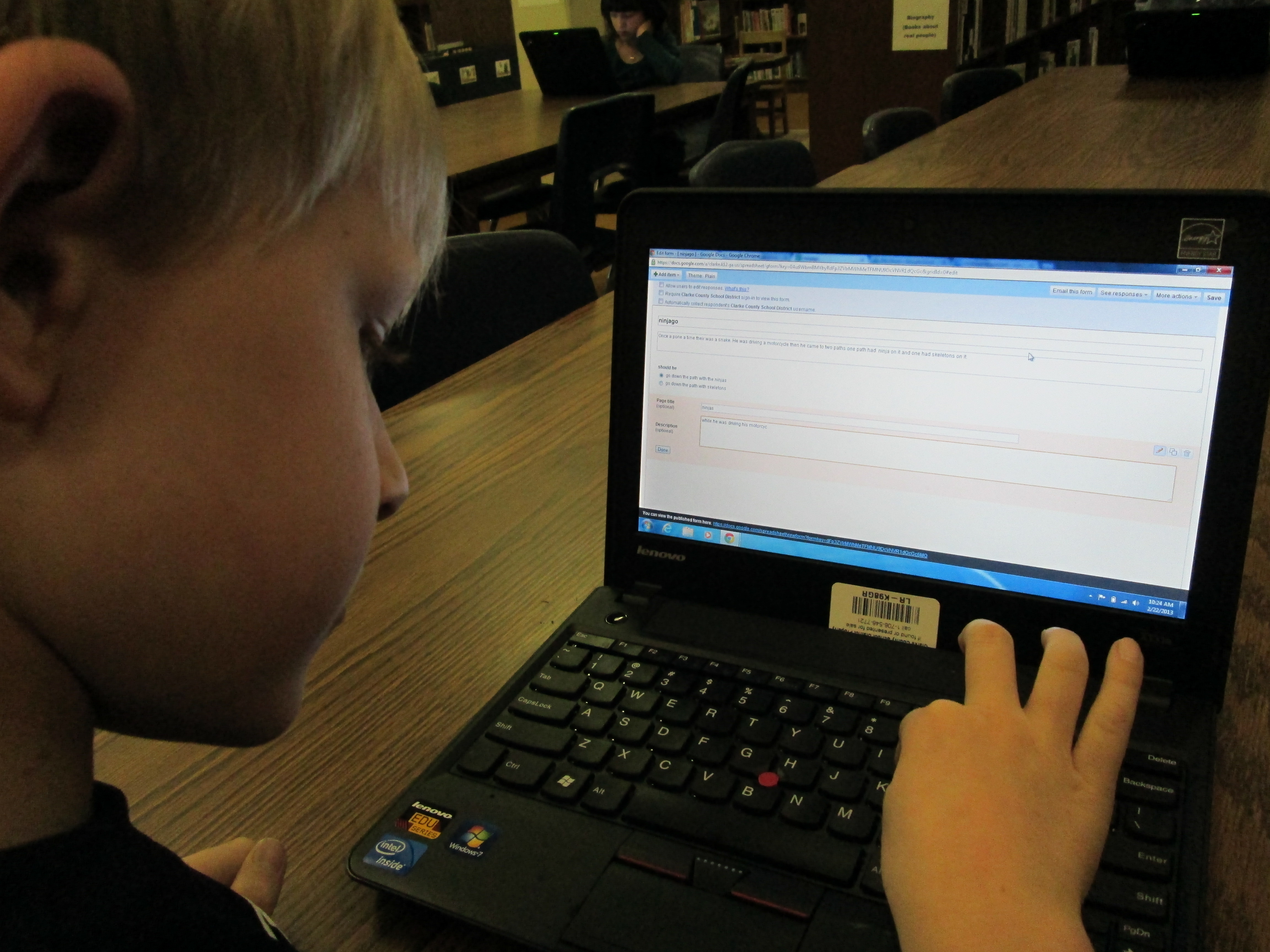 These students needed a lot of assistance during this project, so I feel like this is something that would work better in small group settings with adult support for younger students. I do think that the structure of these 4 sessions was very obtainable for these students and 1 adult. These students now have a lot of expertise that they can now share with students in their class. I’m not sure that they could fully create one of these on their own yet, but they definitely developed their skills in Google docs and forms.
You can read their stories here:
The Apple and the Chocolate Trainer by Kyusung
The Clouds by Katie
The Fairy by Adaline
Ninjago by Bo
This story was still in progress at the time of this post:
Tinya the Teacher Fairy by Carinne
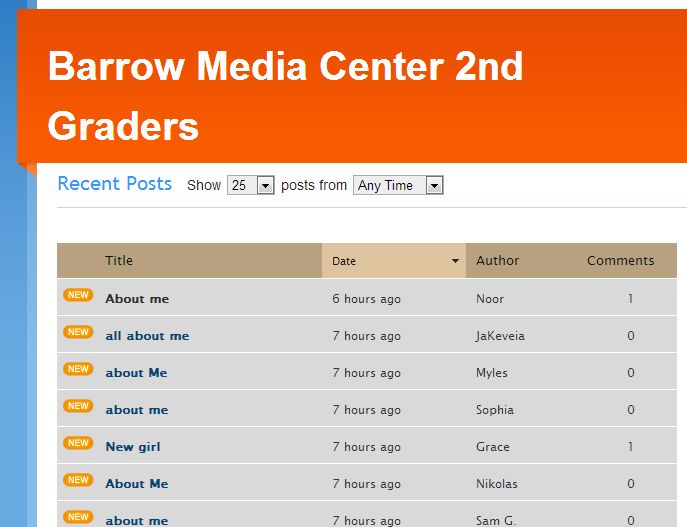 Two 2nd grade classes have embarked on a blogging project with Shannon Miller’s students in Van Meter, Iowa. We’ve connected with one another via skype and read the book Same Same but Different. Our students have been working on writing their first blog posts on KidBlog to introduce themselves. My students did this on paper, but Shannon’s students did their work in Google Docs.
 For the past 2 days, my students have been busy typing their first “About Me” blog post. While they typed, the teachers and I conferenced with students on their posts to check for details, spelling, and punctuation. Then, we gave them the thumbs up to publish their post. After publishing, students could personalize their blog with one of the KidBlog themes. Both days, the teachers and I were amazed by the students’ focus. They worked diligently for 45 minutes each day and were very willing to go back and check spelling and edit their punctuation. Again, I think that the idea of having an authentic audience is very motivating to the students.
Our next step will be to mail our rough drafts to Iowa where Shannon will have her students practice commenting on post-it notes before commenting online. Her students will mail paper copies of their posts as well so that we can practice too. From there, we will continue to post a variety of posts and comment on one another’s writing. 
The students and teachers are fully of energy for this project, and we are excited to see the work that they are eager to produce.
Their blogs are located at Barrow Media Center 2nd Grade KidBlog. We invite you to read and comment on their posts.

Our very first blogger posted his “About Me” post

983 miles to Van Meter
I’m so excited about the project that two 2nd grade classes are working on right now. Mrs. Ramseyer and Mrs. Wright’s classes are connecting with Shannon Miller’s 2nd grade students in Van Meter, Iowa. Right now, our 2nd graders are working on opinion writing. The idea for this project started there, but it has grown into so much more through email and face-to-face conversations with the teachers and tweets, emails, and Google Docs with Shannon Miller.
Yesterday, the 2 second grade classes came to the library to kickoff the project. We looked at Google Earth and mapped the distance from our school to Van Meter Elementary in Van Meter, Iowa. It is 983 miles and would take over 15 hours to drive there. Students were also curious about how long it would take to walk there, so Google Earth showed us it would take about 304 hours! With the approaching snow storm, I’m not sure I want to try that one!
Next we talked about what it means to blog. I showed them the library blog and how it is read by people all around the world. We even looked at the Clustr map showing where our blog readers come from. I was trying to build their understanding of how large your audience is when you publish your writing online.
The students will use Kid Blog to create their blogs. This tool allows you to quickly create multiple accounts through an Excel spreadsheet upload. No email addresses are required. Then, all students have to do is go to the blog, select their name, and type in their password to type their posts. We took a look at this, and you should have heard the excitement when they saw that their names were already on the screen.

Writing our paper blogs
 Finally, we had the kids brainstorm with a partner what they might write about in a first post. We wanted the focus to be “About Me”. Before we sent them to tables to write, I reminded them of the importance of not including personal information such as full names, addresses, phone numbers, etc. At tables, each student wrote a paper blog post about themselves. Mrs. Wright, Mrs. Ramseyer, and I all walked around and conferenced with students on their posts. We were impressed with how much students were willing to write. I was reminded of the importance of kids having an authentic audience for their work and how motivating that audience can be to even the most reluctant of writers.

Same, Same but Different will be a theme for our conversations
Today, we connected via Skype with Shannon and her students. We read the book Same, Same but Different by Jenny Sue Kostecki-Shaw. It was such a perfect book because it pushes the notion that all over the world we do things that are the same but they might look a little different. During our Skype, we paused and let the kids talk about Iowa and Georgia. They stepped up to the camera and asked questions about one another about the weather, activities, and school population. They made several connections to the story. For example, in Iowa it is about to snow a lot. It takes a major snow for them to get out of school. We get snow here in GA, too, but we get out of school if there is just a dusting. Same, same but different! As we blog with one anther, it is our hope to share our favorite books and opinions as well as continue to explore the idea of how connected we are in the world even though things might look and sound a little different. I have a feeling students will continue to say “Same, same but different”.
On Monday and Tuesday, our 2nd graders will type and post their blogs. We will mail our paper versions of our writing to Iowa so that Shannon’s students can practice commenting on them before they actually comment online. She will do the same with her students’ writing so that we can practice commenting, too.
 From there, we hope to connect some more through Skype and through the continued writing of our blogs.
This is going to be a very rich experience for these students, teachers, and librarians!

Students stepped up to ask one another about living in Iowa and Georgia
Some third graders have been exploring how they can make their own ebooks. This group was a big exploration. We really didn’t know what we were doing when we started, and we gave ourselves permission to just try things, problem solve, and be at peace if something just didn’t work.
We decided to try Barnes and Noble’s Tikatok first. It’s free and can either be done with a parent account with children added or can be done with a teacher account with students added. Students can use a gallery of photos or import their own. Most students chose to search for creative commons photos to use in their book. One student even did her own photography. Some students started with a written story and made their pages and images match their story. Others started with interesting images and tried to weave those into a story or collection of poems.
The free version of Tikatok only allows you to use photos and text. If you want to include audio, you have to pay to upgrade your account. Also, we learned that a parent account allows the books to be shared exactly as they are created, while a teacher account only allows the books to be shared with the word “tikatok” spread across each page. Ultimately, this is a tool for Barnes and Noble to make money through the purchase of the ebook version or the printed version. However, we found that it was useful enough and easy enough to use that we would try it again and only use the features that were free.
Another group will begin exploring in a couple of weeks. This group is probably going to try out a different tool called SimpleBooklet. There are many more features in this tool such as embedding Google docs, video, and audio. The feel of the book is more like a slideshow than the turning of pages in Tikatok, but the features may prove to support more creativity and transmedia experiences for students. Our hope is that these 2 exploration groups will work out some of the kinks for future groups and inspire whole grade levels to try this out.
You can preview 3 of the books that these students created here.
 This week we’ve been kicking off our first persuasive writing contest in the media center. Students are writing persuasive essays about whether or not picture books are important for today’s kids. You can learn more about the contest in this video.
<iframe width=”560″ height=”315″ src=”http://www.youtube.com/embed/htyiaeHCKds” frameborder=”0″ allowfullscreen>
We’ve talked about the contest on our morning BTV show, but we’re also holding lessons on persuasive writing in the media center. A first grade class came and imagined what the library would be like without picture books. 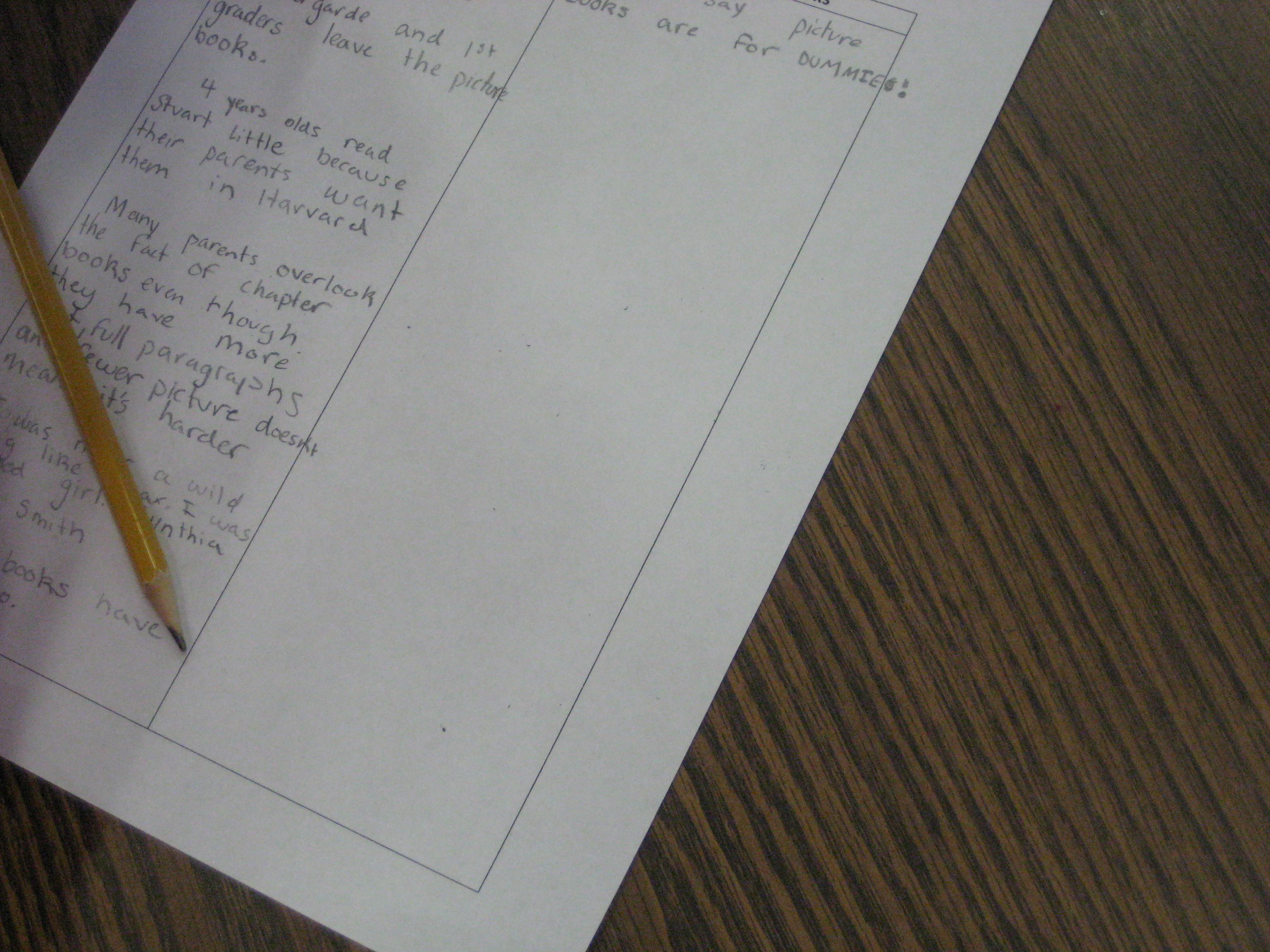 They made a brainstorm list about what might be good or bad about this. That list was a spark to begin thinking about their writing. We also read Keiko Kasza’s Ready for Anything and pointed out persuasive techniques used in the story.
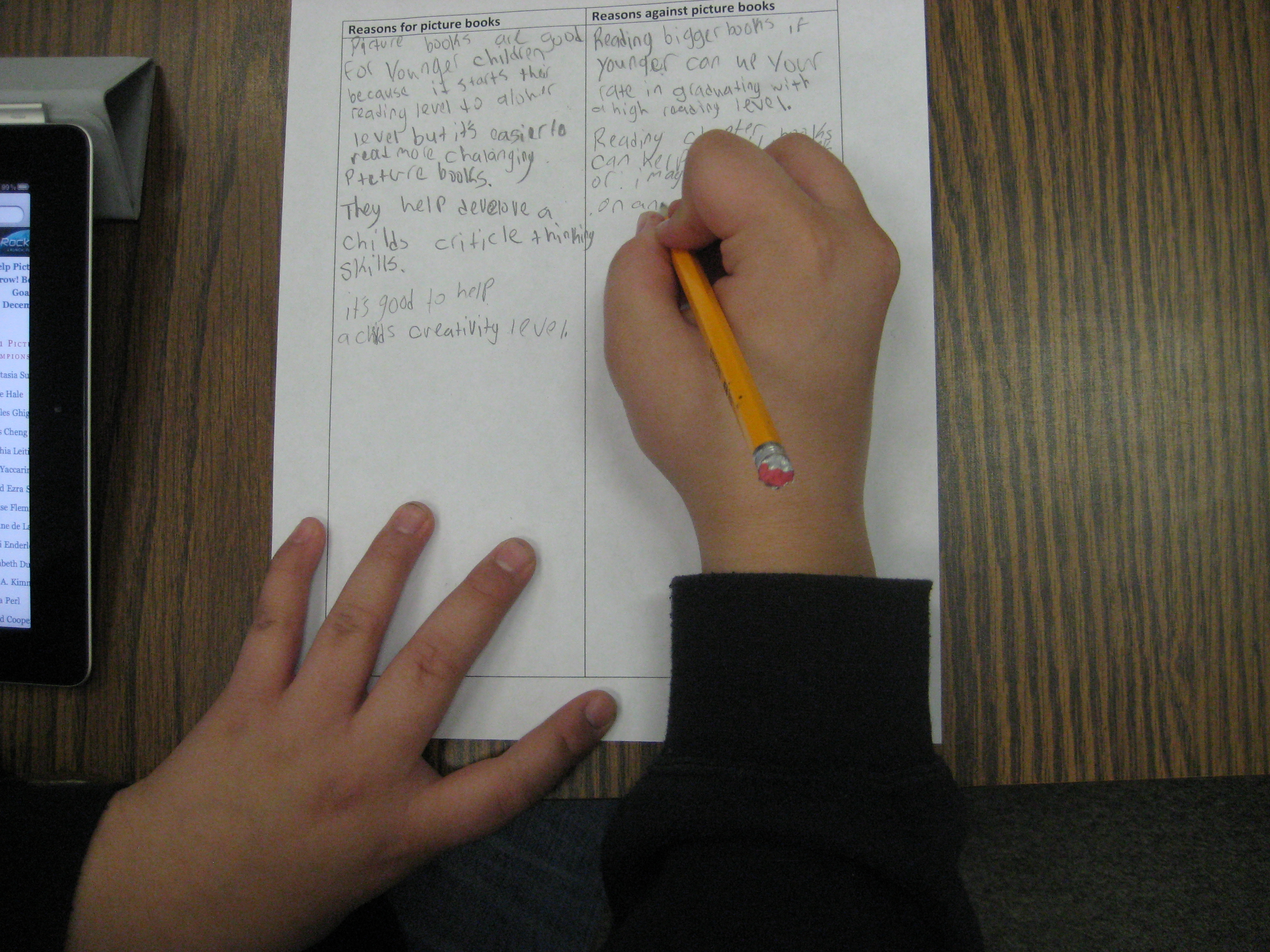
Today, a 5th grade class came and viewed a slideshow of persuasive strategies. Then, they split at tables and read the NY Times article about picture books and essays on the Picture Book Month website using the iPad. They organized their research into a 2-column chart, for picture books and against picture books. Many of them said they would continue this research at home. The teacher plans to schedule a writing workshop time with the media center for students who are interested in the contest. These students will have time to do more research, write, and conference with me about their writing.
A kindergarten teacher has also scheduled time for a small group to meet with me to work on their writing for the contest.
The persuasive writing is flowing at Barrow. We’re so honored to be able to support this writing standard that grades 1-5 are working on this quarter.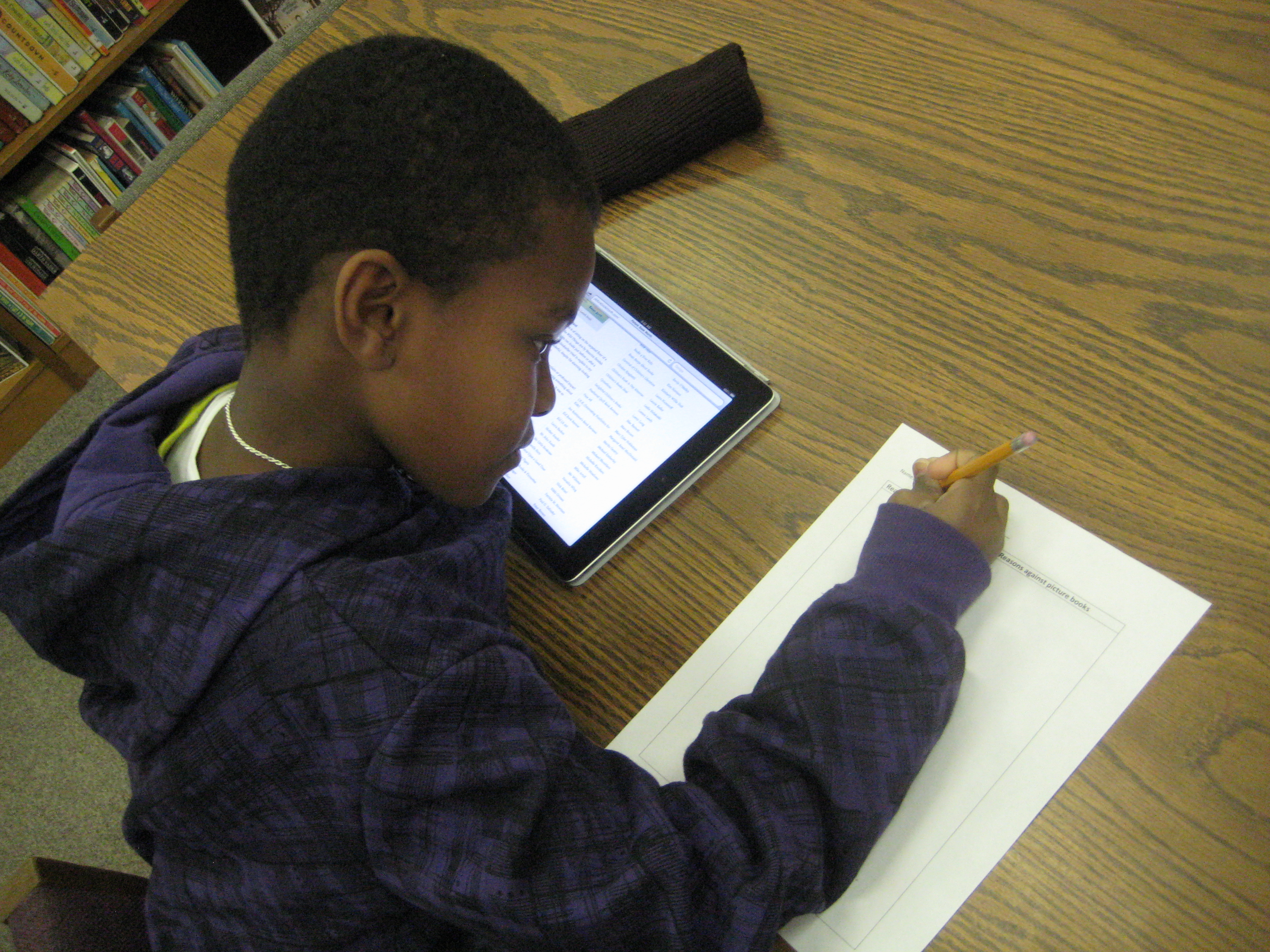
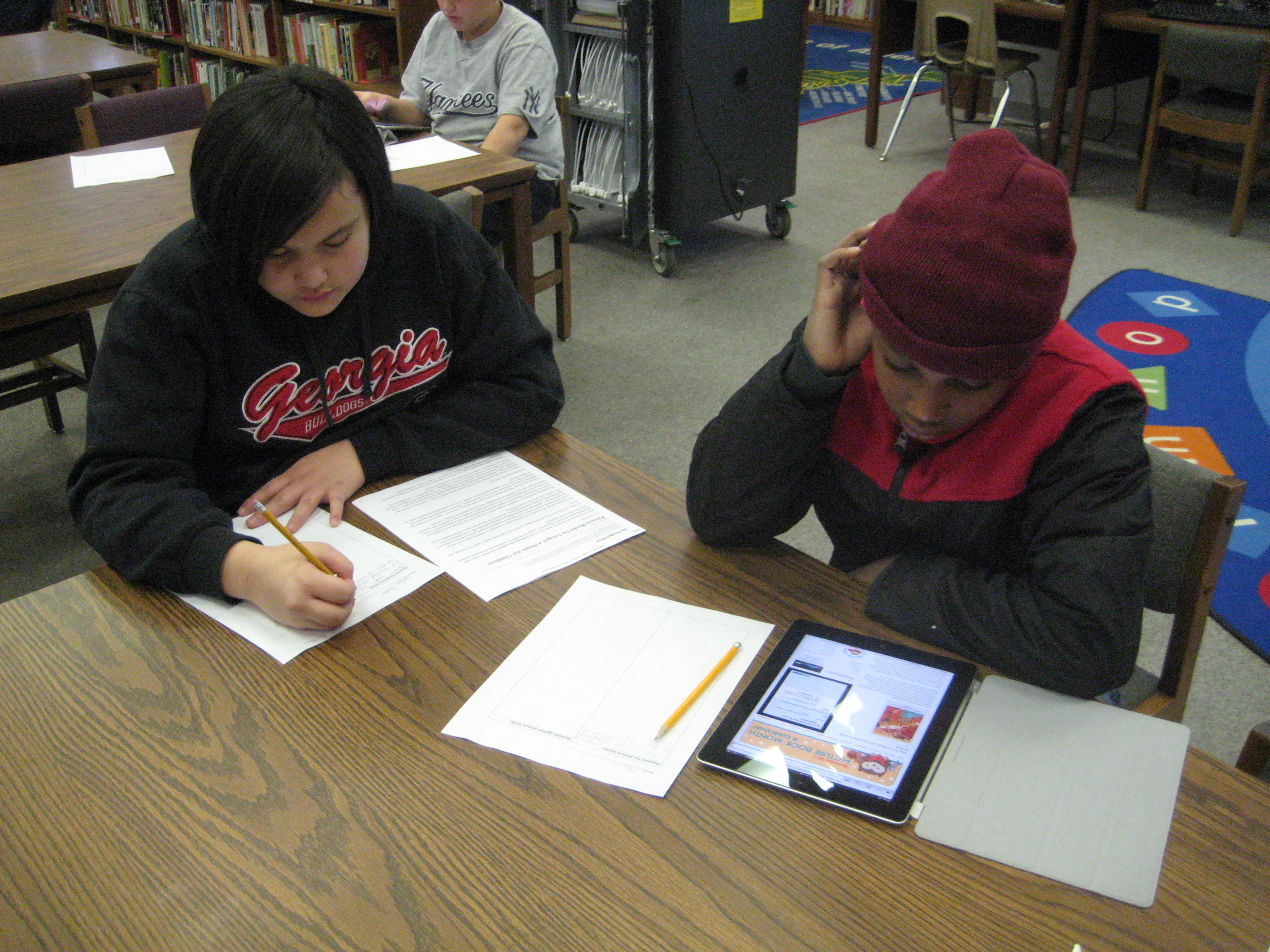
The Barrow Media Center is sponsoring our very first persuasive writing contest. The contest starts now through February 10th. All entries are due by 3PM on February 10th. Students in any grade at Barrow may enter. This contest supports the Georgia Performance Writing Standards that grades 1-5 are working on during 3rd quarter and it is an extension of our Picture Book Month celebration from November. Students are asked about the following topic: Picture books….important for today’s kids or not? Essays must be 500 words or less and preferably typed. Students can use any resources as inspiration, but we recommend the picture book month website and the New York Times article, Picture Books No Longer a Staple for Today’s Kids. Consider using persuasive writing techniques such as big names, playing into emotions, building trust, using facts and numbers, and backing up your stance with reputable research. We will award certificates to the top essays in Prek-1st, 2nd-3rd, and 4th-5th. The top essays will also be recorded for our blog and morning broadcast. The media center will also hold writing workshops for whole classes and small groups on persuasive writing and conference with students on their writing prior to entering the contest. We can’t wait to see what students come up with.
 Expect the Miraculous