Click here to access our September Monthly Report or scan the QR code above.
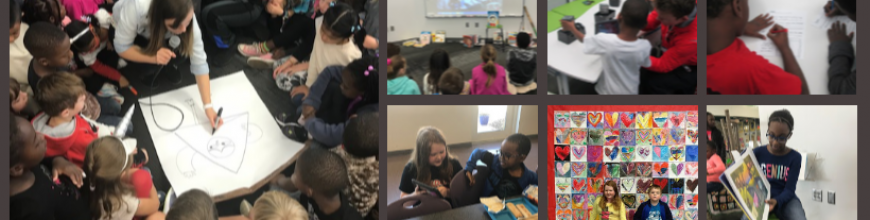

This year, I’m trying to model transliteracy & transmedia in my monthly reports. Hopefully, I’ll get better at this as the months progress rather than get overwhelmed by all that is going on. I used Simplebooklet to make this month’s report.
 Last week, I was sitting in a faculty meeting analyzing grade level math data with PreK. As I listened in, I heard them talk about students from the previous quarter who had not met the standard for counting to ten. They were making plans for new standards that were coming up in the current quarter, but also thinking about how to continue to support this group of students who needed to work on the previous quarter standards.

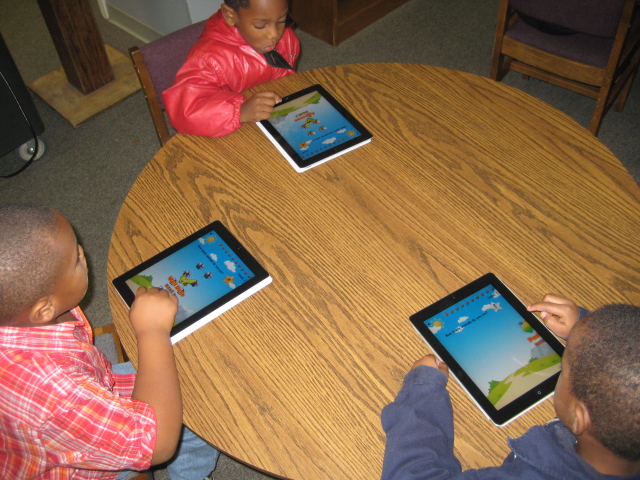
Counting Lite App
I pulled out my iPhone and searched the iTunes app store for counting apps, and found multiple free apps that we might try. Most of the free apps were limited versions of the larger paid versions, but for our purposes, the free versions were enough to try. I suggested that we might try some of these apps on our 10 iPads, and the teachers were eager to give it a go.
Today, the 2 teachers pulled together a group of students and brought them up. I gave very little whole group instruction on what to do other than introducing the iPad and how to touch the screen. I went around to each iPad and opened the app that students needed, and they started. As usual, I was amazed at how quickly students started interacting with the iPads. The teacher, a volunteer, and I went around to each student and prompted them to talk out loud because part of this lesson was to have the students practice counting. They touched objects on the screen, counted aloud, and the apps also counted aloud and wrote the number on each object as it was touched. I appreciated the ease of use of the iPads with PreK because the adults were able to focus on content instruction rather than having to instruct on how to use the technology. Students left feeling successful with using the technology and with counting, and the teacher left feeling like students had practiced multiple standards through a few apps and was eager to come back to use the iPads some more.
I started this year with a flexible plan for the iPads that the district is having me pilot. I’ve listened to teacher and student needs and searched for how the iPad might be a tool to support those needs. The excitement over the device is growing, and I have a feeling that our small cart of 10 iPad is going to be in high demand very soon.
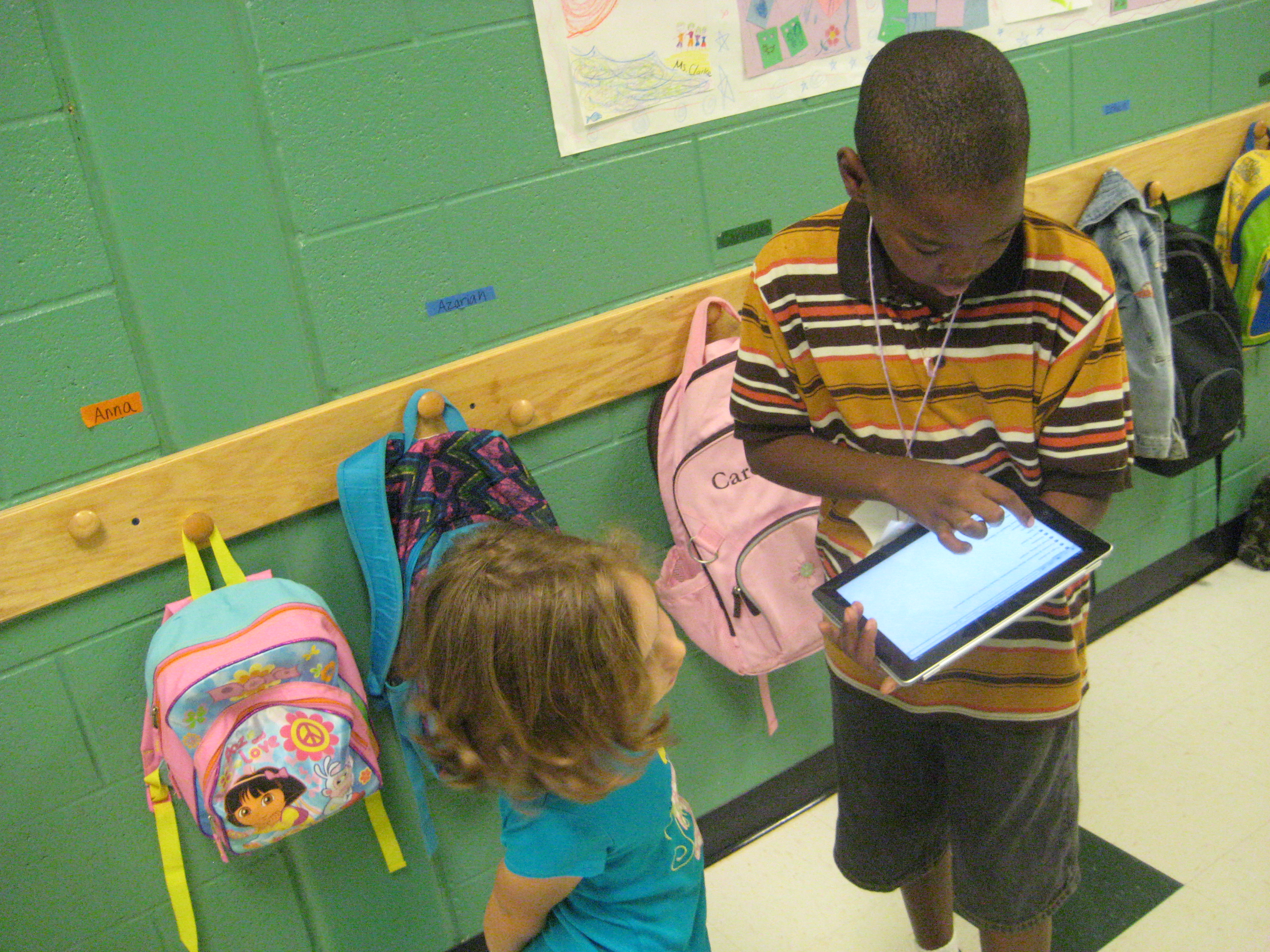
Surveying students using iPad and Google forms
Once again, I’ve set out on a journey with a group of students to make decisions on what books are purchased for the library in a project called Book Choice Champions. This year, I set aside $1500 in book fair profits for a budget that is completely decided on by students. Once again, our school is doing enrichment clusters on Wednesdays, so from 9-10AM I have a group of 11 students in grades 2nd-5th that come to the library to work on this project until late November. The students self-selected which enrichment cluster they would be in based on their interest in the cluster topic. The surprising part of this is that the group of students I’m working with is all boys.
On day 1, the boys immediately noticed that no girls were in the group and they saw this as a problem. How would they buy books that were supposed to be for the whole school without having girl representation in the group? They decided to survey students from the whole school and felt that it was important to know how many boys and how many girls answered the survey. They also wanted to know what grades students were in so that all grades were represented in the decisions. Two students in the group were in a similar group last year and they talked about the problems that we had with surveying, especially using blank paper and simply asking people what they liked to read. For this reason, they decided to develop a Google survey that could be done on laptops, desktops, smartboards, and iPads. They felt it was important to ask about various categories of books such as animals/sports/fairies/etc, kinds of books such as chapter/picture/informational/etc, and to give students a chance to request specific books or series.
The next problem was when would students take the survey. We knew we didn’t want to interrupt instruction, so we thought of the least disruptive process we could. They came up with several idea that they are now trying:
This year, my goal is to do a monthly report that shows happenings and statistics in our media center. This is my first attempt at this, so I’m sure it will evolve as I move through the year. You can view our August Report here.


 Expect the Miraculous