Connecting through Stories: 2015 World Read Aloud Day Part 1

FullSizeRender

Our first day of Read Across America and World Read Aloud was filled with wonderful stories and plenty of technical difficulties, but we didn’t let the technical difficulties prevent us from connecting through stories.

The day began with my first cancellation emails.  Since World Read Aloud Day is right at the beginning of March, many states are still experiencing winter weather.  Two connections were cancelled before we could even begin due to snow.  Did this stop us? No.  Ms. Wyatt’s 1st grade class still came, and we read aloud Goodnight Already and Waiting Is Not Easy and noticed many similarities between the two books.  We just didn’t have a Skype connection to go with it.

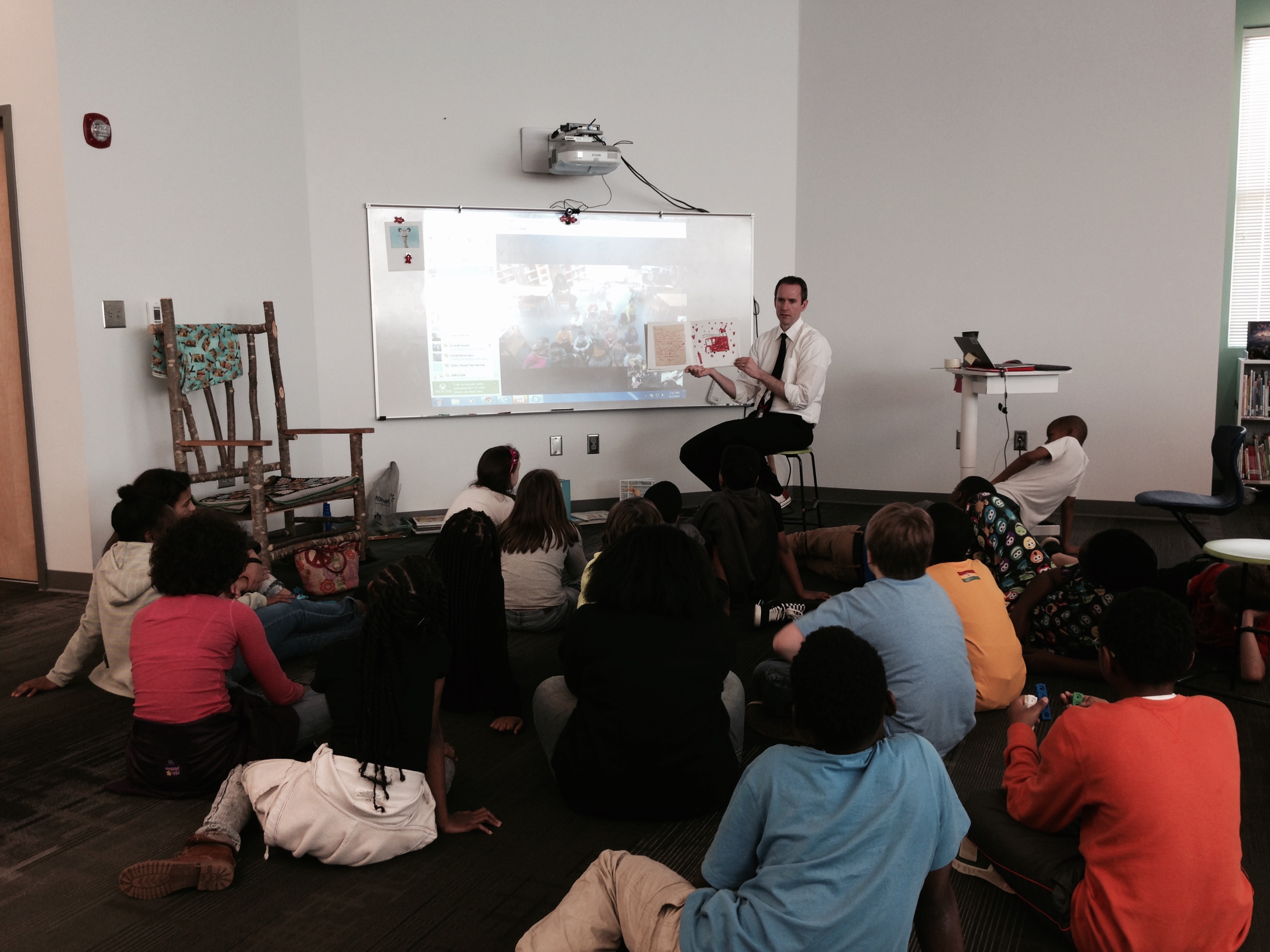
Ms. Freeman’s 5th grade students came to connect with Cassandra Ogletree and her students in Forsyth, GA.  Before we connected, our students made predictions about where they thought Forsyth, GA was located.  Then, we used Google Maps to take a look.  During our connection, we read Goodnight Already with Cassandra and her students.  I was Bear and Cassandra was Duck.  Since our 5th graders are studying perspective, they noticed how the book showed the different perspectives of bear and duck.  As usual, students had time to ask one another questions about where they live.  We often take for granted that students realize how connected we are around the world, but these Skypes surface that our students have lots of wonderings about the day to day lives of others around the world.  When we disconnected, we took time to look at a street view in Google Maps to see the school that we had just Skyped with.  Student were amazed by the lack of buildings around the school.  It seemed to be way out in the country surrounded by pastures and trees.  This is very different from our school that is right next to UGA.

Ms. Boyle’s class skyped with Colleen Friel and her 1st grade in Long Island, NY.  We shared The Story of Fish and Snail.  Our Skype calls kept freezing or dropping, so we reached a point where we just had to stop the call and finish the story on our own.  Once again, the students were so patient during the technical difficulties and we didn’t let it stand in the way of the story.

Ms. Haley’s class had an opportunity to connect with Elizabeth Garton Scanlon, author of wonderful treasures such as All the World and The Good Pie Party.  The downside was that we couldn’t get Skype to work at all in order to connect with her.  I tried every trick I could think of to make the connection better and faster and nothing worked.  Finally, I took out my phone and we huddled around my phone for over 30 minutes listening to her share about her books, her ideas, her dog, and her upcoming work.  We had the treat of hearing the first few pagers of her upcoming book The Great Good Summer.  Within just a few pages, several of our students started opening up about connections they had to the book.  One student shared about losing her dad.  Another talked about her dad being gone on tour.  I love how stories help us make connections to the emotions we wrestle with and give us a pathway to conversation with one another.  It must be amazing as an author to hear how your words open up conversations for readers.

Ms. Freeman’s 5th grade returned at the end of the day to connect again with Colleen Friel in Long Island, NY.  This time, our Skype connection was much better since the district worked on the network.  We read the book The Day the Crayons Quit.  Students loved finding out that even though there were 7 inches of snow on the ground, the New York students were still in school.

Finally, we closed our day by doing a triple Google Hangout with Donna MacDonald in South Burlington, VT and Craig Seasholes in Seattle, WA.  Ms. Carney’s Kindergarten class joined their Kindergarten classes in reading 3 Elephant and Piggie stories.  It was fun to connect across the country and hear words being spoken between thousands of miles of the United States.  We had fun, engaged in some silliness while we read, and made some new friends.  Even though Donna had some technical difficulties, we still made it work.  We could hear her, but not see her.

I won’t lie that I was a bit flustered today with all of the problems, but I have to say how important it is to persevere.  I could have easily given up and called it all off, but we made things work with what we had.  Because of that, our students had an amazing first day of connections through stories.
2015 World Read Aloud Day Blogging Challenge Week 2

It’s time once again for the World Read Aloud Day blogging challenge as we count down the days to this special week-long event of sharing stories with one another across the miles.  My friend and super librarian, Matthew Winner, has outlined the challenge on his blog.

The World Read Aloud Day “Speak Your Story” Blogging Challenge begins February 9 and runs through March 8. If you choose to take the challenge, each week you will be asked to write a post in response to a prompt or question (outlined below), for a total of 4 posts counting down to World Read Aloud Day.

Each of the prompts addresses the WRAD theme “Speak Your Story.” Speak Your Story encapsulates that simple yet effective way that we connect with others by sharing our stories aloud. Your voice is powerful and when a story is shared a bond is made.

For week 2, we have been exploring these stems:

Pick a question to answer with a partner. 1. If I could listen to anyone in the world read aloud to me it would be…2. I think everyone should read… 3. My favorite part about reading aloud or being read to is…

Barrow students used Flipgrid to respond to this question:

Week 2 WRAD Challenge

For this week’s challenge, I interviewed my Facebook friends to see what they would say about these stems.  I love the idea of crowdsourcing content and how technology can pull together so many voices. This has been especially helpful since I’ve been sick most of this week and losing my voice by the end of the week.  It was so interesting to see various friends take time to respond to these stems and learn something new about them that I didn’t know before.  Thank you to all who responded or paused to reflect!

I think everyone in the world should read…

Me:  Because of Winn Dixie by Kate DiCamillo.  I love that this story is about making connections in your community, listening to each person’s story, and finding the magic in your everday life.  Each time I read this book, it makes me feel good and makes me want to go out and explore my community.

Facebook:

  • El Deafo by CeCe Bell (Matthew Winner)
  • The Miraculous Journey of Edward Tulane by Kate DiCamillo (Kaycie Rogers)
  • Wonder by R J Palacio (Julie Moon)
  • Because of Winn Dixie by Kate DiCamillo (Shannon Thompson)
  • Austin Kleon (Carolyn Foote)
  • Anything that sets your imagination on fire! (Amy Fowler James)
  • Whatever, whenever, and wherever they can! (Diane Cordell & Judy Serritella)
  • As many books as you can (Lee Rogers)
  • Anything, everything! (Frances Hensley)
  • Everyday (Em Tendo)

If I could listen to anyone in the world read aloud to me, it would be:

Me:  My daughter.  She is just now learning how to read, so it is truly amazing to see how she has gone from a baby staring up at my face reading aloud to her to a reader who is working hard to figure out those letter and picture combinations on the page.

On a celebrity note though, it would have to be Jessica Tandy.  There is something about her voice that is calming and peaceful to me.  Listening to her characters in Driving Miss Daisy and Fried Green Tomatoes makes me want to hang out with her all day and just listen to stories.  Her voice and her way of bringing stories to life through spoken word exemplify what it means for me to get lost in a story and suspend time.
Facebook:

  • Alec Baldwin (Lizzie Faville Payne)
  • Morgan Freeman (Jennifer Biddle)
  • My Grandmother (Ashlee Hembree)
  • My Grandchildren (Sherry Horton Jones)
  • Christopher Walken (Matthew Winner)  Read Matthew’s post on the Busy Librarian
  • Anthony Hopkins (Dera Weaver)
  • Shelby Foote (Amber Dawn Suman)
  • Andy Plemmons (my mom!)  She says that I make the story come to life 🙂
  • Hemingway (Beverly Hembree)
  • Sarah Koenig (Amy Fowler James)
  • Maya Angelou, Lauren Bacall, William Hurt, Antonio Banderas…(Deborah Bambino)
  • The struggling reader with a good fit book. (Em Tendo)
  • Morgan Freeman, Meryl Streep, Billy Collins (Frances Hensley)
  • James Earl Jones and Mel Blanc together (George Webber)

When I read aloud my favorite character to impersonate is:

Me:  I absolutely love to read aloud Epposumondas.  I love making the southern voices in the story and watching kids’ reactions to the voice changes.  Sometimes I struggle to find the right voice for certain characters, but the characters in that book just come to life for me.

Facebook:

  • Skippyjon Jones and Pigeon (Frannie McClester)
  • Eeyore (Lizze Faville Payne
  • The Giant from Jack and the Beanstalk and the Big Bad Wolf from Three Little Pigs (Amy Fowler James)
  • Emma from a made up story (Cindy Plemmons)
  • The Dump Truck from Little Blue Truck (Amber Dawn Suman)
  • Junie B. Jones (Amber Pace)
  • Pruella the Boo Hag (Dera Weaver)
  • Violet Beauregard (Laura Smith)
  • Veruca Salt (Holly Wolfe)
  • Pigeon (Donna Carney)
  • Any villain (Em Tendo)

The genre or author that takes up most of my bookshelf is:

Me:  It’s no surprise to people who know me that it’s Kate DiCamillo.  I have every book she has written and most of them are autographed.

Facebook:

  • Stephen King (Lizzie Faville Payne)
  • Poetry (Dera Weaver)
  • Harry Potter and Kathy Reichs (Frannie McClester)
  • Female authors Toni Morrison & Anne Pachett (Frances Hensley)
  • Cookbooks & Crafts (Em Tendo)
  • mo willems and michel foucault (Sarah Bridges-Rhoads)

My favorite part about reading aloud or being read to is:

Me:  I love reading aloud because it brings the story to life in a different way.  When a story is spoken into the air and heard by an audience, we all experience it together in many different ways.  We laugh.  We gasp, We question. We discuss.  Reading alone is fun, but when you read aloud, the story comes to life.

Facebook:

  • Listening to how my daughter’s R sound evolves and becomes more developed. I can listen to her mature, and it’s amazing! (Dawn Jameson)
  • Getting to share the private experience of a story with someone else. (Lizzie Faville Payne)
  • Watching the faces of my first graders as I read to them, and then watching THEIR faces as they read to me! (Laura Smith)
  • I loved working with first graders @ the beginning they could not read then by the end they were reading a book! I miss those days! I love for Jacob to read to us! Read the Christmas story out of his bible Christmas Eve (Sandra Williams)
  • Seeing the expressions on the faces of my students when they get lost in a story…all kids deserve to be read to…even the older ones! (Tiffany Whitehead)
  • moving all around and acting out the characters! (Sarah Bridges-Rhoads)
  • My favorite part of reading aloud is doing funny voices. (Shannon Thompson)
  • The students’ interactions with the story and disappointment when the story is over that can be replaced with excitement when another is read. (Frannie McClester)
  • Becoming part of the story and “reeling” the kids in. I believe reading to children is the first step to helping them love to read. (Amber Pace)
  • Getting lost in a story, whether I’m reader or listener. (Dera Weaver)

Join me and countless others as we celebrate LitWorld’s World Read Aloud Day on March 4th, 2015 and throughout that entire week.  Check out the shared Google Doc to find a connecting class or post your own schedule.

2nd Grade’s Black History Flipgrid Project is Ready for Your Votes!

filming (7)

Our Barrow 2nd graders have been hard at work creating this year’s Black History research project.  We built upon our momentum from last year, but added many new layers.

filming (19)

During the project students

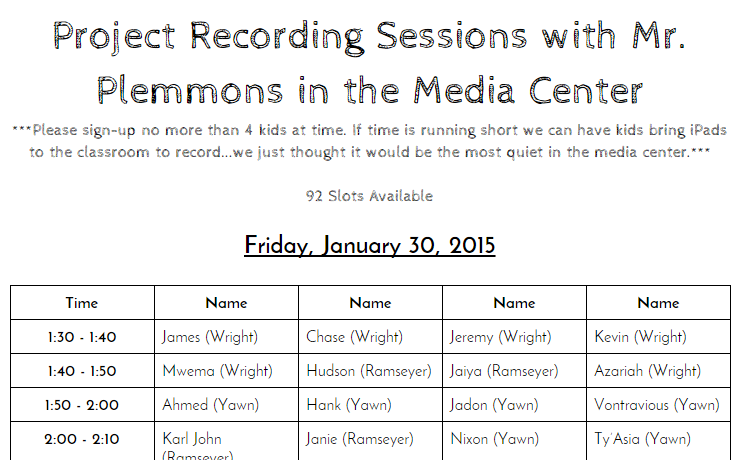
Over the past 2 weeks, students have been coming to the library in groups of 4 during blocks of 10-minute segments.  During each session, I put a sign on the library door to encourage people to enter quietly.

The teachers scheduled their students on a shared Google doc, so I knew who was coming at each 10-minute interval.  This was really helpful for me to know if students really had some extra time or if they needed to finish and hurry back to class.  recording sessions

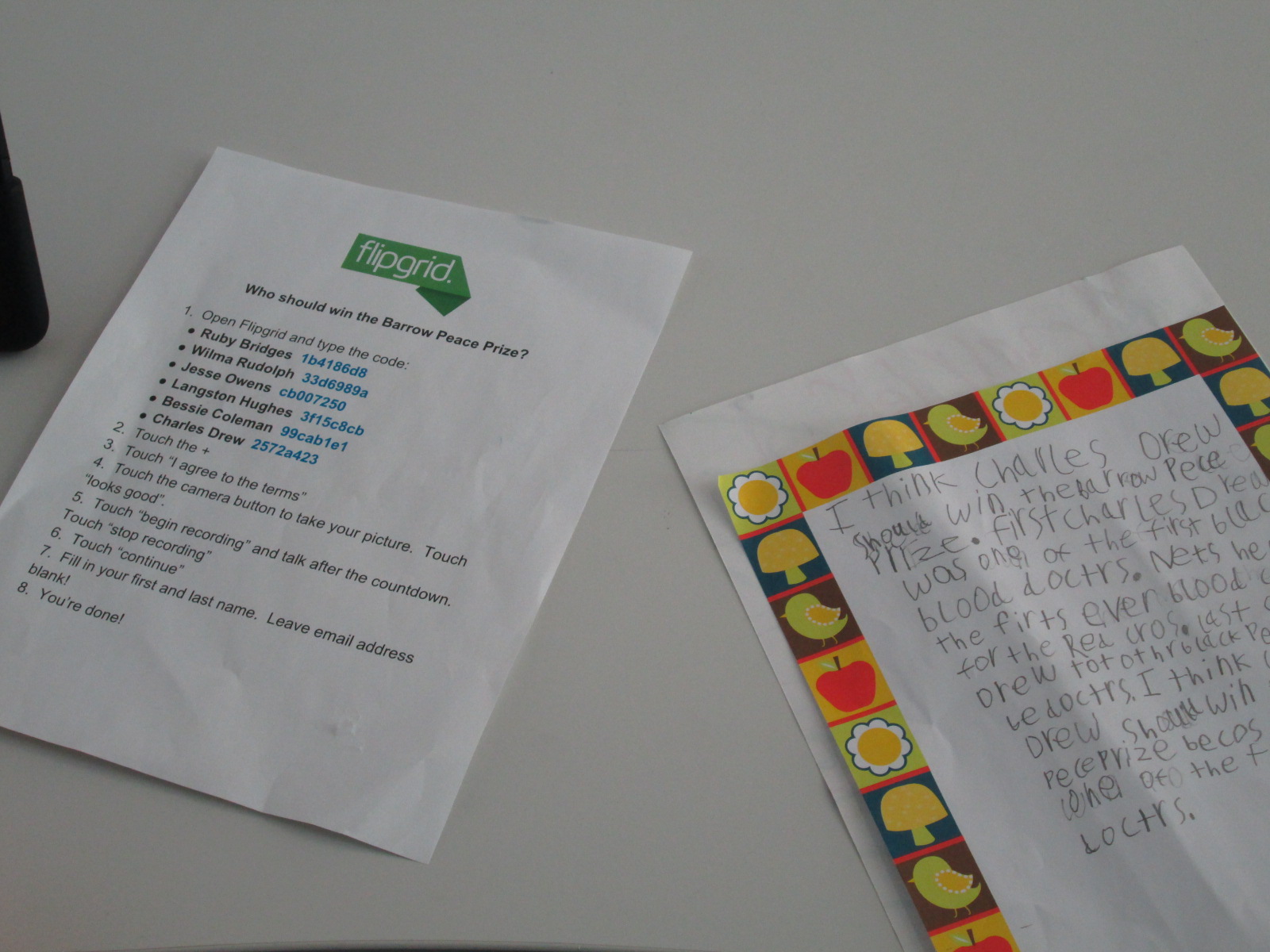
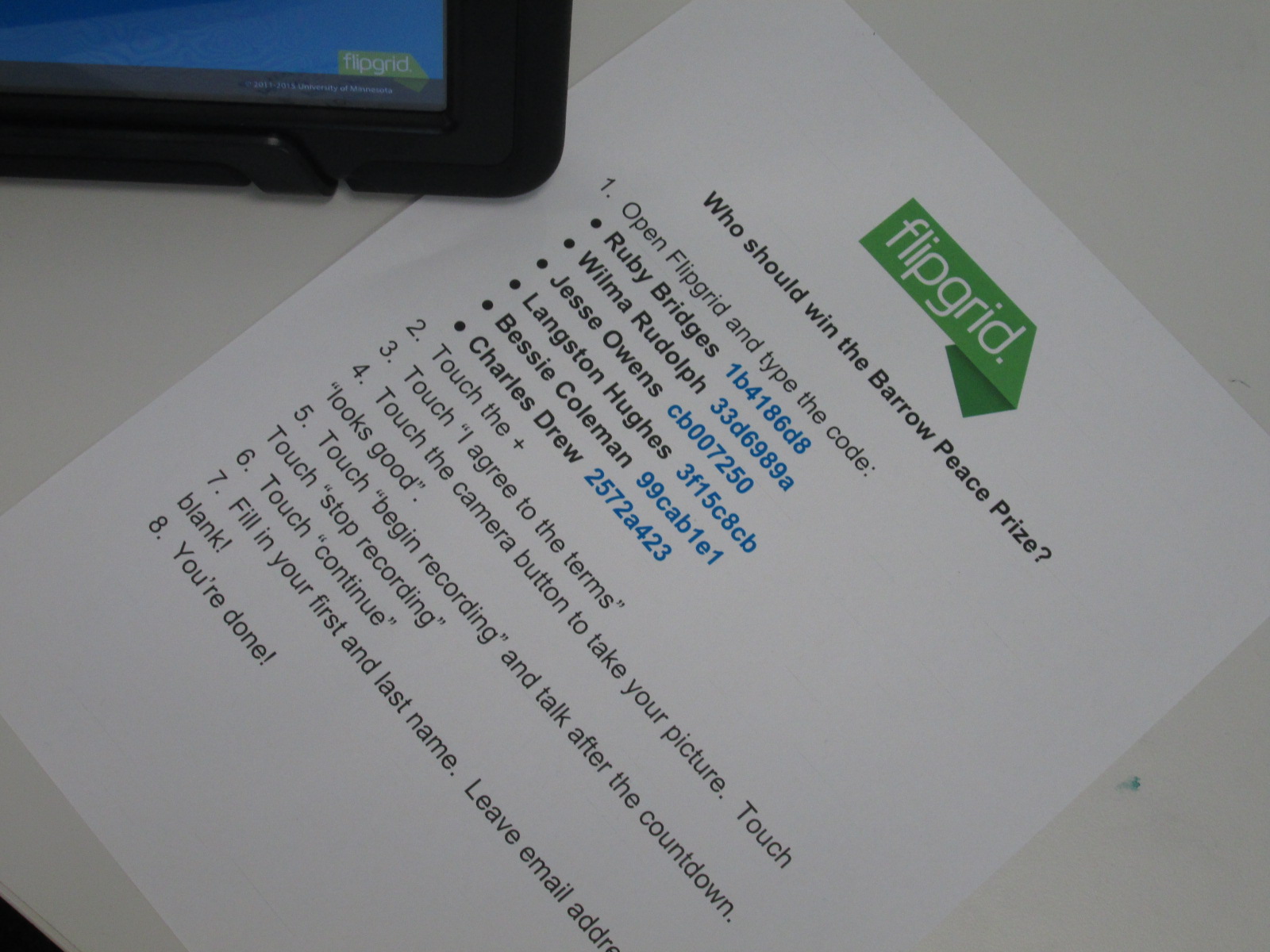
I put out a helpful list of instructions by 4 iPad stations in the library with all of the codes that students would need to get to their questions.

filming (14)

Students were focused and productive as they got their work ready for the world.

Now, the students are finished with their recording and they need your help.

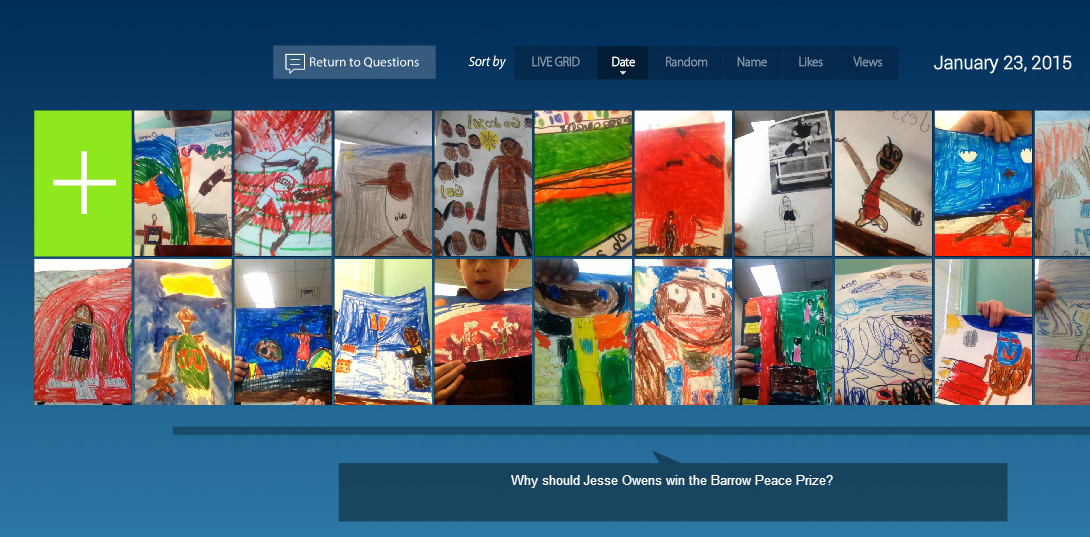
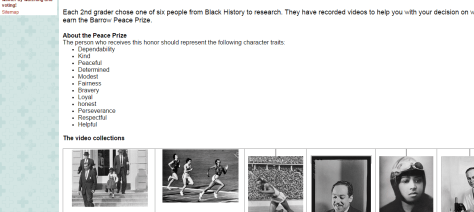
jesse owens

They would like for you to visit their Google site and view videos about each of the 6 people.  Then, help us decide who should win the first Barrow Peace Prize.  Students decided that the person who wins should be someone who represents the following character traits:

  • Dependability
  • Kindness
  • Peaceful
  • Determined
  • Modest
  • Fairness
  • Bravery
  • Loyal
  • Honest
  • Perseverance
  • Respectful
  • Helpful

In a couple of weeks, voting will close and we will announce the winner of this year’s Barrow Peace Prize.  Thank you for taking time to view the students’ work.  If you have any comments about specific videos feel free to leave a comment or a Tweet for me to share with the students.  Also, you are welcome to share this project with other educators you know and encourage them to view and vote, too!

Visit our Google site to view our videos and vote on the Barrow Peace Prize.

Visit our Google site to view our videos and vote on the Barrow Peace Prize.

Click here to visit our Google Site and Vote! 

An Update on Our Recycling Since America Recycles Day

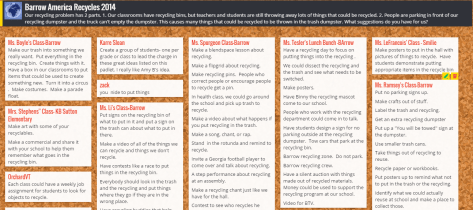
Barrow America Recycles 2014

Back in November, we participated in a nationwide event called America Recycles Day.  During this week, we connected with classrooms across the country to read books about recycling as well as exchange recycling problems in our school.  Other schools brainstormed with us about how we might improve the recycling efforts in our school.  In the past, even though Barrow is established as a “green school”, we’ve struggled with ranking high on the list of schools that contribute the most recycling to the recycling center.

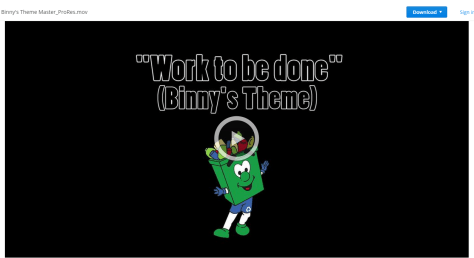
Since America Recycles Day, a lot has happened.  Our students worked with the Athens Clarke County Recycling Division to film a music video for their mascot, Binny.  The purpose of this video is to help people learn what can and can’t be recycled.  It has been sent to every school in our county and will also play on the local government channel.

Ms. Mullins, a Spectrum teacher, is leading an enrichment cluster on recycling.  They have been working extra hard to make sure that things are being emptied into our large recycling bin.  Our environmental committee, chaired by Natalie Hicks, has also been working to encourage our school to recycle.  Our custodians all got updated on procedures for placing items in the recycling bins.  Students also placed signs on all of our recycling bins to show people what can and can’t be recycled.

Dropbox   Binny s Theme Master_ProRes.mov

All of these combined efforts results in several recognitions for our school.  Today on BTV, Suki Janssen from Athens Clarke County Recycling came to tell us about those honors.

  • We are the local winner for the most recycling per student per week average.  We averaged 5.08 pounds of recycling per student per week.
  • We recycled a total of 2,530 pounds of recycling.
  • We are being recognized by the state of Georgia with a $50 gift card to put toward recycling efforts at our school.
  • Suki gave several shout outs on BTV to our students as well as Ms. Natalie Hicks for leading the recycling efforts at our school, Ms. Jan Mullins for leading a recycling cluster, and Mr. Andy Plemmons for organizing multiple Skype connections for World Read Aloud week.

We are so proud of the recycling improvements that our school has made, but we know just like the new them song says “There’s work to be done”.

Let’s All Connect For LitWorld’s World Read Aloud Day Again In March

World Read Aloud Day — LitWorld

On March 4th, we will celebrate World Read Aloud Day with LitWorld.  This special day “calls global attention to the importance of reading aloud and sharing stories”.

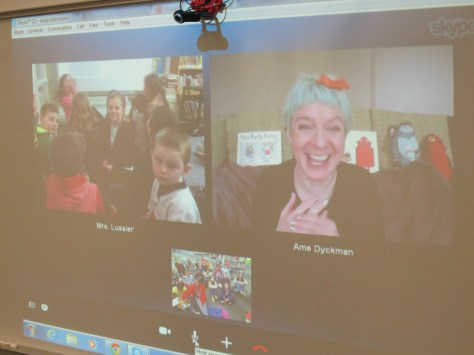
For teacher librarians and other educators, it has come to be a week-long celebration of sharing stories through Skype and Google Hangouts. This year, these connections will happen on March 2-6.Jenny & Ame (2) small

Connecting through stories is always such a rewarding experience for our students.  Students often discover that we are all very much the same even though we are different.

Shannon McClintock Miller and I invite you to post your schedule to our shared Google Doc and start making connections for this special week.  You may even discover a long-time collaborative partner through this one experience.

2015 World Read Aloud Day Blog   Google Docs

You can read about our 2014 World Read Aloud Day experiences in my post “World Read Aloud Day Final Thoughts” as well as others on the Barrow Media Center Blog.  Shannon shares how she documented her school’s World Read Aloud Week via a Smore journal.

Be sure to check out the LitWorld site for more information on planning for World Read Aloud Day.  They even have a special classroom kit with ideas for schools.

World Read Aloud Day — LitWorld (1)

If you are interested in connecting with others on this day, please add your name, schedule, and ideas to the informations in the Google Doc that we started.  This will begin to fill up with others around the world as they want to connect their students and schools too.  We plan to celebrate throughout the entire week of March 2-6th.


Google Tour

We think it’s important to know that there’s no “right” way to plan for World Read Aloud Day.  Whatever you decide to do will be the right plan for your school and your students.  Whatever you do, your life will be richly rewarded with the power of spoken word and voices connecting together across the miles to lift up our right to read!

In the words of Kate DiCamillo, National Ambassador for Young People’s Literature, “Stories Connect Us”.  We can’t wait to connect students around the world through story.

Make a Resolution to Collaborate Globally and Join us for the TL Virtual Cafe January 5th

It’s almost 2015!  Many of us will make resolutions for the year, but in the education world a new calendar year most likely is a halfway point in the year.  For me, it’s a great time to pause and check in on what I hoped to accomplish for the year, and think about what I still need to tackle.  One of my big goals for the 2014-2015 school year was to “engage in global thinking and global collaboration”.

So far this year:

  • We collaborated with multiple schools for International Dot Day and used Google Drawing to create works of art with our collaborating schools.
  • We beta tested Wandoo Reader for Evanced and held Skype sessions to offer feedback on improving the tool for schools.
  • We exchanged our recycling problem with multiple schools during America Recycles week and brainstormed solutions for one another, while realizing that we all have recycling challenges as well as ideas for both recycling and reusing.
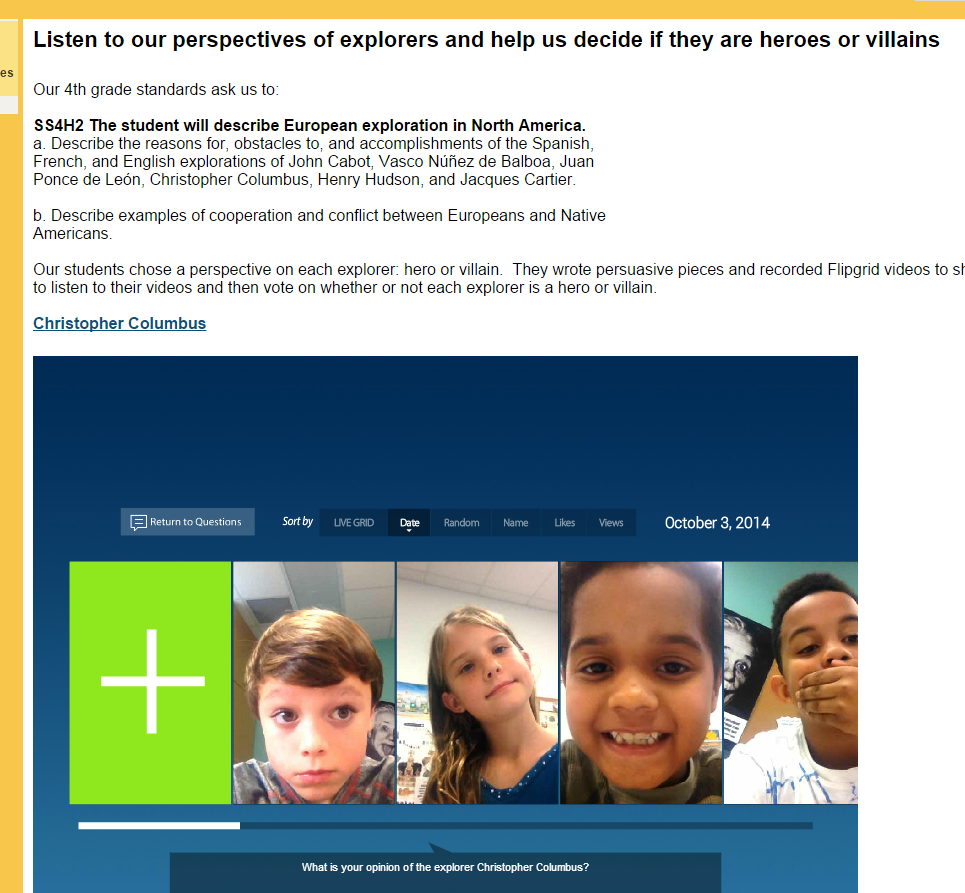
  • Our 4th grade pushed their explorers project out to the global audience and invited people to view and vote on the explorer perspectives that were offered
  • Joyce Valenza and I hosted a GlobalTL Google Hangout to encourage librarians to push the start button on global collaboration through multiple online communities including the GlobalTL Google Plus Community

2global

What I know:  I still have a lot of work to do!  While I’ve had many collaborative experiences, I still feel like I’m just scratching the surface of  something that could be much bigger and meaningful.  I also know that I have lots of ideas, but I can’t expand those ideas alone.  I need my professional learning network of global librarians to think, plan, and create with me.

Global TL logo

Joyce Valenza and I will be hosting the 1st TL Virtual Cafe of 2015 on January 5th at 8PM EST.  During our session, we plan to outline three levels of global collaboration.

This process might happen as a three-level taxonomy:

  • Introduction: We learn to use the tools for connection and share their affordances with learners, through engaging, though often one-shot, activities, like__Mystery Skypes__.
  • Inquiry: Guided by teachers and librarians, students engage in authentic partnerships to address issues and problems, engaged in curricular projects like__Flat Classroom__.
  • Independence: Students transfer use of the tools and strategies we’ve modeled, using hashtags to identify global experts, setting up their own investigatory conversations and events. They become citizen journalists, scientists, collaborative writers and creators, engaging in such projects as our Eyes Wide Open initiative.

Our children deserve teachers and librarians who are global. TLs who can plan meaningful global learning partnerships, connecting learners, classrooms and libraries through inquiry projects and expanding the possibilities of expanding the books we read.

Join us for what we hope will be a global conversation.  We want this TL Cafe to not just be a presentation of success, but instead have it be an opportunity to ponder what we’ve tried and brainstorm new ideas for what we can do together as teacher librarians around the world.

Plan to join us.  Bring your ideas and be ready to share them in the chat, on Twitter, and even on the mic during the session.  See you there!

http://tlvirtualcafe.wikispaces.com/

Collaborating Globally with Perspectives on Explorers: The Results are In!

Barrow Explorers

Two big library goals for this year are to give students time to dream, tinker, create, and share as well as collaborate globally.  Our fourth grade is wrapping up their explorers perspective project.  They considered six explorers and whether these explorers were in fact heroes or villains.  This project has spanned a few weeks and has involved research on six explorers in the social studies standards, persuasive writing, thinking from alternative perspectives, and creating persuasive Flipgrid videos.

You can read about how the project started here.

You can read about our videos and voting procedure here.

Students recorded their persuasive videos using Flipgrid.  We put all of those videos onto a Google site along with forms for voting whether or not each explorer was a villain or a hero.  Over the past few weeks, I have invited people around the world to interact with the project and vote.  I’ve shared through this blog, Twitter, Facebook, and Google Plus communities.  It has been amazing to see how many classrooms have viewed the projects and sent us positive tweets and messages about our students’ work.

https://twitter.com/KarenHeathcock/status/539443498232348673

https://twitter.com/KarenHeathcock/status/539188364461608960

https://twitter.com/rdgrooter/status/536928155878297600

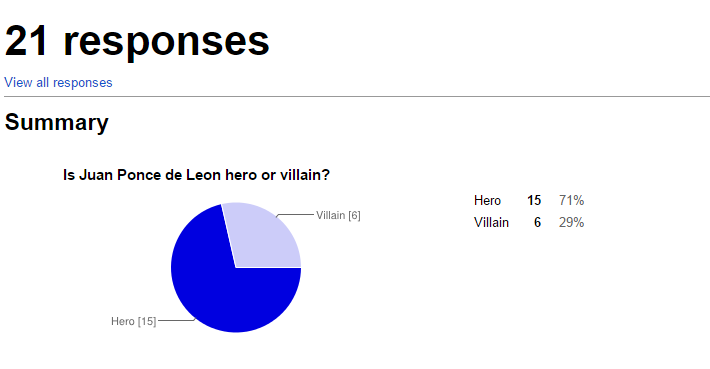
After sharing their work with the world, the results are in.

Is Christopher Columbus a hero or a villain?

Christopher Columbus   Google Forms


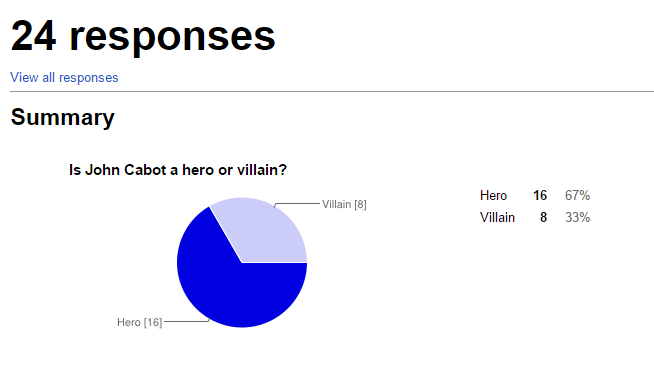
Is John Cabot a hero or a villain?

John Cabot   Google Forms

Is Vasco Nunez de Balboa a hero or a villain?

Vasco Nunez de Balboa   Google Forms

Is Juan Ponce de Leon a hero or a villain?

Juan Ponce de Leon   Google Forms


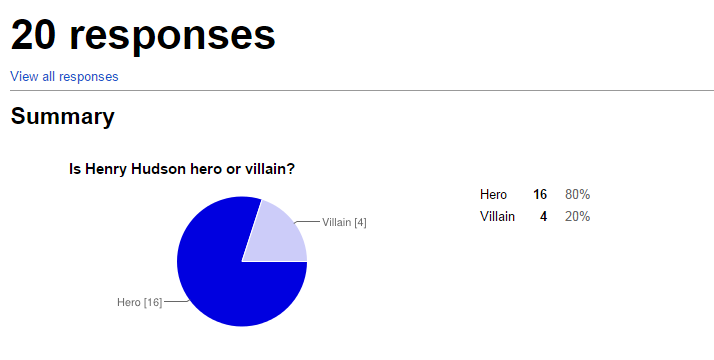
Is Henry Hudson a hero or a villain?

Henry Hudson   Google Forms


Is Jacques Cartier a hero or a villain?

Jacques Cartier   Google Forms

It looks like most of us look to the explorers as heroes with a big exception for Christopher Columbus.

In addition, our Flipgrid had some very interesting data.  As of this posting:

  • The Christopher Columbus question was viewed 530 times and had 186 likes
  • The Jacques Cartier question was viewed 148 times and had 65 likes
  • The Henry Hudson question was viewed 99 times and had 52 likes
  • The Juan Ponce de Leon question was viewed 139 times and had 68 likes
  • The Vasco Nunez de Balboa question was viewed 94 times and had 47 likes
  • The John Cabot question was viewed 120 times and had 45 likes

This has been such a special project.  I hope that we can do more work like this where classes are viewing one another’s projects, offering feedback, and considering different views.  We will end this project with a connection with the Flipgrid team very soon.

If you want to view the student projects, you can still visit their site.


It’s Picture Book Month….Let’s Have a Smackdown

November is Picture Book Month.  It’s a time to celebrate the power of picture books and why the matter in our lives no matter what our age.  Picture Book Month was started by author Dianne de Las Casas to bring awareness to the role of picture books in our lives.  Each year, multiple authors and illustrators contribute daily posts about why they think picture books matter.  The Picture Book Month website has a wealth of resources for you to celebrate picture book month with your students, including a calendar, logos, bookmarks, and certificate.
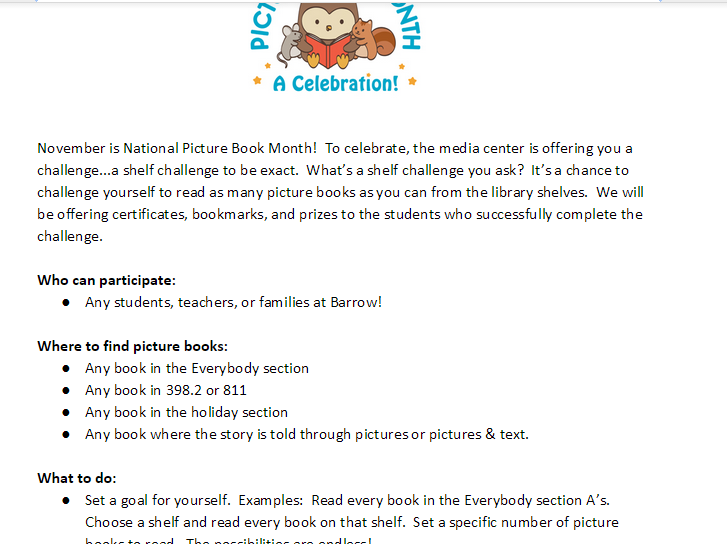
At our school, we host a Picture Book Month Shelf Challenge.  Students set their own goal for how many picture books they will read during November.  I like allowing students to set their own goal because it allows for differentiation and also allows for surprising goals from students.  Each student receives a sheet to document their reading for the month.
Shelf Challenge   Google Docs

At the end of the month, students turn in this sheet.  They receive a certificate, a bookmark, and get entered into a drawing to win picture books that I’ve collected for prizes.

picturebookmonth.com wp content uploads 2011 11 pbm certificate color.pdf

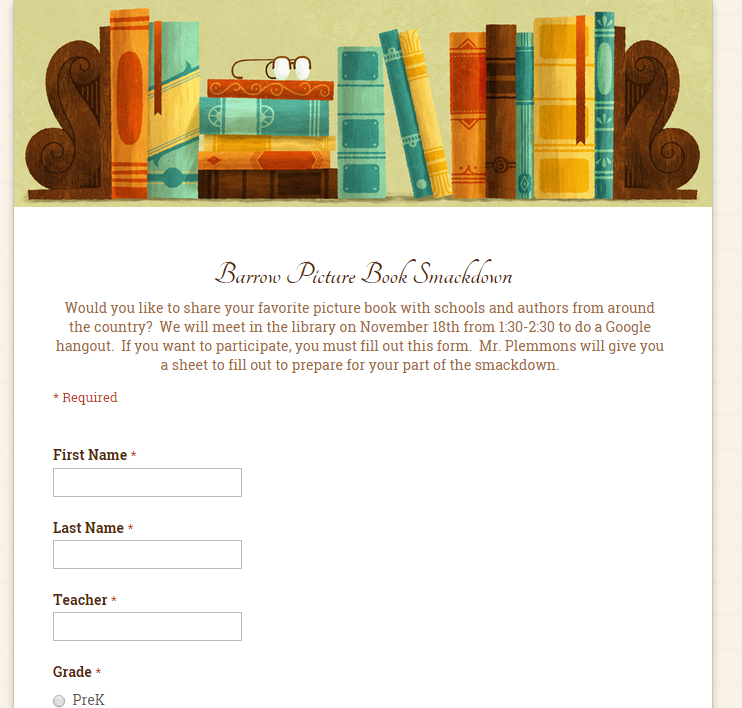
For the 2nd year, we will host our annual Picture Book Smackdown.  On November 18th from 1:30-2:30PM EST, students in multiple schools across multiple states will gather online with authors in a Google Hangout to share favorite picture books and why they matter in our lives.  The event will be a Hangout On Air, so it will also be archived for future enjoyment.

To prepare for the event, I’ve sent a Google form to students to identify students in various grades who want to participate.

Barrow Picture Book Smackdown

As students share their interest, I’m sending them a script to help them prepare for their sharing during the smackdown.  They don’t have to use this script, but many find it helpful to remember all of the pieces of sharing.  The day before the smackdown, they will gather in the library to do a quick practice.

Picture Book Month Smackdown Script   Google Docs

I hope you will join us on November 18th to watch the smackdown and help spread the word about the event in advance.  During the smackdown, students and authors will step to the microphone in their own states and share a favorite picture book.  We also hope to capture all of these recommendations in a Google doc.

Here are some things to know:

  • Tweet about the event and your favorite picture books.  Even if your class isn’t in the smackdown, they can still share their favorite picture books with the hashtag #pbsmkdwn  as well as leave comments for our authors and students.  You can also include the picture book month hashtag #picturebookmonth

Many thanks to all of the schools and authors who are participating in the smackdown so far this year:

Participating schools include:
Andy Plemmons, school librarian in Athens, Georgia
Jenny Lussier, school librarian in Durham, Connecticut
Cathy Potter, school librarian in Falmouth, Maine
Kathy Kaldenberg, school librarian in Solon, Iowa
Shawna Ford, school librarian in Weatherford, Texas
Julee Murphy, school librarian in Texas
Christina Brennan, school librarian in Pennsylvania

Participating authors include:
Dianne de Las Casas, founder of picture book month
Anne Marie Pace, author of Vampirina Ballerina

How are you celebrating Picture Book Month?  It’s not too late to get a plan together and promote the power of picture books with your students.

Connected Librarians: Eyes Wide Open & America Recycles Day

2global

One of my goals this year in our library is to foster global thinking and global collaboration.  To connect with these types of opportunities for our students, I seek out connections on Twitter as well as in Google Plus communities such as GlobalTL and Connected Classrooms.  I also offer opportunities within the projects taking place in my own school for other people around the world to join in.

This summer, I became involved in a conversation with Joyce Valenza, Shannon Miller, and Paul Fleischman about how books could live beyond the closing of the cover.  What if a book inspired us to take action in the world?  What would those actions look like around the globe?  How could they be documented?  How could they be shared? What would it look like if the author engaged in conversations about the actions being inspired by the book?

This September, Paul Fleischman’s book Eyes Wide Open: Going Beyond the Environmental Headlines was published.  It’s a different kind of book because it doesn’t give our young people a prescriptive list of answers to solve the environmental problems of the world but instead to take an inquiry stance.  It inspires our young people to listen closely to the environmental stories being shared about our world and to uncover stories of their own.  It calls our young people to take action on those world problems and realize that even at a young age they can make a difference in our world.

Joyce Valenza wrote a great post about the book.  In it, she included Paul’s voice about his book.

About Eyes WIDE Open:

Paul Fleischman 300x225 Eyes Wide Open: A proof of concept for sustaining the conversation around booksWe’re living in an Ah-Ha moment. Take 250 years of human ingenuity. Add abundant fossil fuels. The result: a population and lifestyle never before seen. The downsides weren’t visible for centuries, but now they are. Suddenly everything needs rethinking–suburbs, cars, fast food, cheap prices. It’s a changed world.
Eyes Wide Open explains it. Not with isolated facts, but the principles driving attitudes and events, from vested interests to denial to big-country syndrome. Because money and human behavior are as important as molecules in the environment, science is joined with politics, history, and psychology to give altitude on this unprecedented turning point. It’s a time of bold advances and shameful retreats, apathy and stunning innovation.

What better time to have our eyes wide open?

An Eyes Wide Open Google Plus Community has been established to make connections for global collaboration around the book.  Paul Fleischman has also created a site to house headlines, projects, and conversations about the book.  He wants this to be more than a book that you read and close, but instead for it to be a book that inspires action in the world.

Also from Joyce’s blog, there’s a great list of ideas of how you might use Paul’s book with students.

What sort of reports might students contribute?
  • Take photos (and create a gallery) that document population rise or consumption levels or innovations being used to address these challenges.  Attempt to document how your eggs, milk, farmed fish, and meat are made.
  • Make a video describing a local citizen science project.  Document a plastic bag banning campaign, a local pollution issue, or your own attempt to go vegan for 30 days.
  • Interview someone in city government connected with water, transit, city planning, or emergency services.  Or a biologist, park ranger, or science teacher.  Or a religious leader whose church has taken a stand on the environment.  Or your state senator, state assembly representative, or an aide to your congressperson.  Or fellow students or neighbors to get a sense of how average citizens view the situation.  Google+ Hangouts might be a perfect venue for archiving these interviews!
  • Write a description of one of your area’s key issues and how it’s being dealt with.  Join with one or two others, each tackling one part of the project: research, interviewing, editing.  Would your local newspaper be interested in the result?
  • Do a survey of your city, finding out where your water comes from, how your electricity is made, where your trash goes.  Prepare to make many phone calls and to ask follow-up questions.  More fun with a friend.
  • Annotate local newspaper stories, adding commentary that lets us see how the global trends and mental habits described in the book are playing out locally.  Feel free to refine my thinking.
  • Remix media and create digital stories around an area of local interest.
  • Inspire a meme to invite continual, global reinterpretation around an environmental prompt
  • Submit a field report. Work prepared for school assignment is fine.  Take time to review and revise.  Once you’ve posted it on Google Docs, YouTube, or another platform that all can access, send a description to fieldreports@eyeswideopenupdates.com.  Include a bit about yourself, how you came to the topic, and a photo of yourself or something connected to the report.  If Paul finds it well done, he will add it to the roster, put a pin in the map, and maybe even give it a shout out in his blog.

birds3

Connected librarians have a huge opportunity with this book and the many communities that are available to us.  We are the people within our buildings who work with every student, teacher, and family member within our school.  If we collaborate, then we connect our entire school communities with one another.

November 15 is America Recycles Day.  The week of November 10-14 would be a great week for us to begin to connect our voices with one another around an issue that really affects us globally.  Paul’s amazing book Eyes Wide Open could be a piece that we could use to spark conversations around the globe.  It could also be paired with a plethora of other picture books and informational texts on environmental action.  More than a conversation, our connections could push our young students to take action in our world, and those initial connections could lead to a continued connection between schools around the world in the name of environmental action.

Here’s what I hope to do:

  • Connect with schools throughout the week of November 10-14 via Skype or Google Hangouts
  • Read an environmental text together
  • Have each school identify and explain an environmental issue in our school or community.  For us, it will most likely be the amount of waste being thrown away in our classrooms.
  • Have each school exchange their issue and brainstorm possible next steps for one another.  Wouldn’t it be nice to hand your problem over to someone for a few minutes to see the problem through their eyes?  That perspective might be the very thing you need in order to take a next step in your problem.
  • Share our brainstorming with one another and document suggestions in a digital format such as a Google doc or Padlet.
  • Commit to reconnect at some point to share what actions we have taken, what has been successful, or what new problems have surfaced.

I invite you to connect with my students and also to post your own schedules and find your own connections via this Google Doc.

http://bit.ly/americarecycles14

Let’s do more than just connect our students for a day.  Let’s connect our students to work on an issue that has an impact on our world.  As part of Connected Educators Month, let’s start thinking of how we can connect our students in meaningful ways throughout the year and begin planning those connections now.

As you make connections, create action steps, and make an impact on your world, share it!

Eyes Wide Open hashtag: #ewopf

America Recycles hashtag: #americarecyclesday

GlobalTL hashtag: #globalTL

and don’t forget #tlchat

Making Our Mark with Dot Day 2014 (and I hope well beyond)

Dot Day (42)

International Dot Day is one of our favorite days (weeks) of the year.  It gives us permission to be creative and see what we can do just by making a mark.  It also connects us with so many classrooms around the world.  Classes are always looking to connect on this day, and we have made many collaborative relationships with schools because of this one day of the year.

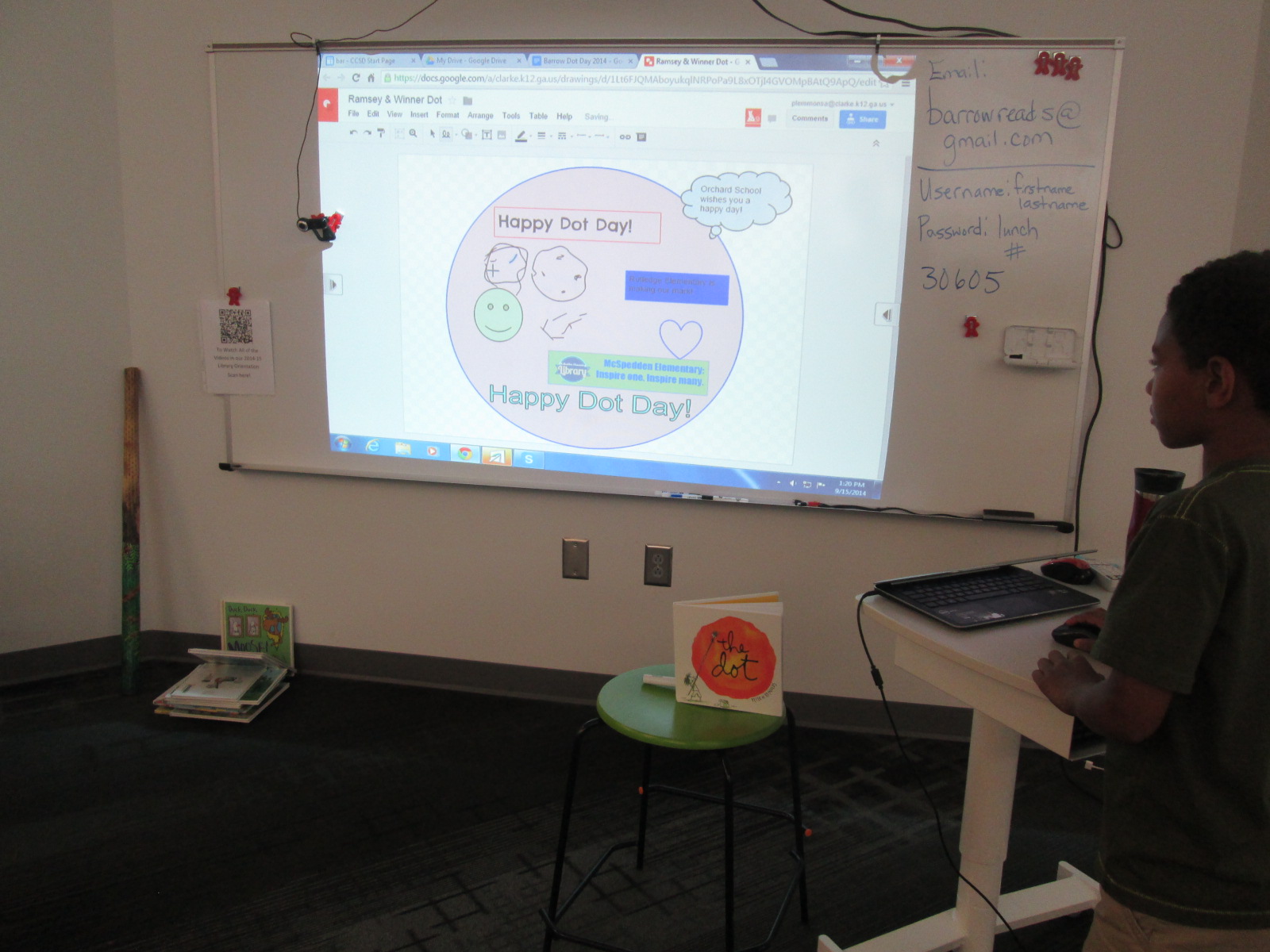
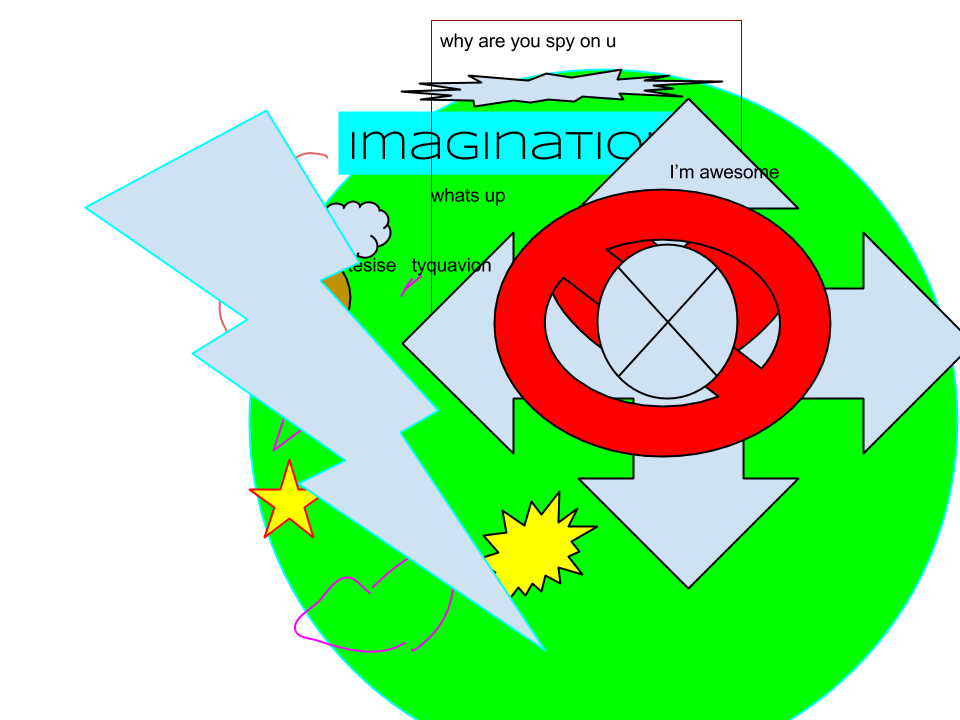
This year, we used Dot Day as a way to explore our goal of dreaming, tinkering, creating, and sharing.  We explored Google Drawing, which was a new tool for most students.  We used Dot Day as a time to tinker and see how Google Drawing functioned as well as how to collaborate on a drawing with another student or class.

We also used colAR mix again this year to make augmented reality dots.  This year, I encouraged students to think more globally as they made their dots by embracing the them of “making your mark on the world” that is the essence of The Dot.  Students were encouraged to design a dot that represented their talents, hopes, dreams, and passions.  I loved this new twist on a tool that we used last year because it revealed so many stories from students.  One student drew a picture of an airplane flying through the clouds because of his dream to be a pilot when he grows up.  Another student drew an astronaut and UFOs because of his desire to explore space.  Another drew her whole family because they are what she loves in life.  Some students chose to highlight their creativity as a way that they make their mark by designing unusual dots with their favorite colors.  These were empowering stories because they allowed students to have a voice to share something personal about themselves in a way that they might now have shown before.

One amazing thing that happened while students were using the colAR app was how they discovered different ways to scan their dot. It started out as what some people might see as a mistake.  A student’s hand was on top of their dot while they were scanning their image, and the hand became a part of the rotating sphere on the iPad screen.  This resulted in an uproar of excitement as sharing began and the idea spread like wildfire.  Soon students were trying to put their faces on their spinning spheres.  Others stacked towers of crayons on top of their dot and tried to see if that would scan into the 3D image.  All of this happened because of an opportunity to tinker.  When we give kids a space to explore, they figure out amazing things and they willingly share and teach others what they learned.  They get excited about their learning and they want to do more.  I bet that these students would have spent an extended period of time continuing to experiment with colAR mix to see what else they could figure out, and they would have done this without getting tired or bored.  These are the things that days like Dot Day reveal.

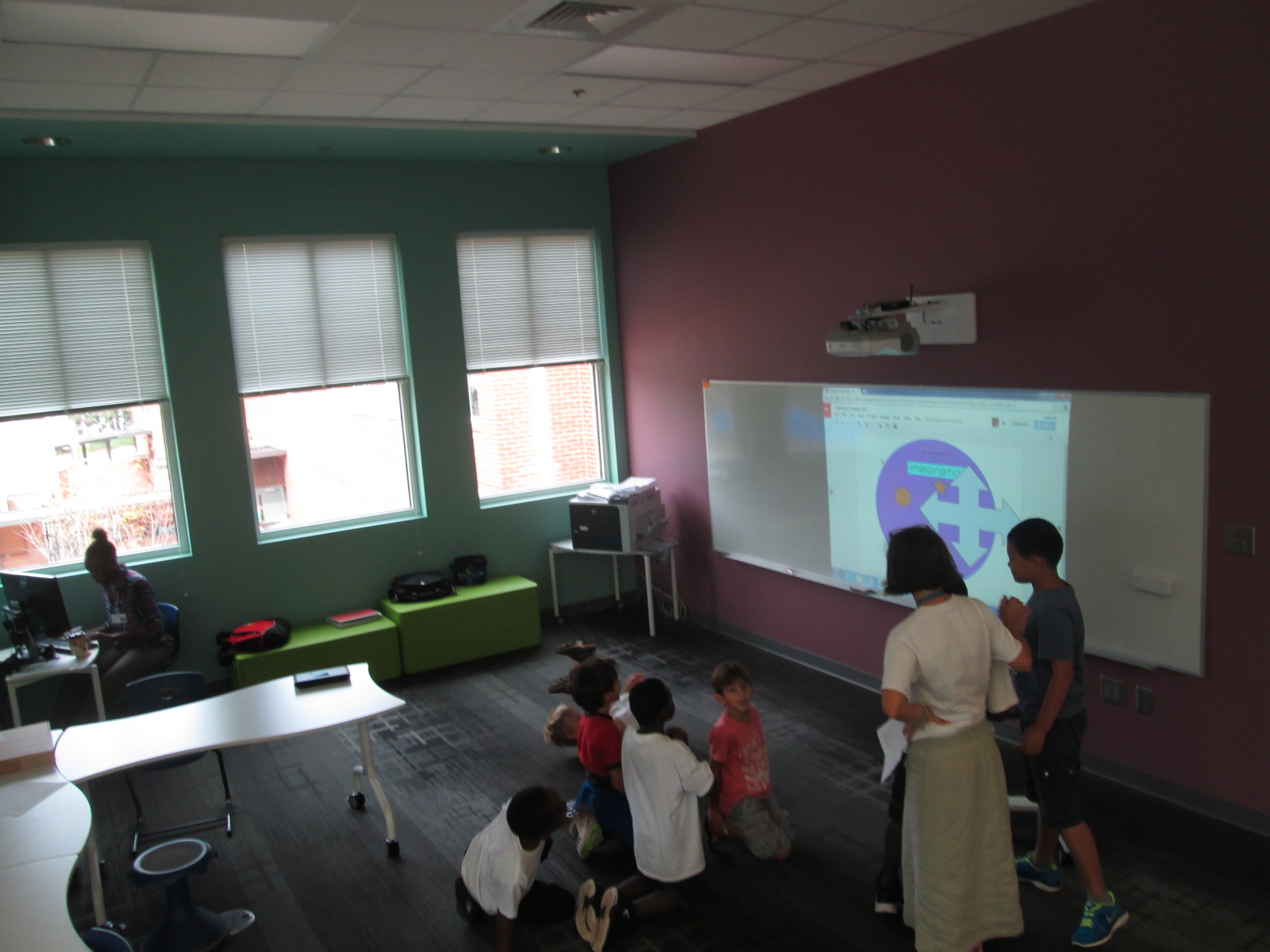
We had numerous Skype connections.  Each one had its own unique twists and conversations between students and teachers.  In many of these Skypes, we collaborated on a Google Drawing dots after reading the book.  This included dots with our friend Okle Miller in Tampa, Edie Crook in North Carolina, and Crystal Hendrix in North Carolina (just to name a few).  Sometimes this was live during a Google Hangout or Skype and other times it was after we disconnected.  One of our hangouts was a large hangout between Matthew Winner in Maryland, Nancy Jo Lambert in Texas, Donna MacDonald in Vermont, and Esther Uribe in Texas.  It was fun to read The Dot to students in so many states at one time, but what was even more fun was drawing with all of them at the same time!  We definitely did some tinkering with this one.  Many of us learned of the challenges of younger students but found ways to involved them even with computer-use difficulties.  The students loved seeing drawings “magically” appear on our shared dot.

Ramsey & Winner Dot

Our multi-school collaborative dot

With Jennifer Reed in Massachusetts, we accidentally deleted all of our work on our collaborative dot.  The kids were in a panic, but it was a fantastic opportunity to do an impromptu lesson on the power of revision history in Google Drive.  We were able to recover our work and learn an important trick.  We even talked about how revision history is one way that work is never deleted, which can be a positive but also a negative if you have written something that you wished you hadn’t.

Wright & Reeder Dot

Our dot with Jennifer Reed that was almost lost!

Mrs. Clarke’s class had a Skype connection, but we weren’t able to do a collaborative dot with our connecting class.  Instead, we split the class in half at our 2 projection boards and they created a dot together as a class.  They got just a bit competitive as they tried to cover up each other’s work, but even this was a great opportunity to talk about how to work with others on a doc without being disrespectful of the contributions.

Clarke & Lussier Dot

Mrs. Clarke’s class competitive dot

Some classes that we connected with had already spent a great deal of time being creative, and they shared with us dots that they are going to physically mail to us.  Jenny Lussier in Connecticut had colAR dots as well as Morse code greeting cards.  We can’t wait to decode what they say!  We also discovered with Jenny that there’s more than one version of The Dot floating around out there.

Cathy Potter’s students in Maine read the book Ish to our students and shared their own illustrations for the book.  We had a great conversation about the connections between both books.

Dot Day (60)

Students and teachers alike love this day, but I do leave this day with a wondering.  I’m thinking so much this year about global thinking and global collaboration.  This day is filled with thousands of Skype and Google Hangout connections around the world.  We connect.  We read.  We dream.  We create.  But then what?  We leave one another until the next big event.  I’m by no means being negative about Dot Day.  I’m a huge advocate, but I do wonder about why we don’t build upon these connections we make.  If we are really going to “make our mark” on the world, shouldn’t we be taking some actions together beyond connecting, reading, and creating?  I would like to gently nudge us all to think about this.  I’m just as guilty.  I connect every year and then I move on, but I can’t help but carry this on my mind, reflect on it, and consider what more we might do beyond today.  Think with me!  Let’s keep our dots connected.

Dot Day (43)