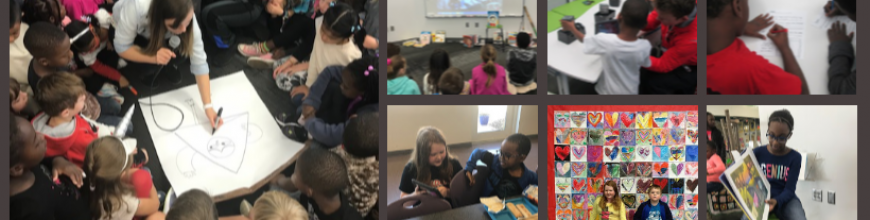
Ms. Kelly Hocking just made a page on her website about the PreK weather forecasters in her classroom. You can find more pictures of the project and a few of her own thoughts on what a great job these students did.
Category Archives: Lesson
PreK Weather Forecasters
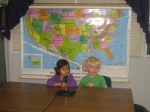
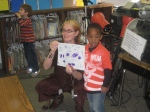
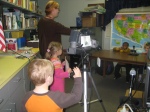
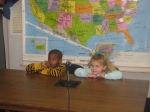
Over the past 2 months, Ms. Hocking’s PreK class has been studying weather. In collaboration with the media center, students have participated in several learning activities to prepare for giving their own weather forecast. Students have watched videos of meteorologists giving weather forecasts and made lists of words that the meteorologist used. They have studied various weather words and what they each mean. Students toured our broadcast room at school and learned about the different jobs that our 5th grade BTV crew performs each morning. They learned about producers, assistant producers, video mixers, audio technicians, anchors, and camera crew. Next, students worked with their teacher, paraprofessional, parent volunteers, and me (the media specialist) to write their own scripts for their weather forecast. After scripts were written, these same adults guided students in creating cue cards for their weather reports. Students then spent several days practicing their scripts and cue cards in class.
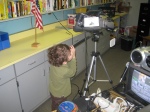
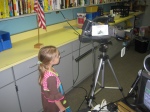
Finally, the big day arrived and the preK students came into the broadcast room buzzing with excitement. Each one assumed a role in the weather forecast: 2 anchors, producer, camera, and cue card holder. Each forecast was recorded and uploaded to Teacher Tube for the class to enjoy and share with the world. Please take time to enjoy their weather forecasts. What an amazing technology, science, and literacy project with such early learners!
Sharing Massive Content: A Collaborative Strategy

Every year, I’m amazed at the amount of content that our 5th grade teachers have to teach in just Social Studies. Not only do these teachers have to concern themselves with the Reading and Math CRCT scores, they also have to teach a massive time span in history with many intricate details.
This year the 5th grade team began talking with me about a project they wanted to try this year to hand over some of the content of their “Bigger, Better, Faster: The Changing Nation” unit. Students will work in teams of 3-4 students. The groups will be mixed across the grade level with students of varying abilities in groups. Teachers will assign topics from the unit to the various groups. In the media center, I’ll do a lesson on note taking and gathering information from a variety of sources. I’ve also made a pathfinder with resources connected to each topic as well as all of the standards covered in the project. I’ll introduce this pathfinder and how the various resources work in my introduction lesson with students. My paraprofessional has worked to pull print resources from the library and sort them by category. These will be checked out to the 5th grade and placed in a central location in the grade level for students to use. The teachers have booked both computer lab and laptop cart time as well as media center time for me to assist students with their research.
Once students get going with their research, the teachers and I will share a variety of options for final products. The teachers want to use a variety of technology along with more traditional kinds of final products such as brochures. The tools I will share with students include Glogster Edu, Animoto, and Photo Story.
Finally, students will showcase their work in the media center. This showcase will allow the 5th graders to learn from all of the projects in an effort to allow students to help teach and take ownership of the 5th grade GPS standards. It will also allow students from other grade levels to see their work as a preview of what is to come in 5th grade. Students will have an authentic audience for the work and will hopefully retain the content better as they share their learning with others.
We’re giving this a try this year, and we’ll fine tune it as we go. I hope that this grows into future kinds of projects like this one for other 5th grade content and other grade levels as well.
Student Blogs
Several second grade students just posted their graphic novel book reviews on our Edublogs site. Take a moment to visit their reviews and see what they thought of these books. These students are also writing their own graphic novels and creating a book trailer for their books.
September GLMA Post

Cartooning with Chuck
Ms. Hicks and Ms. Saxon’s 2nd grade spectrum class have been learning about graphic novels. Their exploration started off in the media center where we looked at how graphic novels are created by watching a video from Capstone Publishers. This video got students started in thinking about storyboarding, penciling, inking, and other terminology used when creating a graphic novel. Next, we moved to our graphic novel collection in the media center and looked at multiple graphic novels under the document camera to see how reading a graphic novel might be different than reading a novel. After exploring this together, students all chose a graphic novel to read at tables and started making noticings about what they discovered in the pictures and text.
Ms. Hicks and Ms. Saxon continued this process in their classroom by having students read multiple graphic novels and compare they writing, art, and other techniques used. Students are also working on book reviews of all of their readings.
All of this exploration is building a foundation for students before they launch into creating their own graphic novels. One more source of support was bringing in a cartoonist to demonstrate his art for the students. Dr. Chuck Cunningham is the assistant principal at Colham Ferry Elementary School in Oconee County, but he is also a cartoonist. He regularly publishes cartoons in the Oconee Enterprise and has created cartoons for other newspapers and magazines for many years. He also shares his talents with many of the classes at his own elementary school, but we were fortunate enough to have him visit Clarke County to share with our students.
Dr. Cunningham created a cartoon with students in the moment and wove in instruction about creating panels, penciling/inking, kinds of text, drawing tips, and more. The students were bubbling with excitement and left the media center fired-up about starting their own graphic novels. Dr. Cunningham left all of the artwork that he created today so that students can reference the tips that he offered.
I love to connect students and teachers with expert guest speakers because it is hard for teachers to be experts in all that they teach. If you are an individual who would love to support our students with a talent or area of expertise that you have, let me know and I would love to connect you with our students and teachers at Barrow.
Native Americans Collaborative Centers

Native Americans Center Rotation.
Watch what happened during our Native Americans collaborative centers with 4th grade on Thursday & Friday. (More to come soon on the GLMA blog).
Constitution Day Lessons
Watch what happened during our Constitution Day collaborative centers with 5th grade on Friday. (More to come soon on the GLMA blog).
What does it mean to read?
I recently got an email from one of our preK teachers, Ms. Kelly, asking if I would join her class during small group time for a library lesson. She sensed that some of her students were feeling frustrated with reading books because they couldn’t read the words on the page. Like many teachers, she wanted to model doing a “picture walk” for her students so that they could read the story from the pictures. I happily agreed and the two of us did some ping pong collaboration via email where we batted our ideas back and forth until we had a plan.
Ms. Kelly’s observations made me start thinking about the many ways that we read, and I decided to open our lesson with these thoughts. We started by learning about oral traditions and how people tell stories aloud and others read the story by listening to the storyteller. We talked about reading the words in a book. We also looked at a book called The Black Book of Colors and thought about how someone who is blind might read a story by feeling the pages of a Braille book. We could have kept going and talked about e-readers and smart phones and more, but I left the ideas at that. I wanted students to know that there wasn’t just one way to read a story.
With this seed of reading planted in the students’ minds, they selected a book from a selection of books in my cart around the theme of families, which was the topic Ms. Kelly is focusing on right now with her students. They checked out with me at my laptop and returned to the floor.
Next was one of my favorite kinds of collaboration where each adult in the room takes a group of students and works with them in their own style using the same topic. Ms. Kelly, Ms. Clarke (the parapro), a parent volunteer, and myself each took a small group of students. Each of us shared picture walking in our own style. In my group, we used the book Chalk, a wordless picture book, and practiced reading the pictures very slowly until we gleaned every detail we could before turning the page. My hope was that students would notice this slow way of looking at the picture and replicate it in their own reading. I quickly learned that they did notice the slowness, but many still flew through the pages without pausing to “read” what was there. Next I worked with each student to picture walk slowly through a few pages of his or her book.
Ms. Kelly invited us all back to the floor and each group shared something that they noticed or learned about how to picture walk. It was so much fun to support our youngest learners in the school with a strategy for reading. It was also fun to get out of the library and interact with students in their own classroom environment. Finally, it was such a treat to work with three other adults with different ideas and expertise. I look forward to many other experiences where adults bring their expertise to support a classroom of students. Thank you Ms. Kelly for this great idea and finding such wonderful adult support for your students.
-
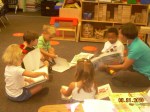
- Ms. Clarke picture walks with a group on the rug
-
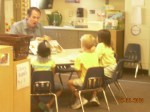
- Mr. Plemmons picture walks at the art table
-

- Ms. Kelly’s students picture walk in the literacy center
-

- A parent volunteer picture walks with a group of students
Library on Wheels
-
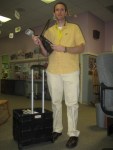
- Super librarian to the rescue!
-
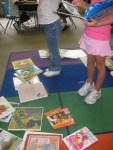
- Students browse the limited (yet exciting) selection of books
-

- Books line the classroom carpet
Each year, just as I get the library up and running, classes in the routine of coming to the library for lessons & checkout, and kids excited about books, the library has to “close” for two weeks. For two weeks, our students are involved in Scantron testing. This testing provides valuable information to teachers about student strengths and weaknesses as they begin the year, but testing takes place in the media center. During testing, we are only open for checkout before school and from 2-2:30 at the end of the day. It always saddens me to see kids unable to come checkout books, so this year, I’m taking the library to them. Today I filled my rolling cart with books, got my laptop and scanner, and set off to classrooms. I did an impromptu lesson using the book My Librarian is a Camel and showed how children around the world get their library books in many unique ways. Then, I spread the books out on the floor. Students looked at the books and decided if they wanted to keep their current library books or if they wanted to exchange for a new one. The kids were so excited, and they didn’t even seem to mind the limited selection of books that I had to offer. Since today was a success, I think my next step is to see if there are genres of books that teachers would like me to focus on in my cart when I visit their room. My time to visit classrooms is limited because I have to help with the Scantron testing, but I was overjoyed to see books leaving our library and getting into student hands. It was a mini access enabler project, and what fun it was!
 Expect the Miraculous