Paul Revere Transliteracy: A Third Grade Collaborative Project

Back in September, third grade took a transliteracy approach to exploring rocks and minerals.  After participating in this experience, Mrs. Shealey, 3rd grade teacher, had some ideas for how the transliteracy approach could inspire the Paul Revere standards that 3rd grade was about to work on.  She scoured the internet for resources and developed her own Sqworl pathfinder to share with students.  She also developed a menu of projects that students could choose from.  After introducing the idea to her team, we all met together to continue brainstorming and think about how technology could be incorporated with the menu ideas.

Ideas included:

  • Make a map of Paul Revere’s ride with important events, photos, and videos using Google Earth & Google maps
  • Create a newscast of Paul Revere’s ride with eyewitness accounts.  Use the iPad to film the newscast and iMovie to edit.
  • Use Museumbox to create various cubes about Paul Revere:  his ride, his character traits, events leading to American Revolution, etc.
  • Create a piece of art related to Paul Revere.  Use Photo Story, iPad, or Glogster to display the art and talk about it.
  • Write a poem or a song about Paul Revere.  Use the iPad to film a performance of the song/poem.

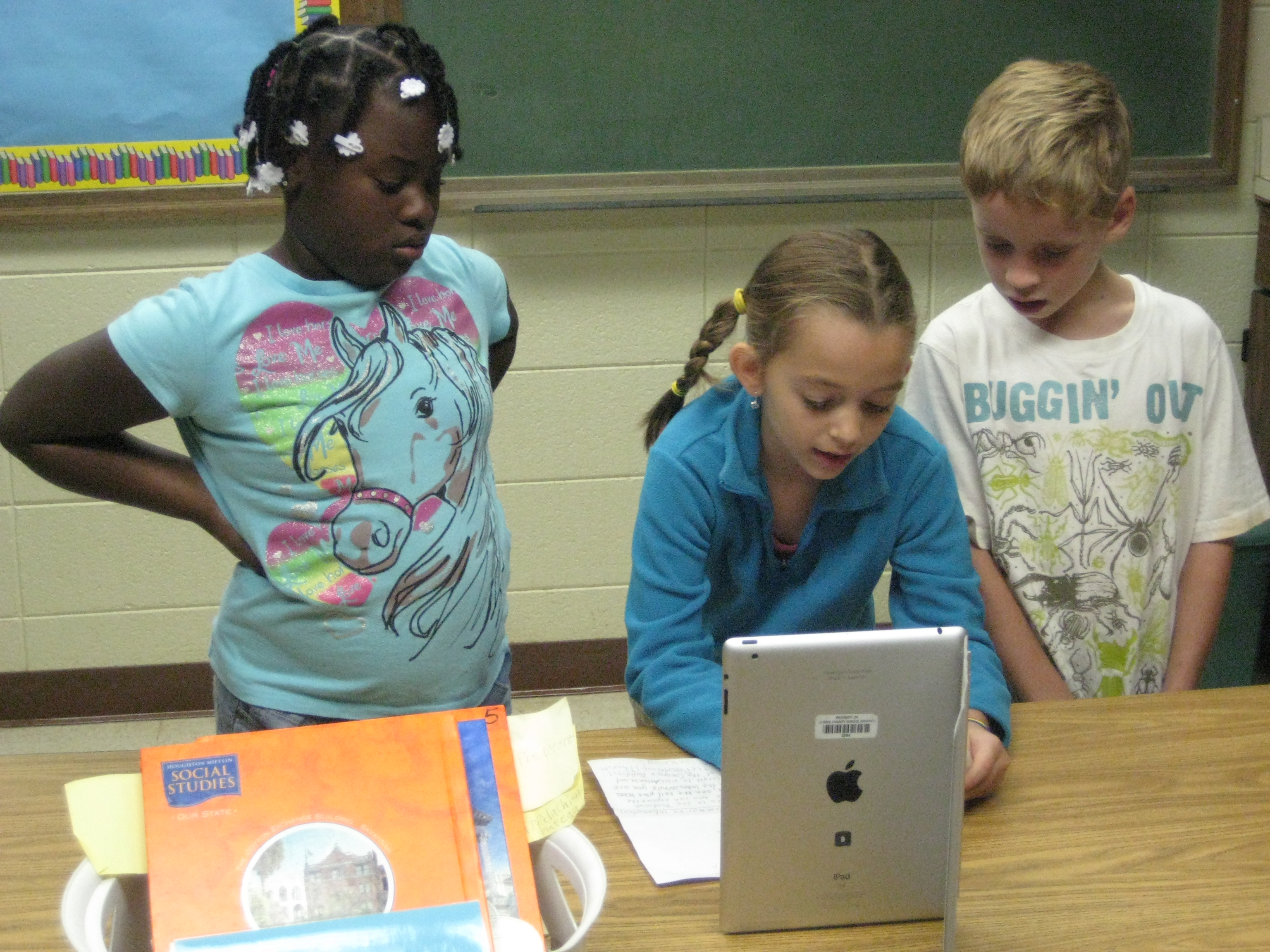
Ideas continue to be added to this menu.  We decided to narrow the technology focus to just a few tools:  Glogster, Museumbox, Photo Story, Animoto, iPad & iMovie, and Google Earth/Maps.  Many of these tools were new to students so we wanted students to have a chance to explore each tool before committing to a project or tech tool.  We decided to have a technology fair where each class could come and tour through the tech tools to gain some familiarity with each tool to inform their decisions.  I saw this as the perfect opportunity to bring in student expertise, so Ms.  Hicks, a spectrum teacher, helped identify students who could teach other students about each of the tools.  Google Maps and Museumbox were new to all students, so I led the station on Museumbox and Todd Hollett, technology integration specialist, led the station on Google Maps.  

The students and adults setup their stations, and each class came through the library for about 30-40 minutes to see mini-presentations and play around with each tech tool.  Students freely moved from table to table and at times needed encouragement to move on.  Many students wanted to stay at one table to become an expert in a tool, but that was not the point of the tech fair.  Expertise will develop later.  We just needed them to be familiar enough with each tool to know what it was capable of doing.  Even though all students did not make it to all stations, each class had a good representation of students who visited enough of the stations to be able to share back in class.

Our next step is for students to decide on their project and tech tool.  The teachers will then group these students into groups based on their tech tool.  Then, during a block of time each day, students using the same tech tool will meet in the same room so that they can support one another as needed.  I’ve seen amazing things happen when a large group of students using the same tool are in the same room.  They discover things that I would have never had time to figure out or teach to everyone and they willingly share their learning with other students.  I think we will be pleasantly surprised by the knowledge that students gain about these tools during this process.

The teachers and I will also support students with the technology, but we also want our focus to be on supporting students in locating quality information for their projects.  We will rely on the pathfinder as well as books from our library for this endeavor.  I can’t wait to see what students come up with!
This slideshow requires JavaScript.

Storybird with Kindergarten

Mrs. Kelly Hocking’s Kindergarten class has been hard at work collaborating with me in the media center on writing stories from art.  This idea was initiated in their classroom, and Mrs. Hocking asked me how I might support their class in doing this exploration using some kind of technology.

To start, I showed the class Storybird very briefly.  Storybird offers collections of artwork that inspire stories.  You select images from a collection and add your story.  Then, you publish your digital book to the web.

We spent the remainder of the first session looking at a wordless picture book under the document camera.  We used Andy Runton’s Owly and Wormy: Friends All Aflutter.  On each page, we asked ourselves who is in the picture?, where are they?, and what are they doing?  We split into 4 groups to look at even more wordless books in a smaller setting.  The classroom teacher, paraprofessional, special education teacher, and EIP teacher all supported a group.  I rotated between all 4 groups and took over groups if the teacher needed to give a particular student more support.

A couple of weeks went by where the students continued to use wordless books in their classroom to practice telling stories from art.  When they returned to the media center, I did a whole group modeling of how to use Storybird.  We looked at features like how to add a page, how to drag and drop a picture, and where to type the words.  We also talked about putting together a story and how you have to think carefully about which picture makes the most sense to come next in the story.  Finally, we talked about how to go back and re-read your story and make changes if needed.

The final lesson was back in small groups in the media center.  Each group had the same adult leaders and a laptop logged into storybird.  Each group had a different account.  The adult facilitated each group in creating their own storybird, but the students were expected to interact with the technology and construct the story.  The adult did most of the typing while the students selected pictures, typed limited text, and added pages.  Even in small groups, it was a challenge to maintain focus, but each group completed their story in our 45 minute time block.

These students are the only students in the school to have used Storybird, so they are now available to show other students and teachers in the school how it works.  I look forward to trying this again with many more classes.

This slideshow requires JavaScript.


Read their Storybirds here:

Dragon Bat Girl Attacks Creepy Girl

Super Lightening Boy Saves the Day

The Party

The Happy Fairy and the Five Birds

Regions of Georgia Commercials

For the past 4 years, I’ve collaborated with 2nd grade on a Regions of Georgia center rotation.  We usually setup one center for each region of Georgia and the teachers and I lead each region.  Over a several days, the students rotate through the stations, and the main goal has been for students to gain more understanding of the regions.

This year we decided to try something new.  As a culminating project, students were placed into groups in every classroom and assigned one of the regions of Georgia.  The goal was for students to work together to create a commercial advertising their region.  They included things like land features, attractions, animal life, plant life, and persuasive reasons to visit their region.

Once scripts were written and a few props were made, students came to the library to record their commercials using the iPads.  Our temporary media center has several small rooms attached to it, so 3 groups at a time were able to record their commercials.  We used students to do the actual filming as much as possible, although a few student teachers and the classroom teachers did some of the filming.

Since our district decided to open Youtube to both teachers and students, uploading the videos took a matter of seconds rather than the hours it took when we would have to download the videos onto a PC, convert the videos to WMV, and then edit the videos in Movie Maker, and upload to Youtube at home.

Instantly uploading the videos also allowed me to show the next classes what the previous class had done.  As they watched videos from their peers, they critiqued them by thinking about what they would congratulate the class on and what they would want to improve about the videos if the groups had a chance to record again.  This surfaced a lot of the reminders that I would have given anyway, but it meant more coming from the active thinking of the students.

This was 2nd grade’s first time using the iPads to film.  It certainly wasn’t perfect, and there were many logistics that could have been better.  However, overall I would call it a success that will hopefully inform the future video projects we do together in 2nd grade.

This slideshow requires JavaScript.

Take a look at their work below.

Ms. Li’s Class Alphabet Book

I recently posted about a project I have been doing with Kindergarten where students created a class alphabet book using Photo Story.  Today, Ms. Li’s Class finished their book.  Enjoy!


International Dot Day 2012 @barrowmc

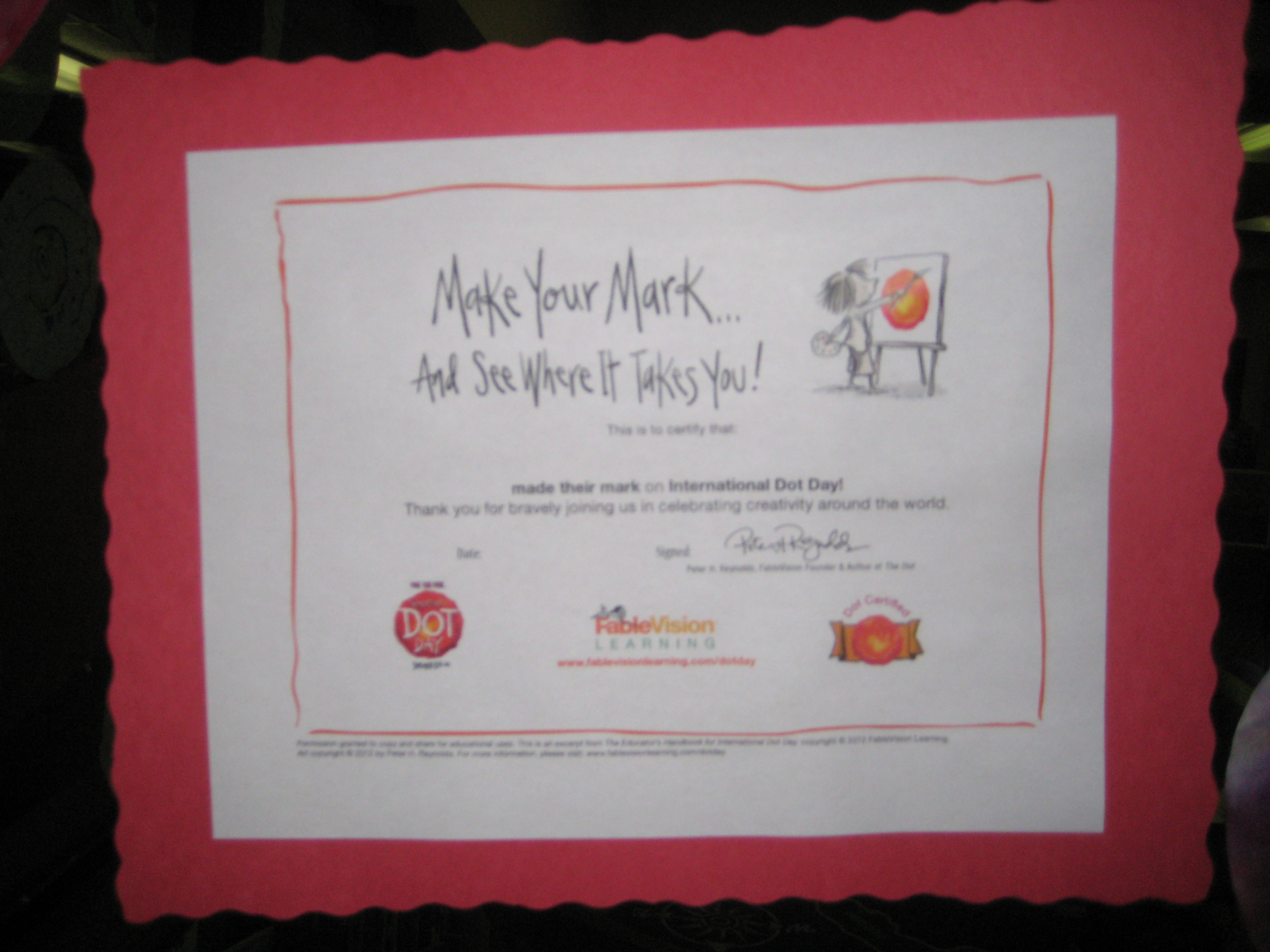
September 15(ish) is International Dot Day.  We’ve been celebrating for the past week in the Barrow Media Center.  Numerous classes came to listen to The Dot by Peter Reynolds.  We talked about the importance of making your mark on the world and avoiding the words “I can’t”.  After our discussion, students moved to tables and made dots in 2 different ways.

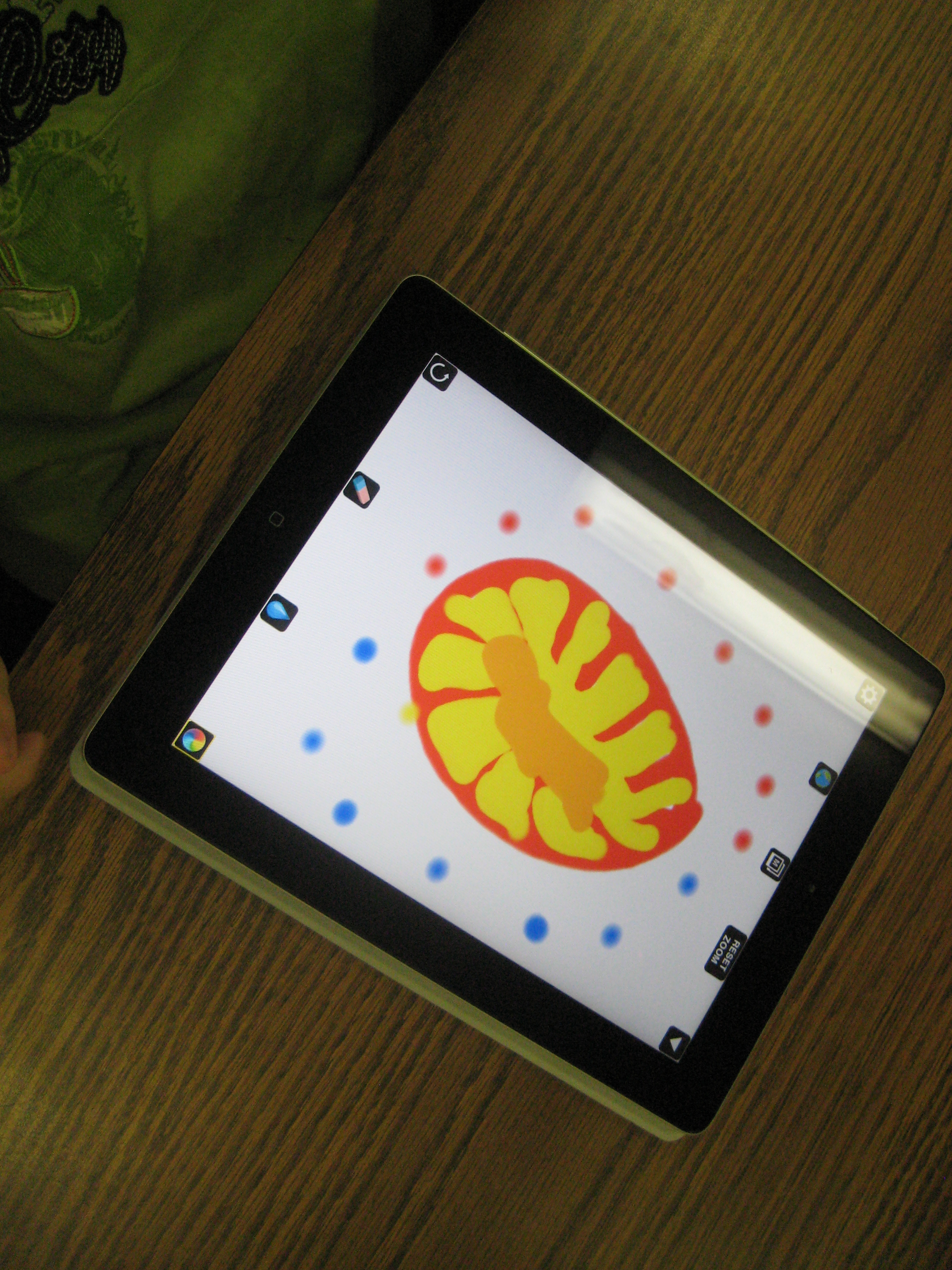
Using Drawcast on the iPad, students made digital dots in a variety of ways.  They saved their images to the iPad photo gallery.  We took those dots and imported them into a collective dot folder and used Animoto to make a digital dot gallery.  We also made a QR code and displayed it outside the library to link to our Animoto video.

At the other tables, student had access to coffee filters, markers, crayons, and color pencils.  They decorated their coffee filters in creative ways.  All of the paper dots filled the windows of the media center to the point that you almost couldn’t see in!  Some students used a spray bottle of water to spray their filters so that the color ran together.  After many classes came, we realized that our sprayed dots had created even more dots in the drying area.  The final class, Ms. Olin’s class, wrote on the drying paper “Barrow School Made Their Mark” and we displayed this in the hallway as well.

We hope our creativity will inspire others to make their mark on the world!


September 11th: Another Transliteracy Experience

Last year, the 5th grade participated in a series of experiences around September 11th.  We used transliteracy as a lens to plan these experiences so that across a full day, students were learning about September 11th in a non-linear, cross-platform way.  This year, we continued this idea and built upon it.  Both 5th grade teachers, our 5th grade spectrum teacher, and myself each planned an experience for students to rotate through.  The teachers also thought about the day as a whole and what they could add to the day to support the study of September 11th, which is a part of the 5th grade standards.

Students began their day in their homeroom morning meetings viewing a brief speech from Barack Obama declaring September 11th as a day of remembrance.  After students went to ELT and specials, we launched into our 4 experiences. Students spent 30 minutes at each experience with a 5 minute transition window.

Center Descriptions:

1) Learning more about the attacks on the Twin Towers in New York City and the brave response of its citizens through a wonderful children’s book by Maira Kalman, Fireboat: The Heroic Adventures of the John J. Harvey. This old fireboat which was first launched in 1931 was called into duty by the NYC fire department and volunteers responded so that water could be pumped to battle the raging fires of the Twin Towers. One teacher will read this book aloud (a very special book to her and her young grandson from a visit to the 9/11 Museum together in NYC) to students and they will be able to also watch news video of the John J. Harvey.
2) To help students learn more about how the nature of heroism, another teacher will share from two more books:, Messages to Ground Zero that includes how children responded in poems and letters about heroes of 9/11, and 14 Cows for America BY Carmen Deedy, about how the Maasai people of Africa responded to 9/11. They will respond with their own artistic rendering of a postage stamp celebrating heroes of 9/11.
3) A lesson about haiku poetry which will review the magic of the brief three-line poem with seventeen syllables to express a feeling or image and students will write their own Haiku for Heroes.
4) Technology sites on 9/11 and Wallwisher Reflection -Students will view multiple interactive websites, videos, oral histories, eyewitness accounts, and more in order to build a picture of the events of the day.  Students will have full choice of which sites they visit and how long they spend at each site.  http://sqworl.com/9vf2t4  After processing what they have seen, they will write a reflection, memory, wish, etc. on a collaborative Wallwisher wall.  http://wallwisher.com/wall/barrow911-2012

During recess, students participated in an alternative recess picking up trash and offering their service to the school.  They closed their day by thinking about our local first responders and writing letters to thank them for their service in the community.

Once again, I was amazed to look around and see all of the ways that students were engaging with the events of September 11th.  Some students were listening to the 911 phone calls with the planes.  Some were looking at diagrams of the towers and what was located on each floor, including the impact zone.  Some were watching National Geographic video footage of the events of the day.  Some were looking at memorials created across the country.  Others were listening to oral histories of family members of victims and 9/11 survivors.  Each experience carried over to the next and inspired discussions and creations made in the other experiences.  For example, I noticed one student who had viewed images of people jumping from the twin towers and then used that image in her haiku that she wrote in another experience.

I continue to think that there is a lot to learn from this type of planning.  Students left the day talking and energized.  I have a feeling that they will go home and continue conversations with their families and hopefully continue to investigate the many resources available on 9/11.

We had a lot of press here at Barrow today, too.  UGA Grady Newsource will air a feature story at 5PM today.  You can watch live at http://www.ustream.tv/discovery/live/all?q=gradynewsource or you can view the story later by visiting their website http://gradynewsource.uga.edu/

The Athens Banner Herald will also feature our work in a story tomorrow, including the following haikus from some of our students.

HAIKU FOR HEROES
th grade students at David C. Barrow Elementary School
Poems from 5
*************************************************

Hear the sound crashing
Innocent people crying
I hear, “Let’s roll.”
~by Tymarius~

It was so tragic
Lives were lost, people were missed
You’ll be remembered
~by Caroline~

It was a bad thing
Many heroes saved the day
They were great and brave
~by Brian~

The Tragic Day
Screams fill flaming streets
As sad tears roll down faces,
We watch the horror.
~by Emily~

So many lives lost
A lot of damage for us
So many heroes
~by Henry~

Chaos everywhere
Heroes save lives and risk them
Death of love and friends
~by Ryan~

I feel unhappy.
I feel like I wanted to help them.
I am very sad.
~by Jasiyah~

9/11
Insidious, mean
People dying, lives ending
A new beginning
~by Parker~

I didn’t realize
Passengers had lost their lives
People risked their lives
~by Joel M~

What they did was sad.
Those terrorists were so mean.
It was so, so sad.
~by DeMontre~

This slideshow requires JavaScript.

Digital Alphabet Books


Two Kindergarten classes have been collaborating with me in the library to support their study of the alphabet.  First students came to the library for a lesson on alphabet books.  We explored numerous alphabet books, upper/lowercase letters, and the sounds letters make.  I used LMNO Peas by Keith Baker to look specifically at upper/lowercase letters.  Next, we used Gone Wild: An Endangered Animal Alphabet by David McLimans to continue looking at upper and lowercase letters, but in an animal format.  We put each illustration under the document camera, guessed what letter the animal was making, looked at the standard upper/lowercase letter, and talked about how the animal’s name started with the letter.  We ended with Alphabet Explosion: Search and Count from Alien to Zebra by John Nickle.  We put a few illustrations under the document camera and had students identify as many things as they could find that started with the letter of the alphabet represented on the page.  At the close, students checked out an alphabet book from our wide selection.

In class, students were each assigned a letter of the alphabet.  They decorated an uppercase & lowercase letter, added an illustration that represented that letter, and wrote the word for the illustration.  They also began practicing saying the letter, the sound it makes, and the word for their illustration.  In small groups, they brought their finished illustrations to the library to use the scanner to scan their images.  While students waited to scan, they continued practicing their scripts.  After 2 days of scanning, I imported all of their pictures into Photo Story.  Then, in small groups they came back to record their scripts for their assigned letter(s).  Once again, while students waited, they practiced.  After all students recorded their voices, I finalized the Photo Story and uploaded it to Youtube.  The students will come back to the library the next time they check out books for a premiere of their video, but you can get a sneak peek of one class below.

IPICK: Choosing a Just Right Book

Every year at the beginning of the year, teachers ask me to do lessons on choosing a “just right book”.  While sometimes the focus is just on finding words that you know using the “five finger rule”, I like using the IPICK model because it is more inclusive of all of the pieces it takes to find a just right book.  IPICK stands for:

  • I=I choose my books
  • P=Purpose
  • I=Interest
  • C=Comprehend
  • K=Know most of the words  (this is really where the five finger rule fits)

Each year, I show videos of students singing a song about IPICK.  There are several examples on Youtube.  However, I know that our students are using this strategy in various classes, so when I heard a 3rd grade teacher reminding her students to use IPICK, I asked her if she had some students who might be interested in making a video.  Of course, they were very interested!

For about 45 minutes, 3 students and I met together.  We planned what we might do during the video.  Then, we started recording with an iPad.  After we filmed one take, we watched it and thought about what we needed to change.  Each time, the students made more and more suggestions and their video improved every time.  Here’s the video they created during our time together.


This year, I want to continue to listen for opportunities for students to participate in creating content in our library and be a bridge builder to get that content to a global audience for our students.

Exploring the Solar System

Right now our 4th grade is working on the Georgia Performance Standards dealing with the solar system and stars.  They kicked off their unit of study in class with a KWL chart.  With that knowledge named and questions formed, they came to the library for an exploratory lesson to further expand their knowledge and spark additional questions before they continue their unit of study in the classroom.

We began our time together as a whole group.  I sparked their interest with my own research of the end of the shuttle program, the price tag for a seat on a Russian shuttle, and updates on the Mars Rover.  Next, students got to choose from two books to read aloud:  You Are the First Kid On Mars by Patrick O’Brien and The Planet Hunter: The Story Behind What Happened to Pluto by Elizabeth Rusch.  I was actually surprised that they picked The Planet Hunter because we had talked so much about the Mars rover and they were excited about it.  Nevertheless, we read the story and they were amazed to learn that scientists could change the definition of what a planet is and things we once called planets are now called something different. They wondered if there would ever be a day that Earth would not be a planet anymore.

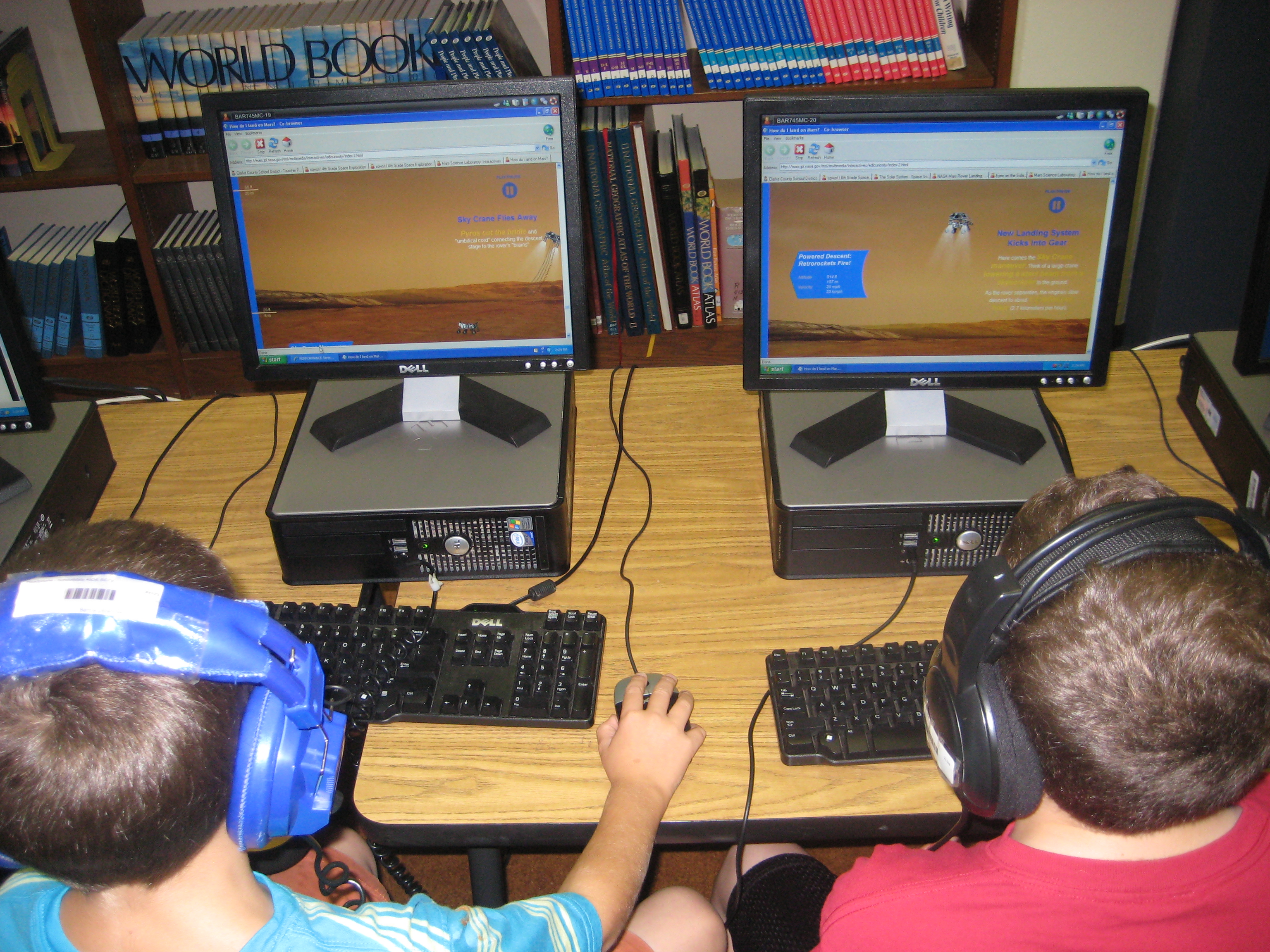
After our book exploration, students split into 2 groups.  One group went to the desktop computers and used a pathfinder created with Sqworl to explore YouTube videos and interactive sites.  The other group used our 10 iPads to explore a variety of free solar system and constellation apps such as Distant Suns, Moon, Solar System, NASA Viz, Stellarium, GoSkyWatch, and Planets.  Groups switched halfway through our time so that they went to both centers.

The students left with excitement about the solar system.  They left with questions and a desire to continue learning.  When one student discovered something in an app, video, or interactive site, they immediately wanted to share it with other students in the class.  Without any prompting, they were teaching one another how to use the tools.  The teacher and I served as facilitators in both groups.  One student even said he wanted to go build a model rocket after watching one of the YouTube videos.  They will carry this new knowledge and energy back into their classroom to continue their unit of study on the solar system.

In total, this took about 45-60 minutes, but I feel like the energy that was created in the students at the front end of their unit will be well worth the time and exploration.


This slideshow requires JavaScript.

21st Century Learning: A visit to the GA DOE Center for Classroom Innovation

What does learning in a 21st century classroom look like?  We had the opportunity to visit the Georgia Department of Education’s Center for Classroom Innovation.  The room is setup with different spaces depending on the kinds of learning and collaboration taking place.  The room also offers flexibility with some mobile furniture such as rolling chairs, rolling tables, and screens that divide the space into different learning areas.  The spaces include:

  • The bar:  a high top table for collaborative group work
  • The Mediascape Area:  a space with a U-shaped couch, 2 Mondo boards, and the ability to easily connect devices for display on the boards
  • The Campfire Area:  Another collaborative space with a couch and a table that has a pad of paper as its top so that you can write on the table and take your ideas with you.
  • The high top:  A high table that can be used for large collaborative projects and hands-on activities
  • The Post and Beam:  An area that can be divided multiple ways such as 4 smaller meeting spaces that contain tables, chairs, and dry erase boards
  • The Node Classroom:  A space that features  “desks” that swivel and have a tray table that can be for either left or right-handed people
The room is also equipped with these technologies:
  • Wireless internet with multiple access points
  • Document camera
  • Xbox with Kinnect
  • Laptop cart
  • 3D projector w/3d glasses for a class
  • 2 Mondo boards (large touch screen computers) w/videoconferencing capabilities
  • Plug and play connections to easily display content from any device
You can view a slideshow of the room and find out more here.  The room is available for any classes to use as long as you schedule the room with Chara Lee (404) 651-9500.

This visit began taking shape several weeks ago when we were invited to bring a class to the space to engage in a lesson and be filmed.  Our collaborative wheels immediately began turning as me, Mrs. Selleck (fourth grade teacher), Mrs. Foretich (art teacher), Mrs. Yawn (2nd grade teacher), and Mrs. Hunter (gifted teacher) began planning.  We chose a 4th grade unit focusing on the social studies standards about how price incentives affect people’s behavior and choices.  Ultimately, students would design a t-shirt for our temporary home at Barrow 2.0 while our new school is being built.  Their role would be to establish themselves as a business, create a design, consider wants/needs/cost, and create a marketing plan for their new shirt.

Several pieces of our project took place at our school before we made the journey to Atlanta.  Our principal created a video charging Mrs. Selleck’s class with the task of designing a new shirt.

In class, Mrs. Selleck established 4 groups of students.  Each group had a manager, an accountant, a designer, a technology specialist, and an advertiser.  The groups created names and logos for their companies.  Mrs. Selleck also did a lot of work with wants and needs as well as developing products and advertising slogans.  In art, Mrs. Foretich worked with the students on their designs and discussed multiple art elements that they might consider in creating an effective design for a shirt.  In the media center, the technology specialists met with Mr. Plemmons and Mrs. Hunter to go over many technology options that the groups might consider while developing their advertising components of the project.  These included Glogster, Animoto, and Prezi.

At the Center for Classroom Innovation, several things happened:

  • Mr. Plemmons introduced the day with the book Have I Got a Book for You by Melanie Watt.  Persuasive strategies were discussed
  • Mrs. Selleck led the group in a needs and wants activity where students split into separate areas of the space to work and then came back together
  • Mrs. Hunter met with all the advertisers.  Mr. Plemmons met with all the technology specialists.  Mrs. Yawn met with all of the managers.  Mrs. Selleck met with all of the accountants.  Mrs. Foretich met with all of the designers.  Each group focused on their specialty and learned more about the role they would play in designing a shirt and marketing the shirt.
  • Groups met in separate meeting spaces within the room to design.  Using Zazzle, groups considered the images they would use, explored options for t-shirt types and colors, and considered how the price was affected by their decisions.  Groups also used giant dry erase boards to take notes and brainstorm as they worked.
  • As needed, groups went to the Mondo boards and Skyped with our graphic design expert, Tony Hart.  His feedback helped groups revise their designs as needed.
  • Students were treated to a great pizza lunch before launching into part 2.
  • Students considered what technology tool they would use to market & persuade people to choose their design.  Three groups chose Animoto and one group chose Glogster.
  • All adults assisted students as needed during their product creation.
  • The day closed with each group presenting their final advertising product.  Mrs. Foretich led the students in a critique session.

While all of this was going on, the Department of Education had 2 videographers documenting the day.  They will eventually edit this video into a model video for how this space can be used with students.  It was an exciting day.  Our next steps will be to continue the project, but also to reflect on how this space served us in the kinds of work that we want to do with students.  This will inform the design of our new classrooms in our new school.  We loved how productive students were in this space.  The flexible divisions of the space allowed students to create their own private nooks and work spaces.  Even though there was a rumbling energy in the room, groups did not distract one another from the tasks their group was trying to accomplish.  The space was a big component responsible for this success.  The space also supported students with a strong infrastructure for technology.  We did not have any problems with computers connecting and staying connected to wireless.  The large Mondo boards were very dependable for displaying student work as well as video conferencing through Skype.  We had one of the best Skype connections I’ve every experienced.  The size of the room wasn’t extremely large, but again, the divisions of the space provided multiple ways for students to be productive and engage with technology and other forms of documentation.  Seeing students work in this space is inspiring.  We  have already been doing this kind of learning in our media center and classrooms, but today showed us how a space and tools can strengthen 21st century learning.

This slideshow requires JavaScript.

Here are the 3 Animoto videos created by groups today:

Here’s a  link to the Glog created by one group:

Lightning Minds