
Images on display through September 27th
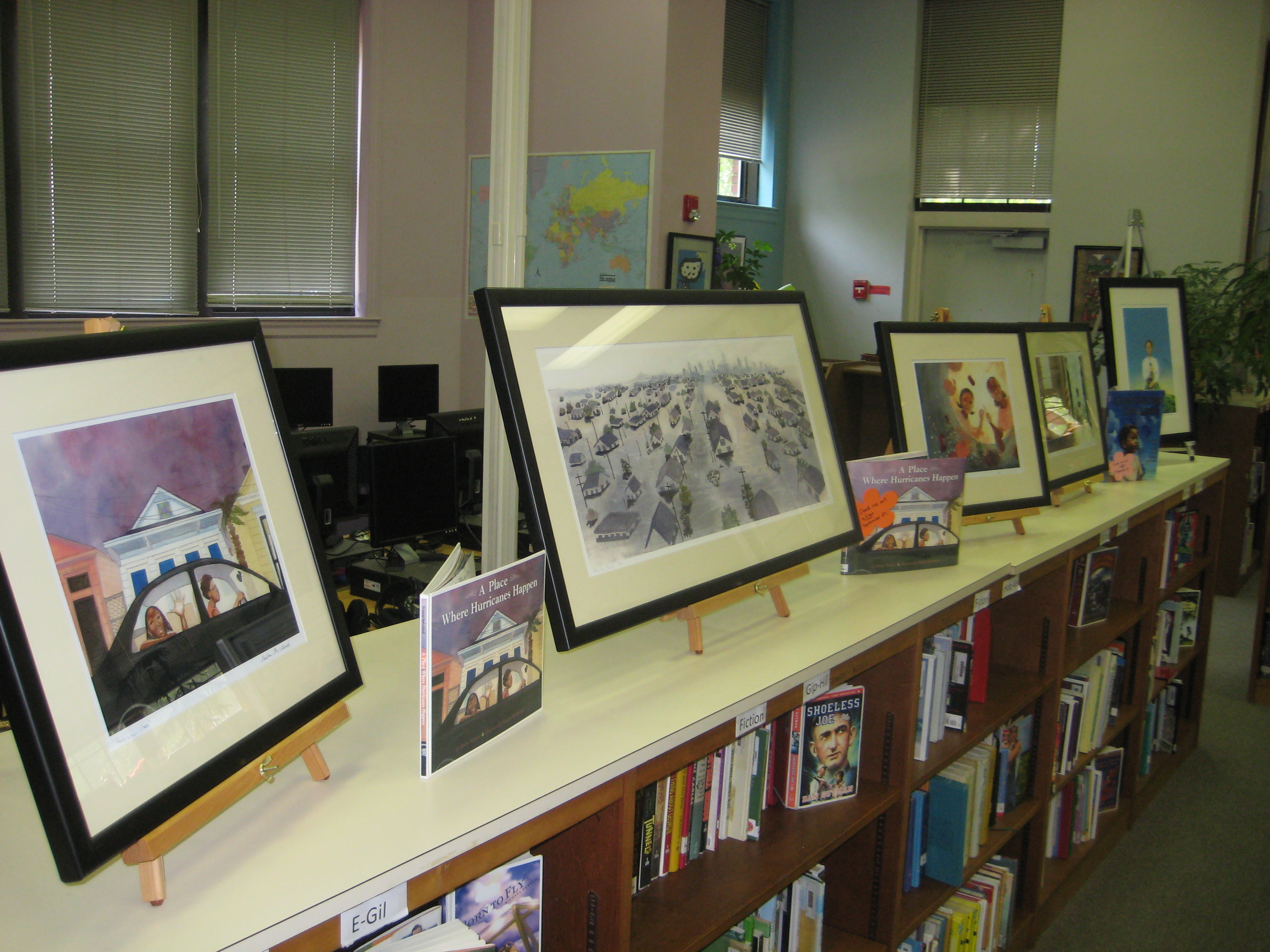
The Ashley Bryan Traveling Exhibit of Illustrated Africana Children’s Literature is now in our library! This exhibit is provided through a collaboration between the Auburn Avenue Research Library and the National Black Arts Festival. The display is on the tops of the shelves and features 8 works of art by Shadra Strickland, award-winning children’s illustrator. The exhibit will be with us until September 27th when Shadra Strickland will visit our school. To support the exhibit, we have copies of six books that accompany the exhibit, a curriculum guide to inspire lessons using the texts and artwork, and a school-wide subscription to Literacyhead.
From the accompanying curriculum guide:
Ashley Bryan
“A renowned author and illustrator, Ashley Bryan is perhaps best known for his work celebrating the African American experience. In 1962, he was the first African American to be published as both the author and illustrator of a children’s book. Since that time, his work has expanded the catalogue of children’s literature by African Americans and has led the way for other African American authors and illustrators. Born in Harlem and raised in the Bronx by Jamaican immigrant parents, Bryan always harbored a love of books, art, and music. He recalls writing his first book in kindergarten and never gave up writing and illustrating books until he was finally published at the age of 40. Bryan was a talented and dedicated student, graduating from high school at 16 and attending Cooper Union Art School on a scholarship. After serving in World War II, Bryan attended Columbia University and studied in Europe as a Fulbright Scholar.
Ashley Bryan’s children’s books have won several awards including the Coretta Scott King Award for illustration, six Coretta Scott King Honors, and the Arbuthnot Prize. Bryan’s work is heavily influenced by African American poetry and storytelling. His retellings of African folktales such as Beautiful Blackbird and Beat the Story Drum, Pum-Pum have successfully exposed a wider audience of children to the African oral tradition.”
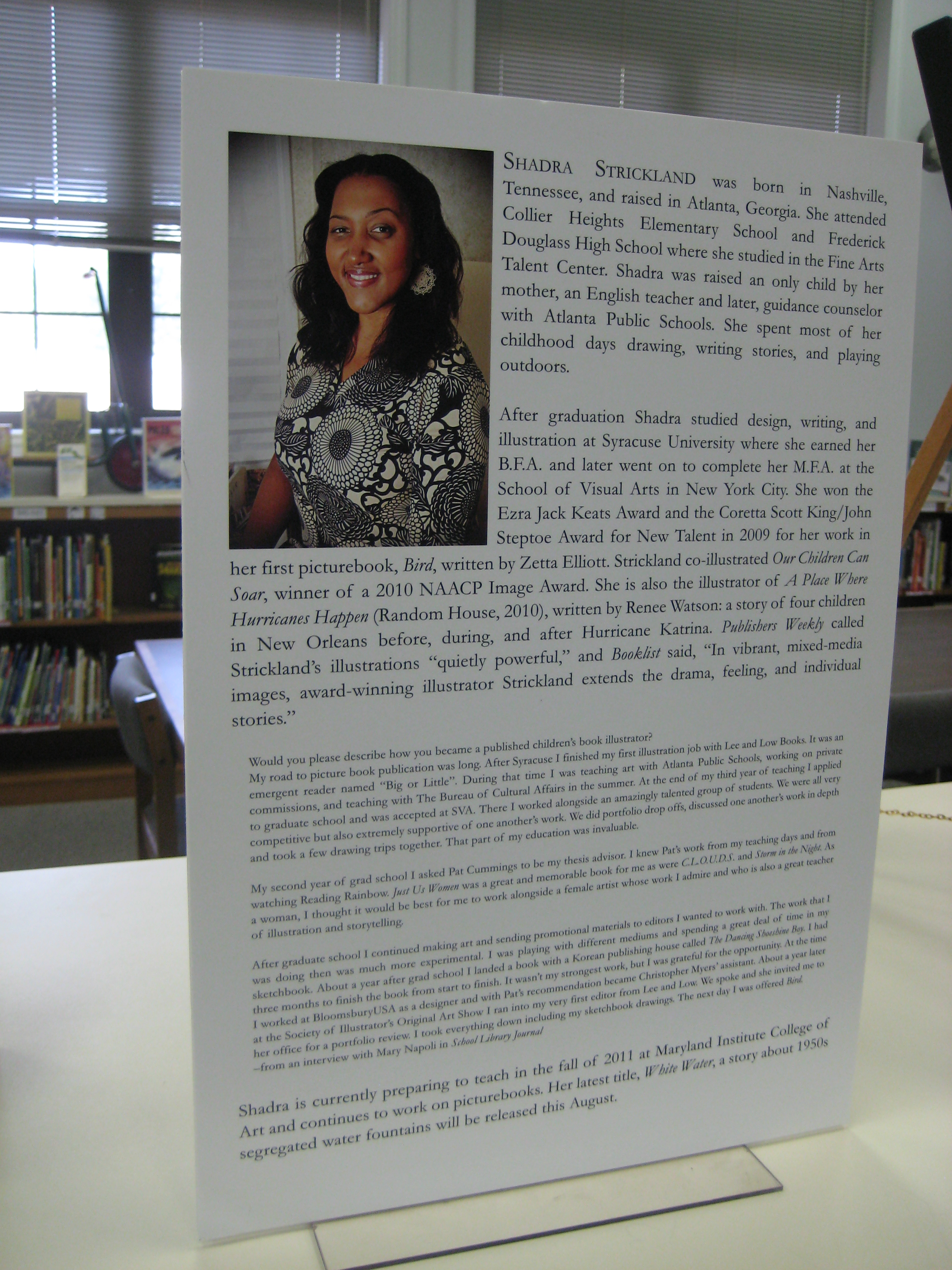
Shadra Strickland
“Shadra Strickland studied design, illustration, and writing at Syracuse University before earning her MFA at New York’s School of Visual Arts. Her illustrations have received numerous awards including the American Library Association’s John Steptoe Award for New Talent and the Ezra Jack Keats New Illustrator Award as well as an NAACP Image Award and the Ashley Bryan Children’s Literature Award.
Strickland’s illustrations start with real-life images. For her work on Bird, Strickland spent time walking the streets of New York, and her research for A Place Where Hurricanes Happen involved time in New Orleans. Yet, her illustrations, while based in reality, also manage to capture the imaginative worlds that children create.
When not at home in Baltimore where she teaches illustration at the Maryland Institute College of Art, Strickland can be found conducting workshops across the country with children, teachers, and librarians.”
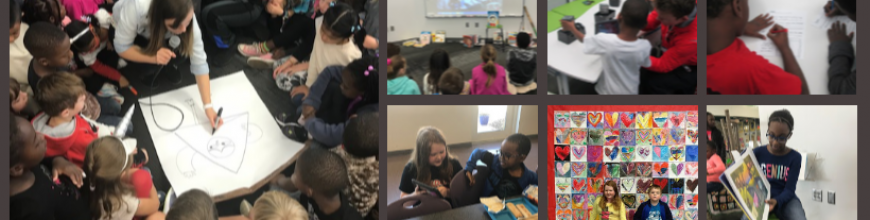
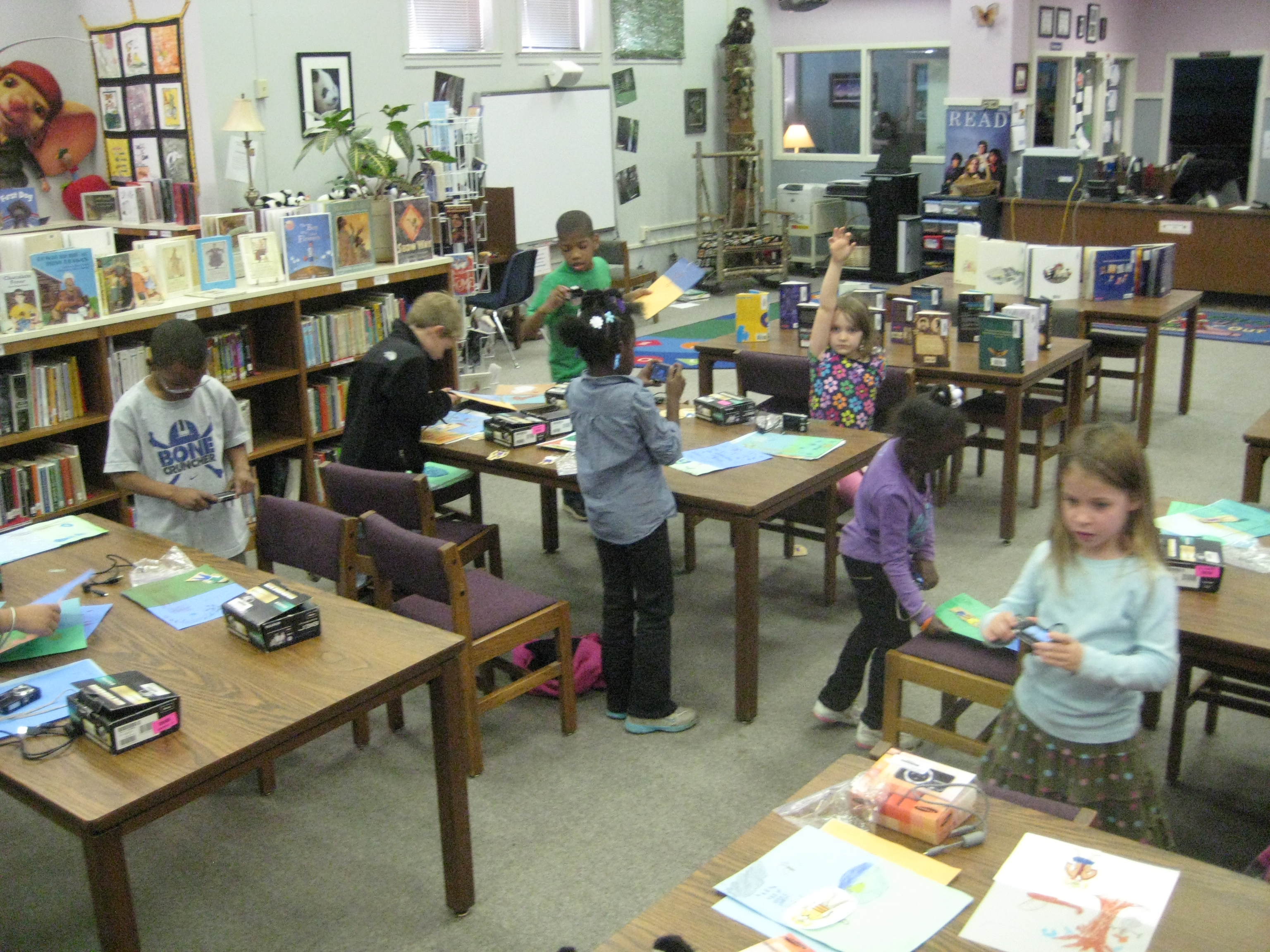
Throughout the next month, students will be coming to the library to view the exhibit and participate in a variety of lessons exploring the illustrations and text.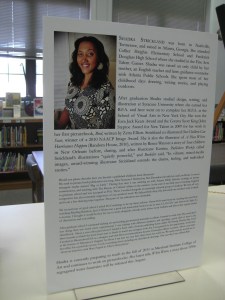
Some possible lessons that students may experience:
1. Where I’m From: Read aloud one of Shadra’s books. Discuss how the words and images help us learn more about the characters in the story. Examine one piece of artwork from the exhibit that is from the picture book and use the picture to think about what the character might write in a “Where I’m From” poem. At the end, students can either craft a poem from the character’s perspective as a class using Poll Everywhere in the computer lab or students can write individual poems
2. Connections: Students will examine two pieces of artwork from Shadra’s exhibit and compare and contrast the two images using a venn diagram on the smart board. Following this, we will read aloud one of her books and continue looking at how the images have connections to one another. At the end, students will have time to examine all the pieces in the exhibit and write a response on an index card about connections they saw between the artwork.
3. Text to Self Connections: Examine a piece of art from the exhibit. Have a conversation around a series of questions as a whole group and with partners that build connection between the art and the students. Read aloud one of Shadra’s books and continue the conversation of connections. View the remainder of the exhibit and see if any of the other paintings have a connection to you. At the end, students write a response on an index card about a connection they had to the artwork.
4. Response to Literature: Read aloud one of Shadra’s books and examine the artwork from that book. Ask a guiding question that would build student response about the book. For example, in the book Bird, how is Bird like a bird? Students write a response in relation to the question. This could also be done as a more open response to the book in a book review format. In the computer lab, students could type their response into Tagxedo and print a visual interpretation of their response.
5. Read Alouds:
a. White Water: Inspired by the author’s own childhood experiences, White Water tells the story of Michael,a little boy growing up under Jim Crow laws. He and his grandmother must give up their seats on the bus for a white family and must drink from the “colored” water fountain.Michael begins to dream about the “white” water, and devises a plan to get a taste of it, but Michael soon learns that many things he has been lead to believe are simply untrue.
b. Bird: Mekhai, nicknamed Bird, is struggling to deal with the changes in his life. He grandfather has recently passed away and his older brother has been lost to drug addiction. Fortunately for Bird, he has the love and support of his grandfather’s friend, Uncle Son, and a passion for drawing that help him to make sense of the world in this difficult time.
c. A Place Where Hurricanes Happen: Adrienne, Keesha, Michael, and Tommy all live in New Orleans prior to the arrival of Hurricane Katrina. This story follows the events of Katrina as seen through the eyes of the four children, all of whom experience the tragedy of the hurricane in different ways. Ultimately, the book is a hopeful reminder that even in the face of devastation and loss, the human spirit is resilient.
d. Our Children Can Soar: Each spread highlights key figures in African American history including George Washington Carver, Jesse Owens, Hattie McDaniel, Ella Fitzgerald, Jackie Robinson, Rosa Parks, Ruby Bridges, Martin Luther King Jr., Thurgood Marshall and Barack Obama.
If you are in the Athens area during the next month, we invite you to stop in and see the exhibit. For more information or to let us know you’re coming by, email Mr. Plemmons at plemmonsa@clarke.k12.ga.us
This slideshow requires JavaScript.

 Expect the Miraculous