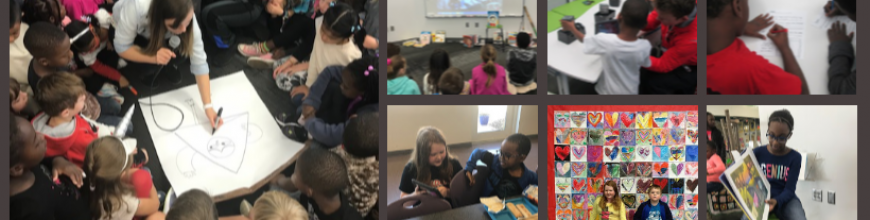
 What does learning in a 21st century classroom look like? We had the opportunity to visit the Georgia Department of Education’s Center for Classroom Innovation. The room is setup with different spaces depending on the kinds of learning and collaboration taking place. The room also offers flexibility with some mobile furniture such as rolling chairs, rolling tables, and screens that divide the space into different learning areas. The spaces include:
- The bar: a high top table for collaborative group work
- The Mediascape Area: a space with a U-shaped couch, 2 Mondo boards, and the ability to easily connect devices for display on the boards
- The Campfire Area: Another collaborative space with a couch and a table that has a pad of paper as its top so that you can write on the table and take your ideas with you.
- The high top: A high table that can be used for large collaborative projects and hands-on activities
- The Post and Beam: An area that can be divided multiple ways such as 4 smaller meeting spaces that contain tables, chairs, and dry erase boards
- The Node Classroom: A space that features “desks” that swivel and have a tray table that can be for either left or right-handed people
- Wireless internet with multiple access points
- Document camera
- Xbox with Kinnect
- Laptop cart
- 3D projector w/3d glasses for a class
- 2 Mondo boards (large touch screen computers) w/videoconferencing capabilities
- Plug and play connections to easily display content from any device
This visit began taking shape several weeks ago when we were invited to bring a class to the space to engage in a lesson and be filmed. Our collaborative wheels immediately began turning as me, Mrs. Selleck (fourth grade teacher), Mrs. Foretich (art teacher), Mrs. Yawn (2nd grade teacher), and Mrs. Hunter (gifted teacher) began planning. We chose a 4th grade unit focusing on the social studies standards about how price incentives affect people’s behavior and choices. Ultimately, students would design a t-shirt for our temporary home at Barrow 2.0 while our new school is being built. Their role would be to establish themselves as a business, create a design, consider wants/needs/cost, and create a marketing plan for their new shirt.
 Several pieces of our project took place at our school before we made the journey to Atlanta. Our principal created a video charging Mrs. Selleck’s class with the task of designing a new shirt.
In class, Mrs. Selleck established 4 groups of students. Each group had a manager, an accountant, a designer, a technology specialist, and an advertiser. The groups created names and logos for their companies. Mrs. Selleck also did a lot of work with wants and needs as well as developing products and advertising slogans. In art, Mrs. Foretich worked with the students on their designs and discussed multiple art elements that they might consider in creating an effective design for a shirt. In the media center, the technology specialists met with Mr. Plemmons and Mrs. Hunter to go over many technology options that the groups might consider while developing their advertising components of the project. These included Glogster, Animoto, and Prezi.
At the Center for Classroom Innovation, several things happened:
- Mr. Plemmons introduced the day with the book Have I Got a Book for You by Melanie Watt. Persuasive strategies were discussed
- Mrs. Selleck led the group in a needs and wants activity where students split into separate areas of the space to work and then came back together
- Mrs. Hunter met with all the advertisers. Mr. Plemmons met with all the technology specialists. Mrs. Yawn met with all of the managers. Mrs. Selleck met with all of the accountants. Mrs. Foretich met with all of the designers. Each group focused on their specialty and learned more about the role they would play in designing a shirt and marketing the shirt.
- Groups met in separate meeting spaces within the room to design. Using Zazzle, groups considered the images they would use, explored options for t-shirt types and colors, and considered how the price was affected by their decisions. Groups also used giant dry erase boards to take notes and brainstorm as they worked.
- As needed, groups went to the Mondo boards and Skyped with our graphic design expert, Tony Hart. His feedback helped groups revise their designs as needed.
- Students were treated to a great pizza lunch before launching into part 2.
- Students considered what technology tool they would use to market & persuade people to choose their design. Three groups chose Animoto and one group chose Glogster.
- All adults assisted students as needed during their product creation.
- The day closed with each group presenting their final advertising product. Mrs. Foretich led the students in a critique session.
While all of this was going on, the Department of Education had 2 videographers documenting the day. They will  eventually edit this video into a model video for how this space can be used with students. It was an exciting day. Our next steps will be to continue the project, but also to reflect on how this space served us in the kinds of work that we want to do with students. This will inform the design of our new classrooms in our new school. We loved how productive students were in this space. The flexible divisions of the space allowed students to create their own private nooks and work spaces. Even though there was a rumbling energy in the room, groups did not distract one another from the tasks their group was trying to accomplish. The space was a big component responsible for this success. The space also supported students with a strong infrastructure for technology. We did not have any problems with computers connecting and staying connected to wireless. The large Mondo boards were very dependable for displaying student work as well as video conferencing through Skype. We had one of the best Skype connections I’ve every experienced. The size of the room wasn’t extremely large, but again, the divisions of the space provided multiple ways for students to be productive and engage with technology and other forms of documentation. Seeing students work in this space is inspiring. We have already been doing this kind of learning in our media center and classrooms, but today showed us how a space and tools can strengthen 21st century learning.
Here are the 3 Animoto videos created by groups today:
Here’s a link to the Glog created by one group:

 Expect the Miraculous