It took a little longer to get to January’s report, but here’s a look at what happened in the Barrow Media Center during January 2013.
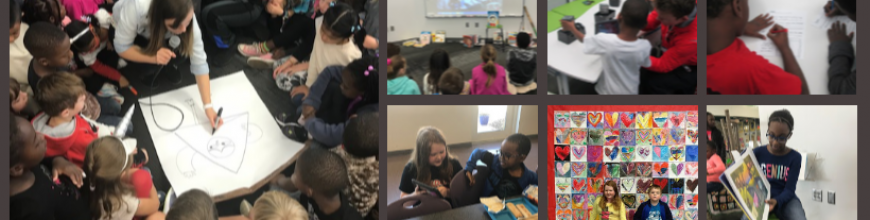
It took a little longer to get to January’s report, but here’s a look at what happened in the Barrow Media Center during January 2013.
Ms. Carney’s Kindergarten Class came today to write storybirds in small groups. Ms. Carney, Ms. Samuel, and I each facilitated a group and a parent volunteer rotated among the groups to assist as needed. This class followed a similar sequence of lessons that other Kindergarten classes had followed. Please see previous storybird posts for those details.
Here are their final results:
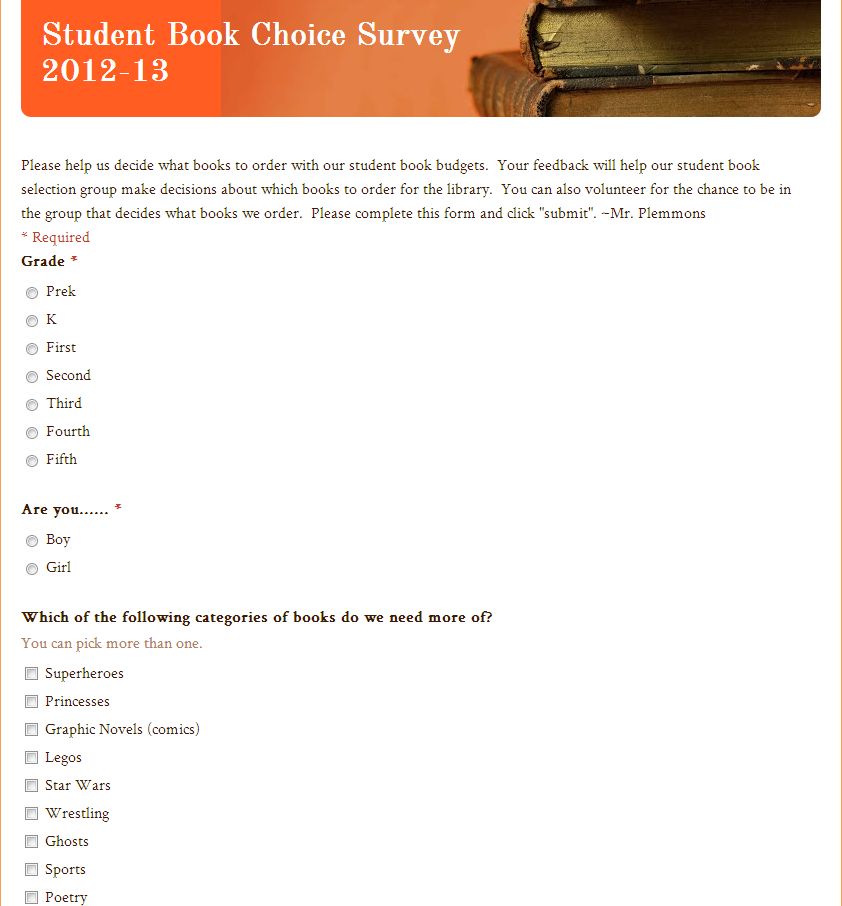
A snapshot of the form that students used to survey other students
Once again, I have reserved a portion of our library budget for complete student control. I have done this over the past three years and have come to value it so much that I plan to continue and improve upon the process. So far, this year is proving to be one of the most interesting so far. In the past, I’ve worked with groups of students as large as 40 and as small as 12. This year, we have 27 students in grades 3-5 who have agreed to participate in this process.
This year, I created a Google form asking about some reading interests and gauging student interest in being a part of the book budget group. I emailed the form to all students in the school. In general, our 3rd-5th graders are the main students who check their email, so those were the students who responded. Out of about 60 responses, I had about 40 students who were interested in being in the group. I went through the list and tried to select a mix of boys, girls, grade levels, classrooms, backgrounds, and reading interests. This narrowed the list to the 27 students.
I then got permission from the students’ teachers to allow them to be in the group. Next, I blocked out some times on the library calendar. Here’s the rough outline of what I did/planned to do:
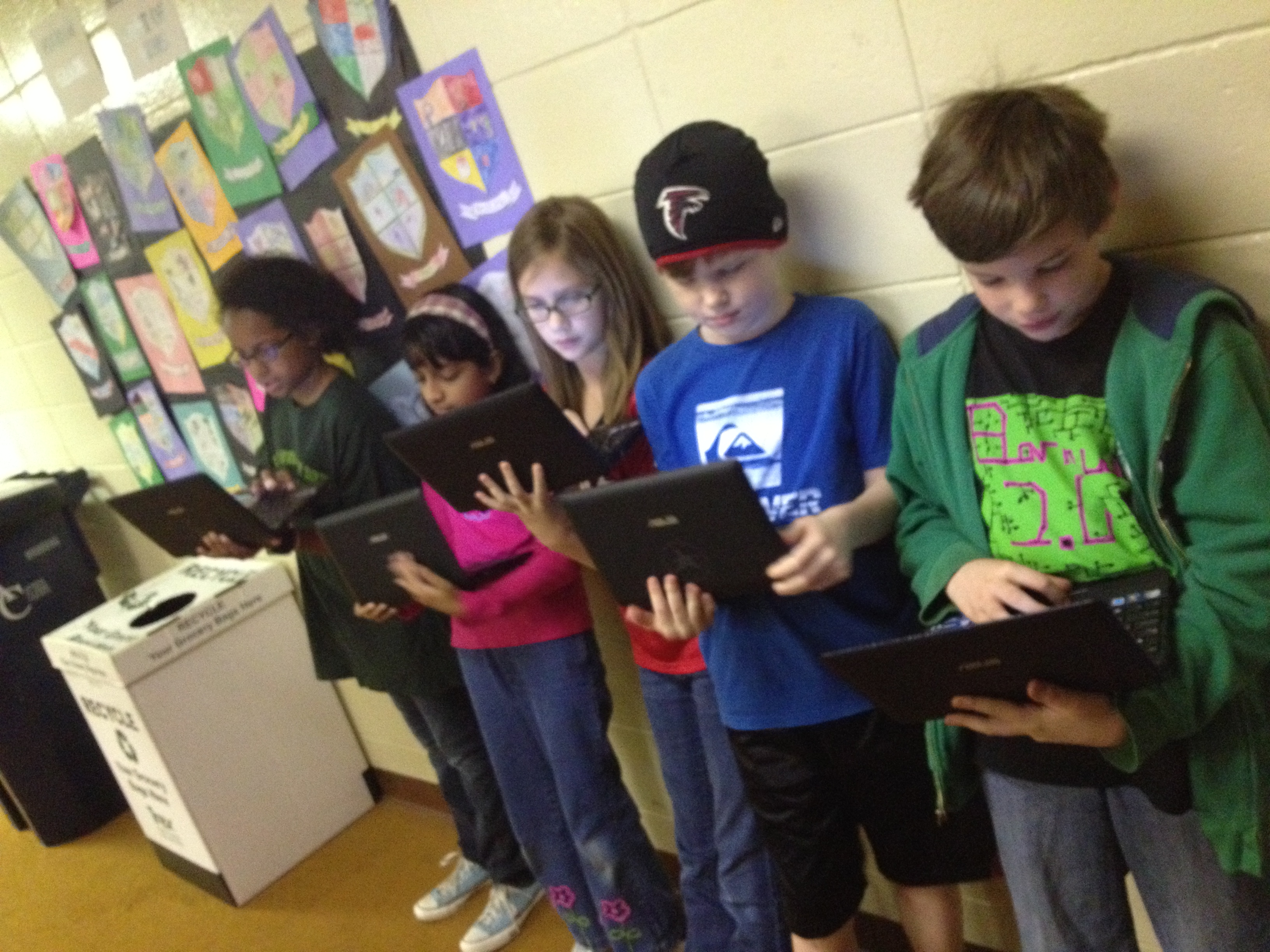
Students pulling up their Google Form to begin roaming the school.
At our initial meeting, students did a great job adding to the form I had already started. In the form, I asked about specific series of books, genres of books, and created a space for students to list specific books. This was all based on what students are constantly asking for in the library so there were things like: The Hunger Games, Diary of a Wimpy Kid, World Records, Rainbow Fairies, Ninjago, Lego, Princesses, etc. The students decided to add a question about grade level and gender so that we could balance how many boys, girls, and students from different grade levels we surveyed. They also added their own series and genres that I completely missed. This is what I love about this participatory aspect. It’s impossible for one person to know the reading needs of the entire school. It has to be a collaborative effort.
During the week of 1/28-2/1, students surveyed as many students as possible. I was amazed that by the end of the week they had surveyed over 400 students, which is almost every student in the school! This is highest amount of students we have ever been able to survey in this project. Almost every day, I emailed the students an update on how many students in each grade level we had surveyed. This helped them focus their time. I was also amazed by the decision making of many of the students. They were careful not to disturb a classroom if the teacher had already started a morning meeting or a lesson. They also came to the library to ask me my thoughts about where they might go next. In the library, I watched the number of surveys steadily climb in the spreadsheet that Google Forms automatically creates.
On 2/1, I emailed the students the final results so that they can hopefully look over it before we begin the messy process of making decisions this week. I’ll do another post about the decision making process and book ordering, but for now here’s what we have to work with. How would YOU narrow this down?
| Prek | 42 | 10% | |
| K | 58 | 14% | |
| First | 69 | 16% | |
| Second | 73 | 17% | |
| Third | 46 | 11% | |
| Fourth | 45 | 11% | |
| Fifth | 33 | 8% |
| Boy | 207 | 49% | |
| Girl | 159 | 37% |
| Superheroes | 129 | 31% | |
| Princesses | 92 | 22% | |
| Graphic Novels (comics) | 170 | 40% | |
| Legos | 172 | 41% | |
| Star Wars | 141 | 34% | |
| Wrestling | 96 | 23% | |
| Ghosts | 165 | 39% | |
| Sports | 206 | 49% | |
| Poetry | 124 | 30% | |
| History | 145 | 35% | |
| Animals | 232 | 55% | |
| Paper airplanes | 149 | 35% | |
| Cars | 144 | 34% | |
| World Records | 201 | 48% | |
| Drawing | 197 | 47% | |
| Mystery | 167 | 40% | |
| TV shows | 149 | 35% | |
| How to | 126 | 30% | |
| Action | 159 | 38% | |
| Scary | 177 | 42% | |
| Myths & Legends | 159 | 38% | |
| Picture books | 187 | 45% | |
| Movies | 185 | 44% |
| Hunger Games | 161 | 39% | |
| Rainbow Fairies | 113 | 27% | |
| Diary of a Wimpy Kid | 211 | 51% | |
| Guinness World Records | 168 | 40% | |
| Ninjago | 174 | 42% | |
| Disney Princesses | 87 | 21% | |
| Sisters Grimm | 59 | 14% | |
| Mo Willems books | 90 | 22% | |
| Captain Underpants | 145 | 35% | |
| Geronimo Stilton | 104 | 25% | |
| Magic Tree House | 191 | 46% | |
| Junie B. Jones | 168 | 40% | |
| Lunch Lady | 141 | 34% | |
| Babymouse | 139 | 33% | |
| Goosebumps | 100 | 24% | |
| Dr. Seuss | 190 | 46% | |
| Fashion Kitty | 114 | 27% | |
| Bad Kitty | 142 | 34% | |
| 39 Clues | 109 | 26% | |
| Eragon | 73 | 18% | |
| Bone | 111 | 27% | |
| Genius Files | 75 | 18% | |
| Nancy Drew | 95 | 23% | |
| Corduroy | 89 | 21% | |
| Hardy Boys | 114 | 27% | |
| Percy Jackson | 100 | 24% | |
| Archie Comics | 92 | 22% |
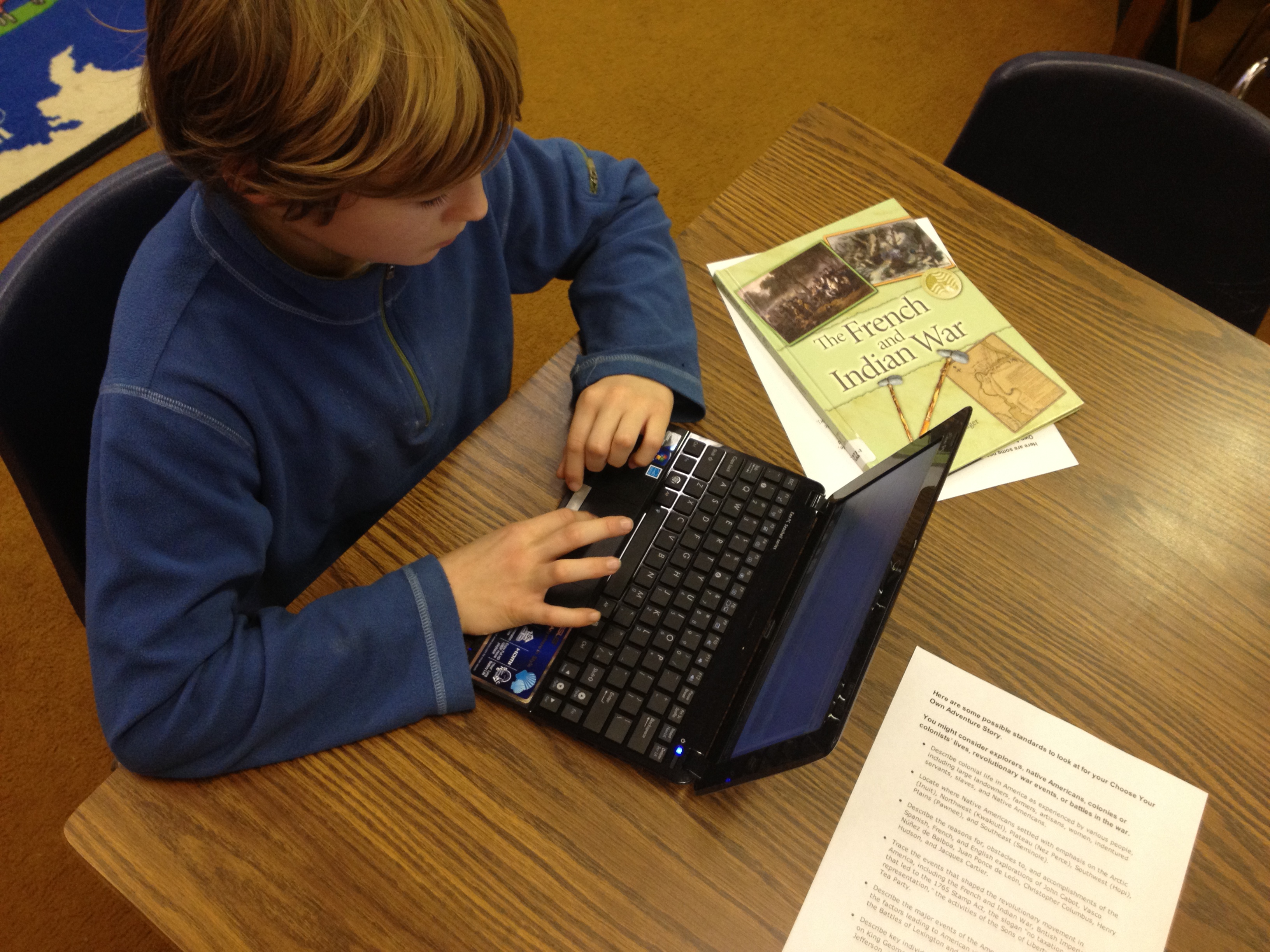 I had heard about how you could write a Choose Your Own Adventure story using a Google form, but I had not been brave enough to give it a try until this year. The idea got placed back in front of me at one of our media specialist professional learning meetings by Tanya Hudson. Then, I went into Google forms and gave it a try. I made a very short, basic fiction story. I won’t go into detail in this post about how the story is made, but it is all about adding multiple page breaks in a form and then directing answers to go to those pages based on the response of the reader.
Mr. Plemmons’s very rough practice story!
Then, at our school level professional learning day in January, I did a session on using Google forms. I shared some very basic uses of forms and also included this advanced idea. Our 4th grade teachers were very interested in how this might be used by their students. After some brainstorming, we decided on writing historical fiction choose your own adventure using some of the 4th grade standards. In the library, I have several nonfiction choose your own adventure stories from Capstone Press, so these became mentor texts for the project.
The teachers gave me a small group of students from each of their classrooms. The reason we started with a small group was so that I could work with them in a smaller setting to explore the possibilities of creating this kind of story. Then, these students could pair with other students in the class to show them the steps to making the stories. The students worked with me during 5 hour-long sessions.
In session 1, we read some excerpts from the informational Capstone Press books. Then, I walked them through the story I made and how it was created. They ended this session by “messing around” in Google forms to practice some of the things I modeled.
In session 2, students looked at the standards and chose their topics to begin researching. They chose from:
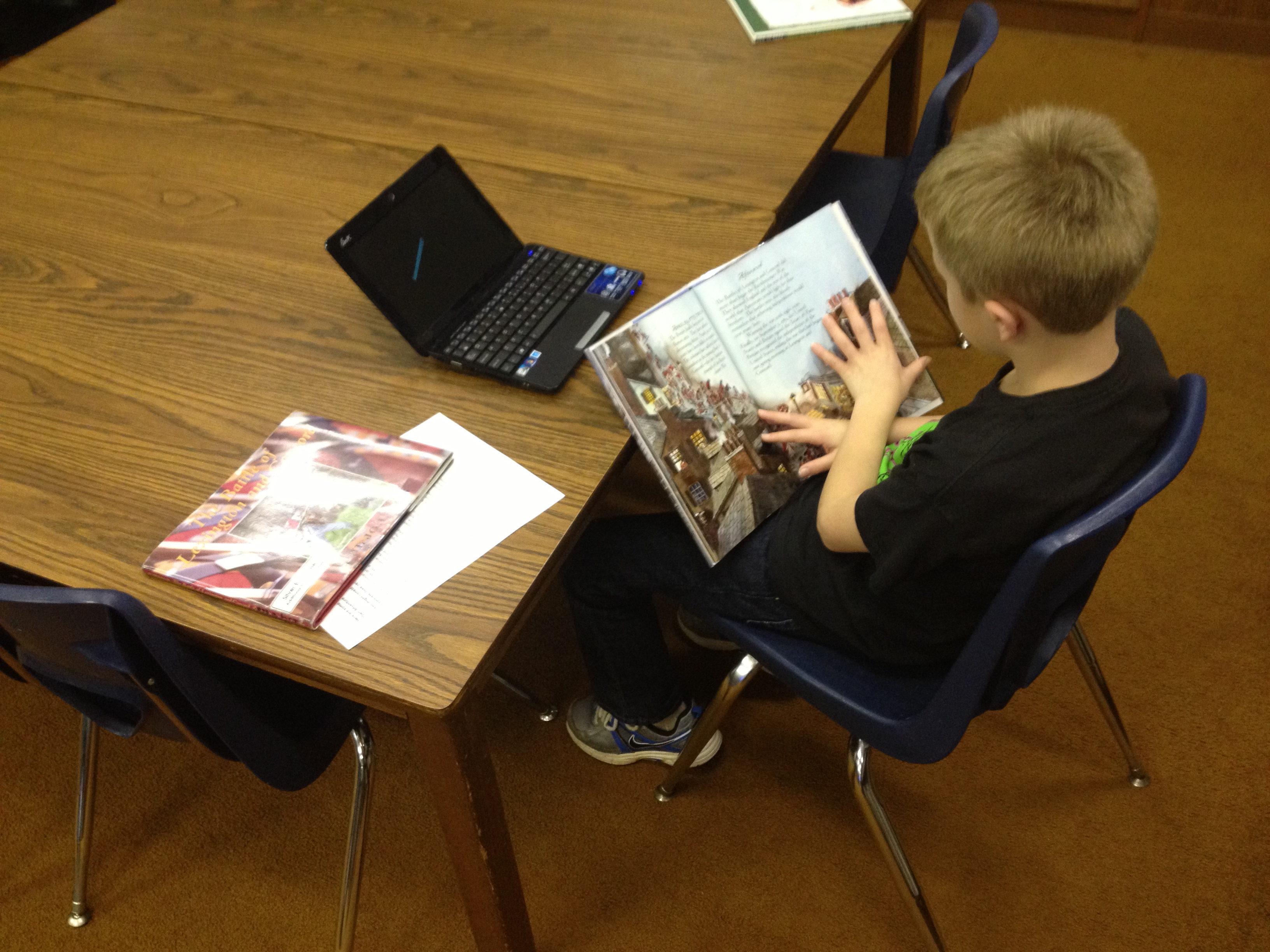 In all of the other sessions, students mixed research from books, websites, ebooks, and the research tool in Google Docs with actually creating their form. Students supported one another as they figured out things, but students also conferenced with me on their stories. About mid-way through their sessions, I had students go ahead and submit the link to their form to me. I used a Google form to gather all of their links. Then, I could easily check-in on students without disturbing their writing.
As I look back at what we’ve done so far, it has been a very messy process with lots of different kinds of learning going on simultaneously. If I had it to do again, I think it would be easier to start with a fiction story than weaving in history. Just making the structure of the Google form and getting it to work took a lot of time and students were also trying to research facts. When they moved to research, their skills at creating their forms were getting a little rusty. I think if students started with fiction where they could just make everything up, they could spend more time being creative and actually getting the form to work. We learned a lot about the process, and I definitely think that these students will be able to show others the steps it would take to create their own.
All of their stories are still works in progress, but you can try them out here:
Dmitri’s French and Indian War
Will’s Battle of Lexington and Concord
Lilli’s Battle of Lexington and Concord
Graham’s French and Indian War
Feel free to leave feedback on any of the stories as a comment and I’ll pass it along to the students to celebrate and improve their stories.

 Expect the Miraculous