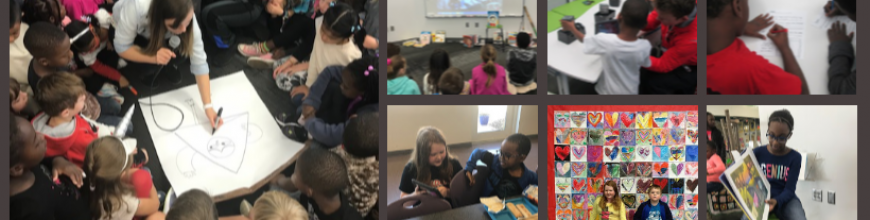
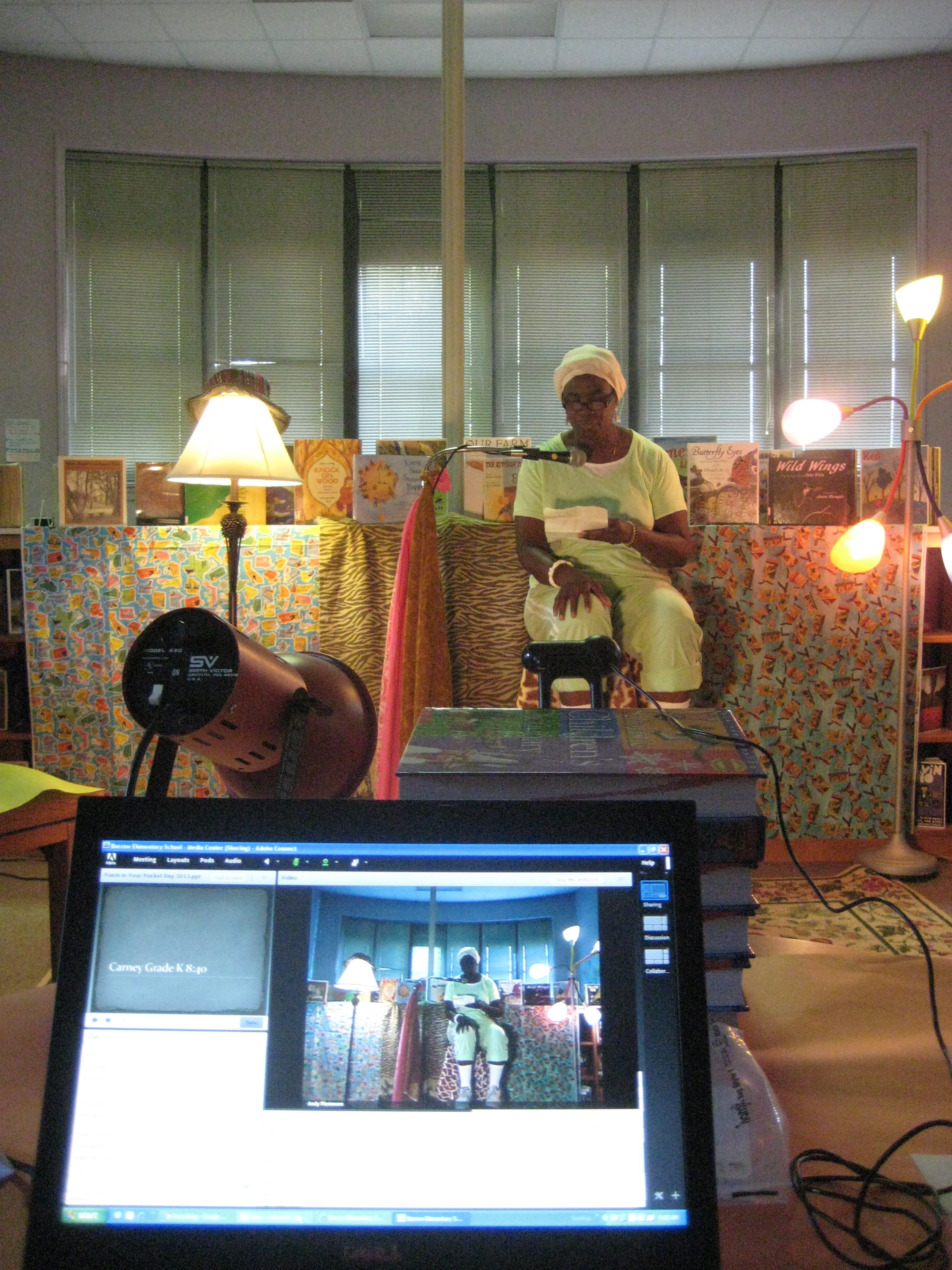
The official National Poem In Your Pocket Day is April 24 this year. Since this date is mixed into our state testing days, we celebrate a bit earlier at Barrow. Over the past few years, Poem In Your Pocket Day has grown into a 2-day event in our library. Every class comes to the library across 2 days. I setup the library like a coffee shop or cafe with a poetic atmosphere: tables with colorful tablecloths, lanterns, lighting, and a microphone. Each student steps up to the microphone to share an original or a favorite poem and we celebrate each poem with lots of finger snaps.
Also each year, we have been broadcasting our poetry reading live via Adobe Connect. This year we will continue this tradition. I’ve created a Smore to show our schedule and to have access to the login link.
To view our poetry readings, you simply visit the Adobe Connect link and sign in as a guest. You will see students reading their poetry and also have a chat window to leave comments for them. To spread the love of Barrow poems to the world, we also encourage you to tweet about our poetry using the hashtag #BarrowPoems We invite you to tune in to some or all of our readings. The schedule is packed for 2 whole days. Our students love knowing that they have a global audience listening and celebrating their poetry. We will see you next week!
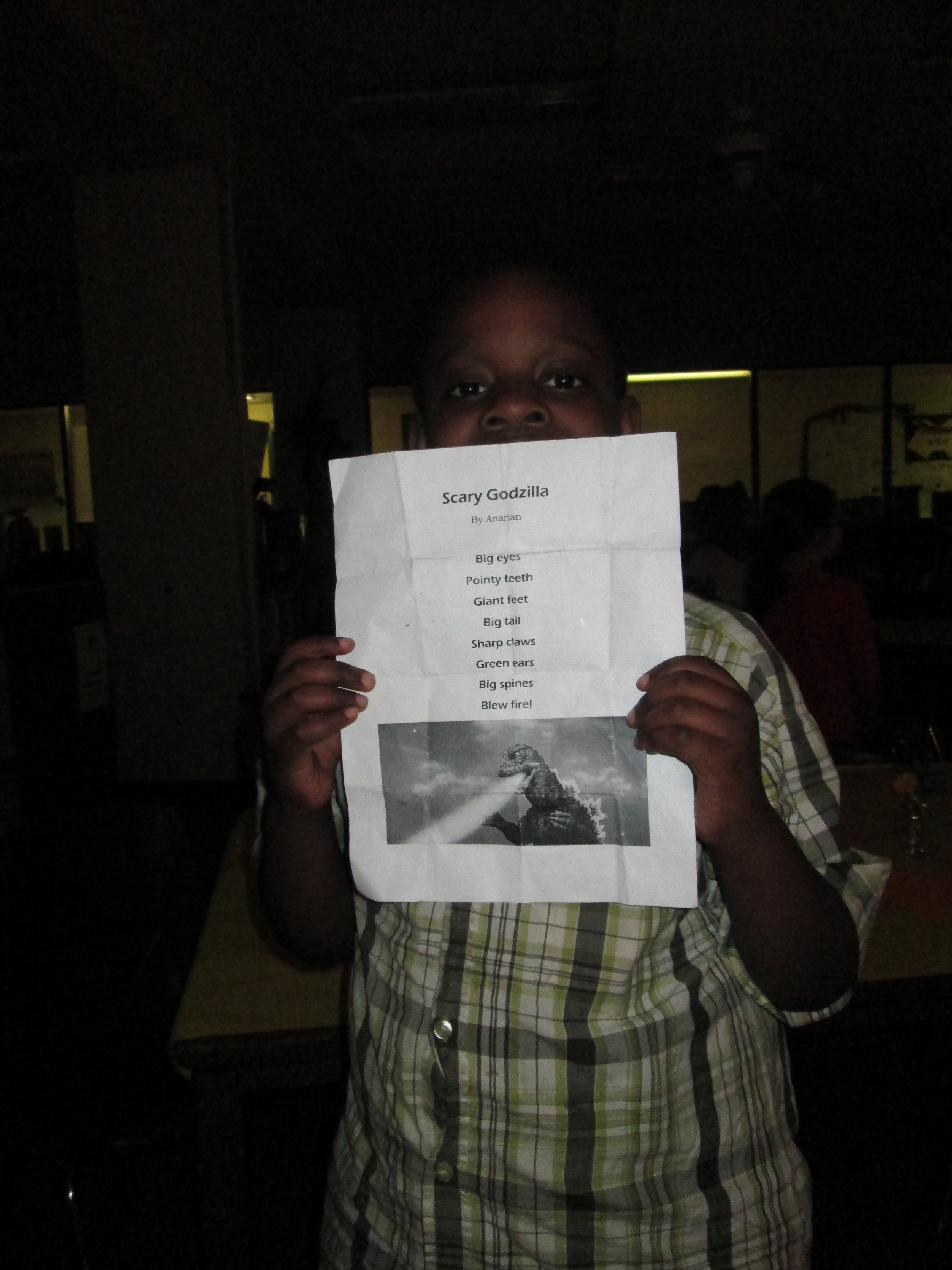
Yesterday, we had a great day celebrating poetry in our poetry cafe. It is truly amazing that almost every student in the school takes the time to get up in front of their peers (and the world) and read an original or favorite poem. Also, more amazing things happened today. Students volunteered to read poems for students who were too nervous to get up. A group of students logged into our Adobe Connect from their own devices and started leaving encouraging comments for peers. A student read a poem from a cell phone. A student made up a poem on the spot about not having a poem in his pocket. It was so much fun!
We had guests joining us online from: Athens GA, Valdosta GA, Randolph OH, Milton FL, Tucson AZ, Indiana, Richmond VA, Lexington KY, Kirkland WA, Belvidere IL, Fremont IA, Lawrenceville GA, Germany, Blue Ridge GA, Jasper GA, New London WI, Tampa FL, Vermont, Baton Rouge LA, New Mexico, and more.
You can enjoy all of the poetry sessions again by viewing the recordings below.
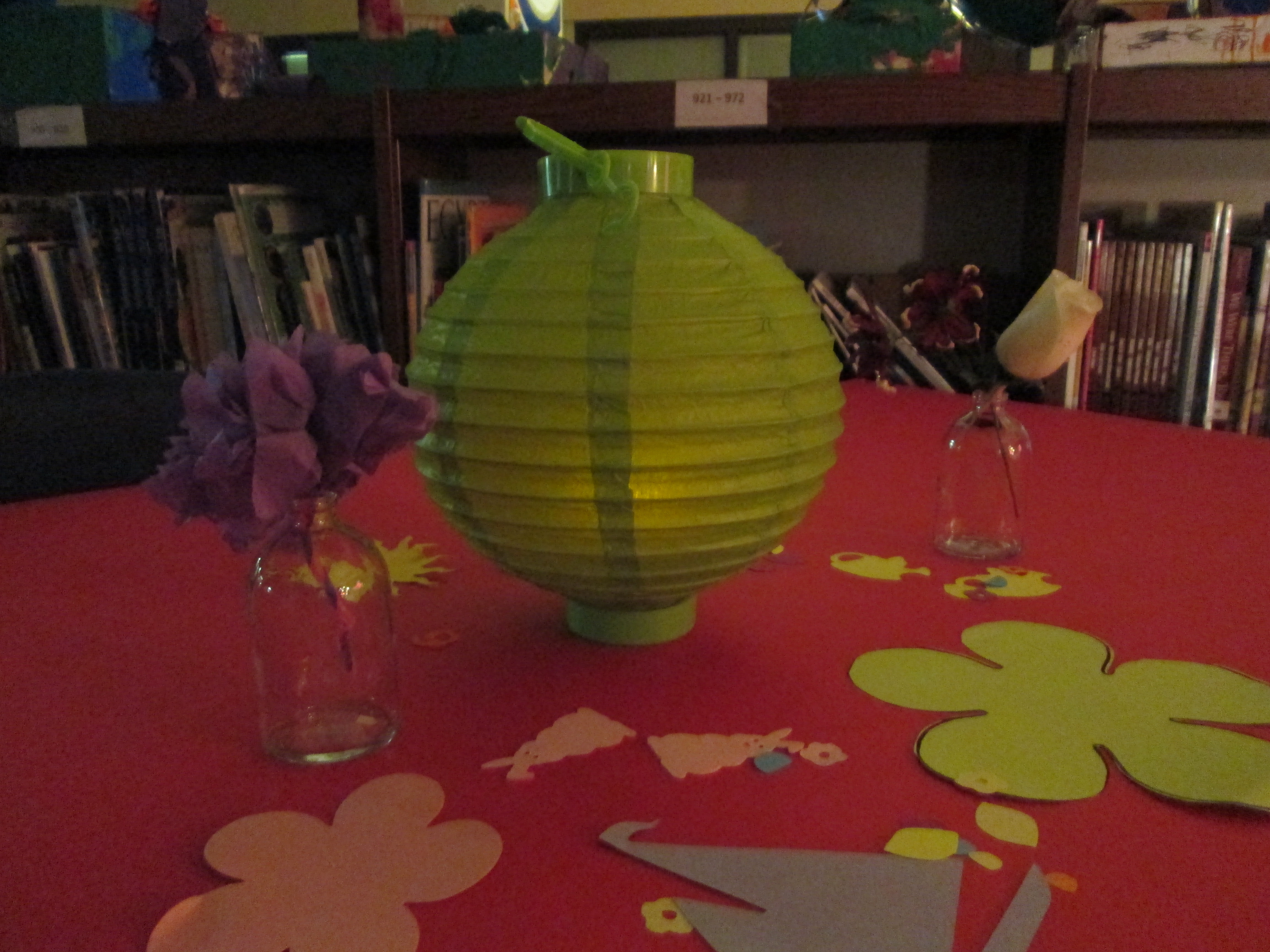
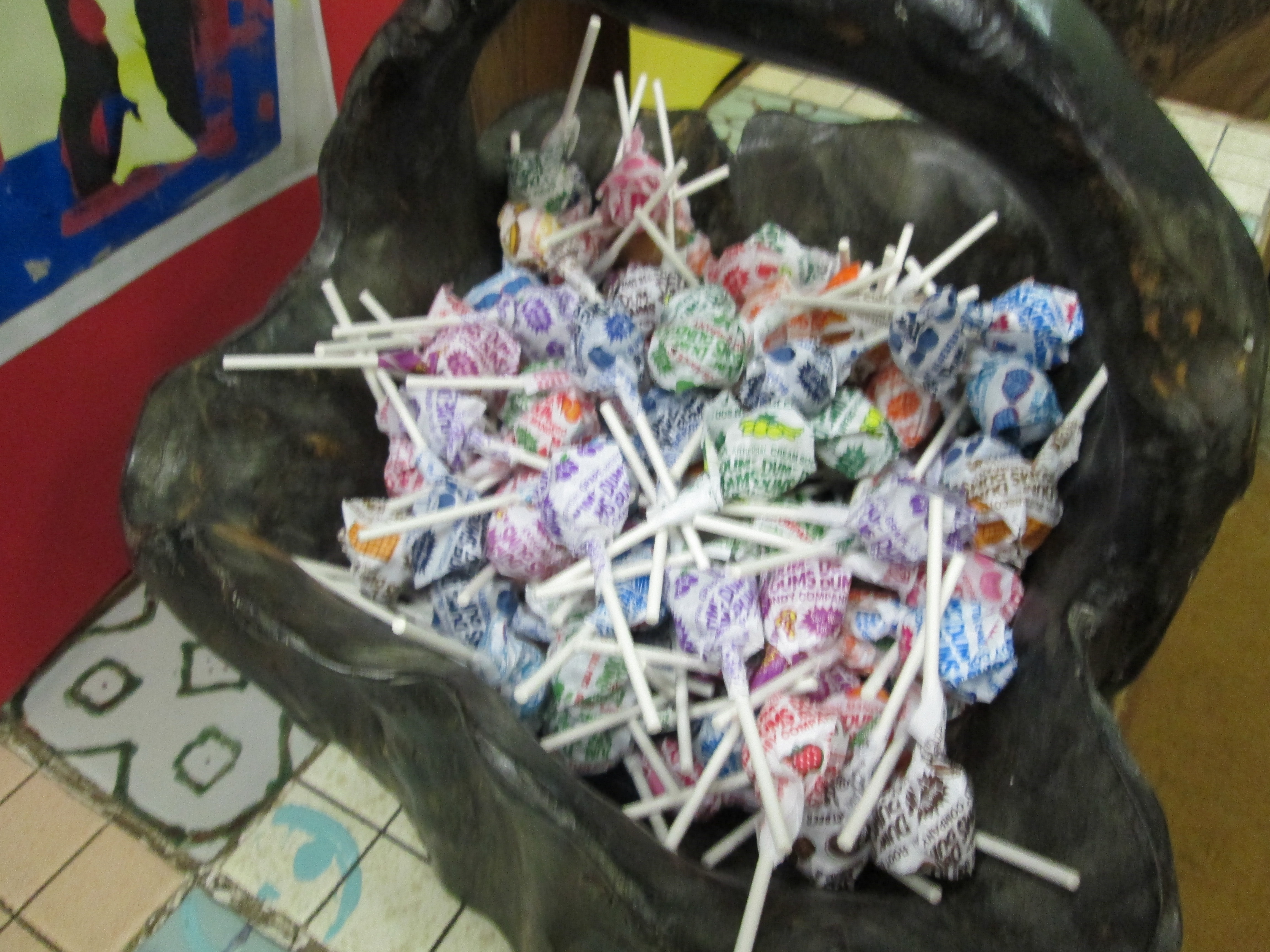
Today, the first classes came to read their poems in our poetry cafe. We broadcast the poetry readings via Adobe Connect. The room was setup with paper tablecloths, paper confetti, lanterns, and flowers in vases. The microphone was surrounded by fabric and lights with a poet step & stool to read from. Students read their poems and snapped to celebrate each reader. Each student got a lollipop when they left. We had online visitors from: Athens GA, Lexington KY, Buffalo NY, Hinsdale IL, UGA, Jasper GA, Cook County IL, Mason City IA, West Central MN, Bogart GA, Dacula GA, Hall County GA, Colbert GA, Gowrie IA, Fremont IA, and more.
As in the past, the comments from an authentic audience fueled the energy of the students. They loved hearing shout-outs about their poetry. An interesting thing that happened was that classes within our school were watching and students in those classes sent shout-outs to brothers and sisters. It was so sweet to hear words of encouragement between siblings. Thank you teachers for making that happen. Each year unexpected, wonderful things happen. This has become a day we all look forward to.
You can enjoy all of the readings again at the following links:
Each year for our Poem In Your Pocket Celebration I try to write a poem that somehow connects with what I love. This year, I had an idea. Since I have talked to the students so much this year about what I hope our library represents and how I want them to take ownership of the space, I thought it would be perfect for them to help me write about that. Also, I often hear adults telling students that “the library is a quiet place”. While that is true sometimes, it’s not really the kind of library that I think we have here at Barrow. Putting these 2 thoughts together, I created a Google form with some various stems about our library not being quiet: Our library is not a quiet place it’s a…, In our library you can hear…, In our library you can see…., In our library you can feel…
I emailed the form out to students and also sent it to teachers so that they could do it with their whole class. After lots of submissions, I went through and pulled lines to use in our poem. I used at least one idea from every entry that was submitted. The following poem is the one that I will carry in my pocket Thursday and Friday and read into the microphone to start each poetry reading session.
Shannon Miller and I have been trying to connect our 2nd graders again, but it has been such a challenge to find a time. Today I had a window of time that might work, and Shannon did her very best to make that time work for her students. With just an hour to spare, she got confirmation that the time would work. I quickly called my teachers who were on standby to come. I love the flexibility that these two 2nd grade teachers have with their students when it comes to unique, meaningful learning opportunities. Then, Shannon and I got to work fine tuning what we would do. We emailed, made a Google doc, and ended by Skyping with one another to fine tune the plan and plan other connections too.
Our planning sounded and looked something like this:
Shannon (at 11:00): My teachers can connect today at 12:00. Can yours?
Me (after a quick phone call to 2nd grade): Sure. This will be fun.
Shannon: What should we do during our connection?
Me (after roaming the shelves and thinking): How about doing a list poem? We could use “In My Desk” and write a collaborative poem. I’ll make a Google doc for us to type into.
Shannon: Sounds great. (Opens Google Doc and makes a colorful title for our poem using spell in Flickr)
10 minute Skype session to confirm plan, plan a K connection, and a future 2nd grade connection. (Walking to our next class, carrying our laptops, finishing our chat, and disconnecting)
During our Skype, I read the poem “In My Desk” by Jane Yolen, which can be found in the book Falling Down the Page: A Book of List Poems edited by Georgia Heard. I talked with students in both states about how we’ve probably all cleaned out a backpack, desk, or something else and found something unusual. We each pulled up the Google doc to show students.
Each of us turned down our sound and started getting ideas from our students and adding them to the doc. The room at Barrow was filled with energy as numerous hands shot up to give lines for the poem. The teachers and I helped students think about being more descriptive by adding adjectives and also really thinking about things that might actually make their way into their desks. As we typed, we also saw Shannon typing. This proved to be a great way for students to see how a Google doc could be used effectively. We even stopped to talk about how Shannon and I were not typing in the exact same space and how I did not delete or change any of Shannon’s work (a common problem we’ve seen with students collaborating at our school). This one skill will carry directly back to a Social Studies project our 2nd graders are working on.
While we were typing, Shannon tweeted the link to our doc so that people could begin seeing our poem as it was written. In seconds, we had 48 people viewing the doc, and the kids were beyond ecstatic. Knowing that they were immediately made into published authors with a real audience made them want to keep going. I think they could have made this the longest list poem ever, but we had to stop.
We ended our time by reading our final poem and laughing together at our shared words. This was so much fun. It may have been a lightning-fast collaboration, but it was filled with meaningful, authentic learning experiences for our students that will carry into many other kinds of learning this year and beyond.
By 2nd Grade Students at Barrow Elementary in Athens, GA
and Van Meter Elementary in Van Meter, IA
In our desks you will find…
one big folder
three dirty notebooks
my stuffed puppy
tiny crumbs
unfinished work
an old crumby lunchbox
two broken pencils
one moldy sock
a tree with a happy family
scraps of paper
one bright striped pencil case
two green and red notebooks
a ripped up paper
my art shirt that has a picture of a puppy on it
old, rotten, bruised banana
a piece of crusty meat
an old broken iPod
a rotten, smooshed up goldfish
a dusty box of crayons
a ripped up dictionary
some broken crayons
a sticky, green, watermelon lollipop
an old tooth that never got taken by the tooth fairy
For the past 3 years, the media center has hosted a poetry contest leading up to Poem In Your Pocket Day. The hope was that this contest would encourage students to carry and read original poetry rather than just a copied poem. Each year participation grows. This year, we had over 180 entries from students in grades PreK-5th grade. It is near impossible to choose just one winner in each age bracket. This year, we had 7 top winners. Each of these students earned a certificate, an autographed book or journal, and their poem featured here on our blog.
Over 60 other students earned certificates for poetry in several categories including: list poetry, science poetry, Where I’m From poetry, concrete poetry, acrostic poetry, feelings poetry, humorous poetry, story poetry, found poetry, and deep thinking poetry. These students had their names announced on BTV and earned a pencil, pen, bookmark, or other small prize.
I can’t wait to see how this contest grows, and I especially can’t wait to listen to all of the great poems read aloud at our annual Poem In Your Pocket Days this Thursday and Friday. Please join us! You can find the schedule here.
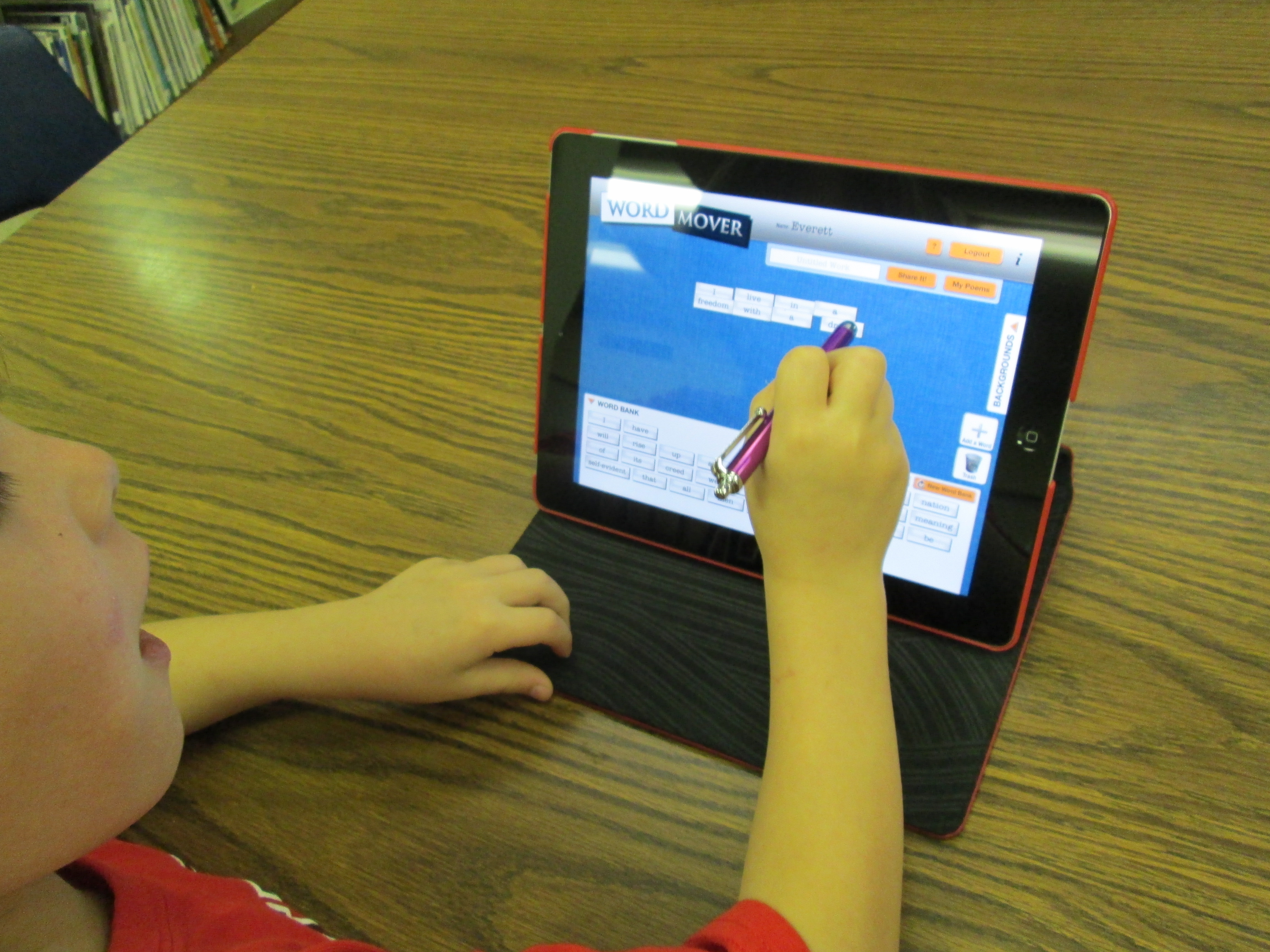
I always love collaborating with Ms. Hocking in Kindergarten. A few weeks ago, she shared a great iPad app by Read Write Think called Word Mover. It’s basically a magnetic poetry app. You can choose from a word bank or from several famous works such as the I have a Dream speech and America the Beautiful. In each word bank, you can also add your own words, change the font, and the color. You can also choose from several backgrounds to put behind your poem. Students drag the words in any order that they want to create their poem just like you would do with magnetic poetry on the fridge. Students give their poem a title and save it to the camera roll. From there, you can use the image however you want. Ms. Hocking plans to display the poems on her smart board during April.
This was a great tie-in to found poetry. We also talked about how you could walk the halls f the school and borrow words from the student work that is hanging on the walls in order to write a new poem. The Kindergarten class used this tool without a lot of instruction. Ms. Hocking and I walked around and helped students with questions. The most common help needed was being able to read one of the words. They really didn’t have problems using the technology.
We are so excited that National Poetry Month is already here! In just 2 weeks, we will be celebrating Poem In Your Pocket Days. On April 11th & 12th, students in every class will come to the library to our open microphone poetry cafe. The tables will be setup with tablecloths, lanterns, and poetry books. A stool and microphone will be available for students to come up and read their original and favorite poetry for their class to hear. Once again, we will be broadcasting all of this live online via Adobe Connect. This has become a very special event for students because they are able to get their writing and favorite poems out to a much larger audience. When people type comments in the chat feature of Adobe Connect, I always share those with students in the moment. It creates a big pulse of energy in the group. We’ve had family, friends, and other schools tune in from as far away as Afghanistan and England and as close by as the classroom next to us! We hope you will join us to listen to our poems and leave some comments. Here is the schedule:
Thursday April 11, 2013
Time
Class
8:30
3rd Shealey
9:00
1st Wyatt
9:30
1st Watson
10:00
1st Hart
10:30
4th Selleck
11:00
2nd Wright
11:30
4th Freeman
12:00
1st Stuckey
12:30
1st Em
1:00
2nd Brink
1:30
K Hocking
2:00
2nd Yawn
Friday April 12, 2013
Time
Class
8:00
5th Cross
8:30
K Carney
9:00
K Boyle
9:30
K Li
10:00
PreK Doneda
10:30
3rd Spurgeon
11:00
4th Olin
11:30
K Vertus
12:00
5th Slongo
12:30
PreK Clarke
1:00
2nd Ramseyer
1:30
3rd Griffith
To login to Adobe Connect, follow these instructions:
Enjoy listening to the poetry and type your comments for students in the chat box.
Leading up to the event, we are having an original poetry contest. All entries are due by this Friday and prizes/certificates will be awarded in multiple categories in PreK-1st, 2nd-3rd, and 4th-5th grades.
Students and teachers are also contributing to a crowd sources poem that I will carry in my pocket on Poem In Your Pocket Day called “Our Library is Not a Quiet Place”. They are submitting lines through a Google Form. You are welcome to submit lines, too. Just go to this link.
Fourth graders have been working on a poetry project for a few weeks now. The goal was to write poem based in the science standards of light and sound and incorporate figurative language. The teachers also wanted students to use some kind of technology for the project. I decided to use a tool called Thinglink because it allows you to take an image and make it interactive. You can put multiple related links on one image to create a transmedia experience, which means that the poem is experienced across multiple platforms. We thought students could explore their poem in different ways: informational text, video, image, and poetry text. Other options could have included song, online games, and ebooks related to the poem’s topic.
The sequence of lessons looked something like this:
Lesson 1: Look at onomatopoeia, simile, metaphor, and personification in several mentor poems and then do a poetry dig in poetry books to find more examples of that figurative language.
Lesson 2: Look at specific poems that focus on light and sound. Examine the science standards and the idea of “found poetry” so that students might incorporate language from the standard in their poem. Begin writing poems.
Lesson 3: Finish writing poems in Google doc and begin Thinglink project. This lesson took longer than we expected because students had to setup a Youtube Channel, create a Thinglink account, search for a creative commons image, and change the privacy setting on their Google Doc. We did this step by step together.
Lesson 4: Create a Thinglink. The goal was to have an image with links to the Google doc, a video of the student reading the poem, and links to informational sites about the topic of the poem.
This was a fun project, but because there were so many accounts to log in to, it made the progress slow down significantly. Students had a hard time remembering all of the steps that it took to login to multiple accounts at the same time and navigate back and forth between multiple tabs to get the links that they needed. I think it really opened our eyes to some skills we need to focus on at the beginning of the year in order to make projects like this successful.
As students finished their work, they submitted their poem in a Google form and I added it to our Smore webpage of interactive poetry images. Smore was very easy to use and a great way to collect and display a whole grade level’s work. As students submitted their links, I copied the link and then embedded it on the Smore page with one click. Then, on the Google spreadsheet, I highlighted the student’s name so that I knew I had already added their work.
I encourage you to take a look at the students’ work on our Smore page. We could have made this project much more complex, but it was a great first step. I think a second round of Thinglink would be much smoother.
We had more wonderful poetry readings today. We also had guests tuning in from India, Seattle, Chicago, Belvidere, Florida, North Carolina, and a media center in Lexington, KY. The students loved extending their listening audience and hearing their warm comments. You can listen to today’s archives at the links below:




























 Expect the Miraculous