Honoring Student Voices in the Library

Last year, I held the first Barrow Media Center Poetry Contest and was amazed by the response from students.  So many talented young writers entered their poetry into the contest that it was impossible to choose just two winners from each grade level.  Instead, multiple students were honored in a variety of categories.  One poem continues to stand out in my mind, and I copied it and held onto it for that very reason.

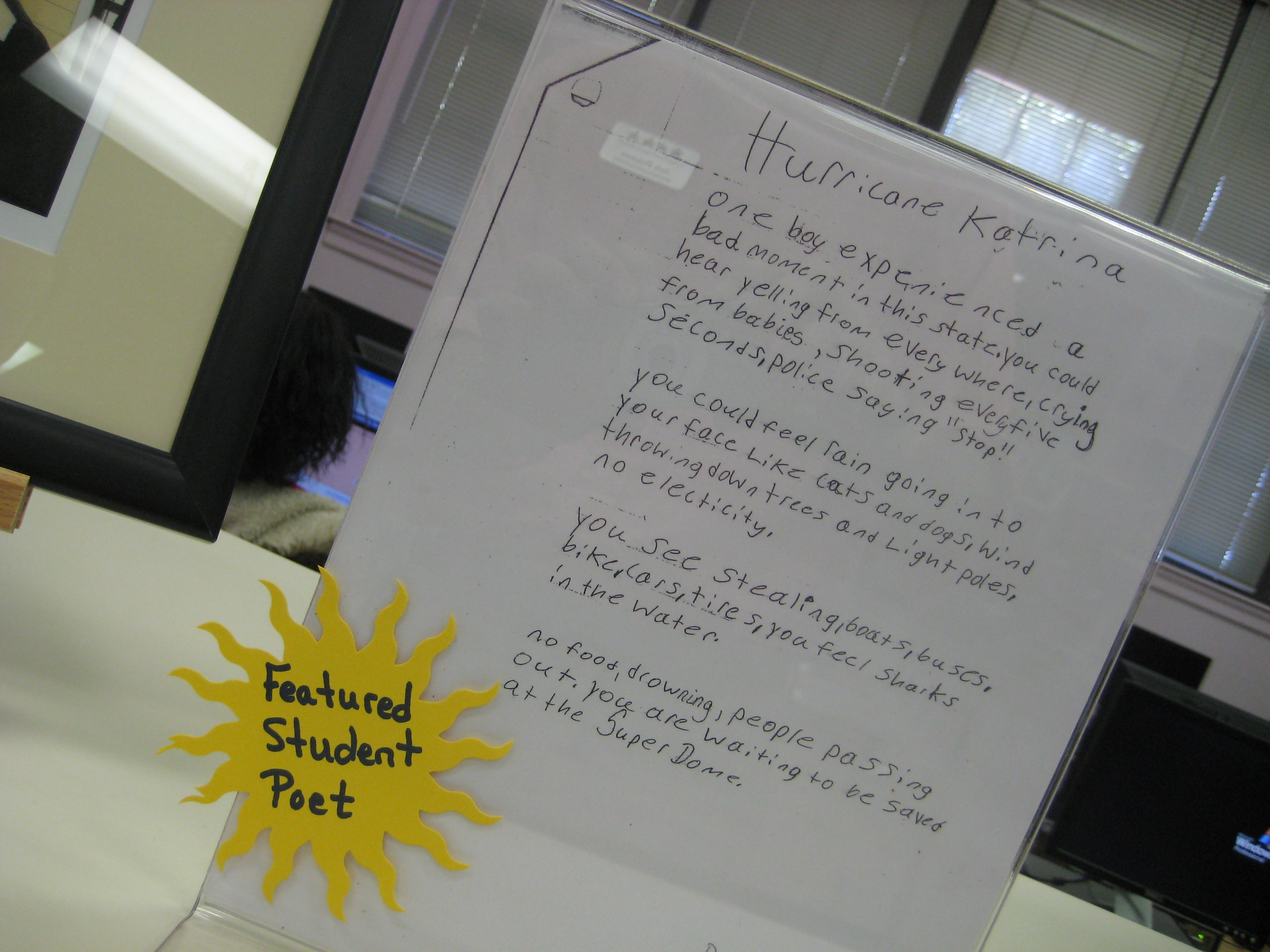
Hurricane Katrina

By David

One boy experienced a

bad moment in this state.  you could

hear yelling from everywhere, crying

from babies, shooting every five

seconds, police saying “stop”!

You could feel rain going into

your face like cats and dogs, wind

throwing down trees and light poles.

no electricity.

You see stealing, boats, buses,

bike, cars, tires,  you feel sharks

in the water.

no food, drowning, people passing

out.  you are waiting to be saved

at the Super Dome.

I can’t read that poem without getting chills down my spine.  I shared it with a group of educators this summer and we started a conversation about the importance of honoring student interests and voices as well as allowing students to write about the things that matter to them rather than assigning topics and requiring certain graphic organizers.  When David wrote this poem, he was very frustrated because he was supposed to be writing a poem about nature from a photograph that he took at school.  In my conferencing with him, I sensed his frustration at the graphic organizer in front of him and the topic he had to write about, so I flipped the organizer over and asked him to think about what mattered the most to him.

Because I know him so well from his media center visits, I know that he has a deep interest in hurricanes because of his experiences with Hurricane Katrina.  I suggested that he think about that.  His writing mood immediately changed and he proceeded to talk to me about everything he remembered about the storm.  While he talked, I made a list of his descriptions and handed them to him.  That was his organizer:  a brainstorm list.  With further conferences with his teacher, he crafted the poem above.
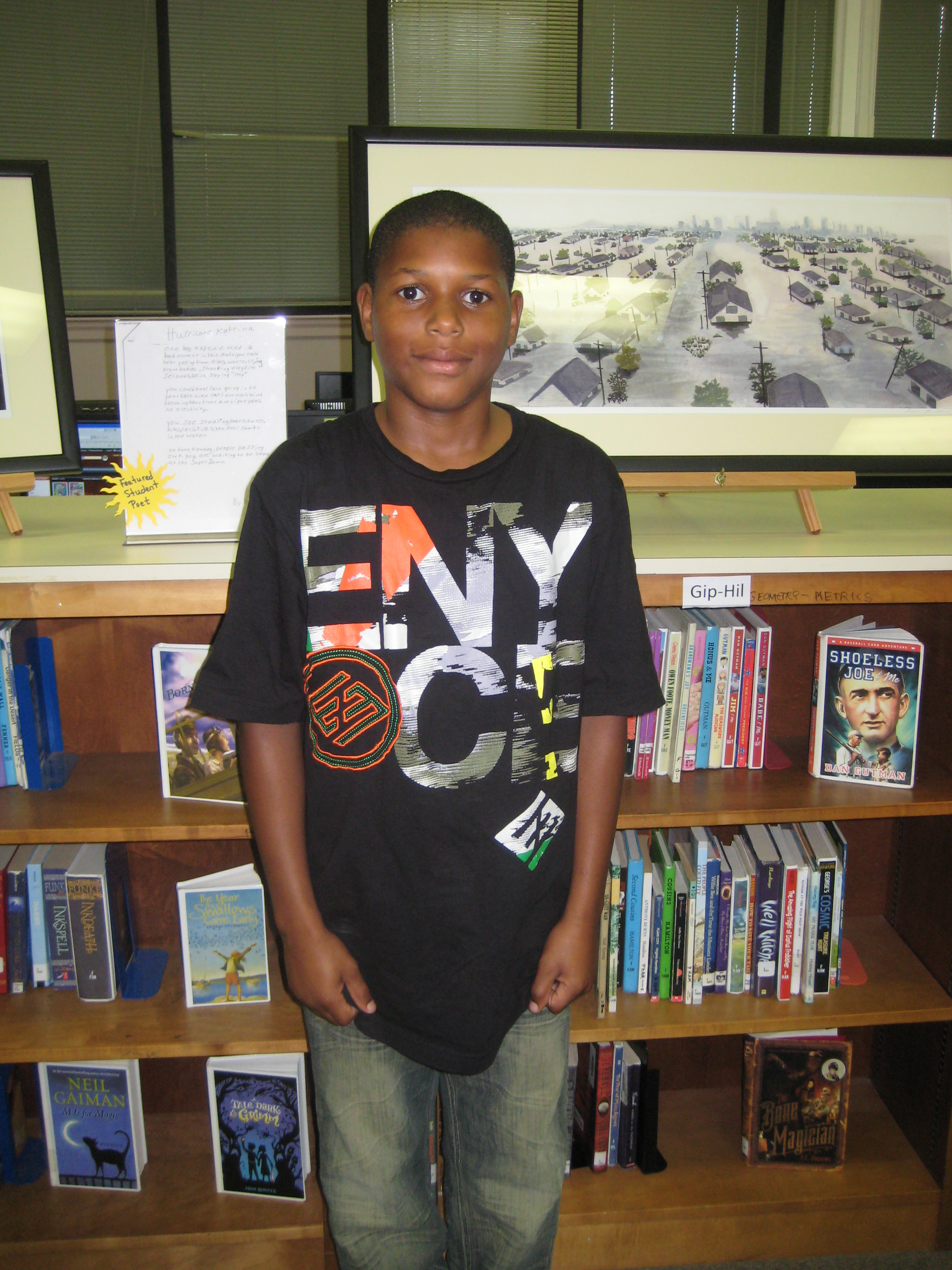
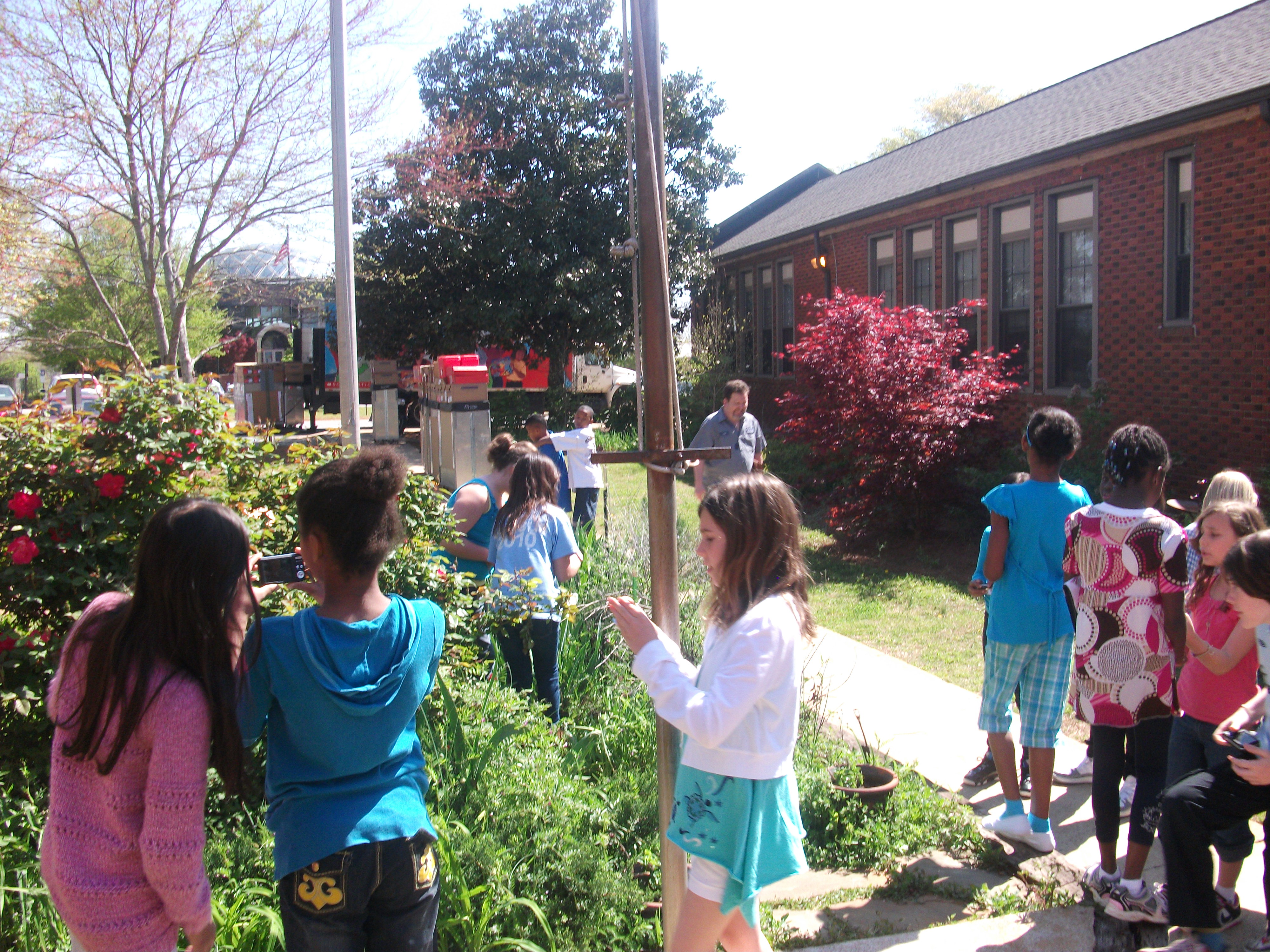
I’ve held onto that poem wondering if there was another way that his work could be honored, so I was so thrilled when our school was selected as the first stop of the Ashley Bryan Traveling Exhibit of Illustrated Africana Children’s Literature featuring the work of Shadra Strickland.  In the book A Place Where Hurricanes Happen written by Renee Watson and illustrated by Shadra Strickland, Watson shows the bond of 4 friends growing up in New Orleans and the stress and devastation that Hurricane Katrina put on their hometown and friendships.  The art exhibit on display in our media center through September 27 features 3 of Shadra’s illustrations from the book.  One depicts Adrienne and her Granny as they load into the car to head out of New Orleans.  Another shows the flooded streets of New Orleans with landmarks such as the Super Dome in the background.  Another features the joys of living in New Orleans and fixing jambalaya with family.  As I put the artwork on display, I thought, ‘This is the perfect spot for David’s poem’.  I pulled it out, rushed to his classroom to ask his permission, and had it on display by the end of the day for my first lesson using the exhibit.  It was so much fun to see the students flock to David’s poem at the end of the lesson when they toured the display.

This morning, David came up to the library to checkout books, but he also wanted to see his poem sitting on the shelf next to Shadra’s illustrations.  “She does really good work”, he said.  I could tell how proud he was of seeing his poem on display.  
I want to continue to seek opportunities for students to display their work in authentic, meaningful ways in the media center.  This seemed so simple and easy to do, but it meant the world to this student.
Joyce Sidman Poetry Study

An amazing opportunity came through my email a few weeks ago when Jennifer Graff, co-chair of the Children’s Literature Assembly Breakfast at NCTE, was looking for student poetry inspired by Joyce Sidman, the keynote speaker at the breakfast.  I immediately agreed to work with students on a poet study because Joyce Sidman is one of the poets that most inspires me as a writer.

I sent out an email to teachers with possibilities for this study.  Here were some options:

  • Read Red Sings From the Treetops: A Year in Colors and write poems about colors in the various seasons
  • Read Ubiquitous: Celebrating Nature’s Survivors and write poems and informational text about things in nature that have survived the test of time
  • Read Dark Emperor & Other Poems of the Night and write poems and informational text about plants and animals of the night
  • Read multiple books by Joyce Sidman and write poetry that was inspired by the elements of her poetry

Each one of these options could involve multiple forms of technology or be done with paper and pencil.  So far, one teacher has completed a Joyce Sidman collaboration with me and another has signed up to begin in late April.

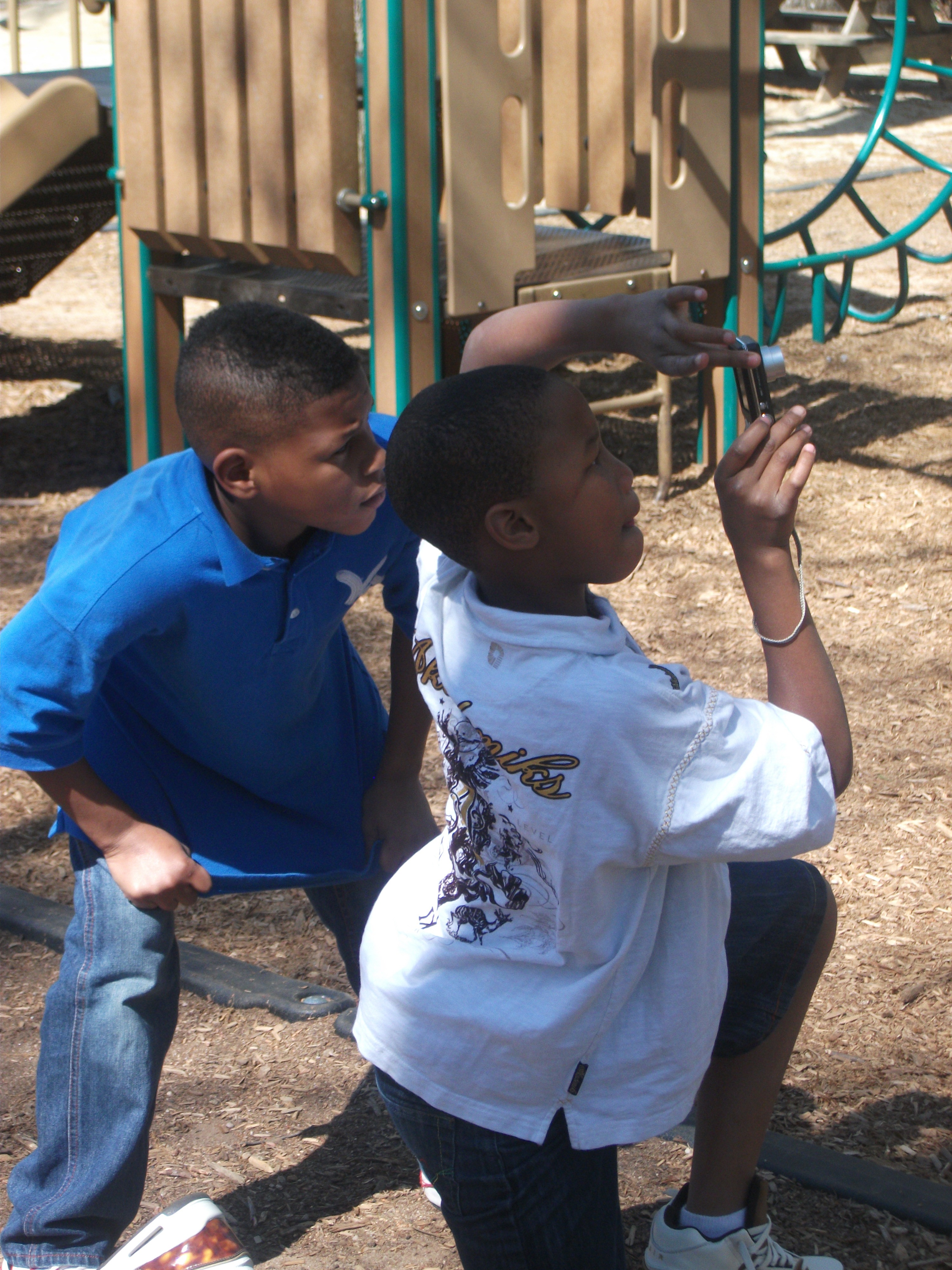
I collaborated with Ms. Olin, my former paraprofessional and now student teacher, to read multiple poems from Joyce Sidman’s books and talk about “noticings” from each of the poems.  We looked at things like similes, repetition, rhythm, shape, form, word choice, and more.  Students decided to write poems about nature since much of Sidman’s work is nature and science based.  They took photographs of flowers, trees, and other nature around our school and also searched on Creative Commons for images.  Students wrote poems at the media center tables and conferenced with me, Ms. Olin, Ms. Biehl, and their teacher, Mrs. Selleck.   Finally, students used Photo Story to import their pictures, add text and music, and record their voices reading their poems.

These poems and others created in the coming weeks will be played at the Children’s Literature Assembly Breakfast at NCTE in Chicago.  I’m so excited that our students’ work will have this authentic audience to appreciate their creative endeavors.  You can get a sneak peek at some of the poems by clicking these links.

This slideshow requires JavaScript.

Book Spine Poetry 2011

Two classes have come to the media center so far to create book spine poetry.  I got this idea last year after reading the 100 Scope Notes blog.

To make a book spine poem, you arrange a stack of books so that the titles create a poem.  Each title of a book becomes a line in the poem.

In my lessons, we’ve done some examples together and listened to past examples from classes.  Students get in groups of 3 and wander around the media center browsing the shelves for interesting titles that seem to fit together.  Once they make their decisions on 3-5 books, they pull the books off the shelf and arrange them in a stack.

Stacks of books go to tables and a teacher helps students take a picture of their stack.

Next students bring the camera to a computer where another volunteer helps them download the picture into a class file.  Students then find a space to practice reading their poem aloud.

Once ready, students come to me and use Photo Story 3 to record themselves reading their poem.

When students finish checking out, they sit on the carpet to hear their final product.

Enjoy listening to one of the book spine poems here.

Mrs. Brink’s Book Spine Poem

Mrs. Yawn’s Book Spine Poem

This slideshow requires JavaScript.

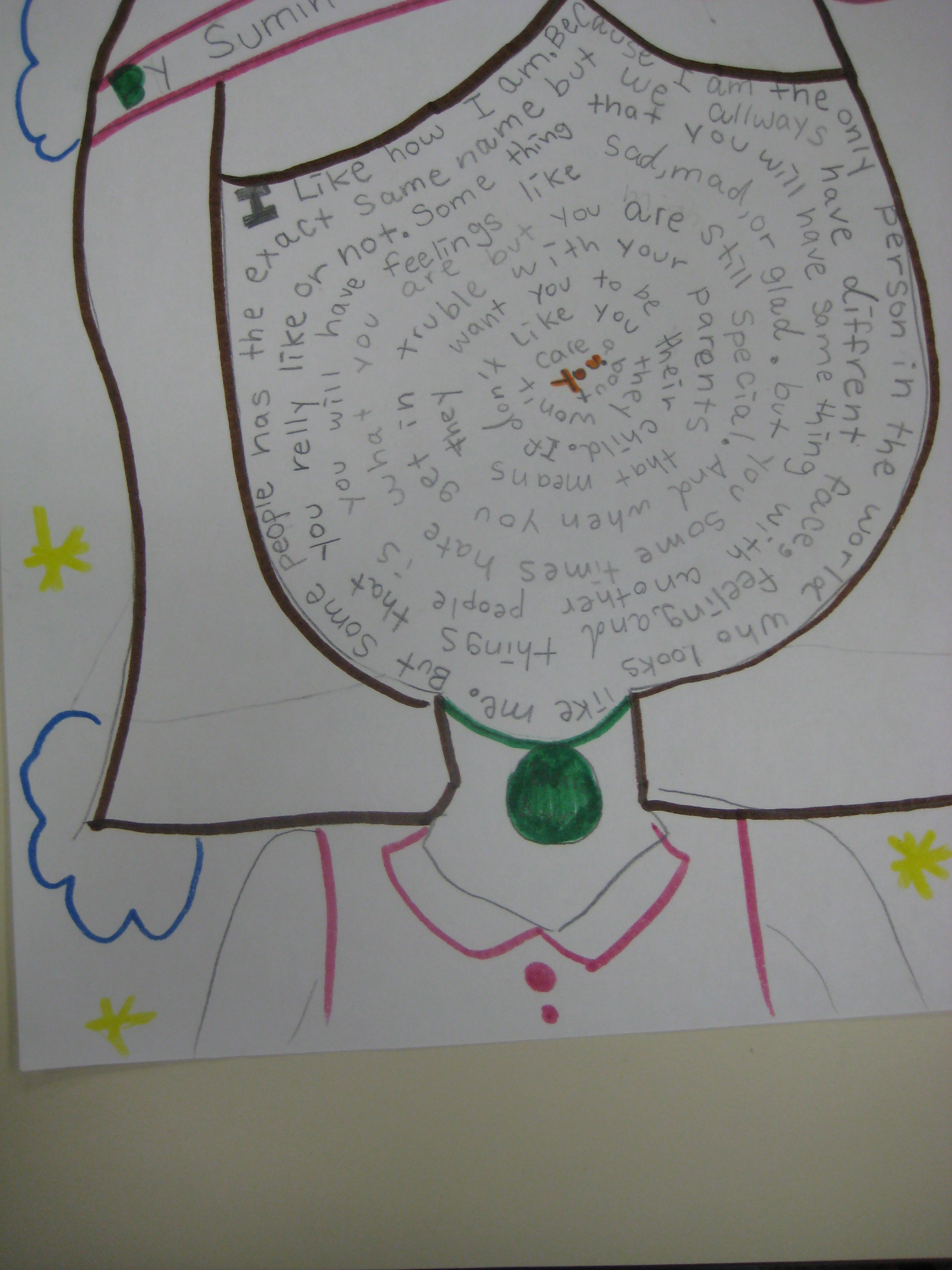
Autobiographical Poetry: A 5th grade collaborative art project

The art teacher, Mrs. Foretich, and I love to collaborate with one another.  Recently, we wrapped up a collaborative unit focused on digital photography, using technology to transform a photograph, and autobiographical poetry.

Students spent 2 days rotating through a center taught by Mrs. Foretich taking digital pictures of themselves and using Picnik.com to edit their photos and center taught by me about the many elements of poetry including personification, similes, strong verbs, and repetition.  Then students spent 2 sessions in a writing workshop using their photograph to write an autobiographical poem that included some of the poetry elements learned in my center.  Students typed their poems in word and printed them.

Mrs. Foretich had all of the student images printed at Snapfish, and she mounted these pictures on matting board.  Now, an amazing display sits atop the shelves of the media center.  Today was the debut, and students and teachers have been reading the poems all day.  If you can’t stop by the media center during poetry month, take a moment to view the pictures of the display and watch a video tour given by two students, Maggie and Delia.

This slideshow requires JavaScript.

Happy Poetry Month 2011 « Georgia Library Media Association

Happy Poetry Month 2011 « Georgia Library Media Association.

PreK Shape Poetry

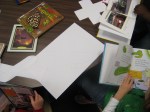
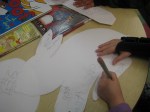
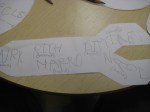
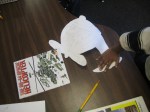
Today was lesson 2 in a 3-part collaboration with Ms. Spurgeon’s PreK class.  Last week, we read multiple examples of shape poems and wrote a model poem as a class.  Today, students focused on writing their own poems.  To prepare, Ms. Spurgeon and her parapro, Ms. Melissa, drew large shapes for each student and cut them out.  These shapes were the symbols that each student uses in class to label various belongings.  Each symbol has come to have special meaning to each student.  I pulled nonfiction and fiction books related to each symbol so that students could reference the books for words to put inside their shapes.

I opened today’s lesson by reading a poem from Joyce Sidman’s Meow, Ruff: A story in concrete poetry.  I used this as a reminder to students that the words that go inside the shape must somehow represent the shape.  Ms. Spurgeon and I found that it was a common mistake for students to want to put whatever words were in their heads instead of focusing on their shape.  She reiterated my opening by sharing a poem that she wrote about chocolate and reminding students that all of her lines were about chocolate.

Next, students each received the books about their symbol and proceeded to 3 work spaces where the pre-cut symbols were already out at chairs.  Ms. Spurgeon, Ms. Melissa, and I each went to these areas and sat with students as they worked.  Students began by looking through their books for ideas from the pictures or reading the words with adult assistance.  As they decided on words, students sounded out words and wrote their words inside the shapes with their best handwriting and spelling.  Next, students read their lines to an adult and the adult wrote the correct spelling of each word in parentheses.

Ms. Spurgeon will continue this lesson by giving students time to finish their poem and add color to it.  They will also practice reading their poems before part 3.  The last part of this collaboration will be recording each student reading his/her poem on camera and sharing those videos on Teacher Tube.

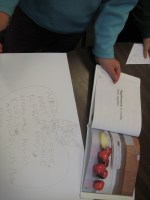
I was surprised by how helpful having books about their symbols was for the students.  Many got ideas from the pictures and several even used direct words from the text.  For example, one girl wrote a poem about rabbits.  In the picture, she got so excited when she saw that the rabbit’s ears were going down.  This turned into a line in her poem that was actually written on the rabbit’s ear.  Another student read her books about apples with Ms. Melissa.  She took facts such as “apples can be made into applesauce” and “apples are mostly harvested in the fall” and used pieces of those lines in her apple shape.

I’ll be sharing more about our media center’s support of poetry writing in the coming days and weeks.

Poetry Lessons 2011

Poetry Month is already in full swing in the Barrow Media Center even though it’s still March.  I’ve found that April gets shortened due to testing, so we start celebrating poetry early.  Classes at every grade level are signing up for various kinds of lessons from now through April.  Some lessons are done in a single session while others span 3-4 lessons.  Here are some of the lessons coming up:

  • Overview of multiple kinds of poetry
  • Book spine poems
  • List poetry
  • Shape poetry
  • Poetry and photography
  • Joyce Sidman poet study
  • Animoto and Photo Story poems

Yesterday, Mrs. Yawn’s class came to learn about many kinds of poetry and we explored a list poem together.  After using poems from the book Falling Down the Page collected by Georgia Heard, students wrote  a list poem together.  Every student thought of an object that was in their pouch in the classroom (the place where they keep their stuff), and they shared their line with a partner in order to give each other feedback to make the line more descriptive.  Then, I went around to every student and typed their line into a poem that we then read together.  I printed a copy for the class and a copy to display in the media center.

In PreK, Ms. Spurgeon and I are studying shape poetry with her class.  We explored many examples of shape poems in books such as A Poke in the I, A Curious Collection of Cats, and Doodle Dandies. Then we wrote a shape poem together about a flower.  Next, I’m going to their classroom to lead a writing

workshop where they will write their own shape poems.  Each student has a symbol that represents them that is used to label things in the classroom.  Each student will write a shape poem about their symbol.  Ms. Spurgeon is preparing chart paper with symbols already drawn on them, and I’m gathering nonfiction books that are about each student’s symbol.  These books will be a source for gathering words about the symbols.  On writing day, Ms. Spurgeon, the paraprofessional, parent volunteers, and I will sit with students to conference and assist as they write.

Finally, we’ve just kicked off our poetry contest.  Every student in the school is invited to submit a poem and prizes will be awarded in PreK-1st grade, 2nd-3rd grade, and 4th-5th grade.  Poems can be any form, can be short or long, and must be original.  Students can submit poems in any format:  a piece a paper, on a napkin, a digital file in my drop box, or anything else they can think of.

I’ll be sharing more about poetry in the media center over the next month.  If you have great things going on in your own library, or if you have a poem to share, feel free to leave a comment.

Kindergarten Poem: A Book Is….

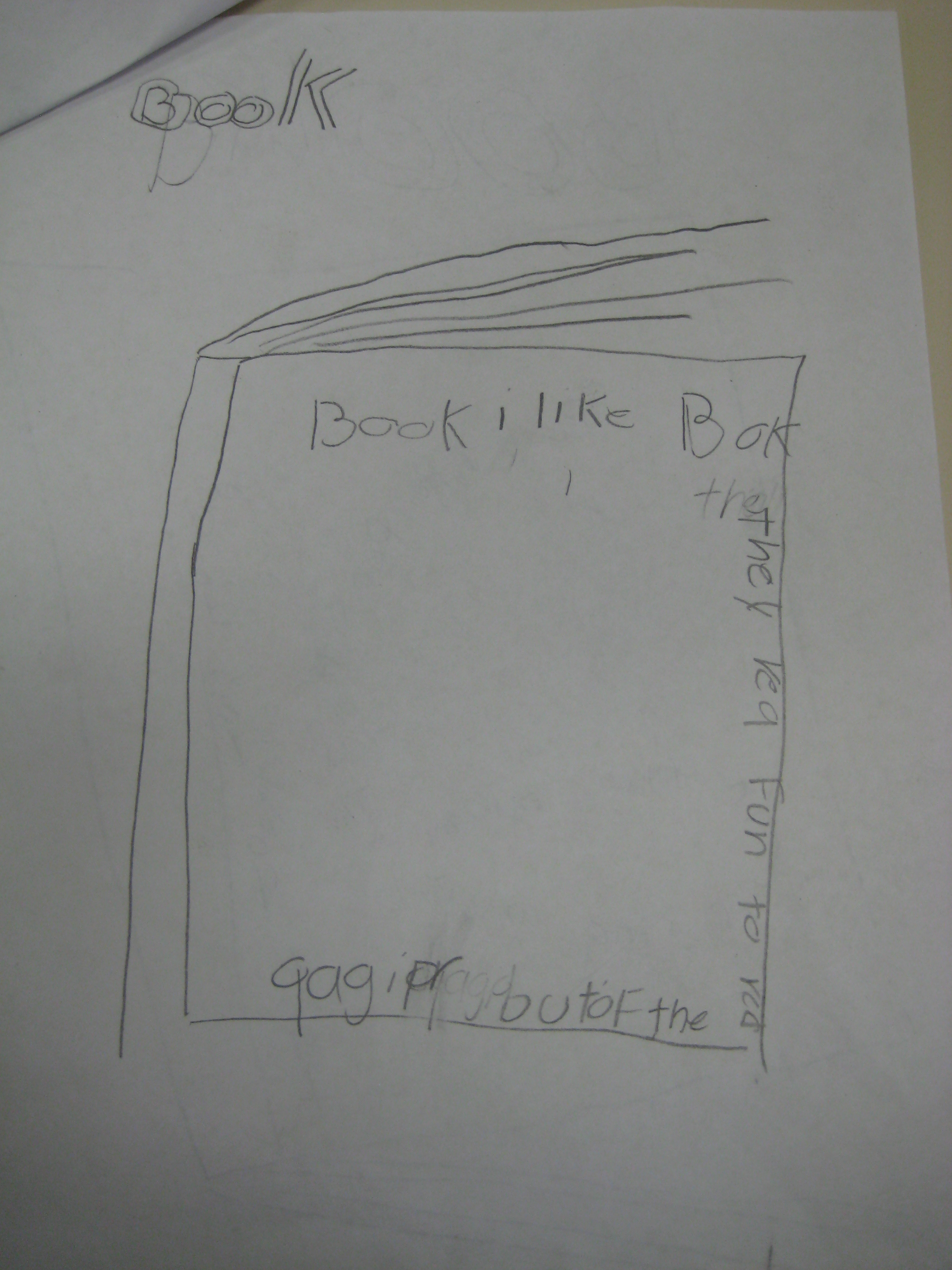
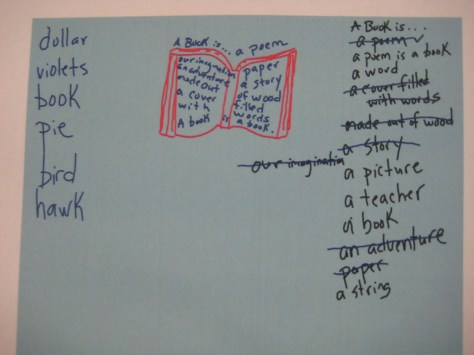
poetryMrs. Carney’s class came to the media center today and studied concrete poetry. Concrete poetry takes on the shape of what it’s about. As a class, we created a poem about a book. Although the version in this blog doesn’t look like a book, our poem that we wrote together on the Smart Board filled the shape of a book (see the picture in this post).   To write this poem, we read lots of concrete poems.  Then, the students brainstormed possible topics.  After choosing “book” as our topic, we made a list of possible lines.  Finally, we chose lines from our list to include in our poem.  Enjoy!

A Book Is…
By Mrs. Carney’s Class

A book is…

a poem
our imagination
paper
an adventure
a story
made out of wood
a cover filled with words
A book is…
A book!