Book Spine Poetry with Tellagami (Day 1)

IMG_2872Poetry month is one of my favorite times of year because I’m always inspired by what kids come up in their writing.  I love that with poetry you can try so many different kinds of writing in a short amount of time.

Each year, we usually have several classes explore book spine poetry.  If you’ve never heard of it, book spine poetry is a type of found poetry where you use the spines of books as the lines in your poem.  In the past, we’ve used digital cameras to take pictures of our stacks of books and Photo Story to put those pictures together and record our voices.

This year, I really wanted to try something new.  I decided to try Tellagami since you can take a picture as your background image, record your voice for up to 30 seconds, and create an avatar to be the narrator of your poem.  I may try some other tools, too, but this one seemed like the best to start with.

Today, Mrs. Brink’s 2nd grade class was my first book spine poetry class of the year.  Right before they came, I walked through the process of making a book spine poem myself and recording a Tellagami.  Here’s how mine turned out.

We started our quick mini-lesson on the carpet by talking about what a found poem is.  Then, we used several Google and twitter images of book spine poem examples.  Some of my favorites are from my friend, Jennifer Reed, librarian in MA.  I love this one.

We spent a little time noticing things about all of the poems.  For example, we noticed how some of them stuck to a particular theme or some started with a main line at the top and then other lines seemed to support the first line.

Then, I told the students the story of how I made my own poem.  I started with Joyce Sidman’s What the Heart Knows.  Then, I walked around and looked at books that were sitting on the tops of the shelves to see if any of them had a title that showed what my heart knows.  I was amazed at how many of them did!  It only took me about 5 minutes to find my stack of books and another 2 minutes or so to make my Tellagami.

The students were ready and eager to get started.  I really try not to give them too many rules, but we did go over a few things to think about:

1.  Spend some time walking and looking without taking books off of the shelves.

2.  Find a book title that speaks to you that might make a good starting place and then start thinking aloud about your poem with your group.

3.  Try your best to use each book you pull from the shelves.  We spent just a few seconds thinking about what would happen if 22 students starting pulling every book that they saw from the shelves.
IMG_2874

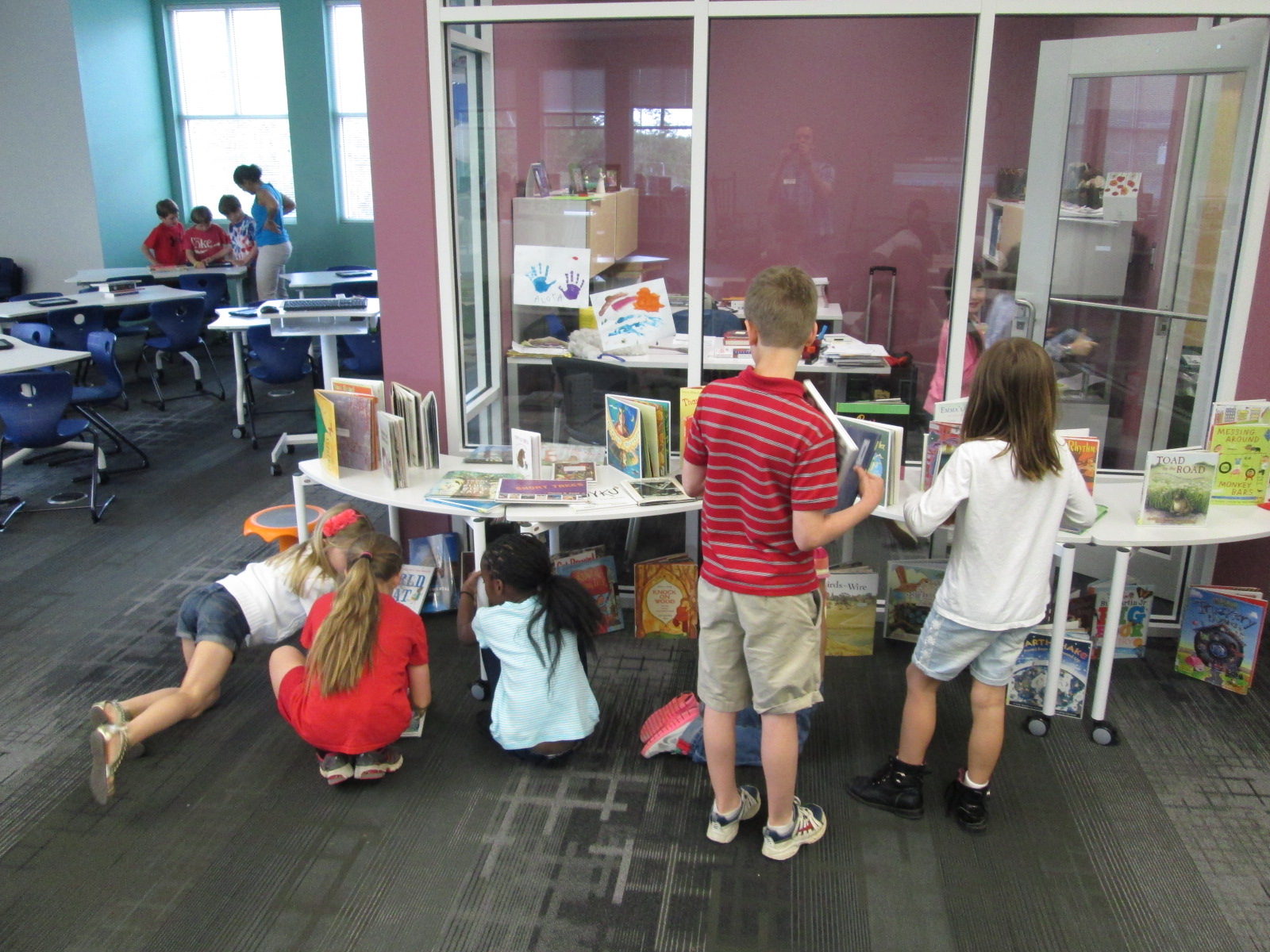
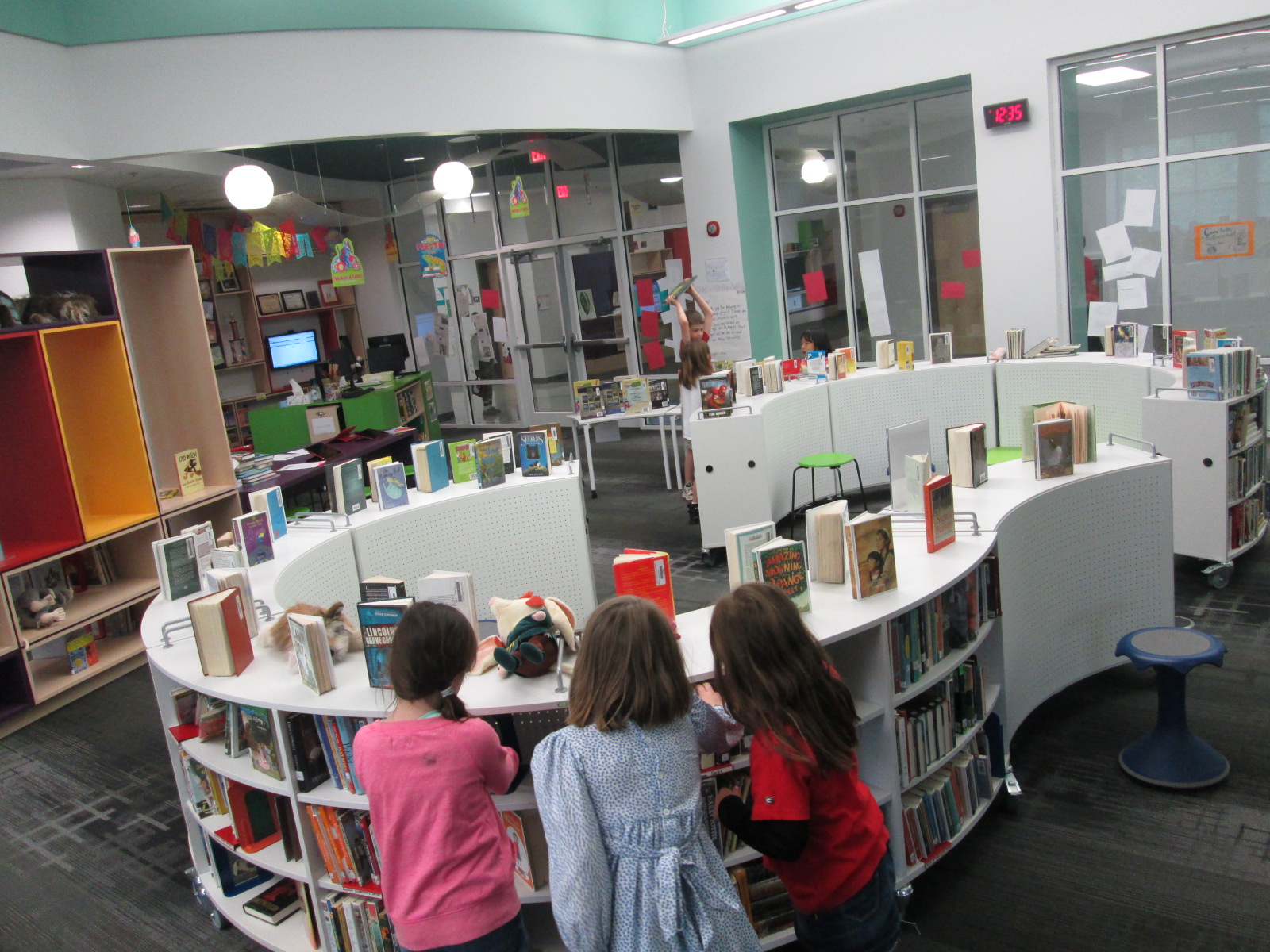
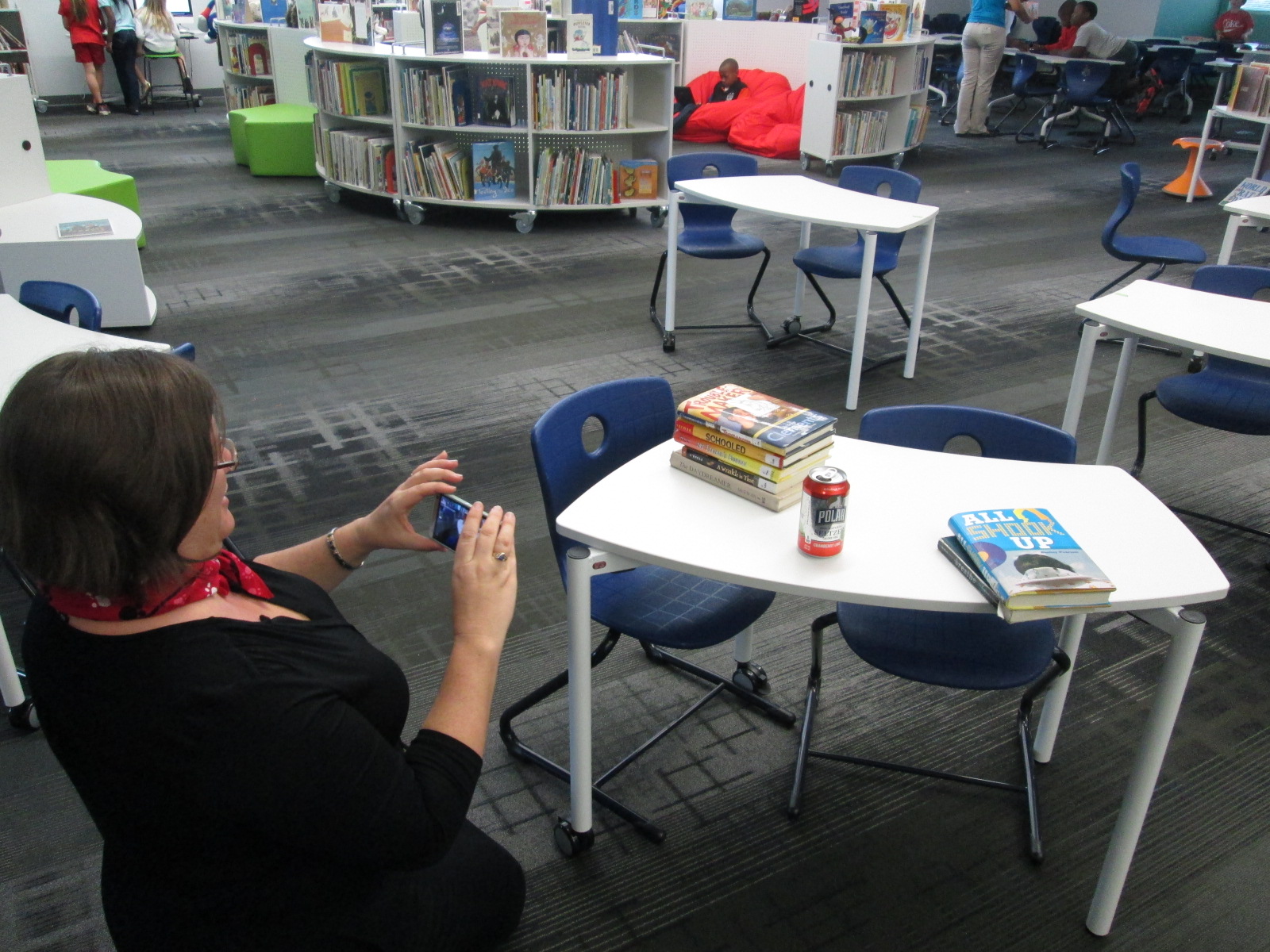
I designated different work areas of the library.  Single tables were setup in the middle of the library for students to bring books to and sort them into their poem.
IMG_2876

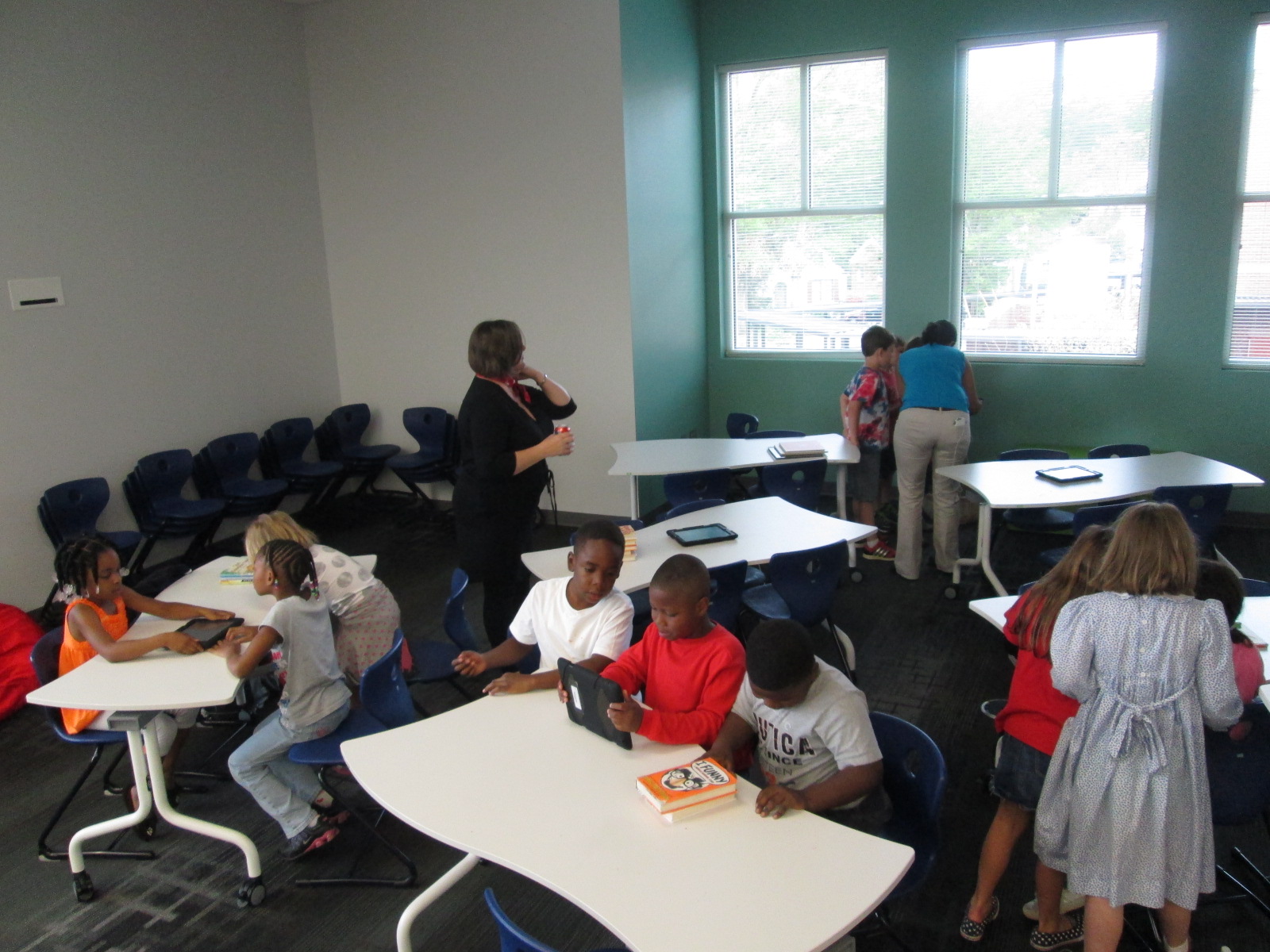
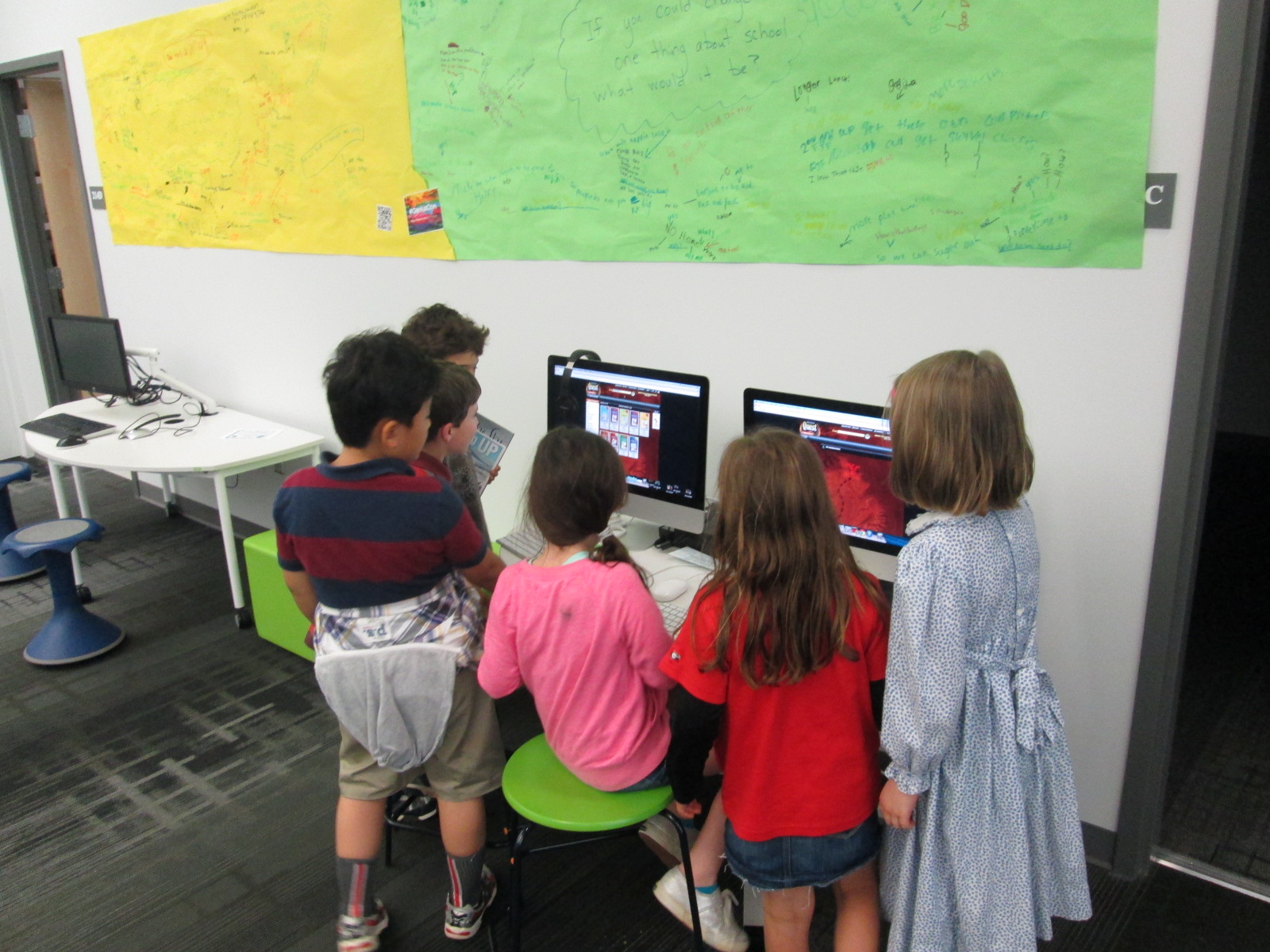
Another section of tables had iPads ready for creating Tellagami projects and taking pictures.  I did not spend time teaching students every step of how to use Tellagami because I knew they could figure this out.  However, I did have Carol Buller-McGee, a graduate assistant, with me today, and she stayed at the iPad tables to assist students.

My office, equipment room, makerspace room, and storage room were available for students to go to and record their projects.
IMG_2867

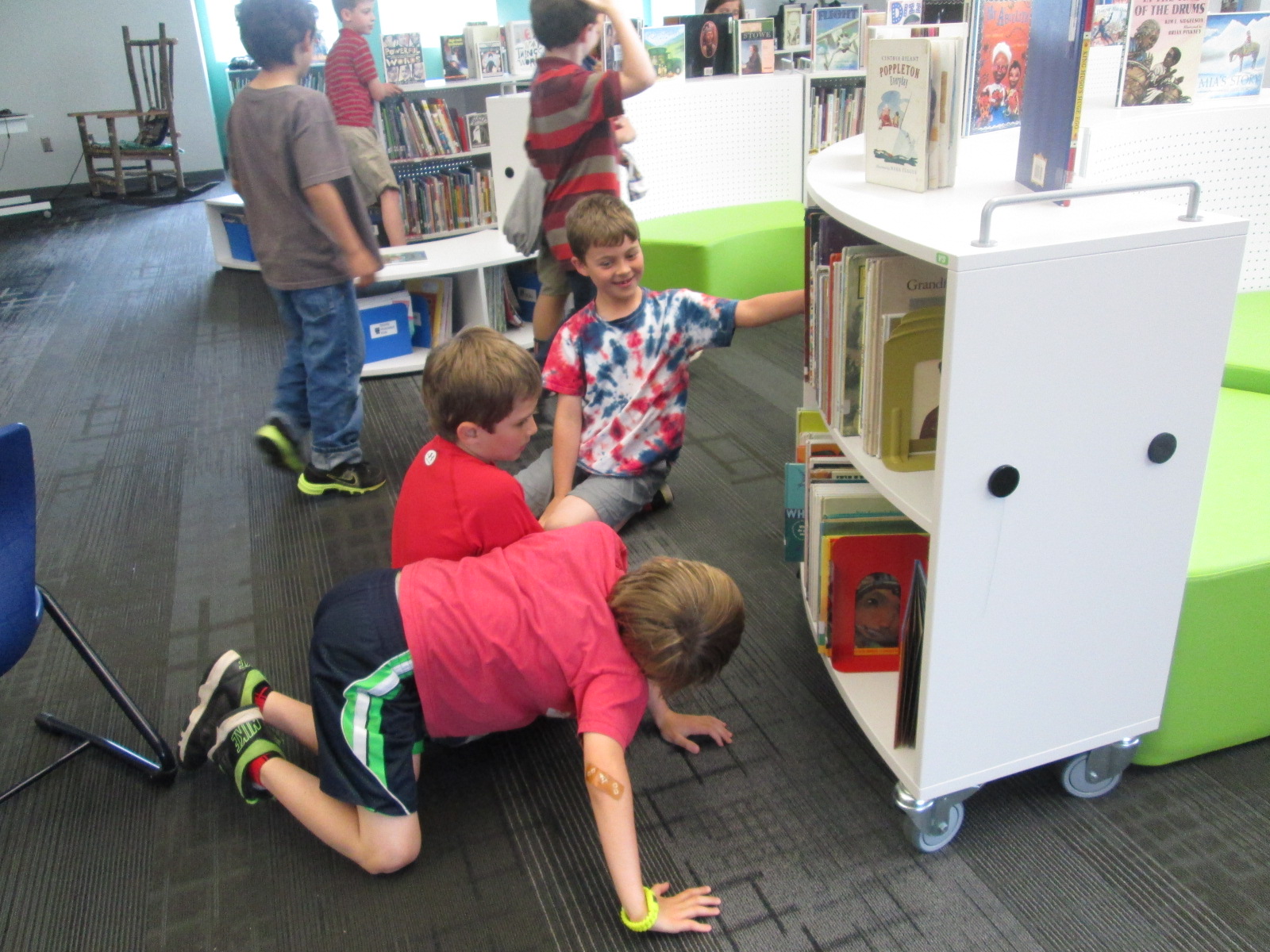
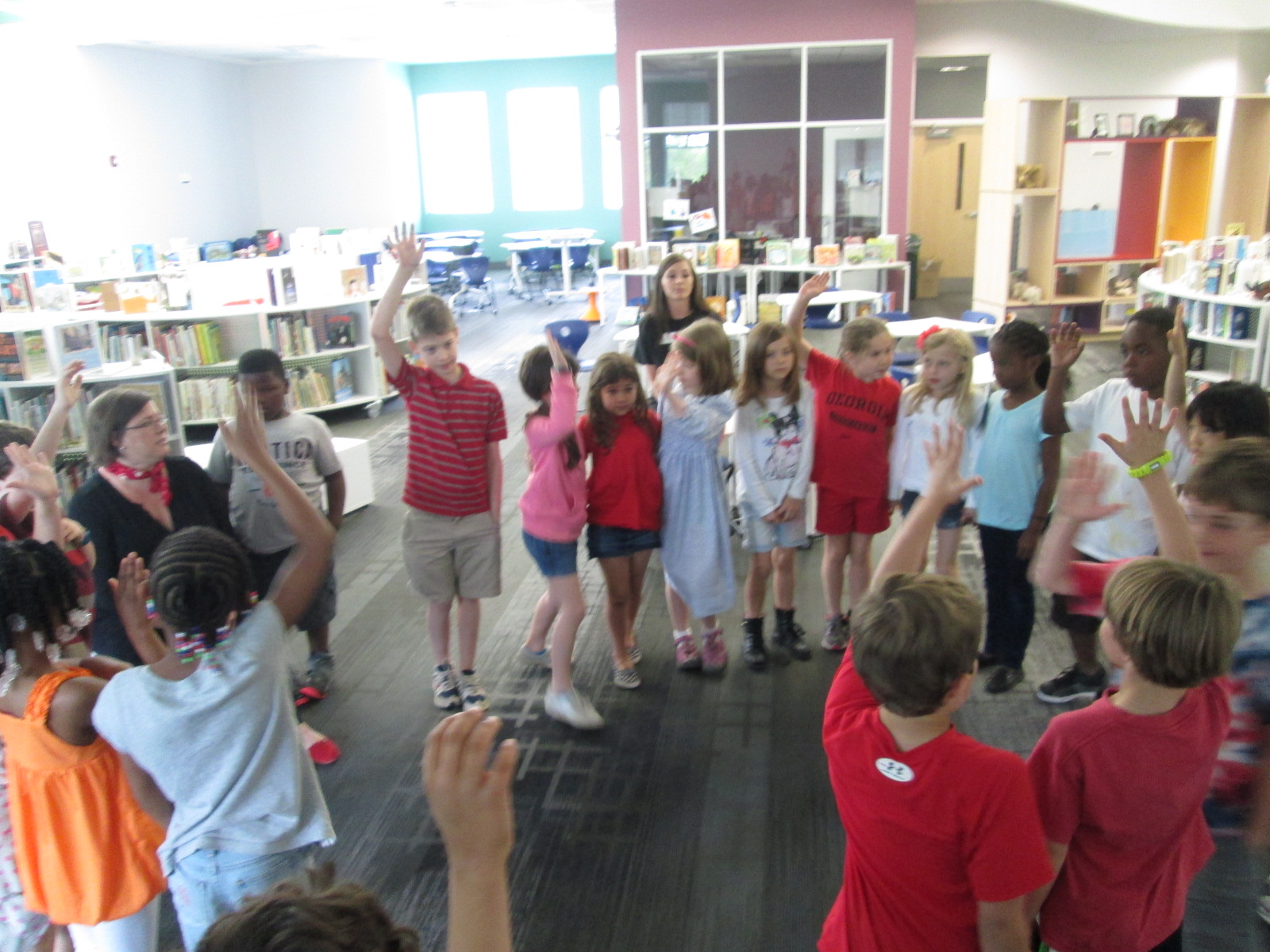
Originally I was going to have students make individual poems, but I made a last minute change to small groups.  The teacher had the whole class stand in a circle and find their own groups of 3.  She assisted students who needed help forming a group.  They went right to work.  It looked something like this.

The teacher and I walked around and talked with students about what they were choosing.  Many of them found one book to start with and started adding books from there.  For example, one group found Please Bury Me in the Library.  Then, they started looking for books that might designate where in the library they might be buried.  I loved how their poem turned out.

Other groups went with a theme.  For example, one group found a book called Dreaming Up, so they started looking for books that had something to do with the sky.  They even went to Destiny and searched for sky books to see if there were any interesting titles.

IMG_2873 IMG_2870 IMG_2869 IMG_2868

I must say that this was the first time that I’ve done book spine poetry where I really felt like kids were thinking about the books going into their stacks.  In the past, it has felt like students just throw a bunch of books in a stack and say they’re done.  While this is still a poem, in my opinion, what I saw today was much more thoughtful and purposeful.
IMG_2875

After students went through the whole process, some of them started again and made a second poem.

We finished by putting our poems up on the projector screen.  I played a poem and we celebrated with snaps.  While I prepped the next iPad, the students talked through the steps that they went through to form their poem.  I really loved this step because it showed me that students really were thinking carefully about each line that went into their poems.


I have 3 more classes coming this week, so we’ll see how this lesson evolves across the week.  I think I’m going to stick to small groups rather than individuals, but we’ll see.

Take a moment to enjoy their book spine gallery.


Poem In Your Pocket: Live Poetry Cafe 2014 Day 2

Poem In Pocket Day 2 (6)Yesterday, I posted about our annual Poem In Your Pocket Day Cafe.  Today, 13 more classes came to share poetry into our open microphone.  It was a non-stop day filled with wonderful words.  As usual, there were many special moments like a student sharing a poem in Chinese and having his class give him the biggest round of snaps I’ve ever heard.  Listen to their poetry sessions at the links below.

Poem In Pocket Day 2 (33)

Boyle Kindergarten

Li Kindergarten

Olin 5th Grade

Watson 1st Grade

Freeman 5th Grade

Brink 2nd Grade

Shealey 4th Grade

Hocking Kindergarten

Ramseyer 2nd Grade

Doneda PreK

Selleck 5th grade

Seeling 4th grade

Stuckey 1st Grade

Poem In Pocket Day 2 (105)


We loved having special guests join us online today:

Jovette Francoeur, educational consultant in Montreal, Quebec.

Grandparents in Goshen, CT

Mary Morgan Ryan, librarian in  Illinois

Grandparents from Illinois

Kevin & Diane Fuchs, uncle & aunt from Indiana

Grandparents in Florida

Friends in Boston

Mrs. Hinger, librarian at Clarke Middle School in Athens

And so many more.

Each year, this day holds many special memories for it.  Each year we add something new.  I would love to hear your ideas for how this  event could grow and change next year.


More Heart Poems for Banding Together

heart poems (14)Each time a group of students submits a new batch of heart poems to our Banding Together project, I smile!  They are so honest in their words.  Some of their poems are filled with joy while others are filled with sadness.  I smile because I am so proud of how they are sharing with the world “what their heart knows”.  You can read more about this project here & here.

Heart Poems

Enjoy the newest group of poems submitted yesterday and today.

Sophia David C. Barrow Elementary Treasure and everyone is everything
aesa David C. Barrow Elementary Please find lovable families so you can have food and games and fun!! please!!!!!!
Jonathan David C. Barrow Elementary My four dogs are furry when I run my fingers through their fur.
Martavious David C. Barrow Elementary Michael Jordan is the best.
Derrick David C. Barrow Elementary I would change my front yard because I want a basketball goal.
Sophia David C. Barrow Elementary Mom and Dad are the greatest treasure
Eunwoo David C. Barrow Elementary My parents and my loving sister always Bring me great joy in my heart.
Katherine David C. Barrow Elementary Love to pass to pupil to pupil
jameriya David C. Barrow Elementary Pets make me smile just seeing pets I feel like I’m in pets world.
Katherine David C. Barrow Elementary Joy to you from me
Jayelan David C. Barrow Elementary Family is love
Hamilton David C. Barrow Elementary We long for our family to take care of us
cyra David C. Barrow Elementary every one has happiness in their lives.
niv David C. Barrow Elementary Friends feel like family when you work together
David David C. Barrow Elementary I am scared of me because I get in trouble a lot and I am sensitive.
Jack S David C. Barrow Elementary Nothing is more powerful than Love.
Jermaine David C. Barrow Elementary Love brings me joy
Carinne David C. Barrow Elementary The sun shines on the other side. You bring joy.
Matthew David C. Barrow Elementary Long, poisonous, snakes make me hide
cyra David C. Barrow Elementary one smile grows into more smiles.
clara David C. Barrow Elementary I love to play in the summer breeze all around me
izzy David C. Barrow Elementary watermelon has great taste, strawberries are juicy, lemonade is sweet
and so are you:)
quavarion David C. Barrow Elementary I dream every one have a good day and a good life.
Kyleigh David C. Barrow Elementary Friends stay friends promises stay promises and we do to.
jameriya David C. Barrow Elementary Haunted houses scare me if I go in one I might cry.
jack k. David C. Barrow Elementary I love chocolate.When I think of my best friends.What do you think of chocolate?
Stefan David C. Barrow Elementary My guinea pig’s squeak is like the good morning for me.
Abney Marie David C. Barrow Elementary When frogs croak it brings peace to my ears.
Jamaria David C. Barrow Elementary My family brings joy to me.
Emma David C. Barrow Elementary Sweet, sour: candy is spectaular
Za’Ryiah David C. Barrow Elementary Dogs bring joy by just the lick of it’s tongue.
Cheyten David C. Barrow Elementary Peace is a wonderful sight that brings a heart.
Elizabeth G. David C. Barrow Elementary Love is happiness and it shines like the morning sky.
Aubrey David C. Barrow Elementary Summer summer 1,2,3 summer summer come to me so I can jump into pools oh it’s so much fun pleas summer come!!!
maya David C. Barrow Elementary Dripping wet leaves, a sunny blue sky, the birds and the bears NATURE
John H David C. Barrow Elementary Do what you want to do, reach for your dreams.
Yehyun H. David C. Barrow Elementary The beautiful trees, the beautiful flowers, the beautiful nature.
Jalondra David C. Barrow Elementary love is in our heart and it makes me happy
elijah David C. Barrow Elementary Love never hates.
Audrey David C. Barrow Elementary Love is a story that never ends
Elizabeth G. David C. Barrow Elementary Believe in love if you do it will come right in to you.
Elizabeth G. David C. Barrow Elementary Summer brings me joy.Does it to you? Come right here and count to two.
Audrey David C. Barrow Elementary It flips and it flutters goes all about.
Jihye David C. Barrow Elementary Hugs bring joy hugs bring love.
Jon M David C. Barrow Elementary puppies are joy that has come to life

Heart Poems, 3D Printed Charms, and Rainbow Loom Bracelets for Banding Together

heart poems (14)

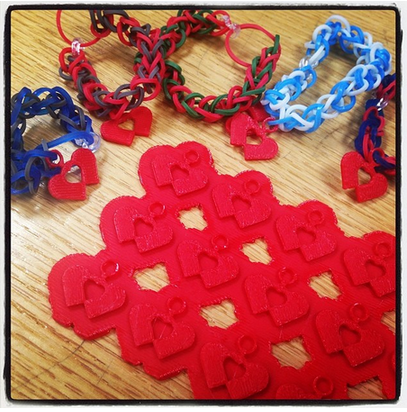
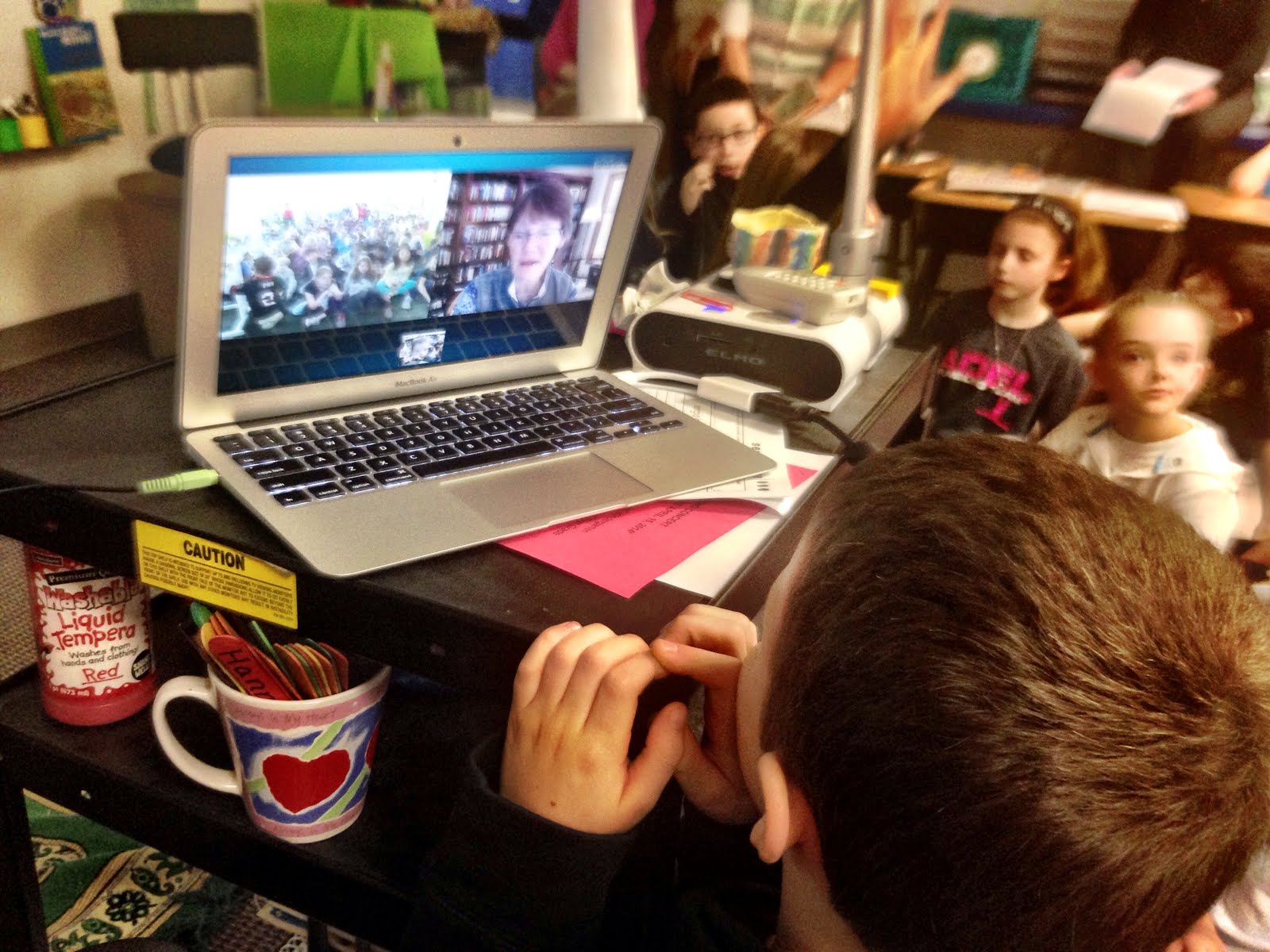
We kicked off poetry month today with Heart Poem writing.  After our wonderful Skype last week with Shannon Miller’s students and poet, Joyce Sidman, our second graders have been hard at work crafting their heart poems to attach to our Rainbow Loom bracelets.

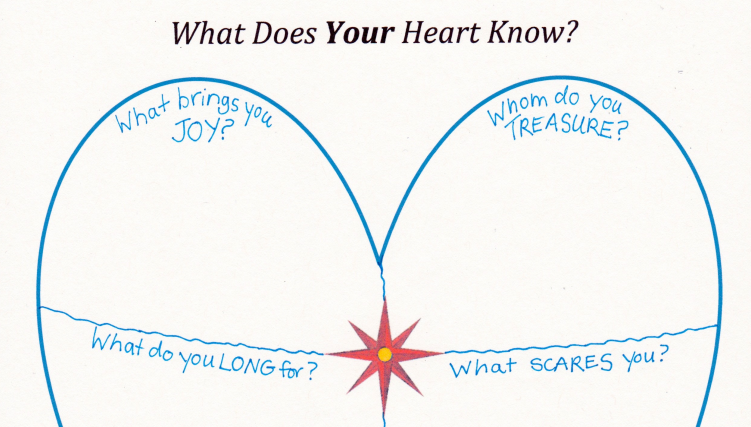
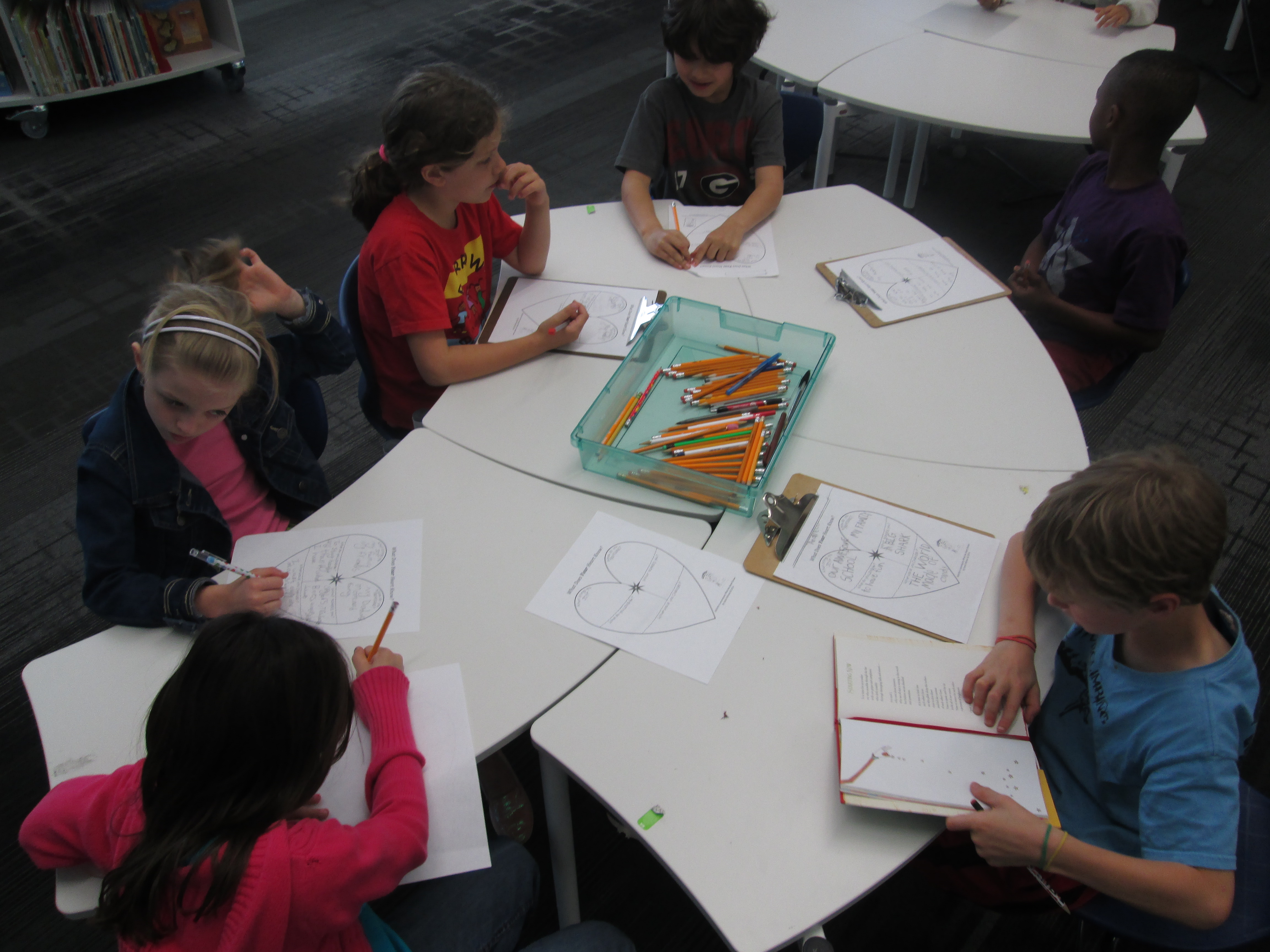
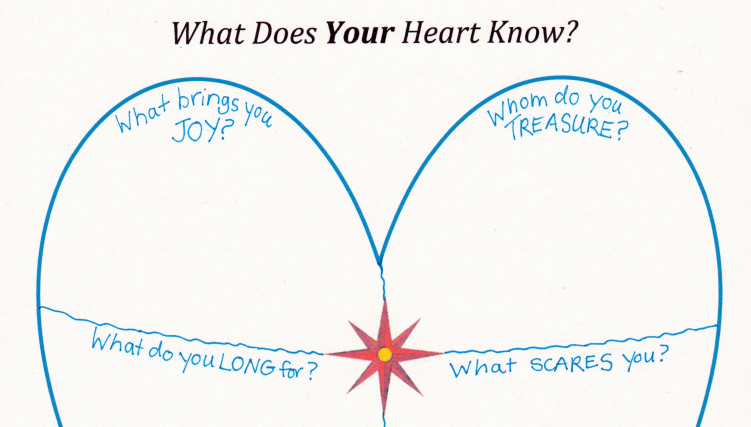
They started by filling out the heart poem graphic organizer from Joyce Sidman’s website.

www.joycesidman.com books what the heart knows chants heart worksheet.pdf

They did this in their classrooms and also in the media center.  Teachers sent small groups to me about every 15 minutes so that I could conference with some of the students and help them think about what their hearts know.  Each heart map was so personal and I smiled with students as they shared the happy things that their heart knows, but my heart also hurt with them as they shared very sad things that their hearts know too.  I was just floored when a student told me, “Mr. Plemmons, even when our hearts our sad, there is still happiness.  Everyone has happiness.”  Wow!  When I heard that, I knew that this project was going to be something that truly mattered in the world.

heart poems (1)

When I conferenced with students, we looked at their map and I asked them if there was a part of their heart that spoke to them more than others.  Most students gravitated toward what brought them joy and what they treasured.  A few wanted to write about what they longed for.  Even fewer wanted to write about fear, but we still talked about that part of their heart since Joyce Sidman really encouraged us to.

Once they selected the part of their heart to focus on, I asked them to think about how to add words to that thought to really make the poem sing or to make a picture in our heads or to make us feel an emotion.  Each conference was a little different.  We played around with words and thought about how a thought in our heart could sound different depending on the words that we put with the thought.

heart poems (5) heart poems (3) heart poems (2)

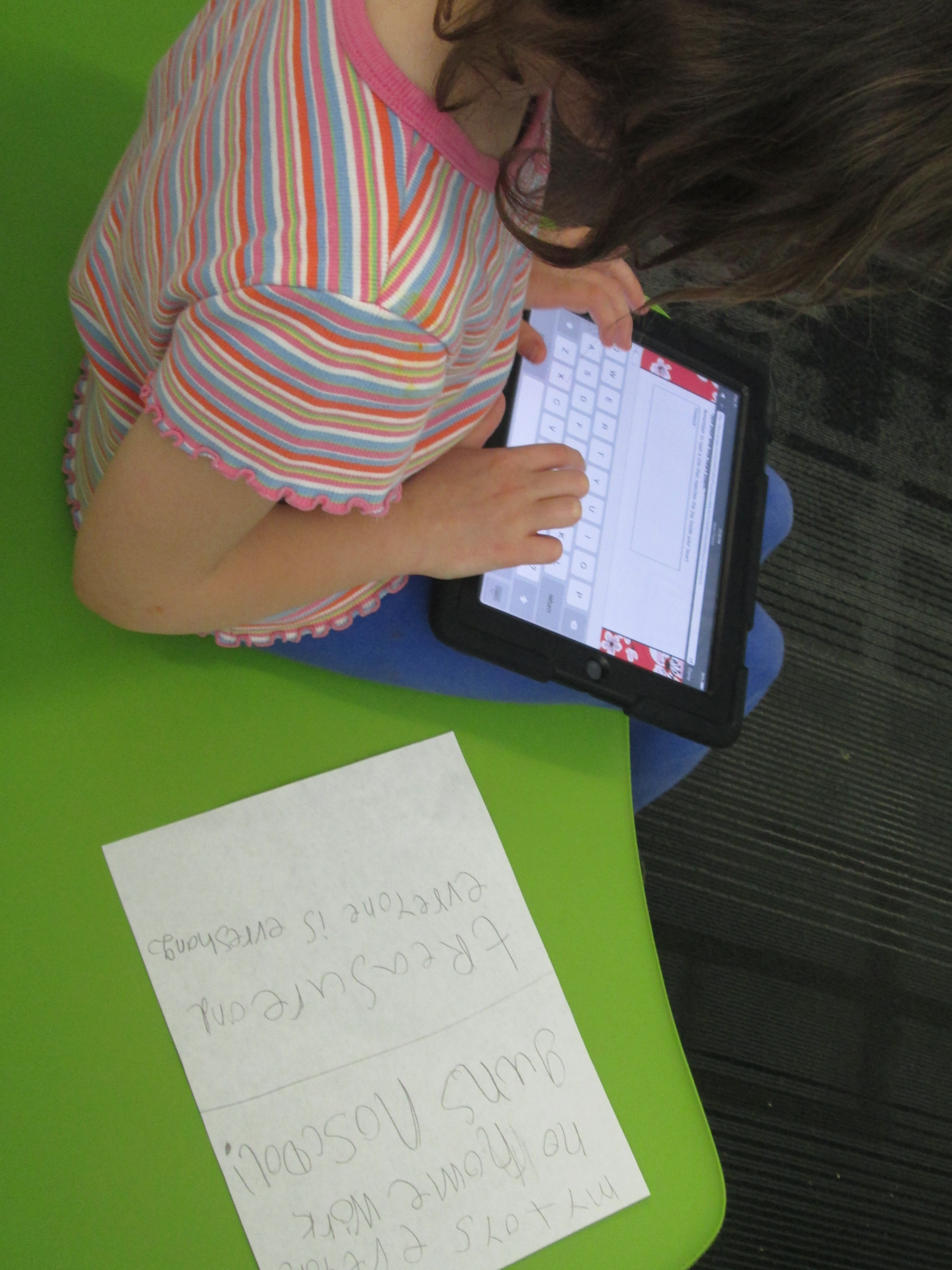
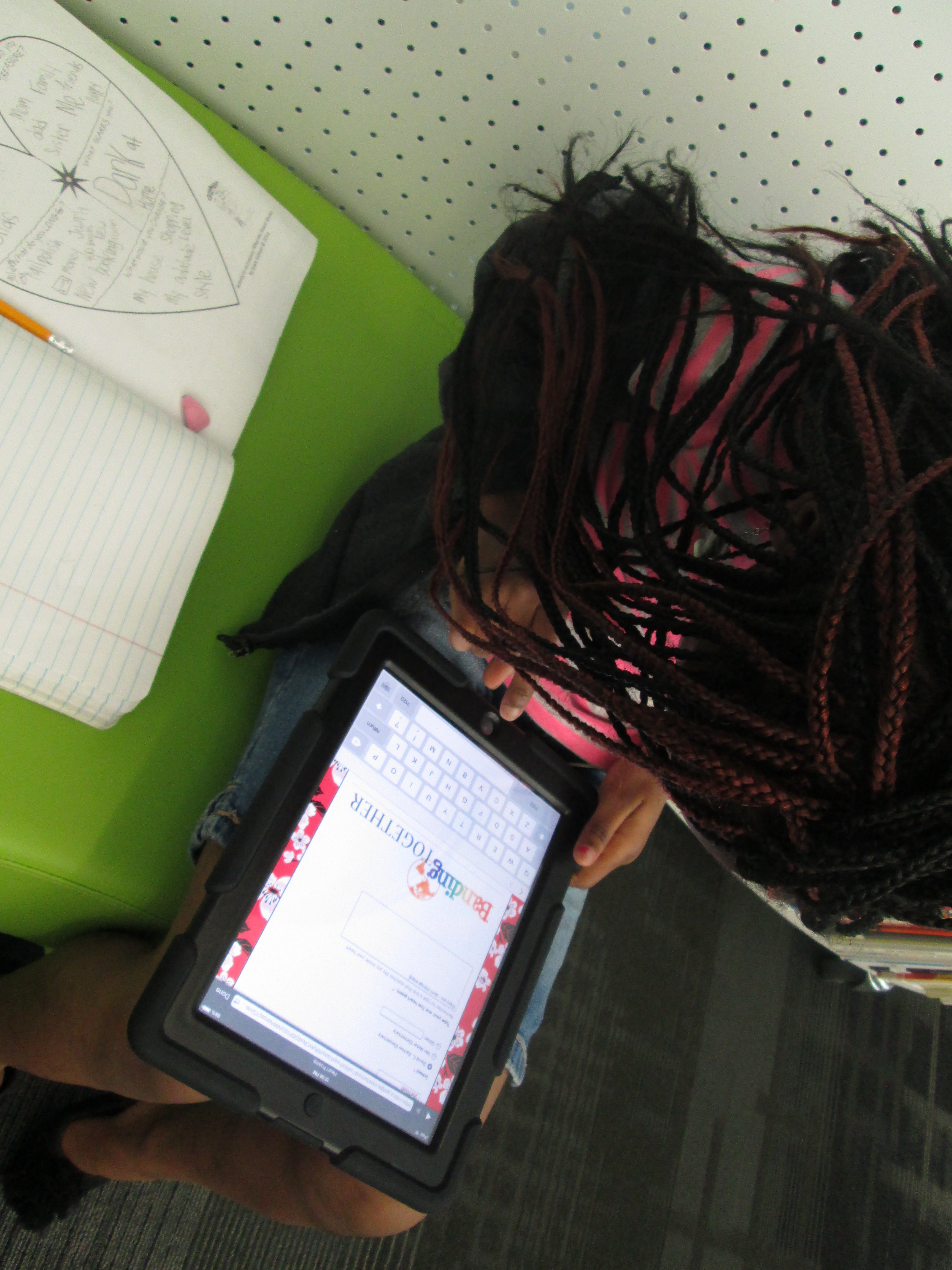
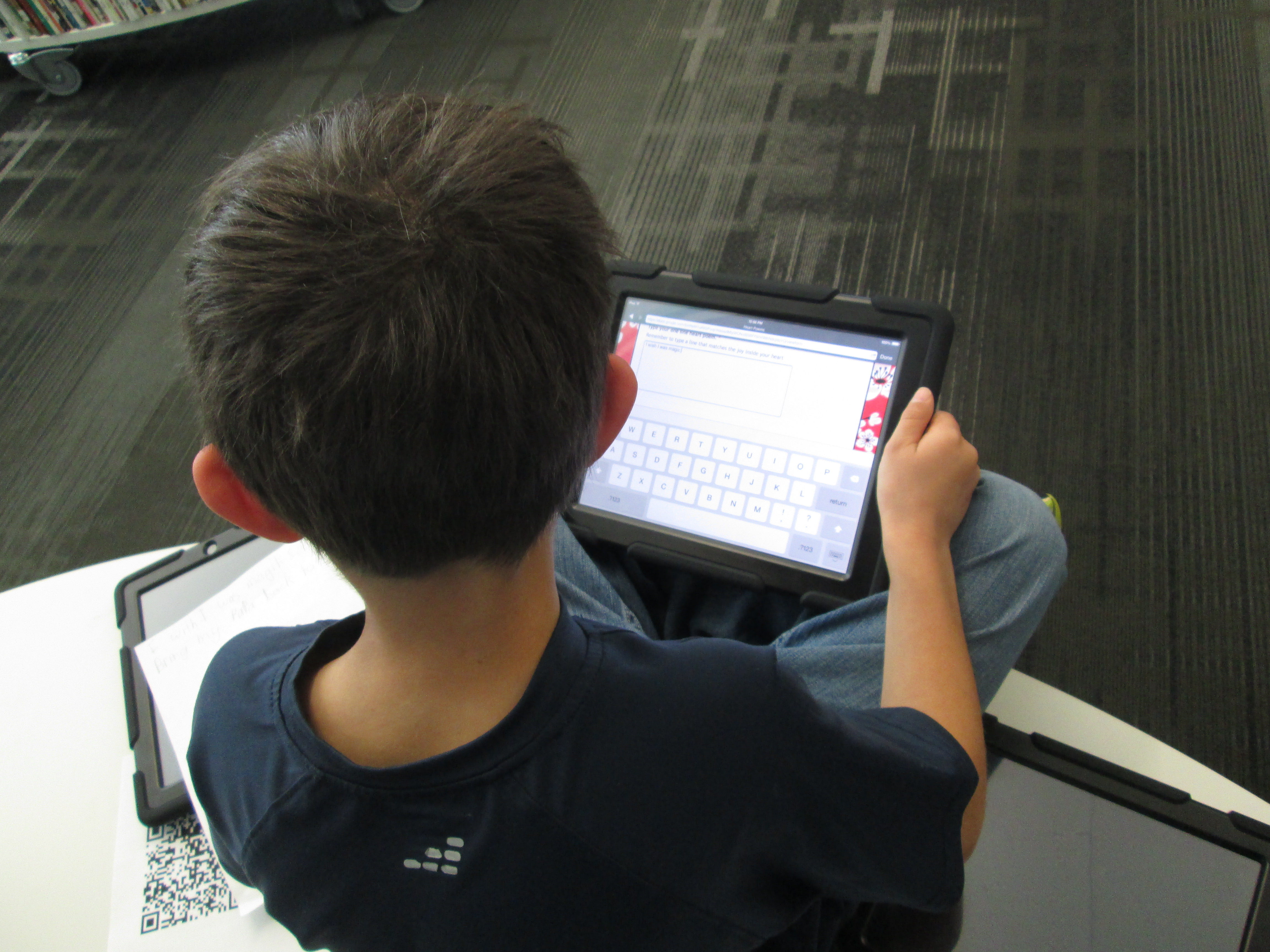
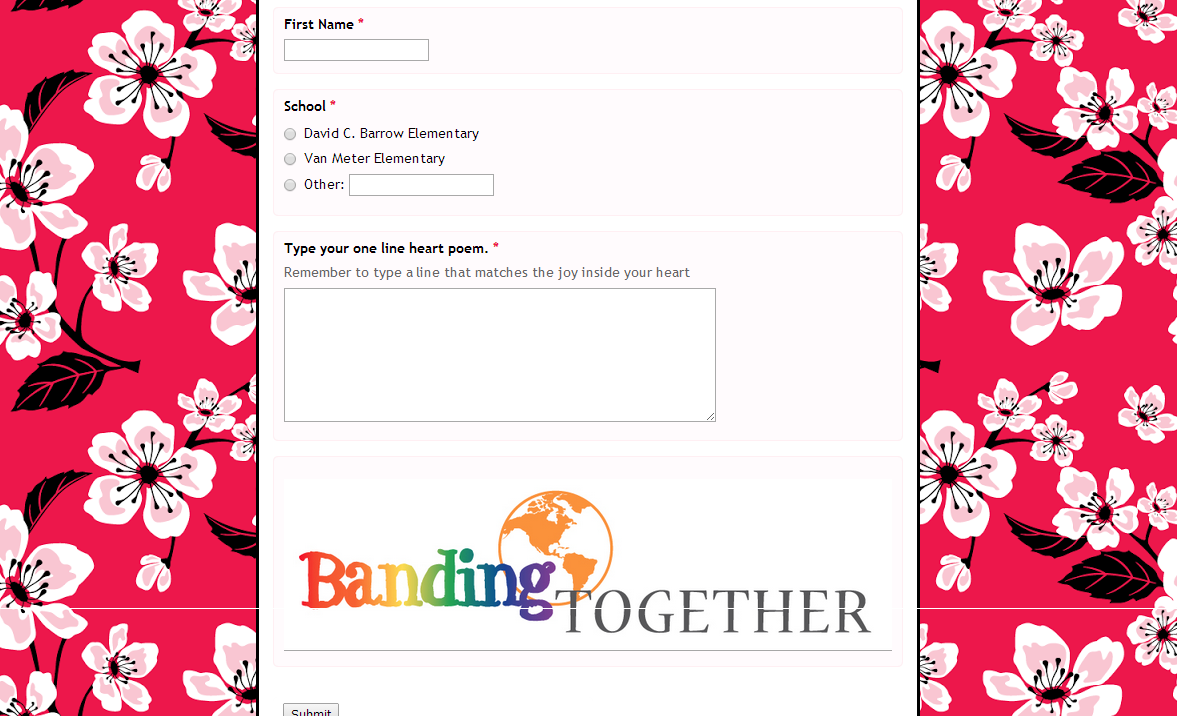
When students were happy with the poem, they used iPads to scan a QR code that took them to a Google form.

Heart Poems

They typed their first name, selected their school, and typed their poem.  Each poem went to a spreadsheet so that I could print them, cut them into strips, and attach them to our Rainbow Loom bracelets.  Here are a few of their poems so far:

Adaline David C. Barrow Elementary The waves, the sun, the beach, it makes me happy!!
cyra David C. Barrow Elementary Dogs spread joy with a wag of a tail.
clara David C. Barrow Elementary Nature brings me joy and love when the wind blows and it rains and I go splashing through the puddles.
Wilson David C. Barrow Elementary Sudden noises scare me but my family comforts me.
Sola David C. Barrow Elementary Love is everywhere,up the hill and over the mill,in nature.
Jacob David C. Barrow Elementary Sun feels warm when you be nice
Finley David C. Barrow Elementary Spring showers brings spring flowers.
Mara David C. Barrow Elementary Love is in this bracelet.
Claire David C. Barrow Elementary You give me the best thing someone has ever gave me and it is the love,joy,and the happiness that makes my heart sing
Carinne David C. Barrow Elementary We are joy. We are bright together. You are powerful.
Evin David C. Barrow Elementary Enjoy the world,keep it healthy
Finley David C. Barrow Elementary Animals spread joy with a wag of their tail
Alanna David C. Barrow Elementary Roses are red, violets are blue. I’m your friend and I hope you are too.
Harry David C. Barrow Elementary Love defeats hate.
Natalia David C. Barrow Elementary April fun and sun. Here. I come! Flowers. Showers Baby. Animals
Axel David C. Barrow Elementary I wish my brother would come back.
Finley David C. Barrow Elementary Bands linked together just like a family
Kyleigh David C. Barrow Elementary My family bring’s me joy and my school bring’s me joy and so do you.
Alice David C. Barrow Elementary Don`t expect things to be bad, expect things to be good.
Adam David C. Barrow Elementary I wish I was magic so I can bring my papa back to life.
Sha’Niyah David C. Barrow Elementary Enjoy you – don’t change enjoy life – do what you like enjoy Love – love your love
Sophia David C. Barrow Elementary Treasure and everyone is everything

Students and families are helping me with attaching poetry to bracelets.

heart poems (11)

These poems are such a great addition to our Rainbow Loom bracelets.  I was excited when we added 3d printed charms, but the poetry brings the bracelets to life as if they had a voice to speak to our friends across the miles.  We will write more poetry tomorrow before we finalize our package of bracelets to ship to India via Van Meter.

Happy Poetry Month!


Banding Together with Joyce Sidman and Heart Poems

IMG_2508.JPG

Our two schools are part of a wonderful project called “Banding Together”.  In partnership with In This Together Media, the Van Meter third graders kicked this off while working on their Rainbow Loom research projects.  After creating so many beautiful bracelets throughout the project, they wanted to do something special with all of these handmade creations.  They partnered with In This Together Media to bring these bracelets, happiness, and friendship to children from an orphanage in Mangalore, India.  The third graders decided to call the project “Banding Together” and the next step was bringing others onboard to make a difference in the world.

Shannon told Andy about “Banding Together” right away….Van Meter School couldn’t wait for Barrow Elementary to be partners with them too.  Together they would bring so much to the children in India….and to each other.

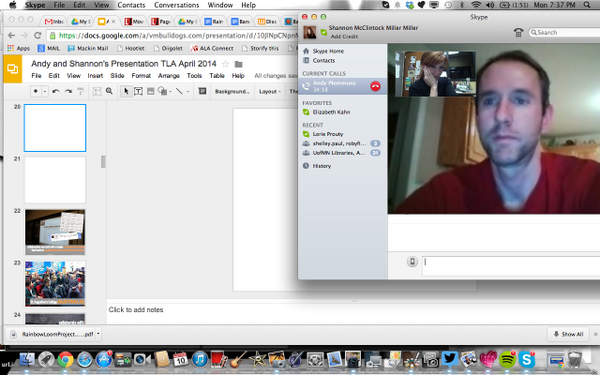
Recently during a Skype planning session, Andy brought up the idea of incorporating poetry into the Banding Together project.  It started with a wondering.  What if we added short poetry, like a fortune cookie slip, attached to the bracelets?  Shannon said, “Let’s go for it.” And the brainstorming began.
BiaKe2-CUAAXkYO.png

We both started thinking of possible titles for the short poetry.  We wanted the title to represent the spirit and joy of the Banding Together project.  In looking through poets, we thought of Joyce Sidman and her new book, What the Heart Knows:  Chants, Charms, & Blessings.  In her note to readers, Joyce Sidman writes, “We believe in the power of words themselves.  Why else would we pray, sing, or write?  Finding phrases to match the emotion inside us still brings an explosive, soaring joy.”

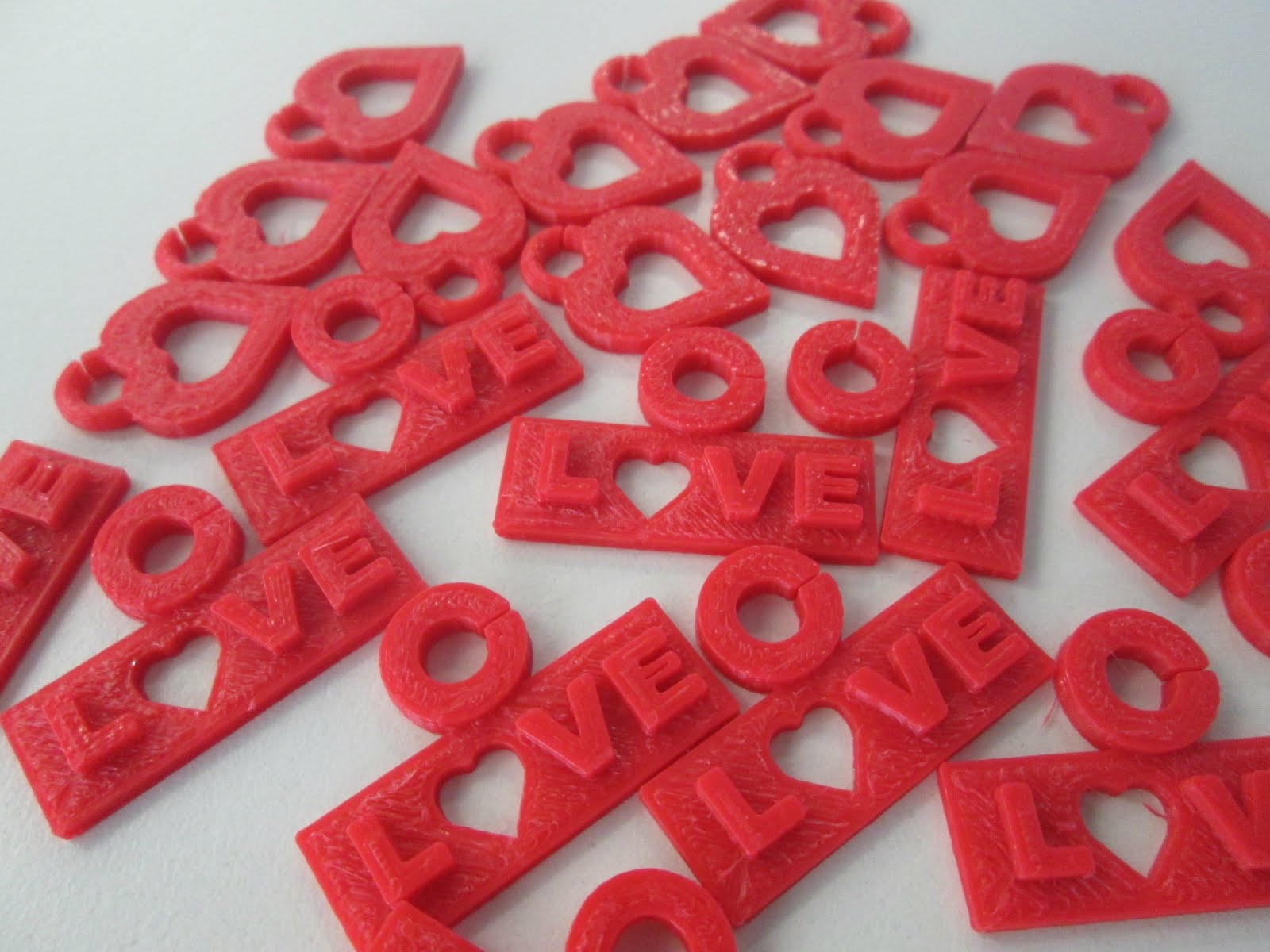
That idea of finding a phrase that matches the emotions in our hearts really connected with what we hoped the Banding Together poetry would represent.  Suddenly, we had a thought about our poems.  What if we called them “Heart Poems”?  They would have a connection to our inspiration from Joyce Sidman’s words.  They would represent spreading the joy in our hearts to friends across the miles.  They would also be symbolic of the heart charms that we have been creating on our Makerbot 3D printers.
charm design (1).jpgScreen Shot 2014-03-27 at 10.24.47 PM.png

We both reached out to Joyce Sidman to share our ideas and see if she would like to meet our students to kickoff the heart poem project.  Not only did she say yes, she pointed us toward a great graphic organizer on her website that would help our students figure out what their heart knows. www.joycesidman.com books what the heart knows chants heart worksheet.pdf.png

IMG_2512.JPG

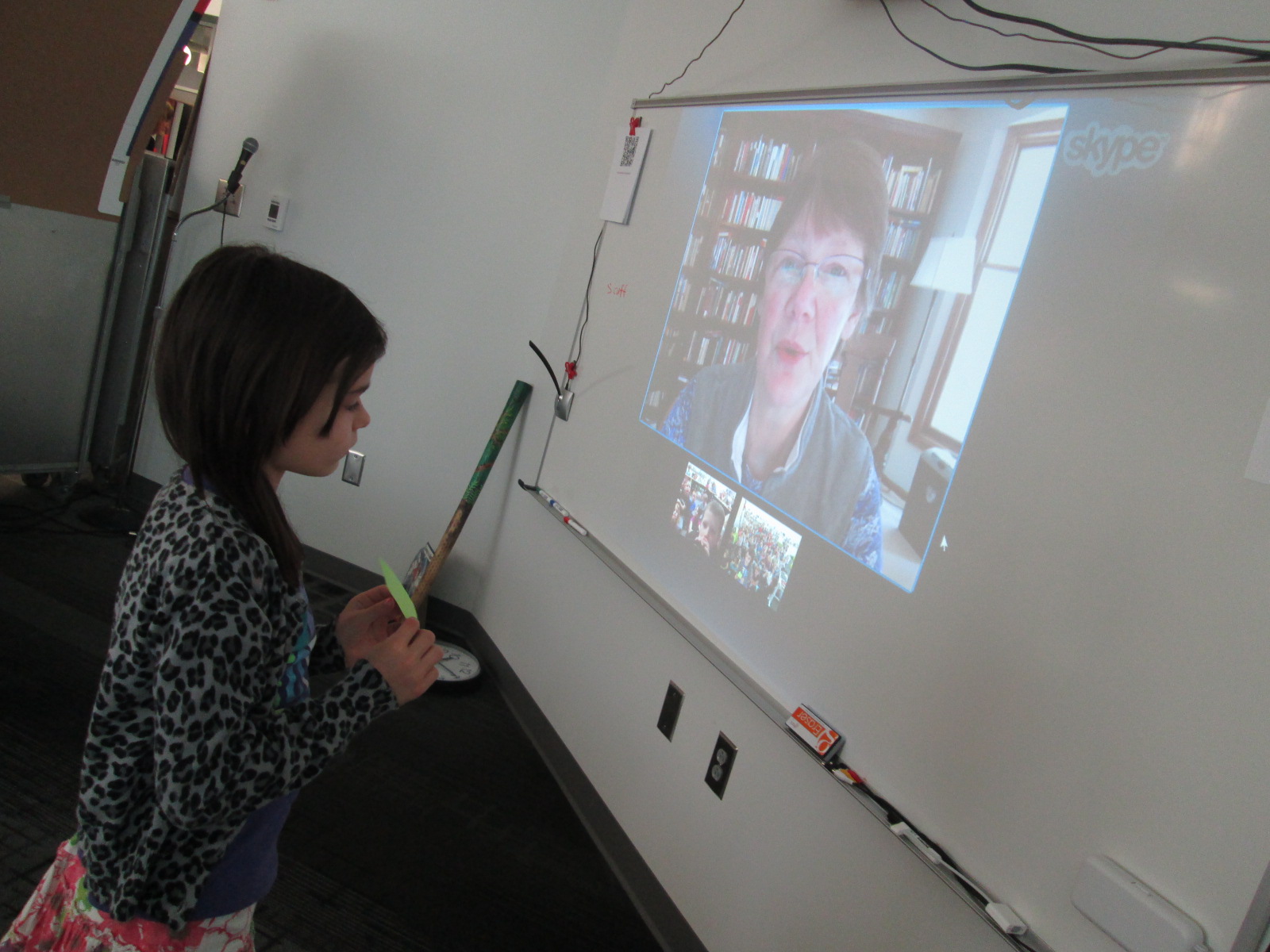
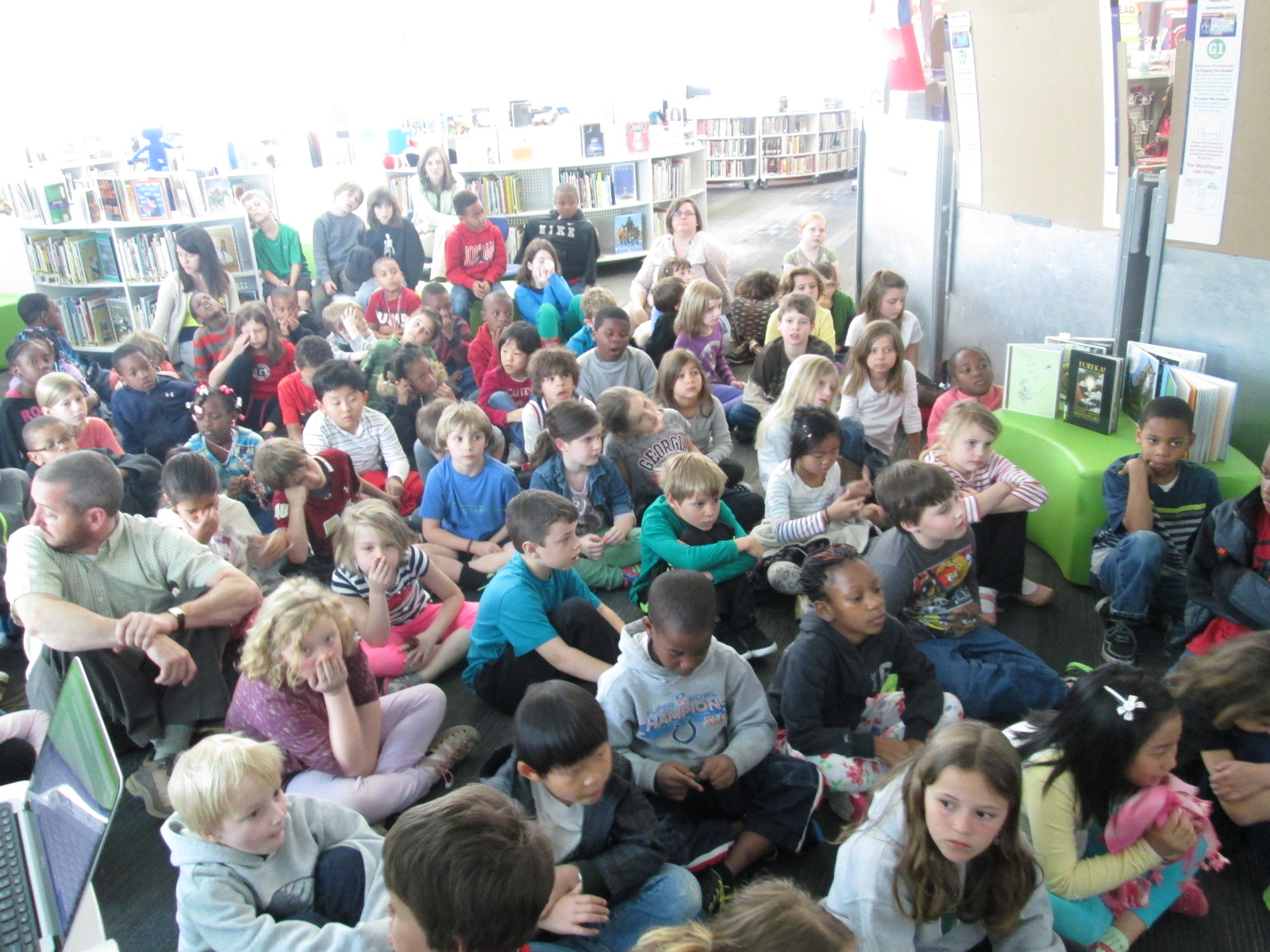
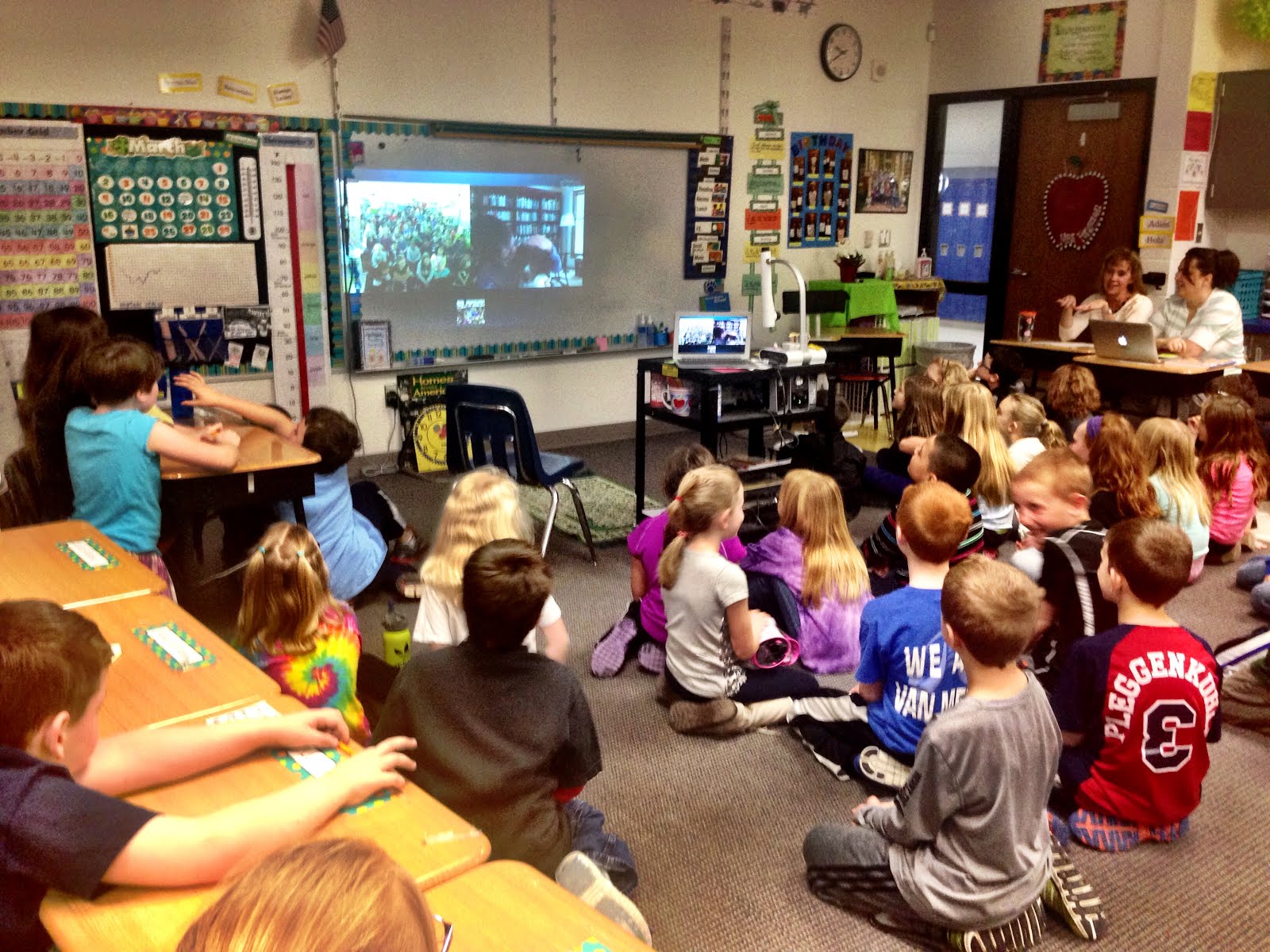
Today our students in Athens, Georgia and Van Meter, Iowa came together with Joyce Sidman via Skype.  After a quick hello and meeting her dog, she read the poem, “Blessing On the Smell of Dog”.  She reminded us that when she is with her dog, she feels like she is home.

This setup the idea that poems come from what he hold in our hearts whether it’s joy, treasures, things we long for, or even what scares us.  Joyce spent time walking through each question on the graphic organizer and giving examples of what the question means to her and why it’s important to think about all of these emotions we hold in our hearts, even the feeling of being scared.

She encouraged our students to write from their hearts.  She also connected with our Banding Together project.  She said, “You’re helping form a bond between you and kids in another part of the world.”
IMG_2519.JPGIMG_2448.JPG

Our students were able to ask her some questions at the end of our Skype.  When asked why she writes poetry and not other kinds of writing, Joyce said, “I notice the things that are happening around me and I celebrate them.  Poetry allows me to focus on that one thing”.  IMG_2523.JPGIMG_2450.JPG

She also told our students, “Even if there are times when you don’t write, you can always go back to writing from your heart.”

Our students left this experience eager to begin writing heart poems to attach to our Rainbow Loom bracelets.  They will fill out the graphic organizer and then submit their poems using a google form.
Heart Poems.png

Students can quickly get to this form from Symbaloo or by scanning this QR code.

Poems will go into a spreadsheet when they are submitted which will allow us to easily print them and attach to our bracelets.  Heart Poems  Responses .png

We invite you to join us by submitting your own heart poems.  Use Joyce Sidman’s great graphic organizer and have your students submit their poems in our Google form.  We’ll attach them to bracelets that we have as well as share them with other special friends in coming months.  You can also use the hashtag #heartpoems to share some of your poems on Twitter.

IMG_2526.JPG

Thank you, Joyce Sidman, for inspiring this special addition to the Banding Together project, and thank you for taking time to connect with our students.


An Author Visit with Nancy Krulik

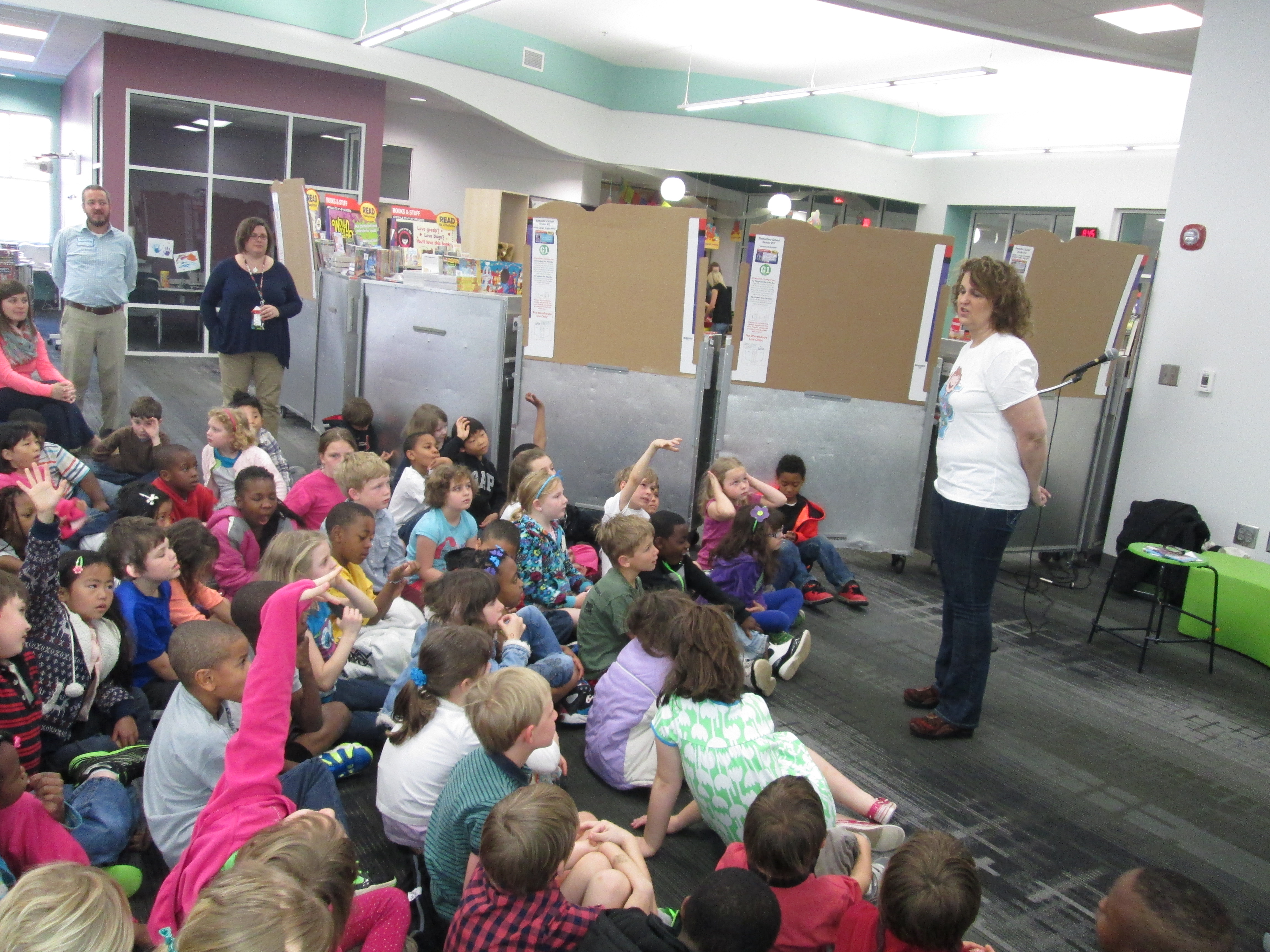
nancy krulik (23)I love our local independent bookstore, Avid Bookshop.  They work very hard to bring children’s, young adult, and adult authors to our community.  They also reach out to schools and connect us with these authors.  Today, Nancy Krulik visisted 3 Athens Clarke County schools:  Barrow, Oglethorpe, and Stroud.

nancy krulik (14)

Nancy Krulik is the author of more than 200 books!  The books that the kids get the most excited about are her 3 series:

  • Katie Kazoo
  • George Brown
  • Magic Bone

nancy krulik (5)

She started her talk with a game between 4 students who answered questions related to the Magic Bone series.  The questions were all based on inferences and point of view.  This gave kids context for the section of the book that she planned to read aloud to the students since the dog doesn’t necessarily know the human terms for the things he sees in the world.  I loved how she set the stage for them to understand this part of the story.

nancy krulik (7)

She spent some time talking about her writing life, her first book, and her 3 series.  Finally, she took student questions.  She really wanted to answer every single question that students had.  I think they could ask questions all day.  They had a great time learning that she wrote some of a George Brown book while she was in her hotel in Athens.

nancy krulik (15)

They also loved burping like George Brown.

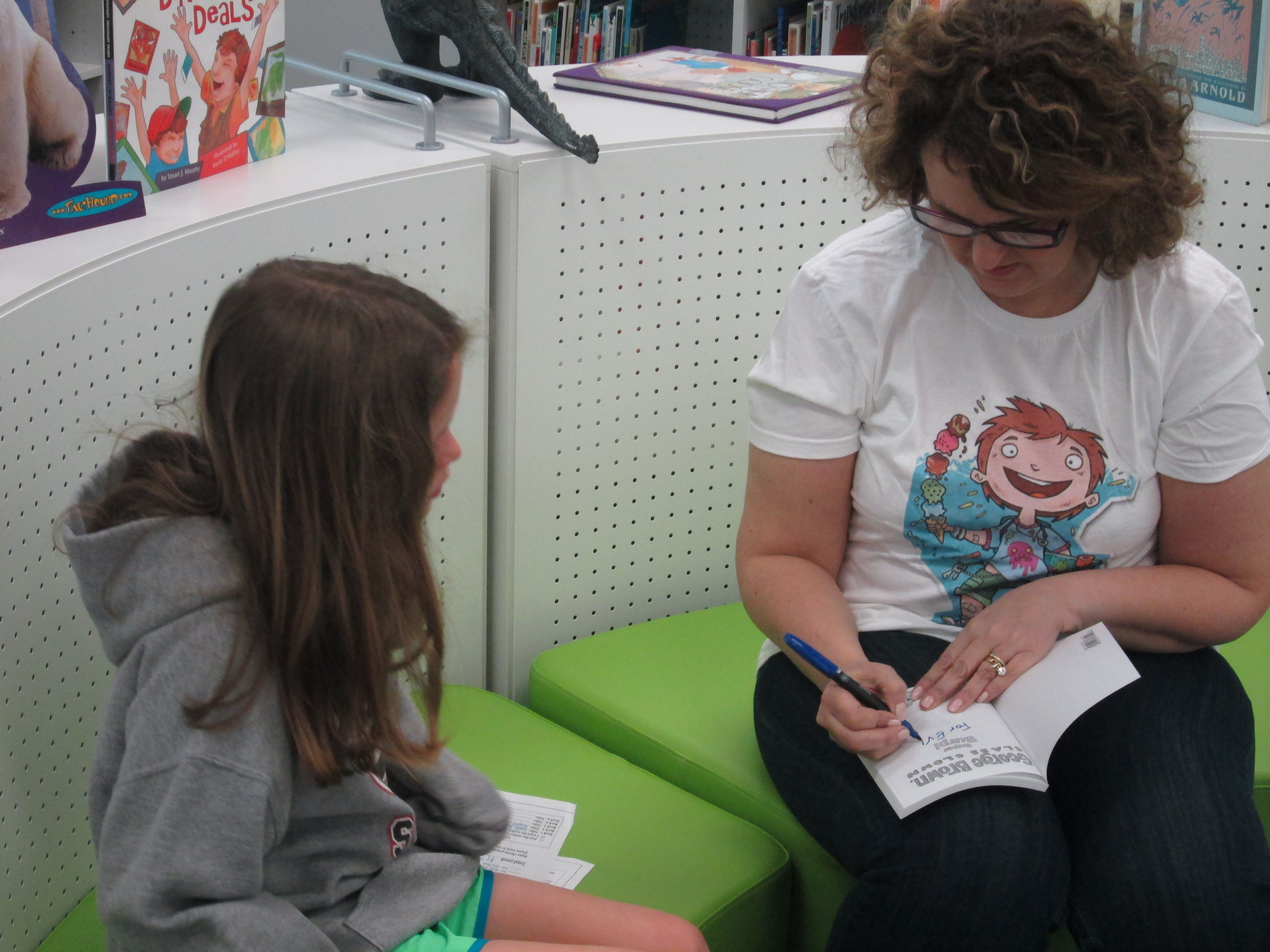
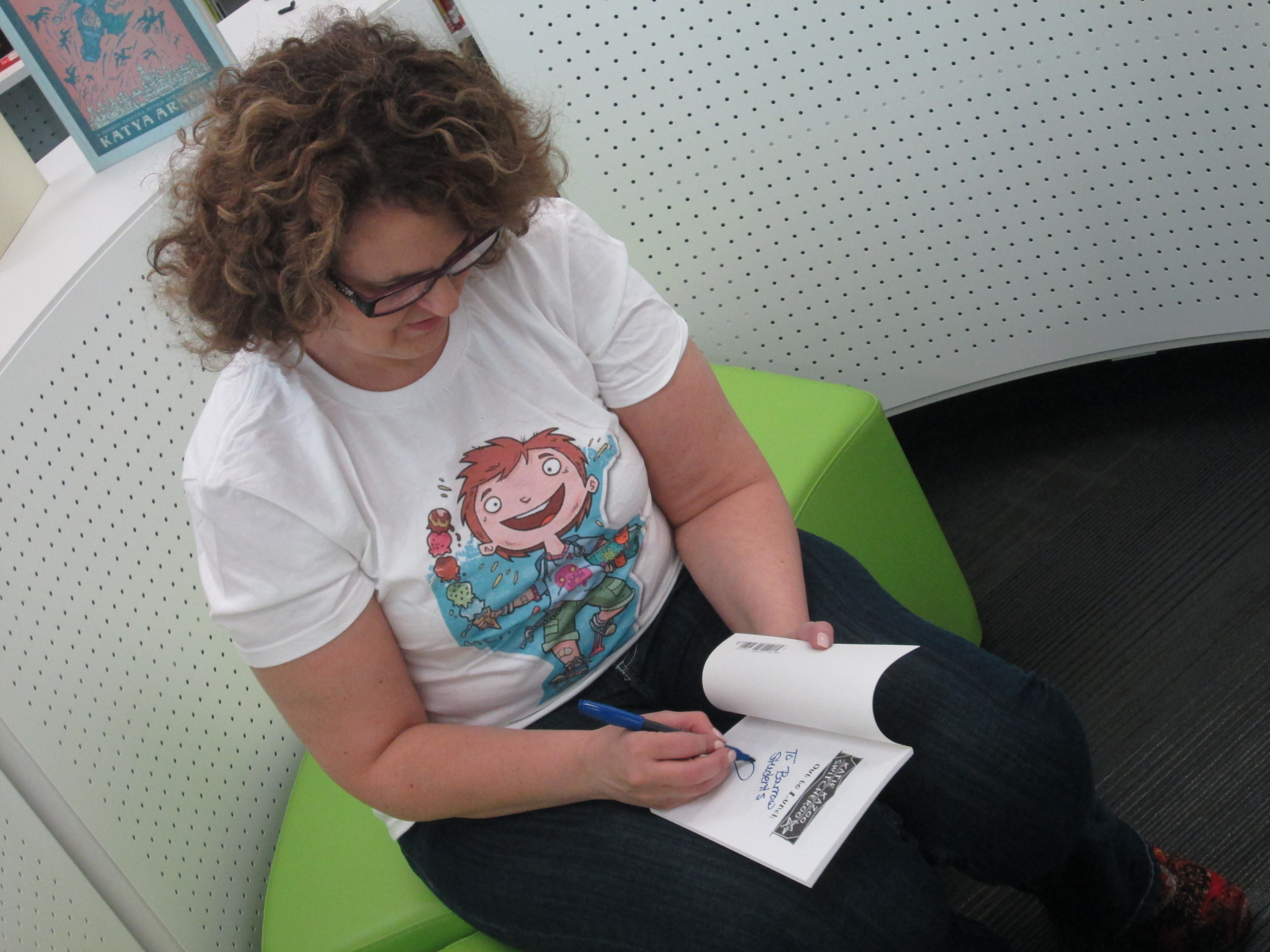
Students who purchased books from Avid were able to stay after the visit and get their books signed.  They loved sitting down with an author, chatting, and watching their book get signed.

nancy krulik (22) nancy krulik (20) nancy krulik (24)

Many thanks to Avid Bookshop, Penguin, and Nancy Krulik for a fantastic visit.  I’m sure there are many new Katie Kazoo, George Brown, and Magic Bone fans in Athens.  In-person as well as Skype author visits always inspire our students to read more but also to write down their stories and work hard to make them the best stories that they can be.


Skyping with Capstone Press and their Graphic Novel Team

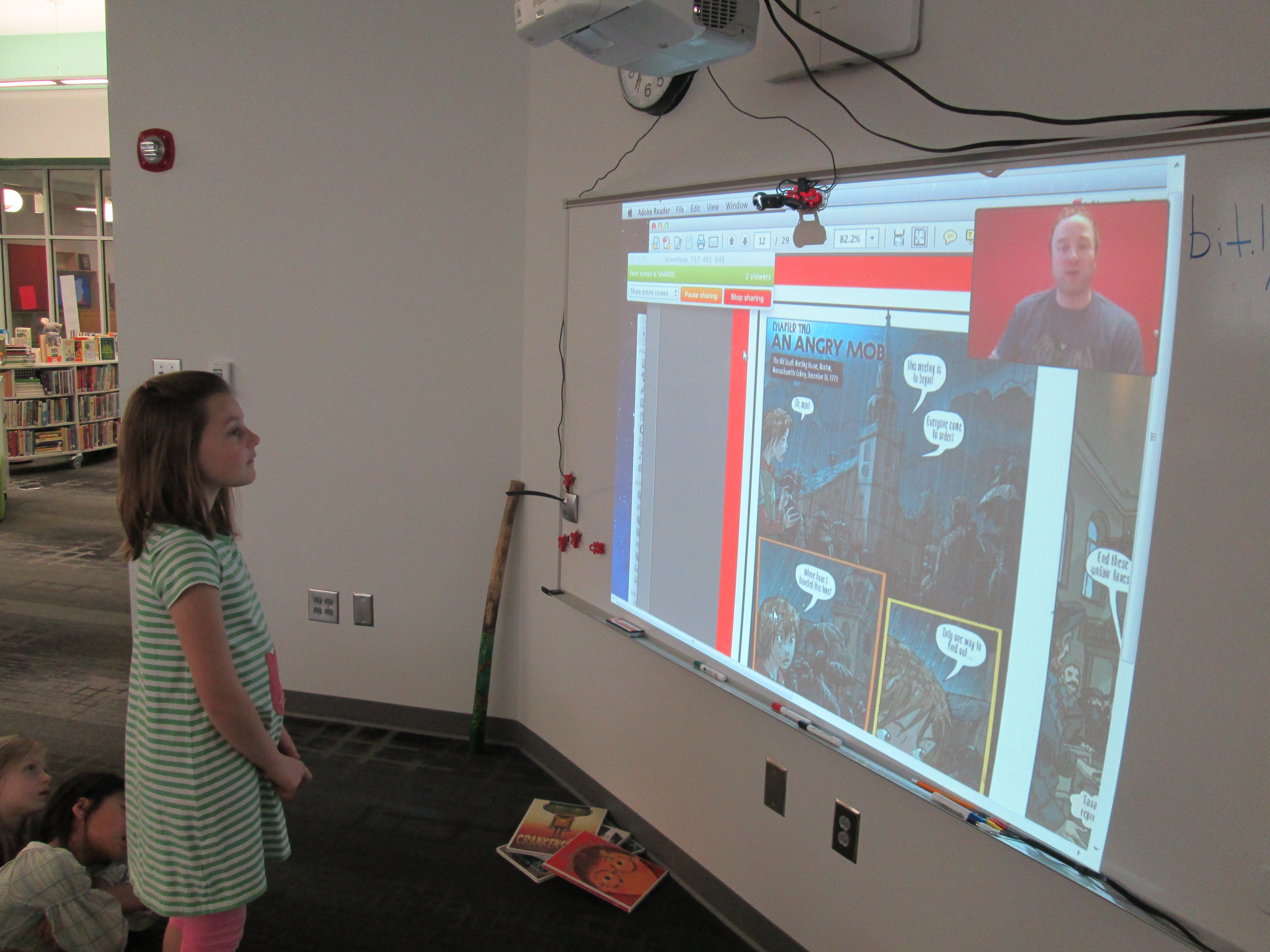
capstone graphic novel skype (2)Our 2nd grade spectrum students have been studying graphic novels.  We started by watching this video from Capstone Press.

capstone graphic novel skype (4)

Then, students started looking at all of the graphic novels in our library and noticing elements of a graphic novel.  They identified speech bubbles vs. thought bubbles vs. captions.  They looked at the inking and colors chosen as well as the layout on the page.  After several days of exploring graphic novels, students began working on their own.  They go through a process of storyboarding, thumbnail sketches, etc.

capstone graphic novel skype (7)

In our library, some of our favorite graphic novels are by Capstone Press.  We can’t keep Princess Candy on the shelves.  In addition to our print graphic novels, we have several simultaneous access ebooks that are graphic novels.

capstone graphic novel skype (3)

Each year we try to think about experiences that we can offer the students in this project to support their development of their own stories.  Sometimes we have a  guest speaker come in and do some cartooning.  However, this year I reached out Amy Cox and the wonderful people at Capstone Press.  Amy connected me with Bob Lentz who works on graphic novels and Ashlee Suker who works on graphic nonfiction.

capstone graphic novel skype (1)

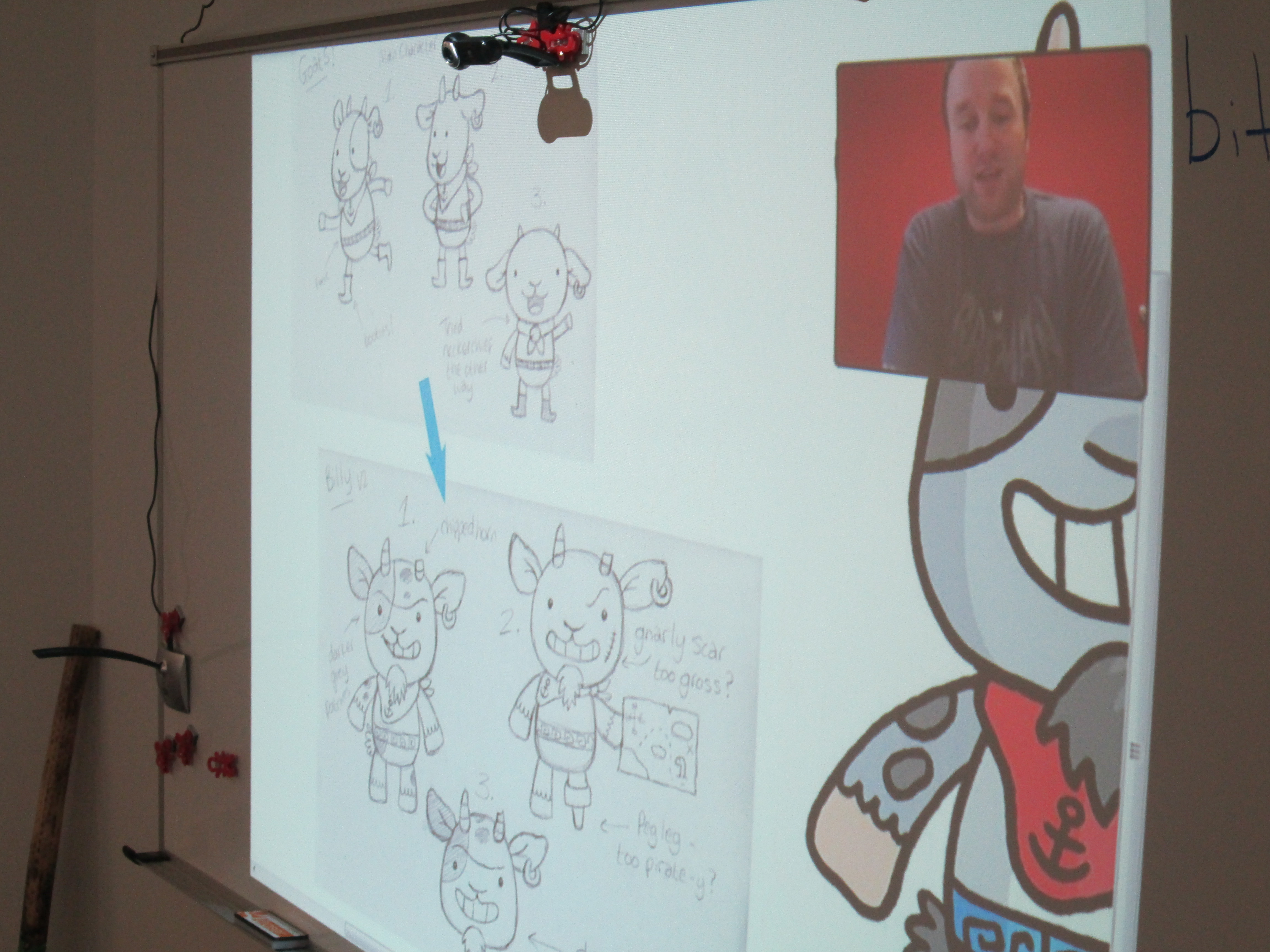
This dynamic duo put together a presentation to show our students how a graphic novel is put together from the beginning to the end.  We got to see how the story is planned over a specific number of page layouts.  We saw how text fits into the various boxes on each layout.  From this text, we also got to see the instructions that are sent to an illustrator along with research links to inform the historical aspects of a nonfiction graphic.

capstone graphic novel skype (8)

Every page that Ashlee showed got several oohs and ahhhs from students.  They loved to see how a character went from a thumbnail sketch to a full color character in the book.  It was also interesting to see the initial attempt at creating a character and how that character changed.  Sometimes the final character was a combination of several sketches put together.

capstone graphic novel skype (5)

Bob and Ashlee paused a lot along the way for students to ask questions.  Some of their questions were about upcoming projects while others were about where ideas come from.  I loved when students thought about specific questions that would help them with their own project.  I also loved when Bob asked the students how many pages their graphic novels were going to be.  Answers ranged from 12 pages to a full box set of several graphic novels!

capstone graphic novel skype (6)

Bob and Ashlee closed with a preview of upcoming Capstone titles for the fall.  The students saw a lot of books that they want in our library.  It was perfect timing because our student book budget group is about to start and graphic novels is once again a category that they will be purchasing books in.  These 2nd graders are sending their recommendations to this group, and I’m sure we’ll see several Capstone graphic novels on our shelves soon.  Thank you Capstone Press for being a continuing supporter of the programs we offer in our library.  You are appreciated!

#GeniusCon: Topic Selection and Question Development

question development (9)We’ve been having so much fun participating in #GeniusCon.  Haven’t heard of #GeniusCon? Visit this archived webinar to learn more and read the post about our first steps.

After students left the library for our kickoff session, they spent time in class reflecting on our chalk talk, writing in their notebooks, and fine tuning their topics.  Today, they came to the library with their topics ready to work on question development.

We started with an overview of what happened since our last session.  I shared tweets from Sherry Gick, Matthew Winner, Peter Reynolds, and more.  I also told them how their work had been featured in the #GeniusCon webinar.  Their eyes lit up knowing that their work was already making a difference!

I framed our session for the day by talking about how questions help us think about what we need to know about our topics in order to focus our research.  We did a practice session asking questions about a topic that I could do for #Geniuscon:  Teaching all of my lessons from home.   At the moment, I’m not really doing this topic, but I wanted to choose something that might raise some eyebrows, and it really did!  Students began asking questions about my topic, but as we progressed they started to ask questions like “how would you feel if you didn’t see us anymore?” and “what if we needed help with something in the library?” and “Wouldn’t you miss being here?”.  This topic did exactly what I wanted because it allowed us to have a conversation about our chosen topics.  I told them that it wasn’t our jobs to tell one another that our topics aren’t possible, that they’re wrong, or that we need to pick a different topic.  Our job is to push one another’s thinking through questions and to support one another even if it means we disagree with topic choice or we feel personally that a topic is “impossible”.

We spent a bit more time brainstorming questions for my topic with partners.  Here are a few questions that they came up with:

  • What lessons should I teach?

  • Do I know anyone that will be interested in learning from home?

  • How will I do it?

  • How many students will I have?

  • How many lessons from home can I teach?

  • What happens if someone needs help checking out and I’m not here?

  • Why would I want to do this?

  • How would people know how to connect with me?

  • What if the Internet doesn’t work?

Next, students logged into their Google Drive and created a document with their topic listed at the top.  Then, they started a bullet list and began adding their own questions.  After all students were set with their doc ready, we began passing the laptops around the circle and asking one another questions.  Students looked at the topic at the top and read the question already generated.  Then, they thought of what questions they would add to the list for the researcher to consider.  I’ll admit that this part was difficult.  Even with our lively opening, students had a hard time generating questions.  Several adults had individual conversations with students to support their question development.  These conversations were critical.  At different times we had me (the media specialist), the classroom teacher, a gifted teacher, a tech integration specialist, and and early intervention teacher supporting students.  Here are a few topics with the questions generated.

Taking Tablets Home:

  • can we for a week?

  • or for month?

  • what happens if you break it?

  • What do students do if they don’t know how to use it?

  • what happen’s if somone needes one at school and you forget it at home?

  • how long?

  • what if people don’t have internet at home?


More Playground Equipment:

  • what equipment should we get?

  • how much equipment?

  • what   kind?

  • what if there’s not enough space?

  • isn’t it expensive?

  • why do you wont to change the playground?

  • will we be kind on it?

  • is the play ground equipment safe?

  • who would pay for it?

At our closing, students got their own computers back, read their questions, and shared their documents with me.  I told them that it was ok if they didn’t understand a question or if they even disagreed with a question.  We closed by once again asking “Why are we asking questions and not jumping into answers?”  We framed the idea of thinking about what we need to research.  Next, we will spend some time developing a research plan.  We’ll brainstorm where we need to look for answers and begin our search for answers.


Observing the Day & Night Sky with Kindergarten

IMG_1377Kindergarten is working on observing the day and night sky in science, and they want to use technology to document their observations.  They are working on the following standards:

ELACCKW6 digital tools help writers write and share their stories.

ELACCKW7 writers work in groups.

SKE1 Students describe time pattterns (such as day to night and night to day) and objects in the day and night sky.

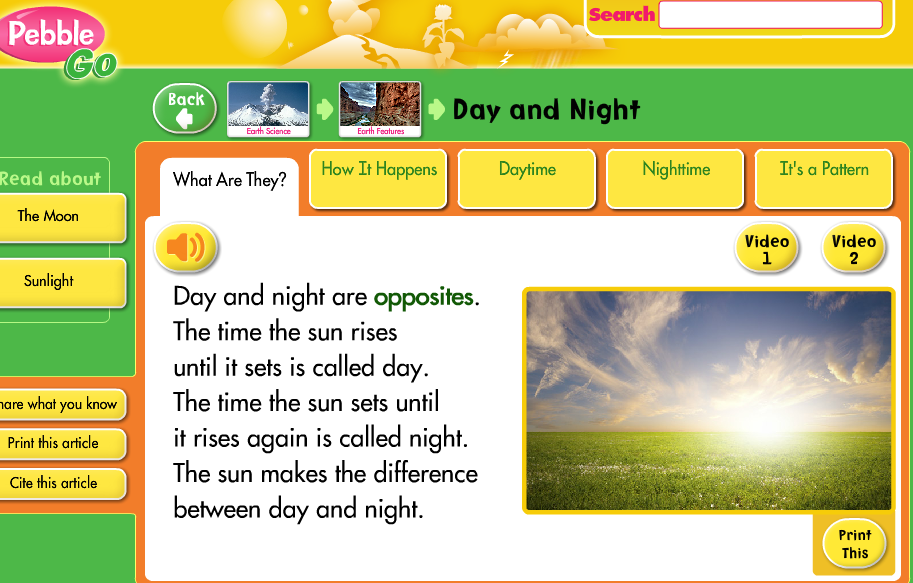
Classes came for 2 separate lessons.  During our 1st session, we used Capstone’s Pebble Go to read about day and night.

PebbleGo - Capstone Digital

Then, we read the book Sun Up, Sun Down: The Story of Day and Night by Jacqui Bailey.  During our reading of both Pebble Go and the book, students discussed the scientific reasons we have day and night.  We setup the idea of starting to “notice” things about the sky and how it changes during the day and night.

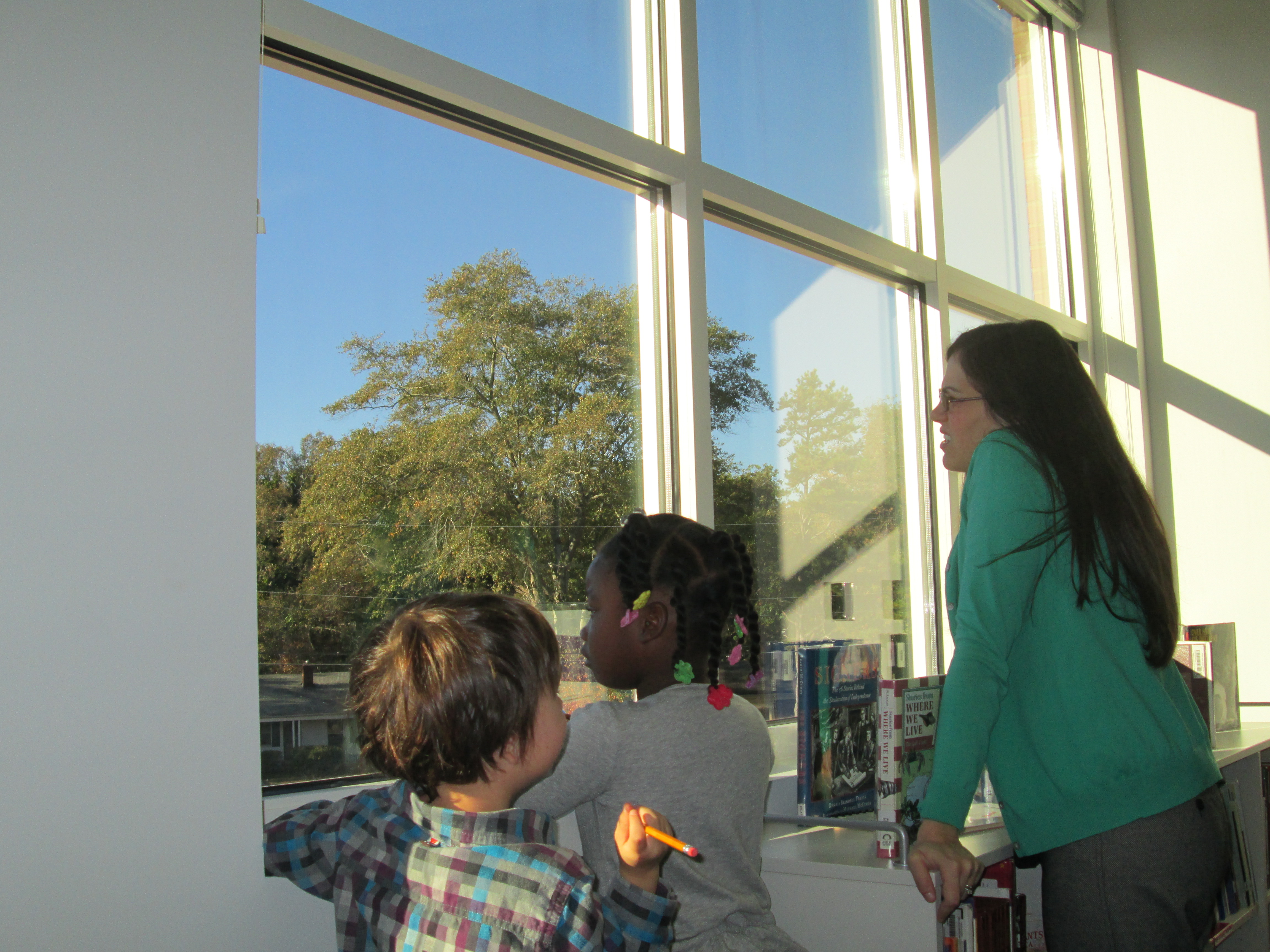
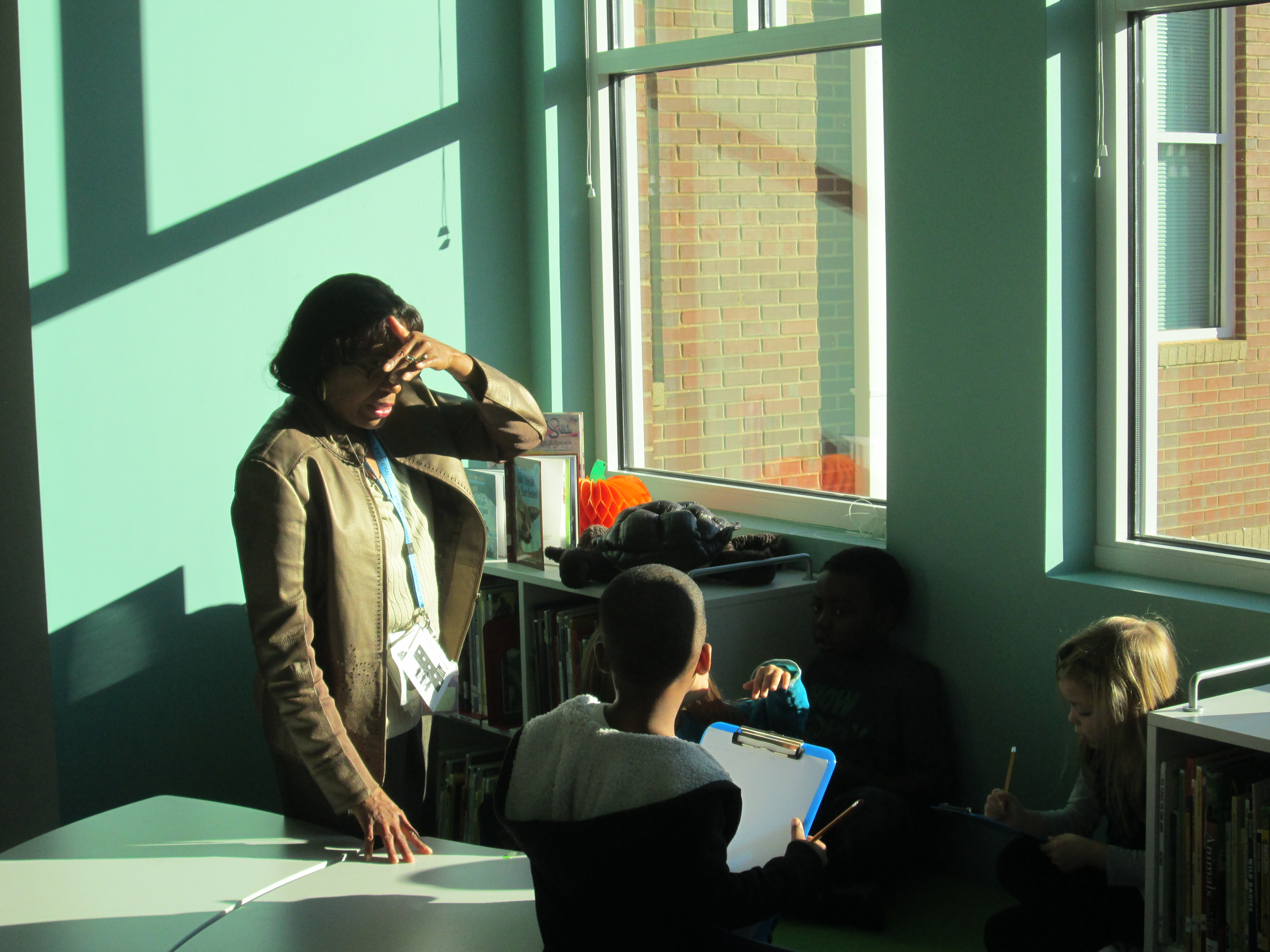
IMG_1376For our 2nd session, I opened up the blinds on our massive library windows and setup observation areas for students.  We started our time together on the floor and shared some observations we had already made at recess or at home.  We practiced saying aloud what we would write on our clipboards at the windows.  Next, the teacher paired the students together, gave them a clipboard with paper and pencil, and I placed groups in front our our windows.  The teacher, parapro, and I walked around and talked with kids about what they saw.  We encouraged them to write and sketch.  We also helped them make connections to the information that we had learned from Pebble Go and our book.  For example, the sun was blinding us in the windows on he left side of the media center but on the right side of the media center it was shady.  We remembered that the sun is at different positions in the sky throughout the day due to the Earth rotating.

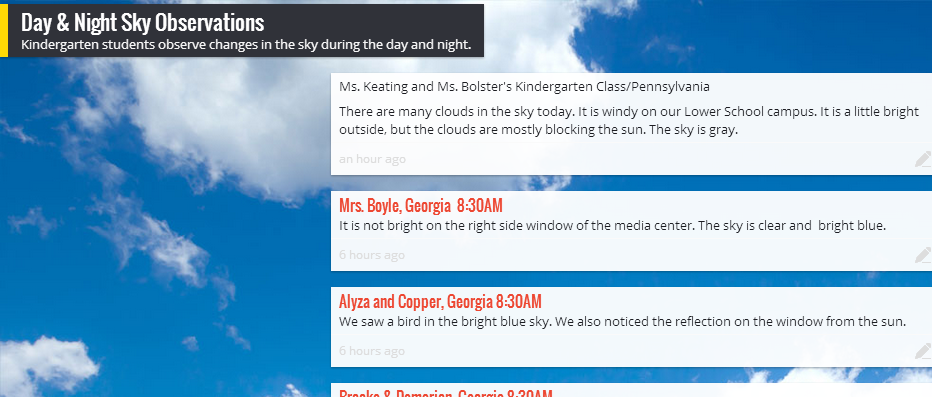
Day & Night Sky Observations

At the end, we split the class in half at our 2 projection areas.  Student groups shared what they observed and we used Padlet to capture the observations.  I tweeted the link to our padlet and later in the day Margaret Powers, Mrs. Keating, and Mrs. Bolster and their students added to the wall from Pennsylvania.  It was interesting to hear about the cloud-filled sky there compared to our cloudless sky in Georgia.

Now, the Kindergarten teachers will share this link with families and encourage them to add notes to the Padlet from home.  This will allow students to make some observations of the night sky.  Please feel free to leave some comments on the Padlet about what the sky looks like where you are!

Using KidBlog with 2nd Grade

kidblog (8)

Last year our 2nd grade teachers collaborated with me on a blogging project using KidBlog.  Our blog was  a way to connect our students with students in Van Meter, Iowa while at the same time showcasing different kinds of writing.  This year, the teachers wanted to start blogging much earlier in the year.

kidblog (3)Each teacher setup her students on KidBlog by uploading a simple excel spreadsheet with names and passwords.  In class, students wrote out their first “post”.  This post was very simple.  Students have been studying important people from Georgia’s history so each student wrote one sentence about one of these Georgians on an index card.  They brought these cards with them to the library to learn about blogging and do their first post.

During our mini lesson, I asked students how many had heard of a blog, and all hands went up.  Then, I ask them who could define what a blog is, and almost all hands went down.  Our first question of exploration was “What is a blog?”  We watched a common craft video on blogging.  I paused along the way and asked students what news they might report on as a 2nd graders.  They mentioned things like:

  • what we do in our classroom
  • math problems that people could solve
  • what we did on vacation
  • books that we are reading
  • and more

Next, I showed them the media center blog.  We looked at the map of readers, tags, how posts are from most recent to oldest, and talked about my audience.

Finally, I showed them Kidblog and how they would login to do their posts.  I stressed the idea that once you click “publish”, your work is instantly connected with an audience.  Students brainstormed what they might need to do before clicking publish.  They said things like:

  • triple check your work
  • check spelling
  • revise and edit
  • read for understanding
  • ask an adult to check your work
  • make sure you said things the way you wanted to say them
  • check that it’s appropriate

Students dispersed to iPads and laptops and began logging in.  Adults circulated and helped students as needed, but students also helped one another to find buttons, login, and any other technical questions they had.  In about an hour, most students were able to learn about blogs & their purpose, make their first post, and go back to class very eager to write more.  The report back from the teachers was that these students are already asking when they will be able to post again.

You can see the beginnings of their work at the following links:

http://kidblog.org/MrsYawnsClassBlog/

http://kidblog.org/MrsRamseyersClassBlog/

http://kidblog.org/MrsWrightsClassBlog/

http://kidblog.org/MrsBrinksClassBlog/