2015 Student Book Budgets Step Two: Goal Setting

Discussion

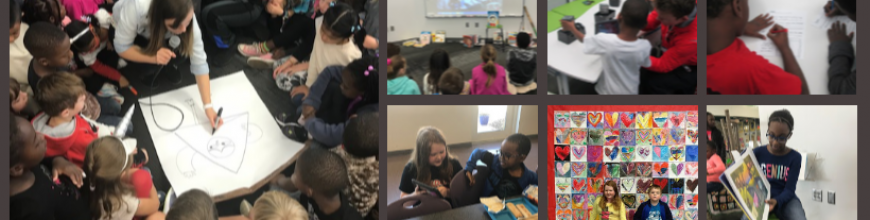
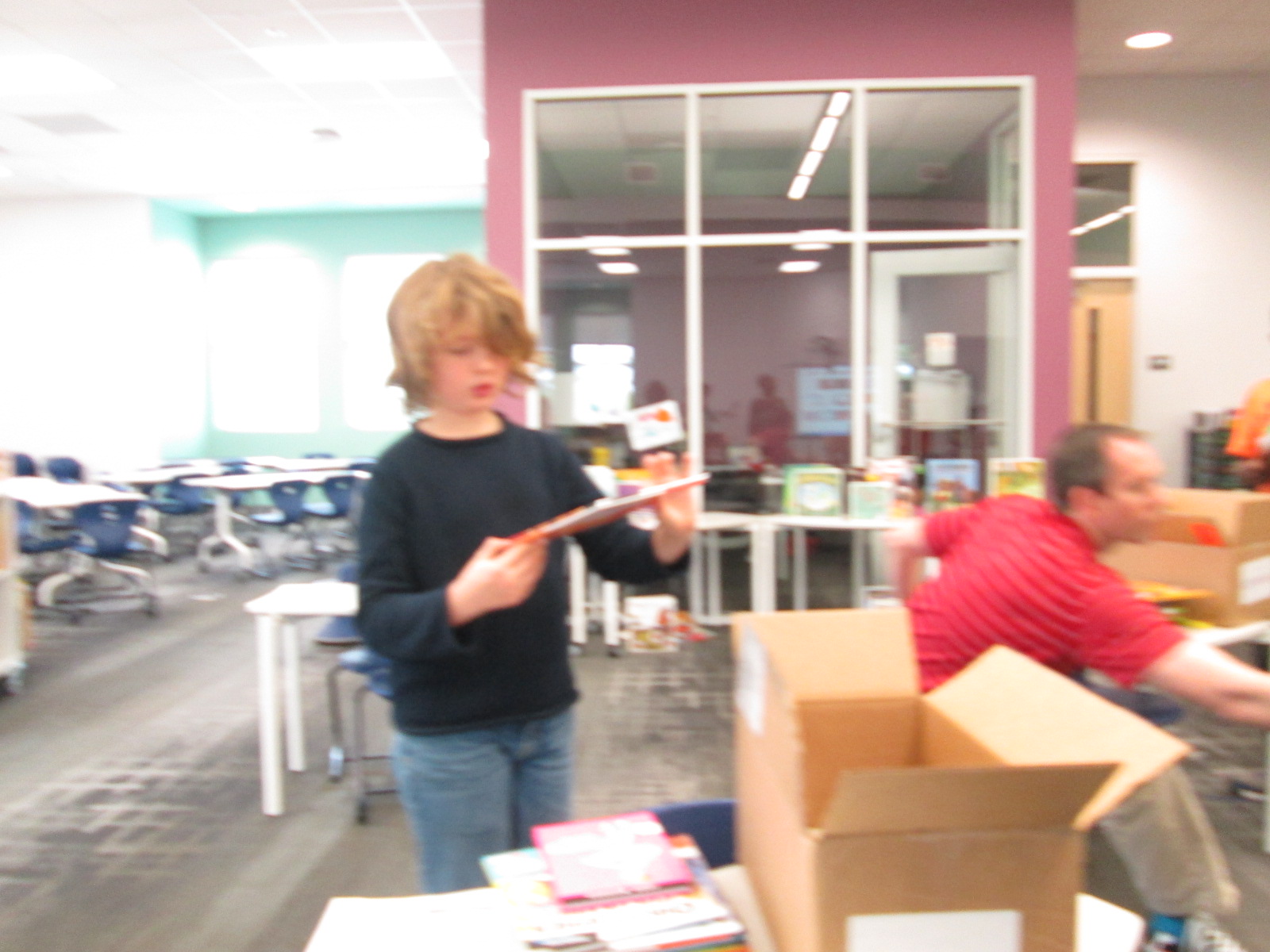
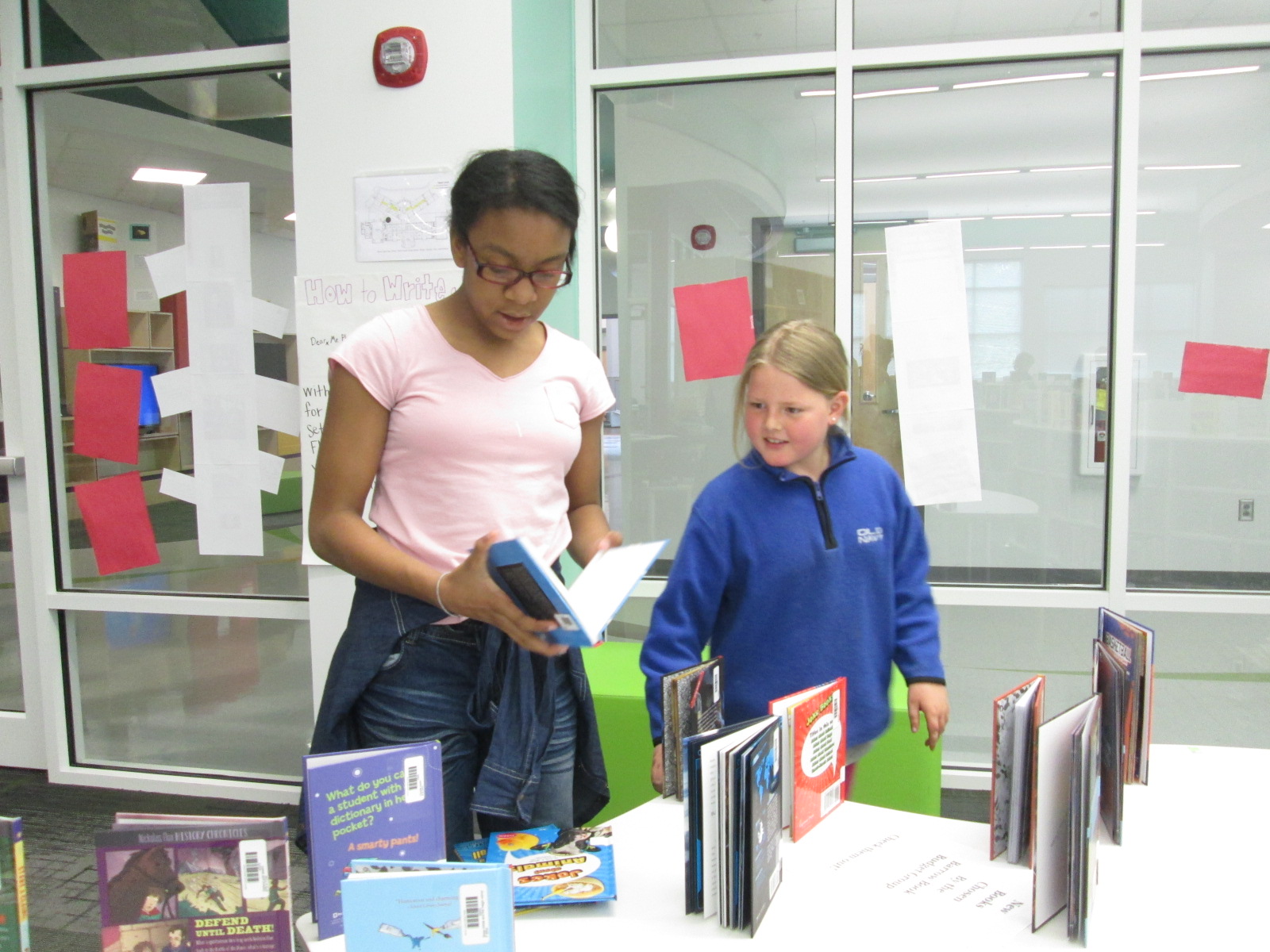
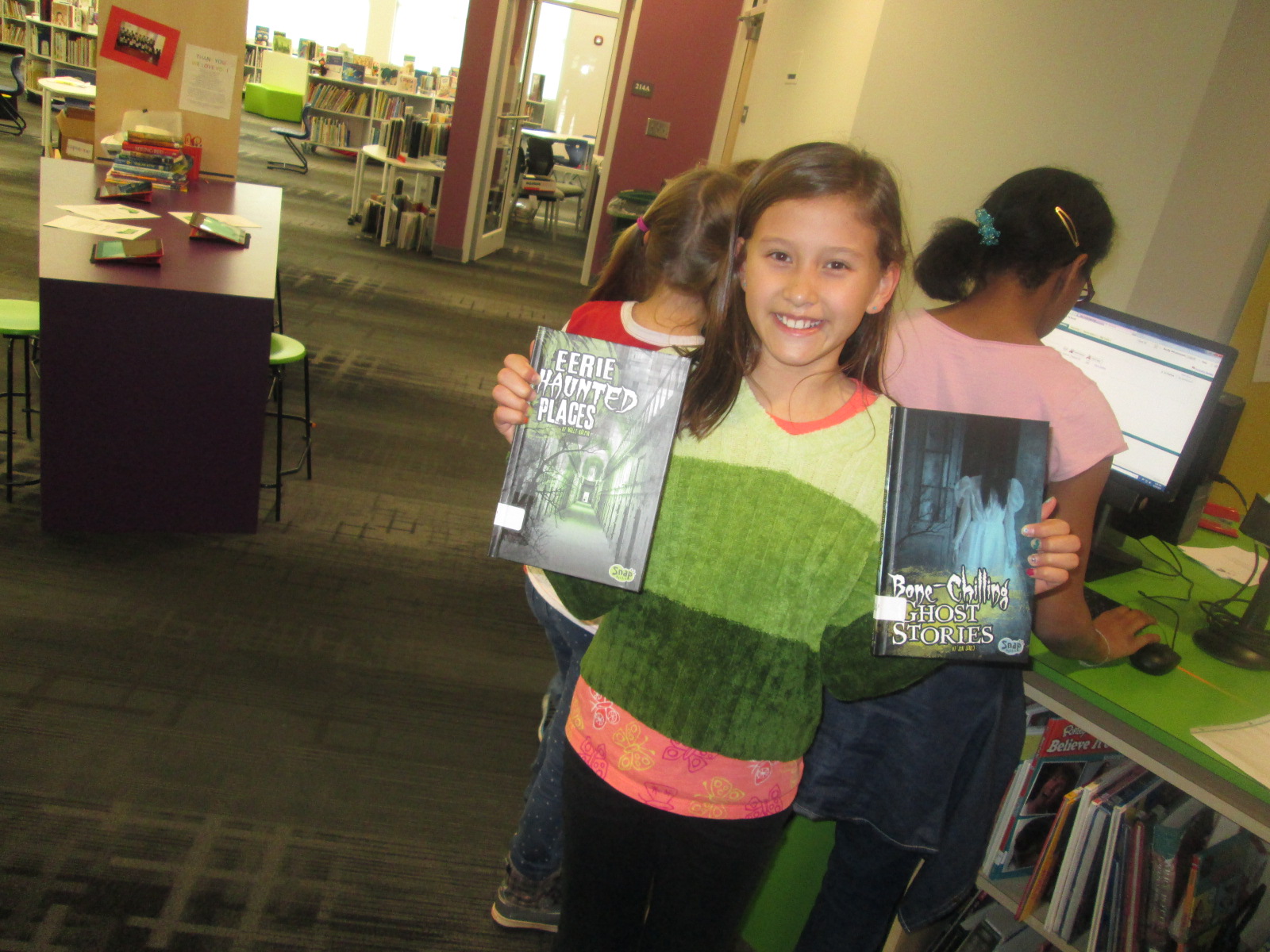
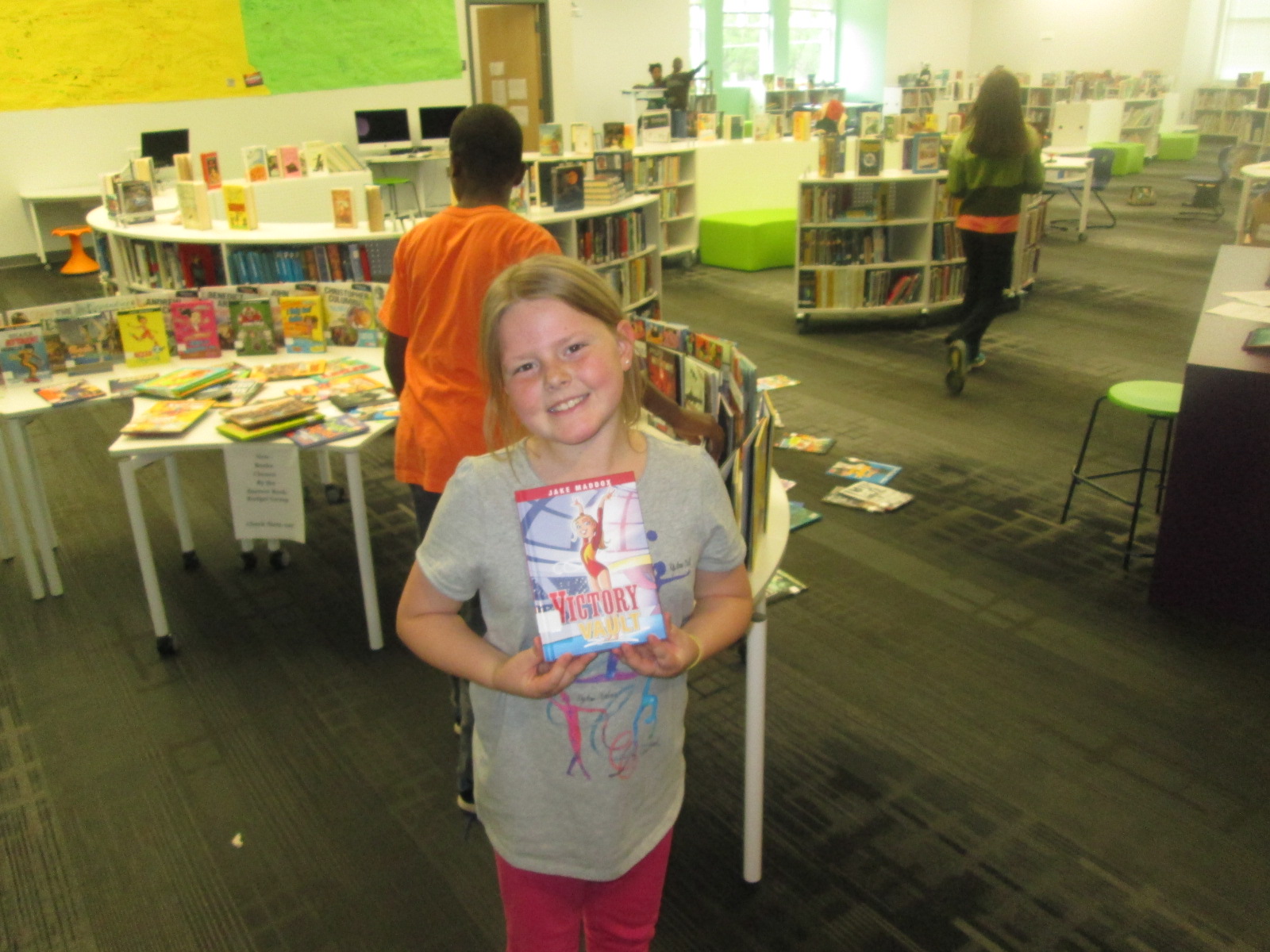
The students in this year’s book budget group have been busy.  We emailed our reading interest survey to all students in our upper grades, but our younger students needed to be surveyed in person.  The book budget crew have carried iPads to recess and lunch as well as picked up iPads before school to survey students.  Over the course of a few days, they have surveyed almost half of our school.

All along the way we have checked the progress in our form by viewing the summary of responses and seeing which grades needed to be surveyed.  We wanted there to be voices from every grade level on the survey.

Finally, we all met in the library for an official meeting to look at the data on the survey.

Discussion

First, the students started picking out the kinds of books that received the most votes.  They made a list of 11 kinds of books.  These books were the ones that received above 60% of the people surveyed who said they liked that kind of book.

Our Goals

The students decided that they wanted to keep this list of 11, so our next step was to decide how to divide our approximate budget of $2000 among the 11 goals.

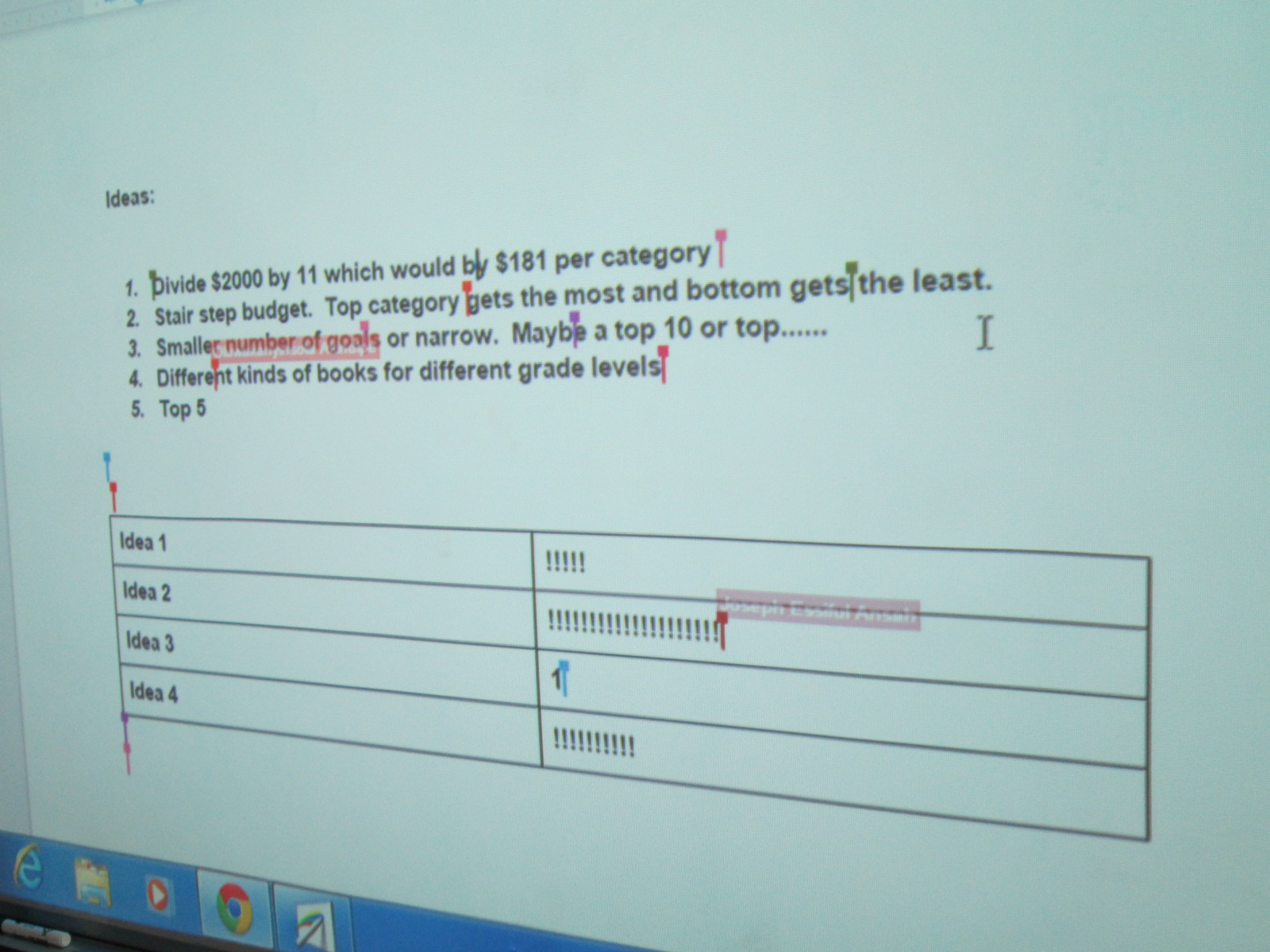
This came with some controversy.  There were lots of ideas.  We decided to make a list of our ideas on our shared Google doc.  Four main ideas came to the surface.

Voting on Budget Plan

1.  Divide the money equally among the 11 goals.

2.  Create a stair step budget or waterfall budget where the top goal on the list got the most money and the last goal on the list got the least.

3.  Narrow the list of goals to a top 10 or top 5.

4.  Focus on different kinds of books for different grade levels based on the survey responsed.


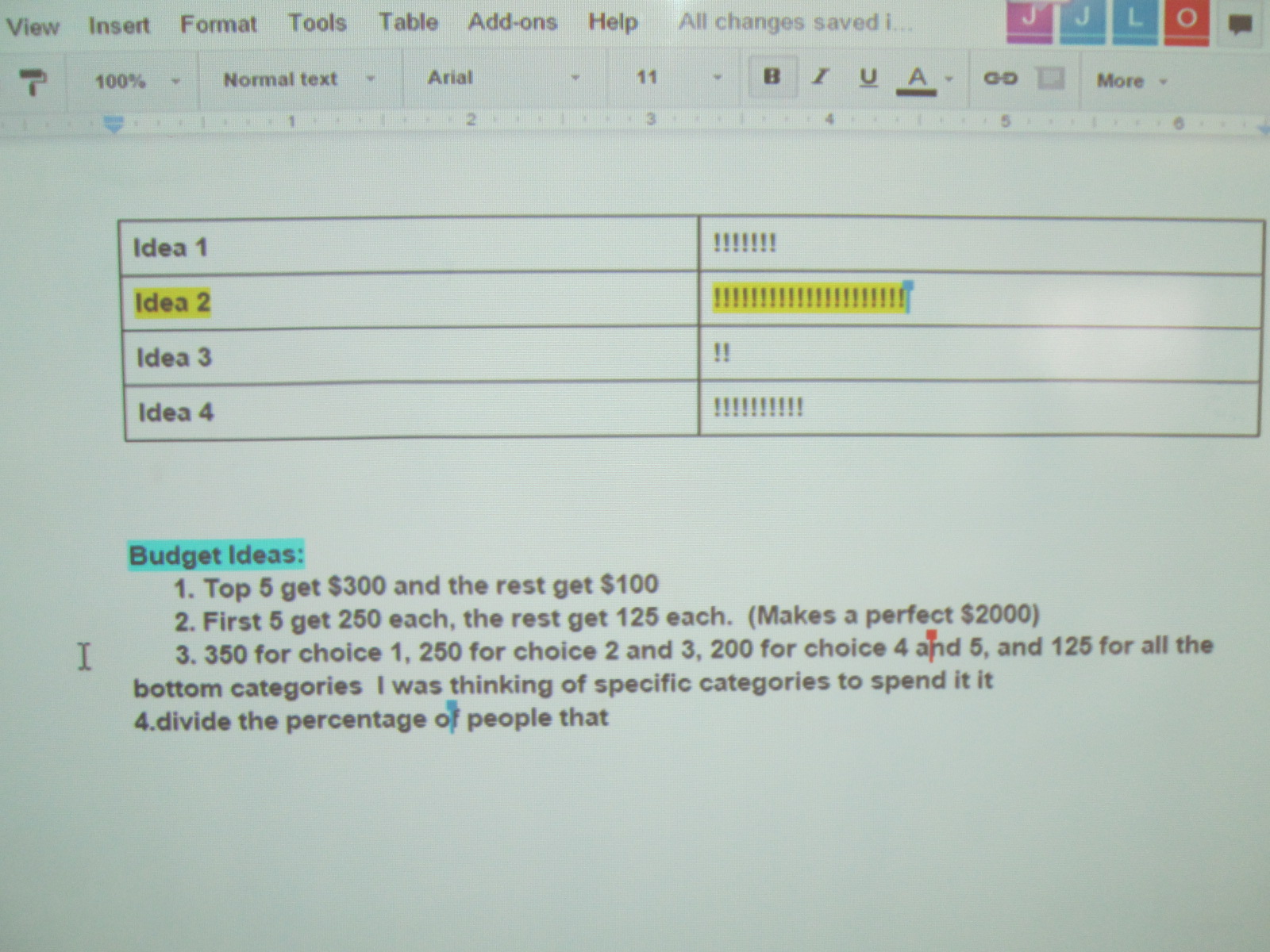
The students voted on these ideas by putting tallies in a table on the Google doc.  The idea of a waterfall budget won the vote, so the next step was to start thinking about how to divide the money among the goals while giving more money to goals requested by more students.  This was even trickier, and we ended up not making a final decision yet.

Voting on Goal Plan


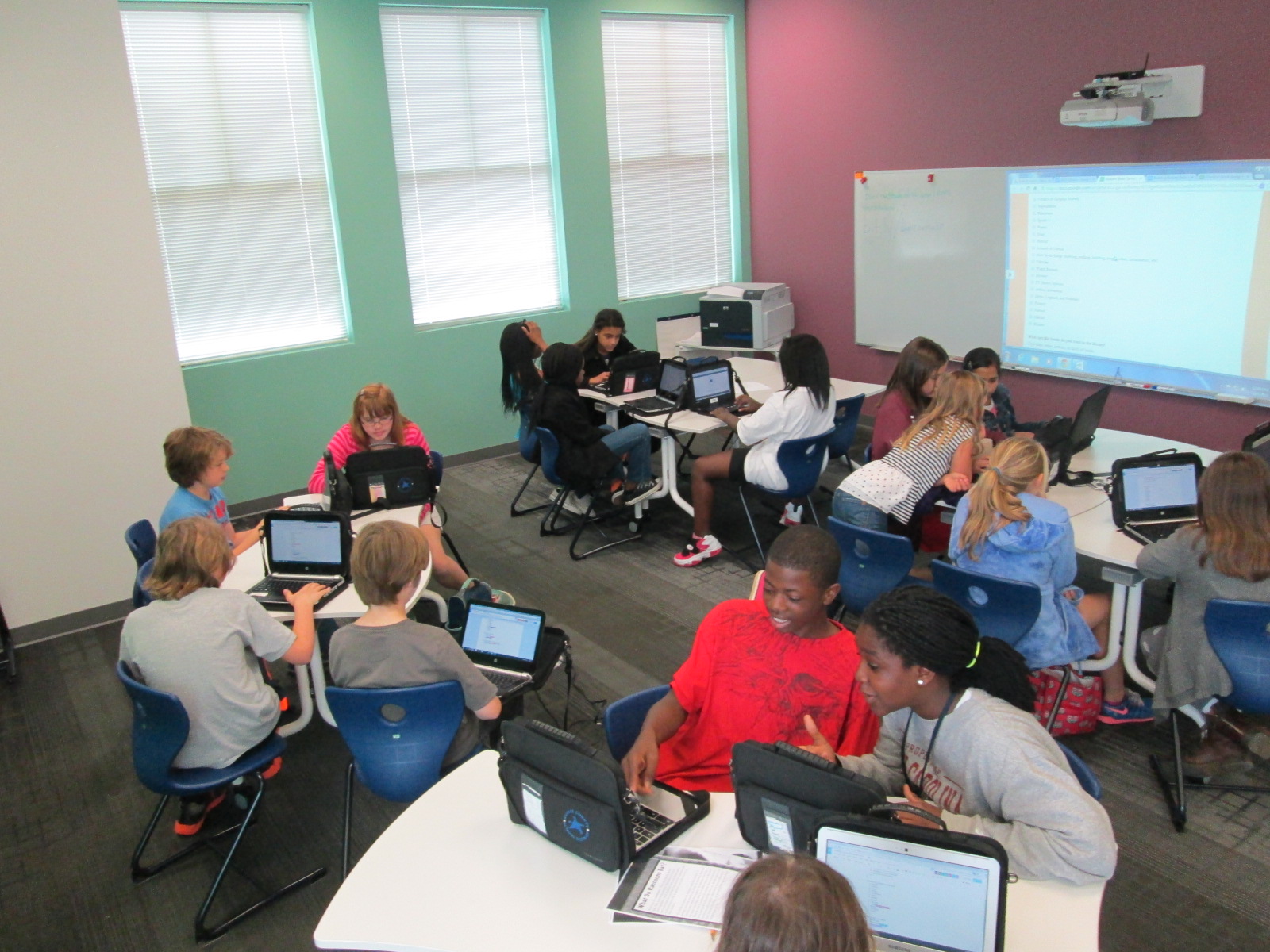
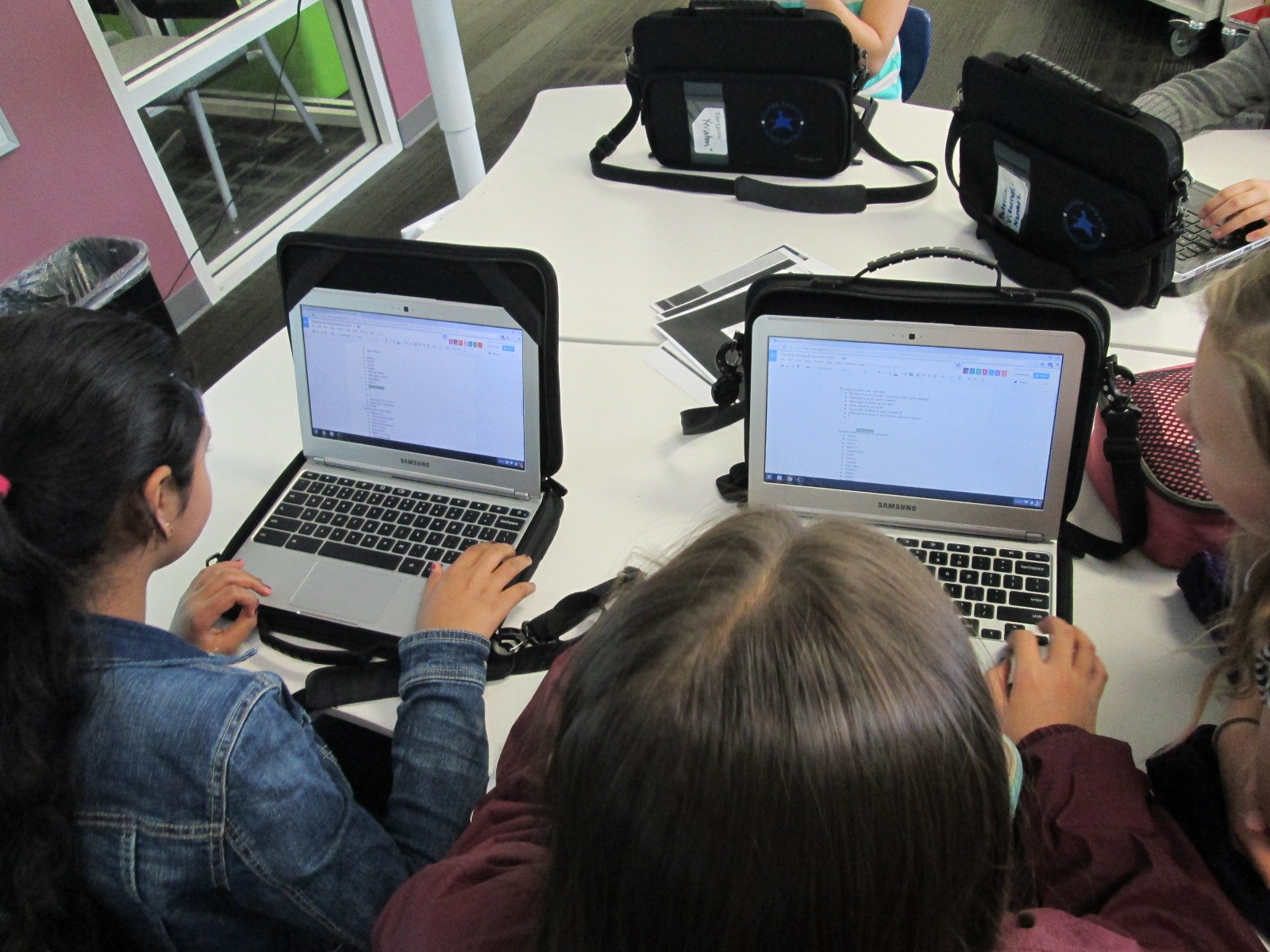
Deciding how to divide the budget really called upon the students’ math skills.  They wrote things on paper, Google docs, and used Google chrome as a calculator to try to add up various amounts to get to $2000 and divide the budget up into multiple categories.  Students were using their problem solving and reasoning skills as they discussed in groups why their various plans worked or didn’t work.  Some were even revisiting the survey data to try to look at percentages on the survey and correlating that to budget percentages.  Math wasn’t just a subject at this moment.  It was a real life skill that was being put into action.

https://twitter.com/capstonepress/status/587723785379250176

Our process was again loud and messy, but I loved how the Google doc allowed us to get lots of voices represented in the conversation rather than hearing from one or two people speaking aloud.

Now that our goals have been decided, we’ve sent these to Avid Bookshop and Capstone Press.  Will from Avid Bookshop will visit the students to book talk some books from Avid that match our goals and Jim Boon from Capstone will share his company’s offerings.  I think the pairing of these two vendors will get the students a great variety of titles to choose from.

I can’t wait to see what they decide.


2015 Student Book Budgets: First Steps

survey production (2)

We are a little late this year, but our student book budget group has finally started.  Each year, I reserve a portion of our library funding and allow students to make the decisions about how that money is spent.  This is more than just having a wish list for students to contribute to.  This is giving them complete control in every part of the decision making process.

survey production (6)

Each year, the groups are chosen in different ways.  This year, I made a video to show to our 4th and 5th graders to explain the project.

Then, I created a Google form that was shared with all of our 4th and 5th graders to tell why they would want to be in the student book budget group.

Aziz Coleman, 4th grade teacher, really wanted his ELT group of 12 fourth graders to be a part of the project, so all of them filled out the form along with about 30 other students.  After reading through the responses, it really seemed like everyone who signed up was genuinely interested in being in the project, so I took them all!

I created a schedule for our meetings along with a timeline of where we are going.  Over the years, I’ve fine tuned the steps that we go through, but student voice and student choice always stays at the center of what we do.

During our 1st two days together, we have focused on creating our survey about reading interests.  I made a contact group with all of the students in my gmail.  That makes it easy for me to invite the entire group as collaborators on docs that we use.  I made 2 docs.  One was a brainstorm doc for us to brainstorm possible things to ask about on the survey.  I thought it would be easier to brainstorm on a doc rather than try to do it all on the Google form.

It was amazing to see so many students working together toward one common cause.

After some brainstorming started, I gave them editing rights to our 2nd doc which was our Google form survey.  We made a copy of last year’s form, and then started using our brainstorming list to make changes.

This was the 1st time I’ve tried collaborating on the Google form.  Usually we just put it up on the board and work together whole group.  I liked seeing every student involved at once, but it was definitely messy.

I checked in with students periodically and gave them some focus.  At times, we broke the tasks up into groups.  For example, one group worked on fine tuning the brainstorm list.  Another group added questions to the survey.  Another group looked carefully at the checklist on the survey to see what needed to be added or changed.

Students worked during their recess, extended learning time, and even left to get lunch and come back.  They were excited and very focused.  There were a few students who started getting off task, so I offered that they might want to go back to recess if they felt like they had contributed their part for the day.  This was totally in their hands, and some of them took me up on the offer.

We are now in the survey process. We want to survey students at every grade level.  We will email the survey to our 3rd-5th graders since they all have a computer and we will use iPads to survey the lower grades.


Click here to view this year’s survey.

Since our meeting time is during a prime lunch time, we have been taking over the lunchroom with iPads to survey students.

Once we have results from the survey we will set goals based on those results and start meeting with our vendors such as Capstone and Avid Bookshop.

New Year’s Resolutions: The Barrow 2015 Reading Challenge

2015 Barrow Reading Challenge   Google Docs

One of the new traditions at our school is to hold a schoolwide assembly when we come back from winter break.  This assembly focuses on goal-setting.  The new year is often a time to make resolutions, but in the education world it is a time to check in with the progress made in the first half of the year and think about what we strive to accomplish in the second half of the year.  Last year, I invited all of our students, teachers, and families to join me in “expecting the miraculous”.  We created a Flipgrid where we shared our expectations for 2014 and “expect the miraculous” because a common mantra in our school.  My principal asked if I would once again share something at this assembly.  I wasn’t quite sure what to share at first, so I spent some time thinking about the goals for the library that I established over the summer.  One of those goals is to “support the reading habits and curiosities of students, teachers, and families.  I’ve done several things so far this year to support this goal.  We’ve held 2 author visits, a storybook celebration, Polar Express Day, a picture book month challenge, and a picture book smackdown.  However, I feel like I haven’t done something that really encourages reading a variety of texts for students, teachers, and families.

Barrow 2015 Reading Challenge

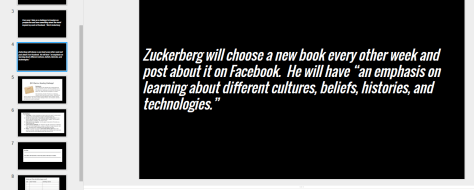
As I was pondering, I was reminded of something in my Facebook feed about Mark Zuckerberg’s new year’s resolution.  Each year he “takes on a challenge to broaden his perspective and learn something about the world beyond his work at Facebook.”  This year, a crowdsourced list helped him decide on his resolution.  He will choose a new book to read every other week and post about his learning on Facebook.  His selections will have “an emphasis on learning about different cultures, beliefs, histories, and technologies.”

I thought this idea would make an interesting challenge for our students, teachers, and families.  What if we invited students, teachers, and families to choose a reading goal for themselves?  Maybe it could be something they want to learn more about.  Maybe it could be about selecting books from a genre that they haven’t tried.  The goal would be completely up to them.

The second piece of Zuckerberg’s goal is a frequency of reading, so I wondered what it would be like to invite students, teachers, and families to choose a number of books to read across the next 3 months of school or a goal for how often they might finish a book.

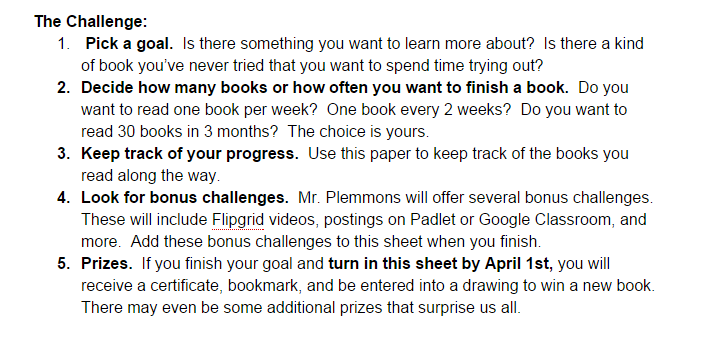
The 2015 Barrow Reading Challenge was born.  I created a log that explained the challenge.  I made 2 versions.  One could be copied to hand out to our prek-2nd grade students who do not have 1 to 1 computers.  The second version could be digitally shared with students.

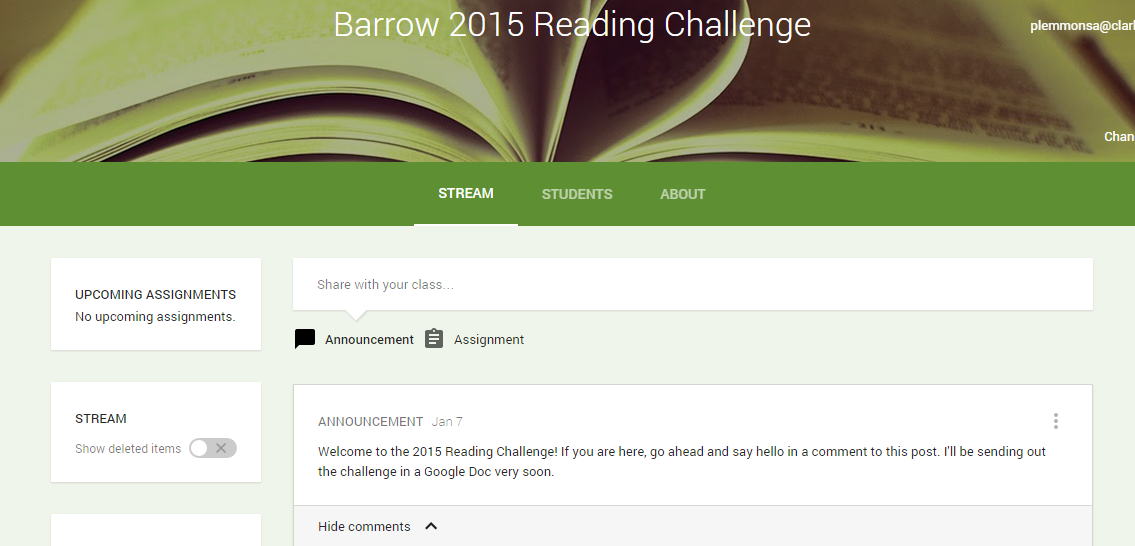
Since our 3rd-5th grade students are 1 to 1, I setup a Google Classroom and sent an email to all students inviting them to join the classroom if they wanted to participate in the challenge.  Once students join, I will assign the Google doc reading log to all of them so that they have their own copy to edit and turn in by April 1st.

2015 Barrow Reading Challenge   Google Docs challenge

In addition, our principal will email the digital copy of the reading log to all families on her listserv and I will copy additional paper copies to have on hand in the library.

Slideshow

I made a slideshow to show students, teachers, and families at our assembly.  It includes slides on the story of where this challenge came from as well as the details.  I hope the assembly will get the whole school excited about participating.

Along the way, I hope to spark some conversations about what we are reading within the Google Classroom as well as offer opportunities for all students, teachers, and families to talk about their reading through tools like Flipgrid, Padlet, and our library glass board.

Once the challenge ends, I hope people will consider continuing their challenge through the year.  There will of course be some rewards beyond accomplishing your goals.  Participants who turn in a log will receive a certificate, a bookmark, and be entered into a drawing for lots of new books and anything else I can round up over the next 3 months!

I can’t wait to see  what happens.  We will continue to expect the miraculous, and I hope to see lots of people join in the challenge and fun.

Participating in World Book Night 2014

Last year was the first year that the Barrow Media Center participated in World Book Night.  It was such a fun and rewarding experience, that I knew we had to do it again.  On World Book Night, each “giver” receives 20 copies of a certain book to hand out in the community.  The process is really simple.  A few months before April, applications open.  You submit an simple application explaining how you will hand out the books.  If your application is approved, you select where you will pickup your books.  I always pick mine up at our local independent bookstore, Avid Bookshop.  They hold an event where givers can meet one another and exchange of ideas of how to hand out the books in the community.  Then, on April 23, you hand out your books.

Here’s a little more from the World Book Night website,

World Book Night is an annual celebration dedicated to spreading the love of reading, person to person.  Each year on April 23, tens of thousands of people go out into their communities and give half a million free World Book Night paperbacks to light and non-readers.

World Book Night is about giving books and encouraging reading in those who don’t regularly do so. But it is also about more than that: It’s about people, communities and connections, about reaching out to others and touching lives in the simplest of ways—through the sharing of stories.

World Book Night is a nonprofit organization. We exist because of the support of thousands of book givers, booksellers, librarians, and financial supporters who believe in our mission. Successfully launched in the U.K. in 2011, World Book Night was first celebrated in the U.S. in 2012.

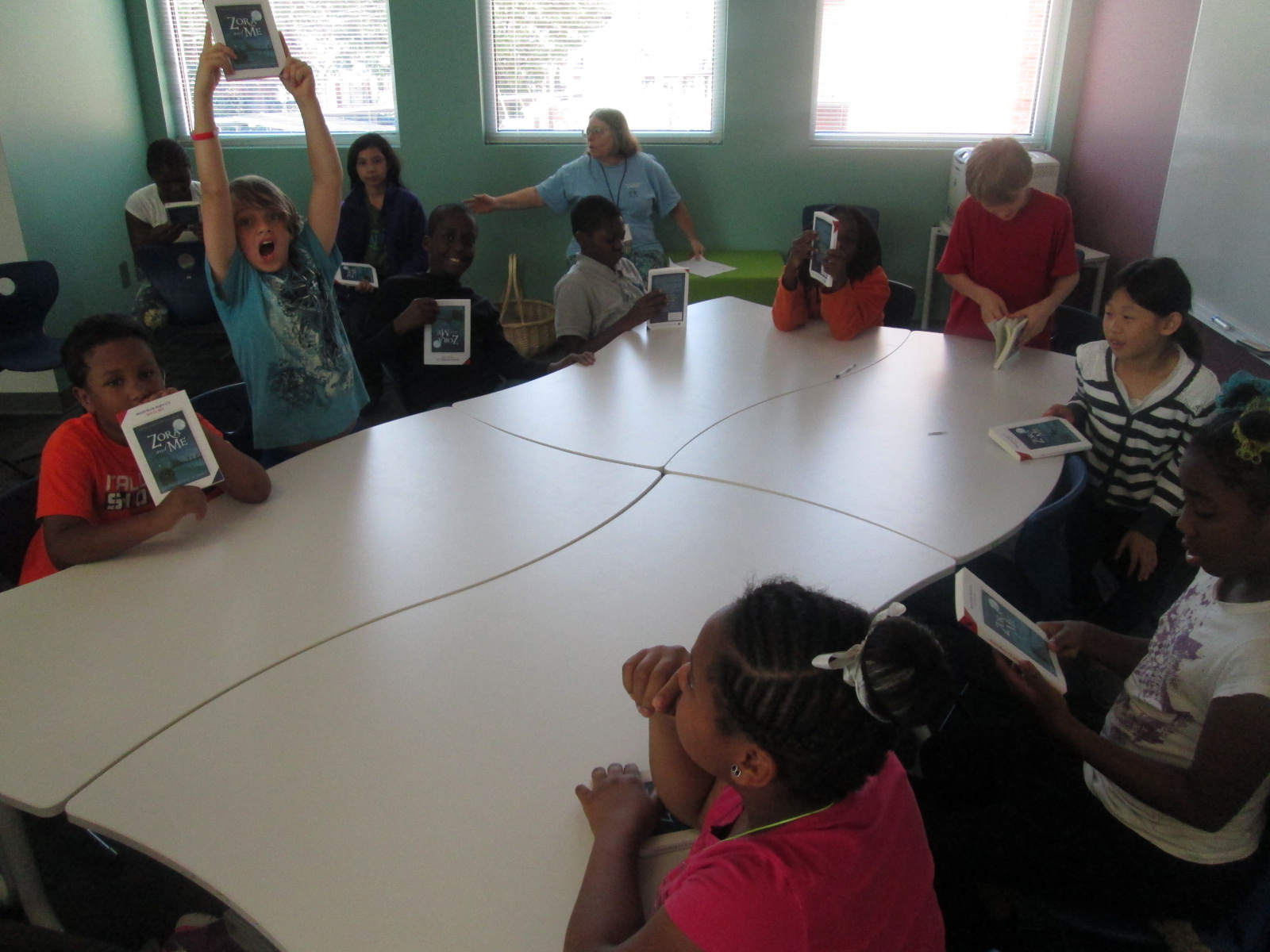
This year, my book was Zora and Me by Victoria Bond and T.R. Simon.  I was so happy that this was the book I was selected to give because it’s a book that I’ve hoped many of our students would pick up.  Rather than randomly hand the book out in our community, I decided to target specific students in our school.  Teachers in 4th and 5th grade helped me select 20 students via a Google doc.  Each student was chosen for various reasons.  There was no set in stone way to choose a student other than we wanted to put the book in the hands of a student who could use a new book in their home library and who would enjoy reading this book.

IMG_3037IMG_3024


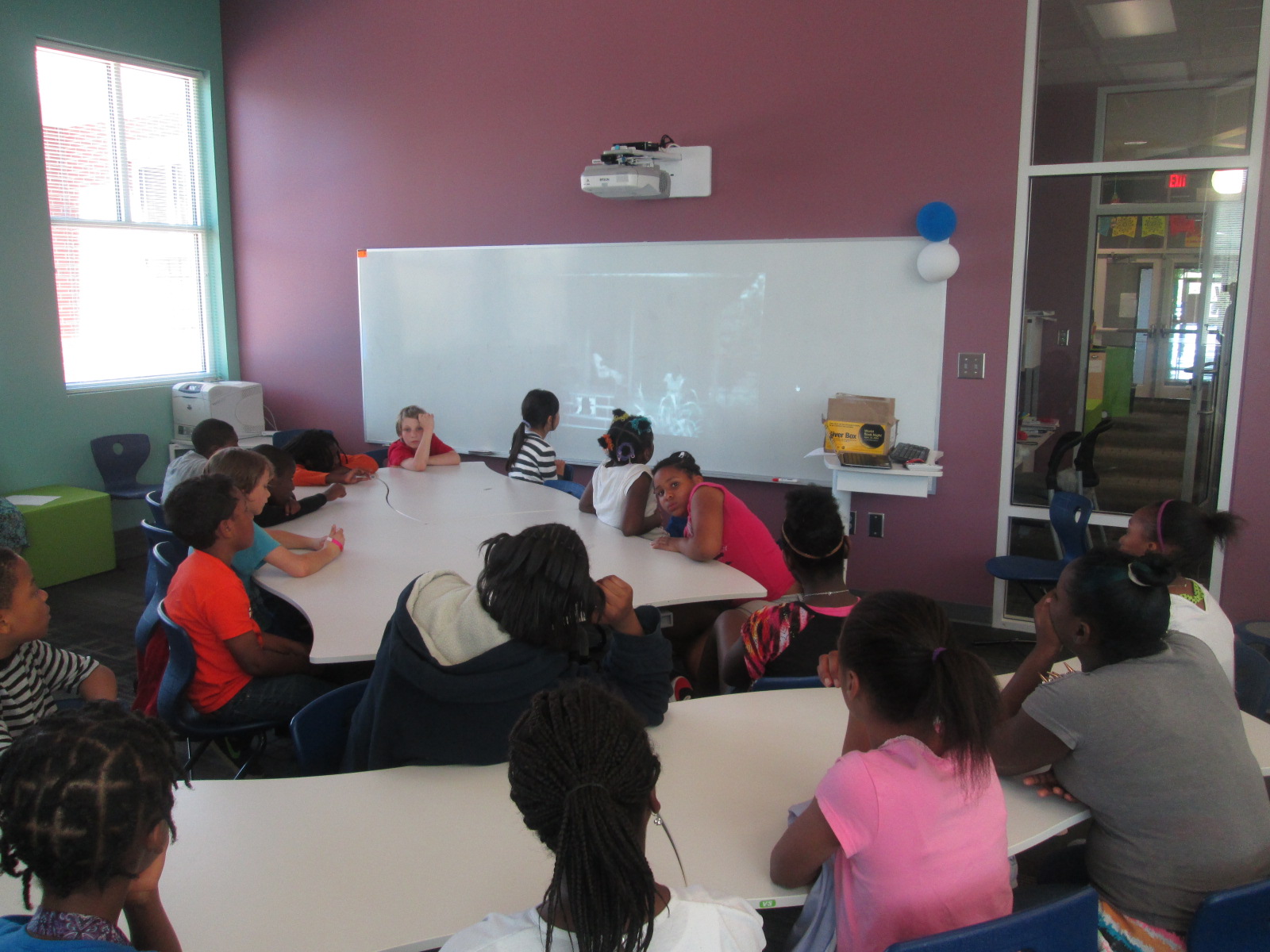
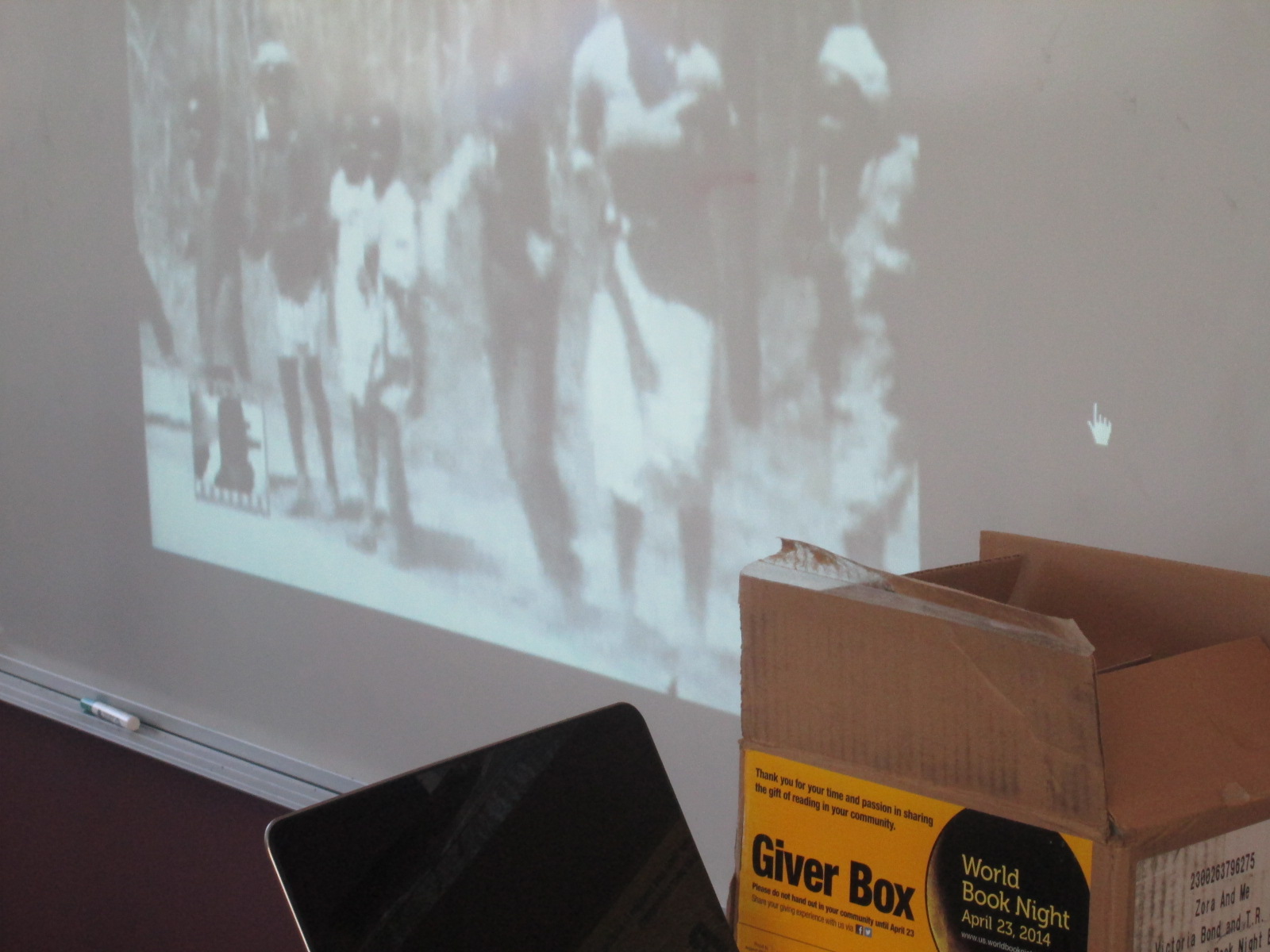
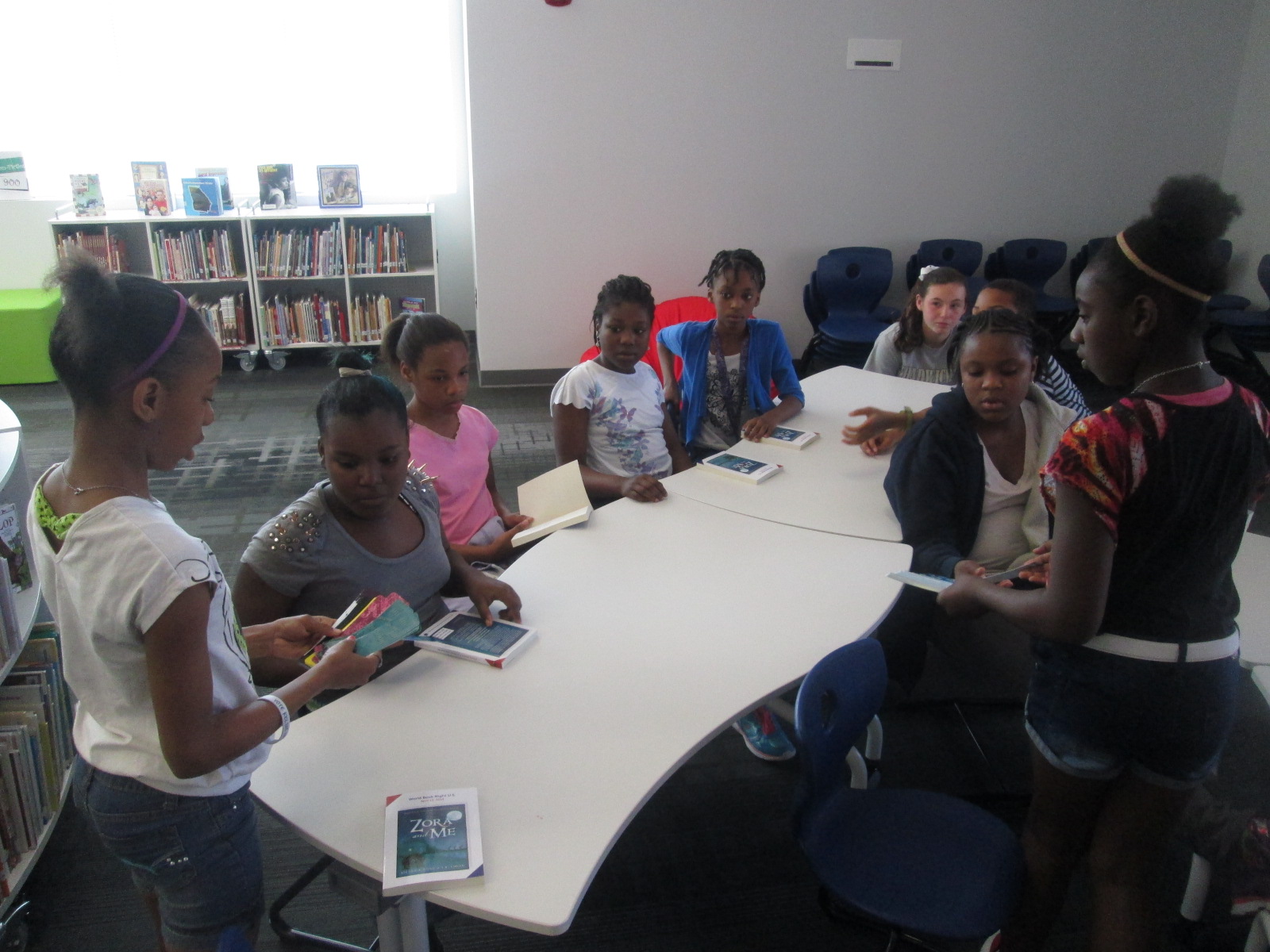
At 1:00, all of the students came to the library.  I told them about World Book Night and we visited the World Book Night website.   I told them about being a giver and picking up my books at Avid Bookshop.  Then, I showed them the book.  We visited the Candlewick site where we could watch a trailer for Zora and Me.  I read the back of the book to all of the students.

IMG_3025

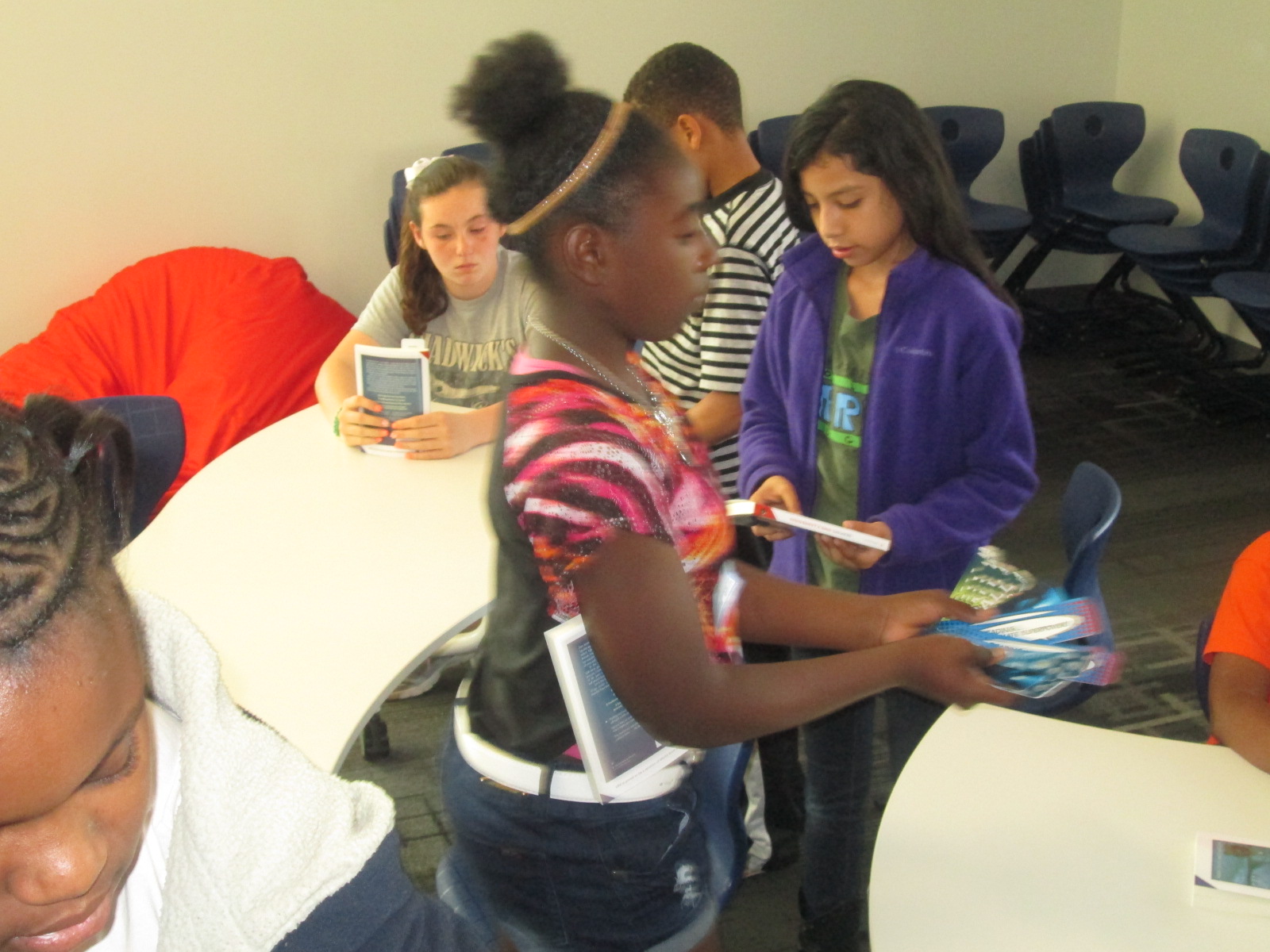
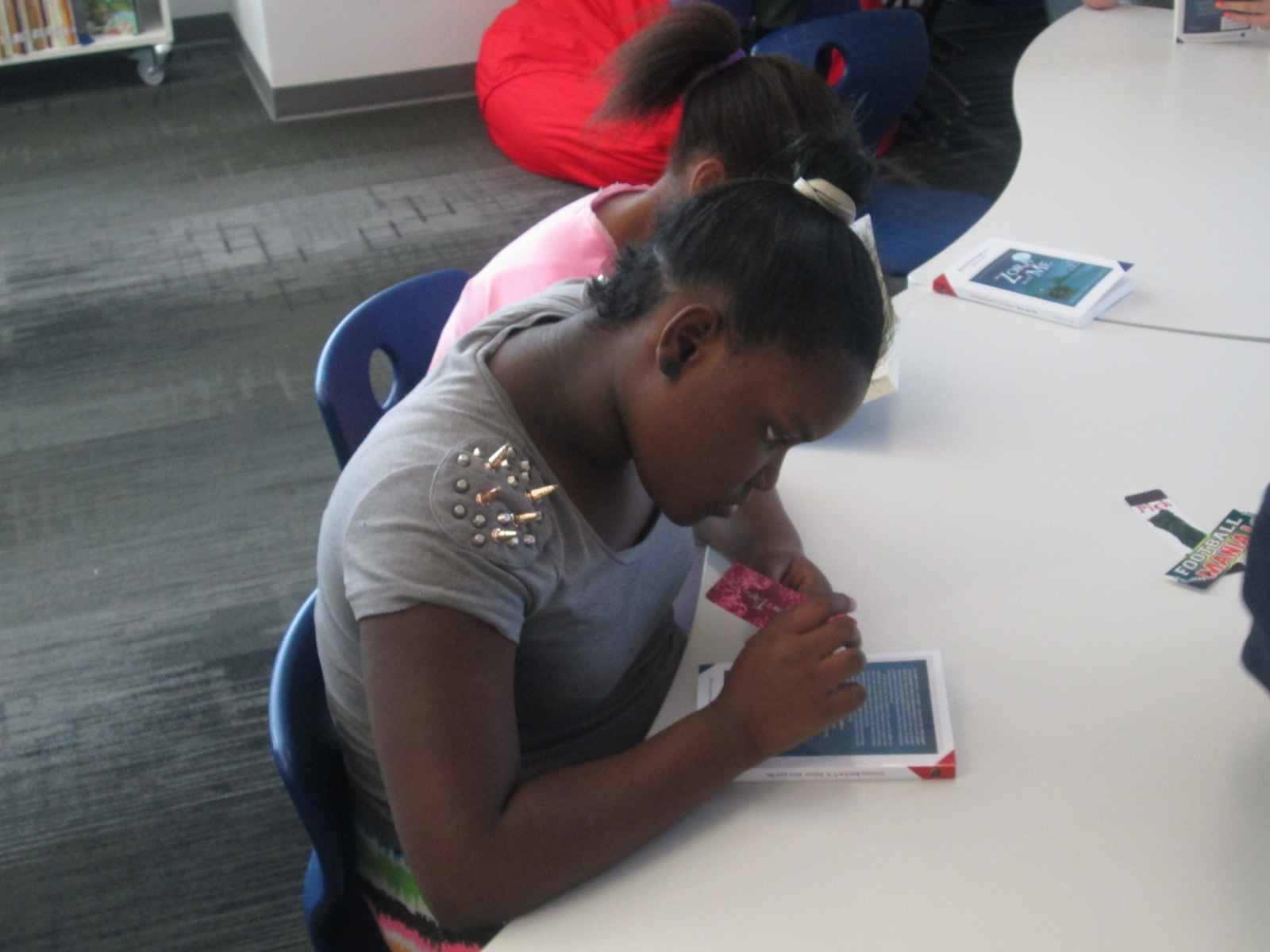
Then, I got to say the words I was so excited to say…”I’m giving a copy of Zora and Me to all of you.  Every single student was so excited.  Some of them jumped up to help pass them out to the group.  I loved watching them immediately open the book and start reading it.  I also gave them all a bookmark.

IMG_3029 IMG_3027 IMG_3026

I told them that my hope is that they would read the entire book, share it with their families, tell me what they thought of, and cherish the book as a part of their home libraries.  I look forward to hearing from them very soon.  One student told me she would probably have it finished by tomorrow!

IMG_3032

World Book Night is an amazing experience.  It seems small when you first sign up, but you are filled with emotion when you put your book in someone’s hand with the wish that they will read it and love it.

IMG_3035

Our Student Book Budget Order from Capstone Has Arrived!

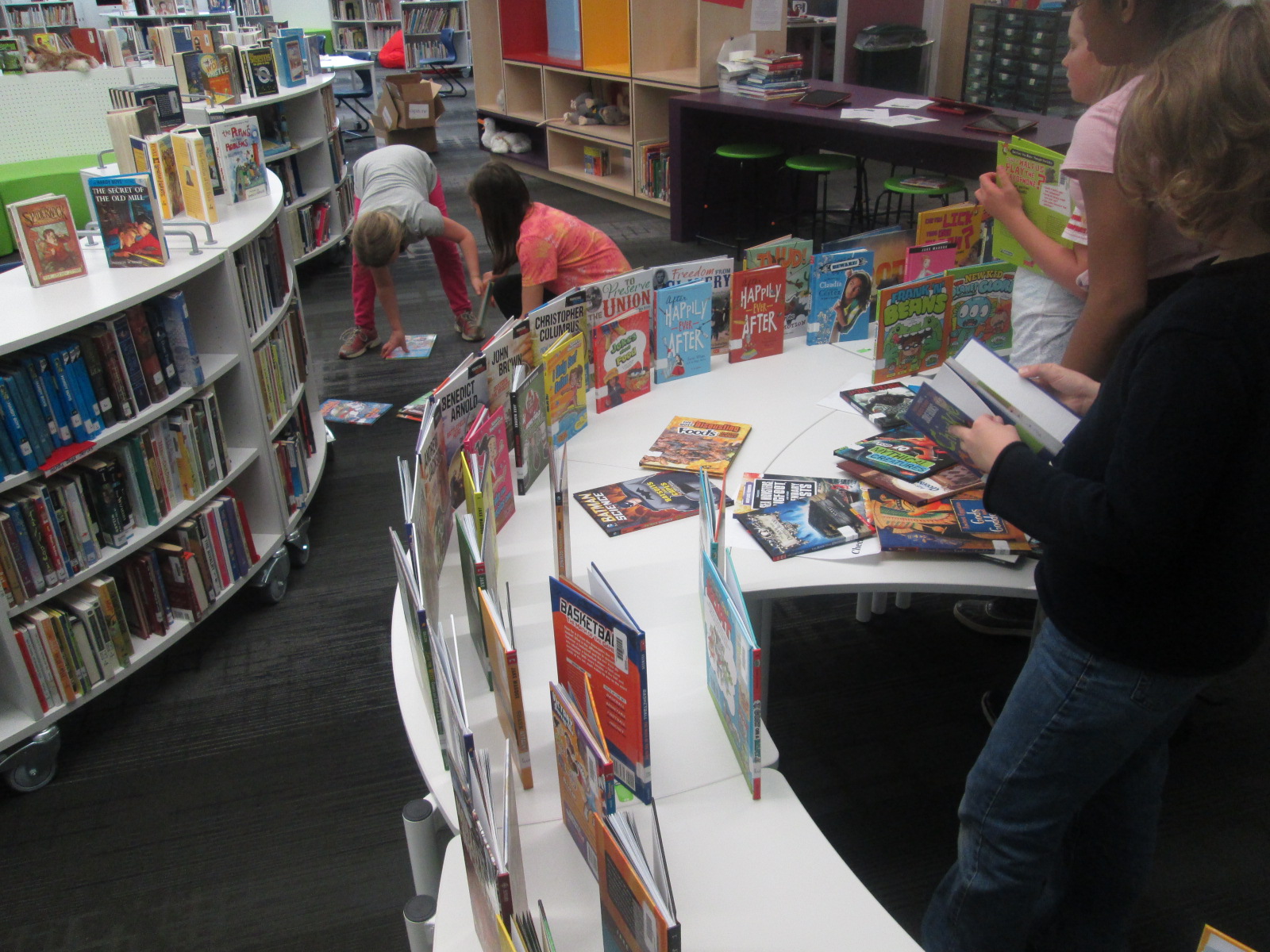
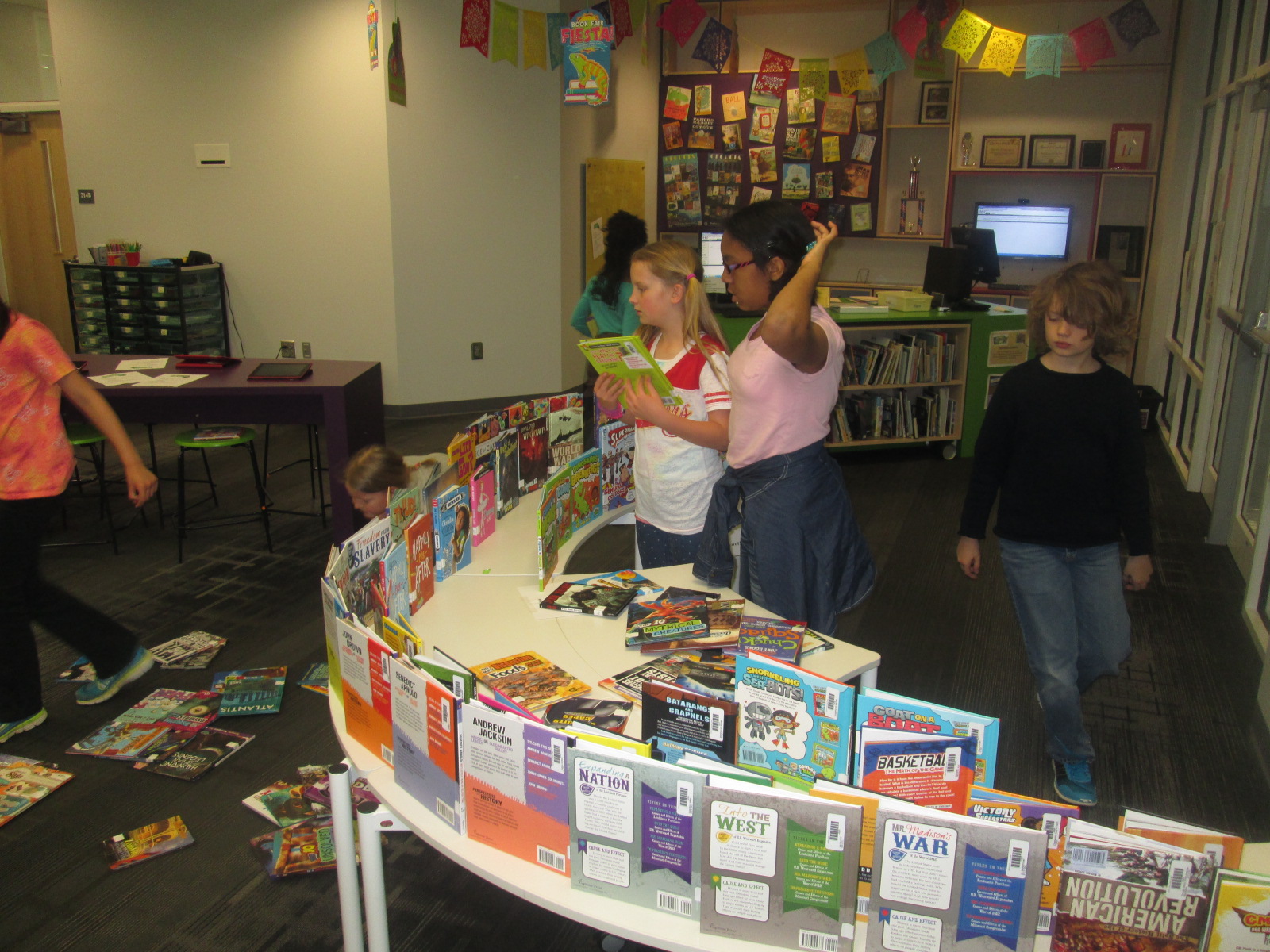
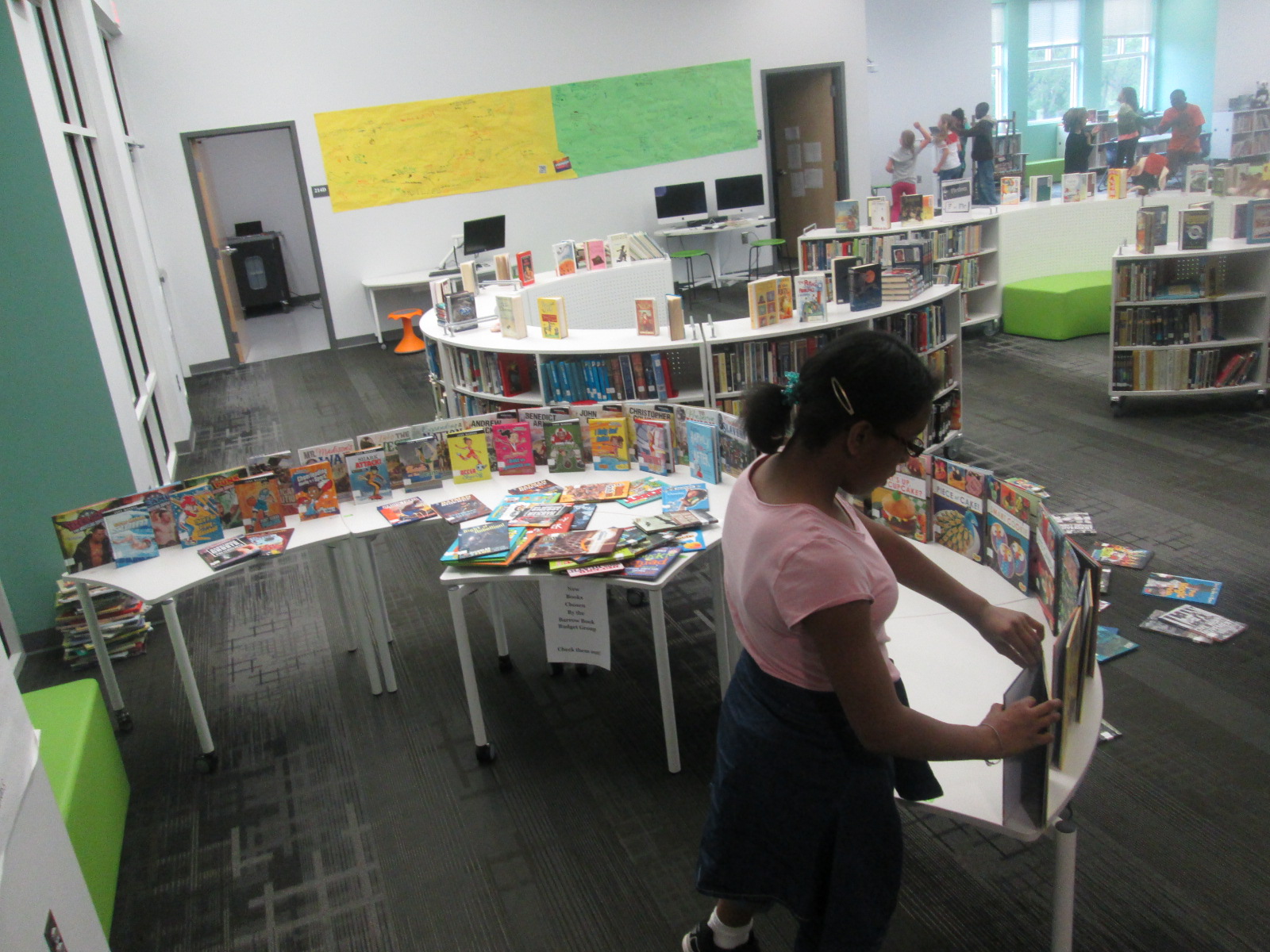
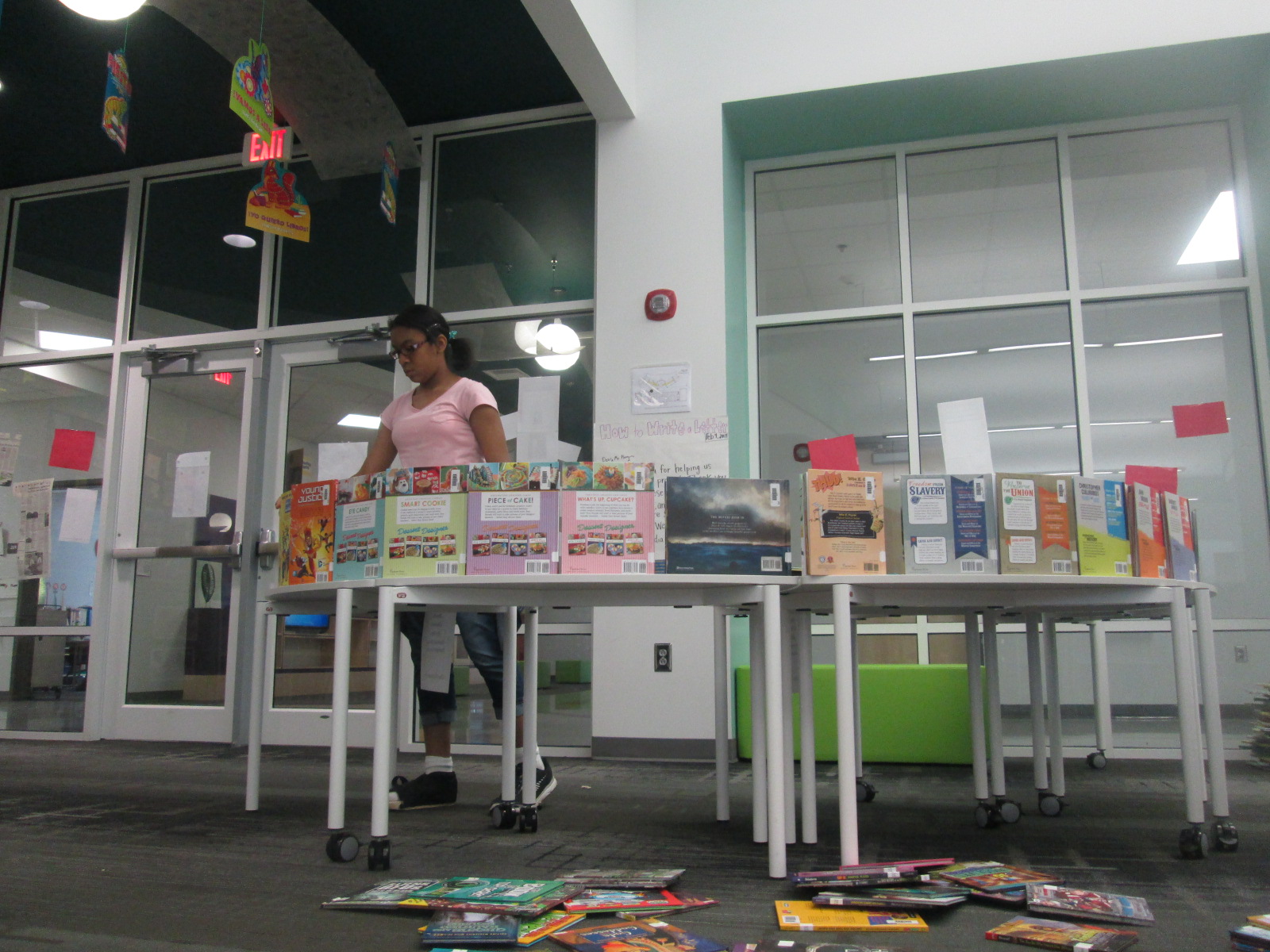
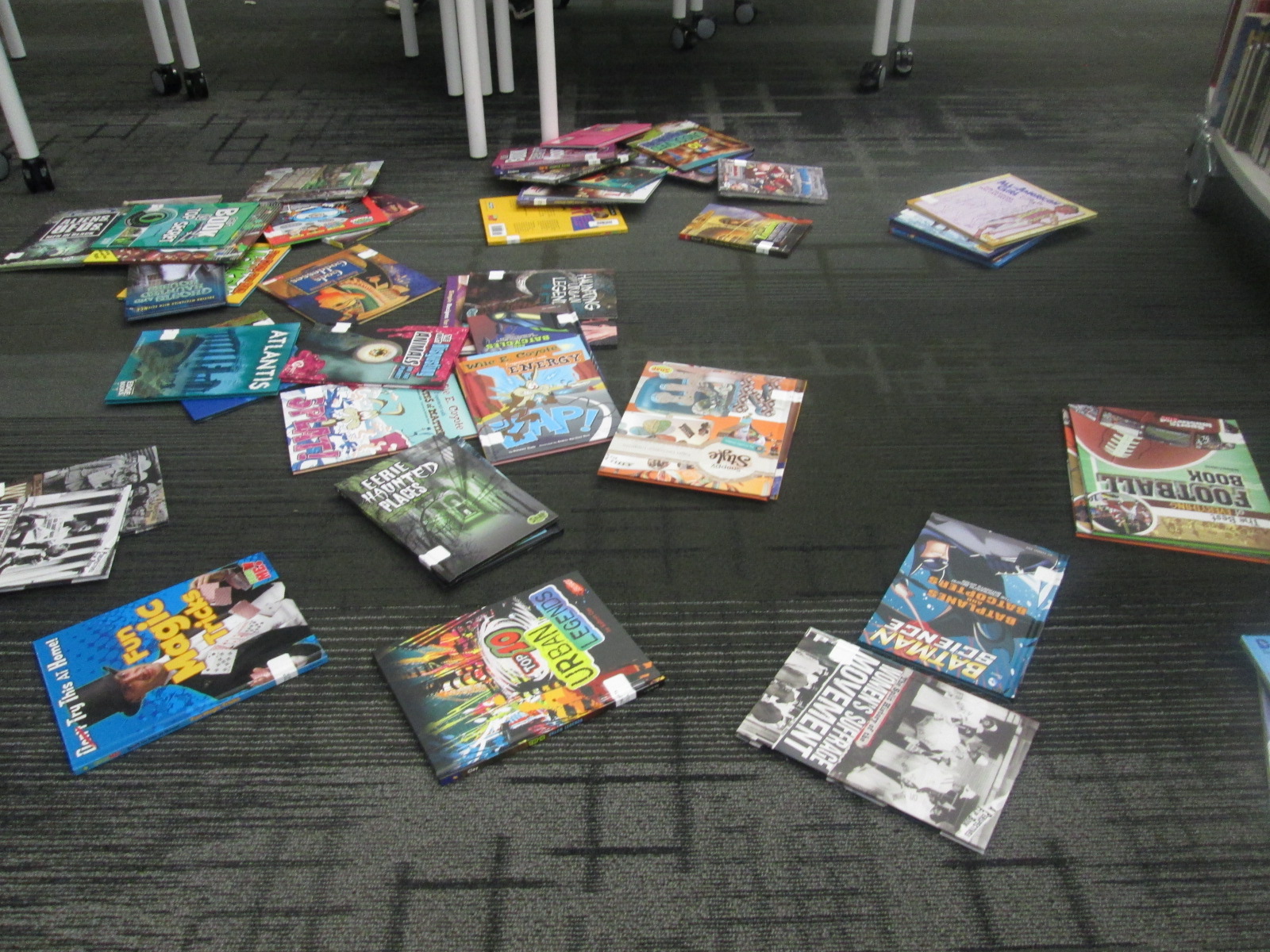
IMG_3014Each year when students participate in the student book budget group, the most exciting day for them is the day that we unpack the boxes when they arrive.  It’s the day that all of their hard work and tough decisions pays off.  After surveying almost the entire school, setting goals, meeting with vendors, creating wish lists, cutting books from the lists to fit the budget, and placing the order, the students finally get to hold books  in their hands.

Today our order from Capstone came.  We love buying books from Capstone each year for many reasons.  One reason is that their books are popular with our students.  We also love their customer service.  Our sales representative, Jim Boon, always comes in and helps students with the book selection process.  We also love how Capstone stretches our budget.  This year’s order from Capstone was $1750, and with Capstone’s current promotion, we earned an additional $525 in books.  When we were unpacking the order today, a student said, “Capstone Rewards sure does help us get a lot of extra books.”  I love that this project really pushes students each year to think about fiscal responsibility and how to stretch a dollar.

Just like every other step of the way, the students are involved in every step of unpacking the books.  We basically form an assembly line.

Some students pull books out of the boxes and inspect them for any damage.  There’s usually not any, but we always check.

IMG_2951

Another student takes these books and highlights each one on the packing slip to make sure they are all accounted for.  Today, I helped with the highlighting process because there were so many books to take through the entire process in only 45 minutes.

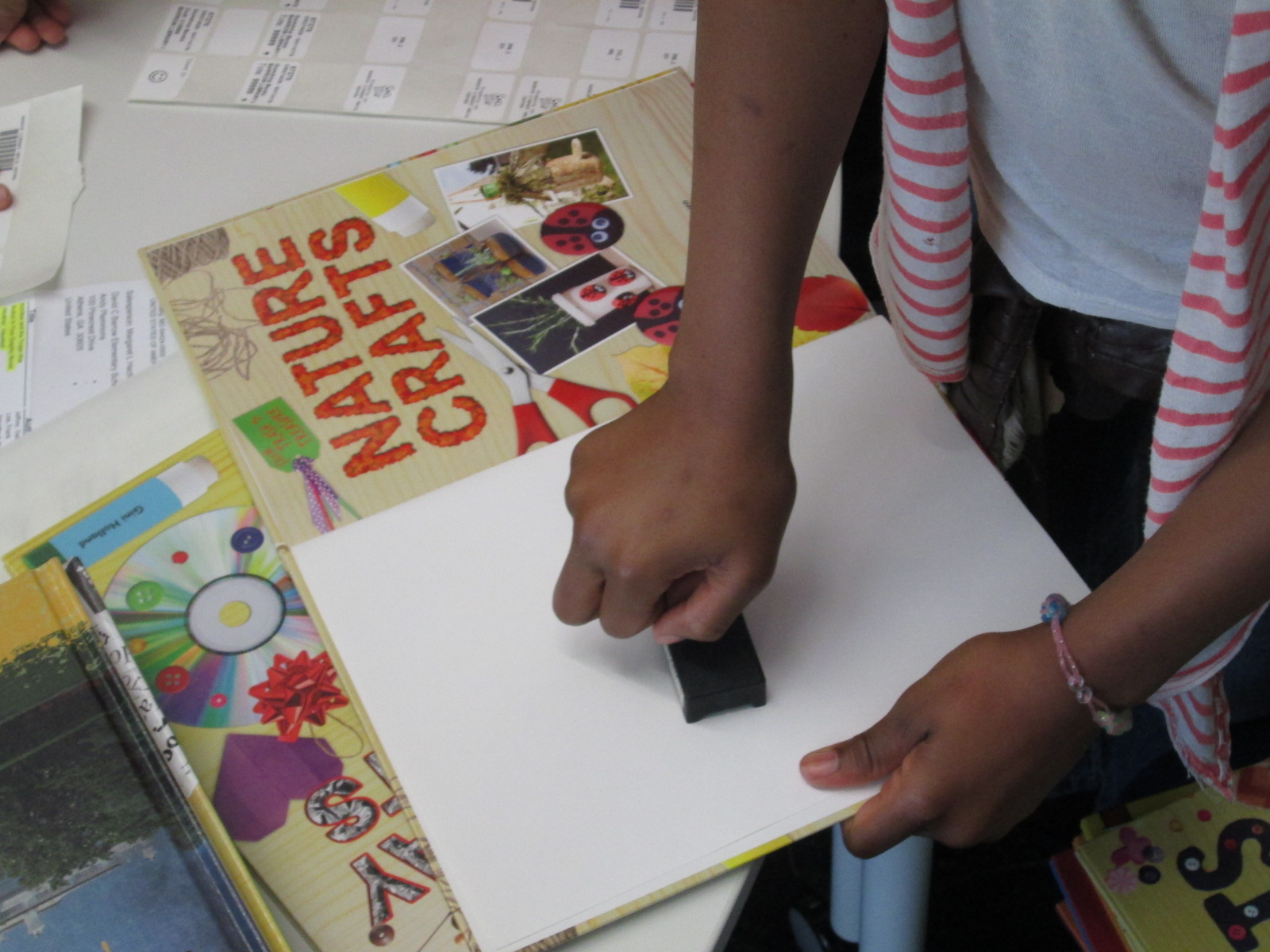
These books then go to a student who stamps them with our library stamp.

IMG_2938

From there, a group of students takes pictures of the covers to put into an Animoto to show on our morning broadcast.

IMG_2942 IMG_2949

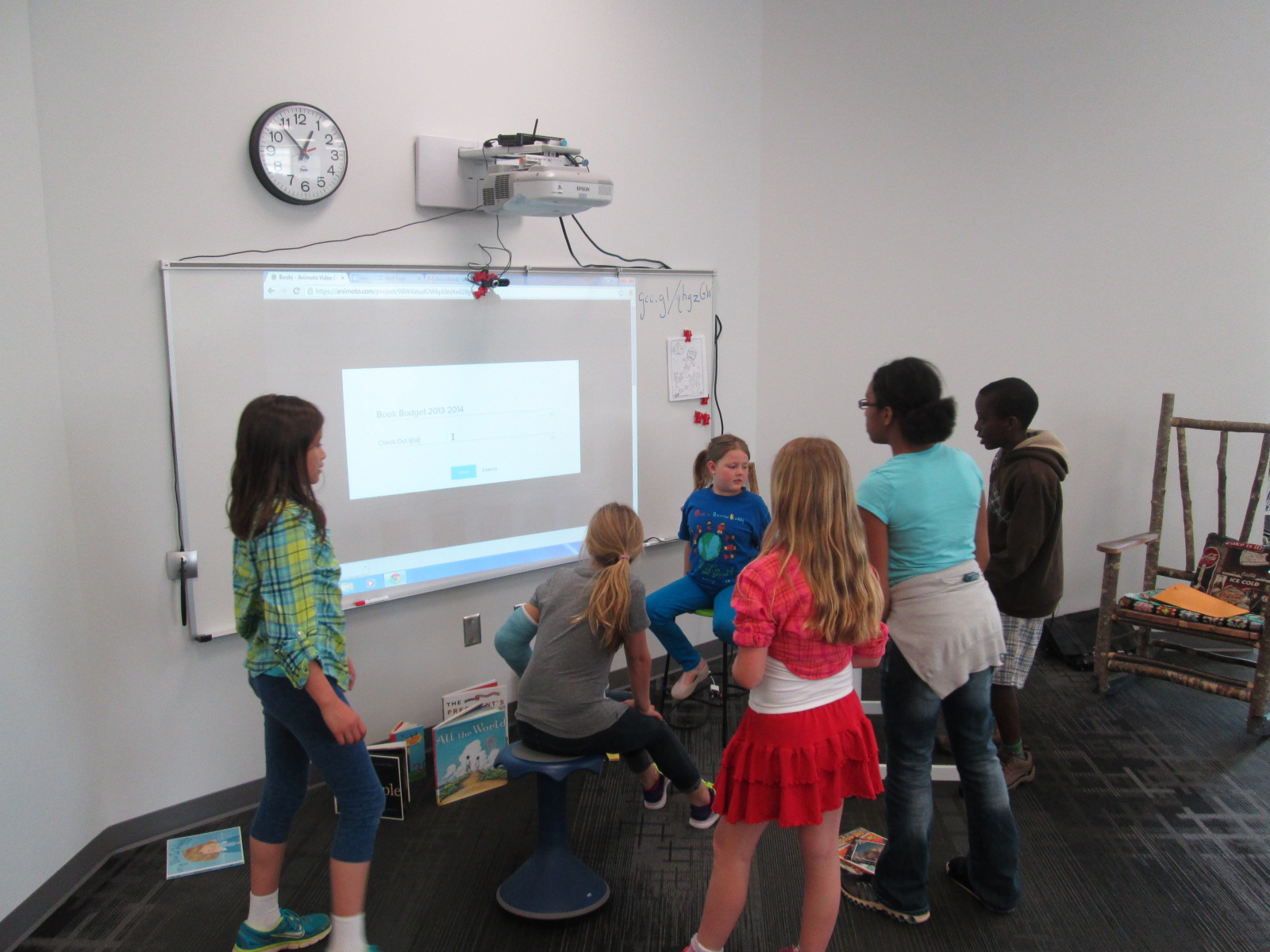
When all pictures are taken, the pictures are uploaded to Animoto by another group of students.

IMG_3009

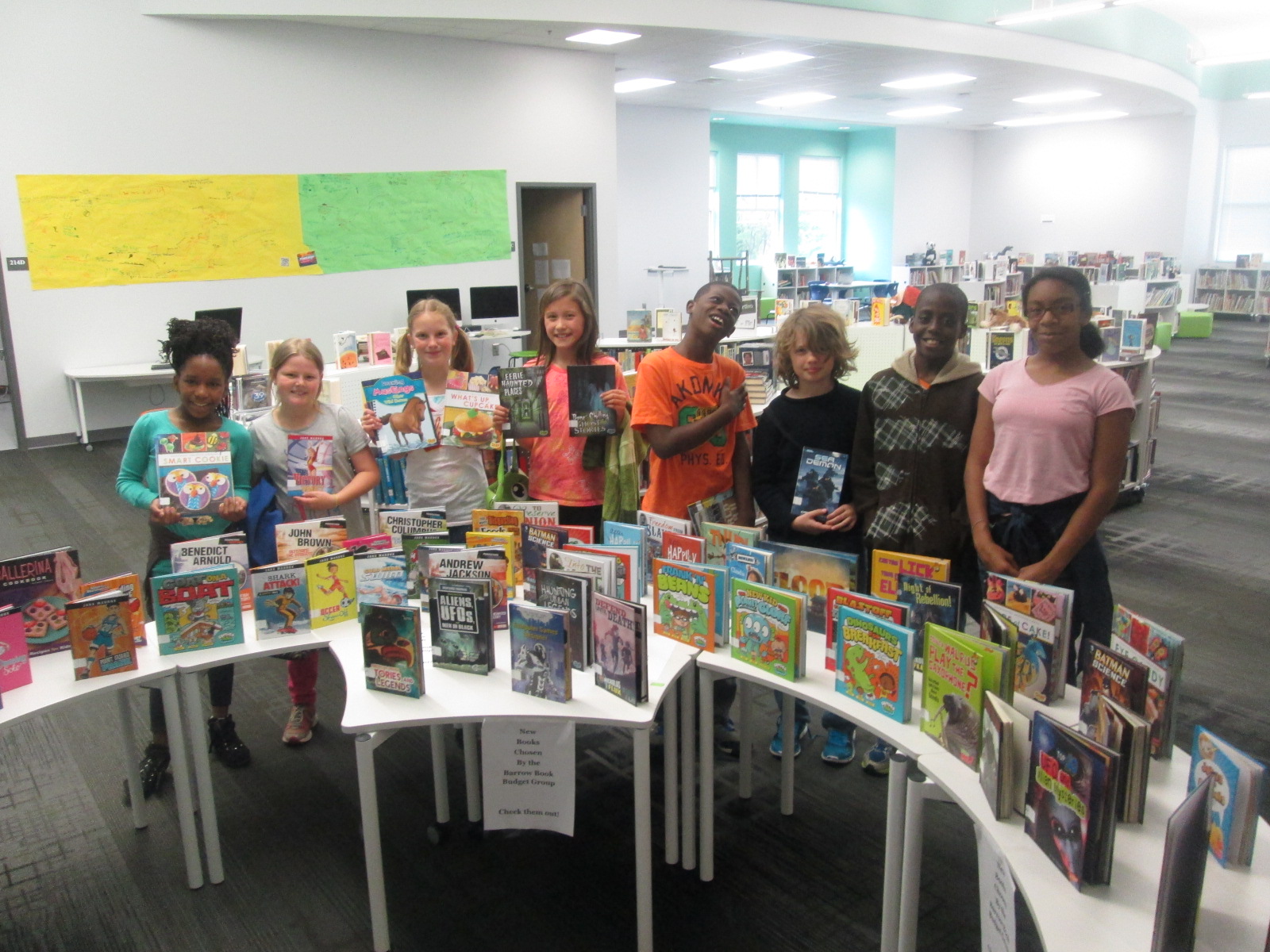
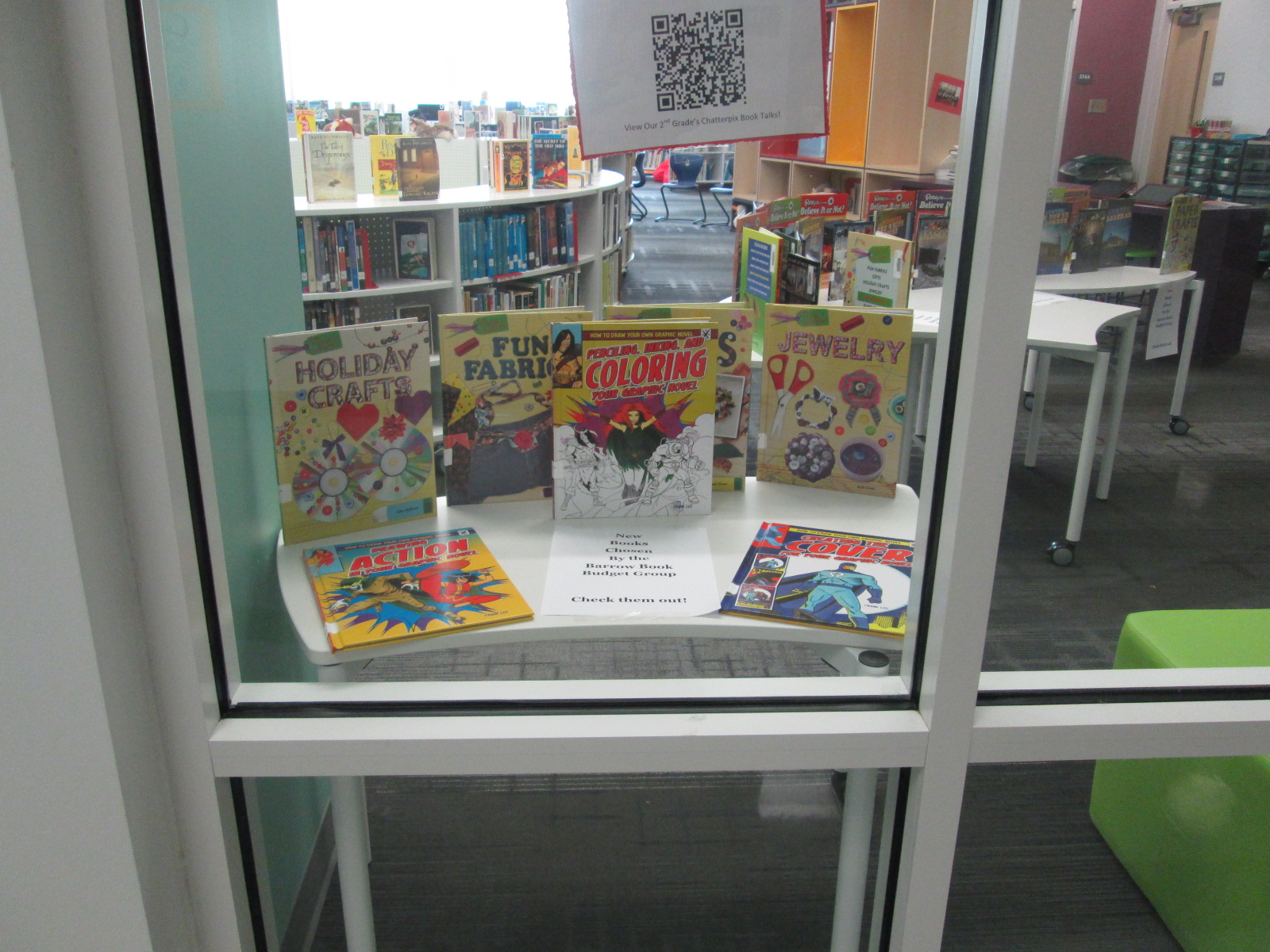
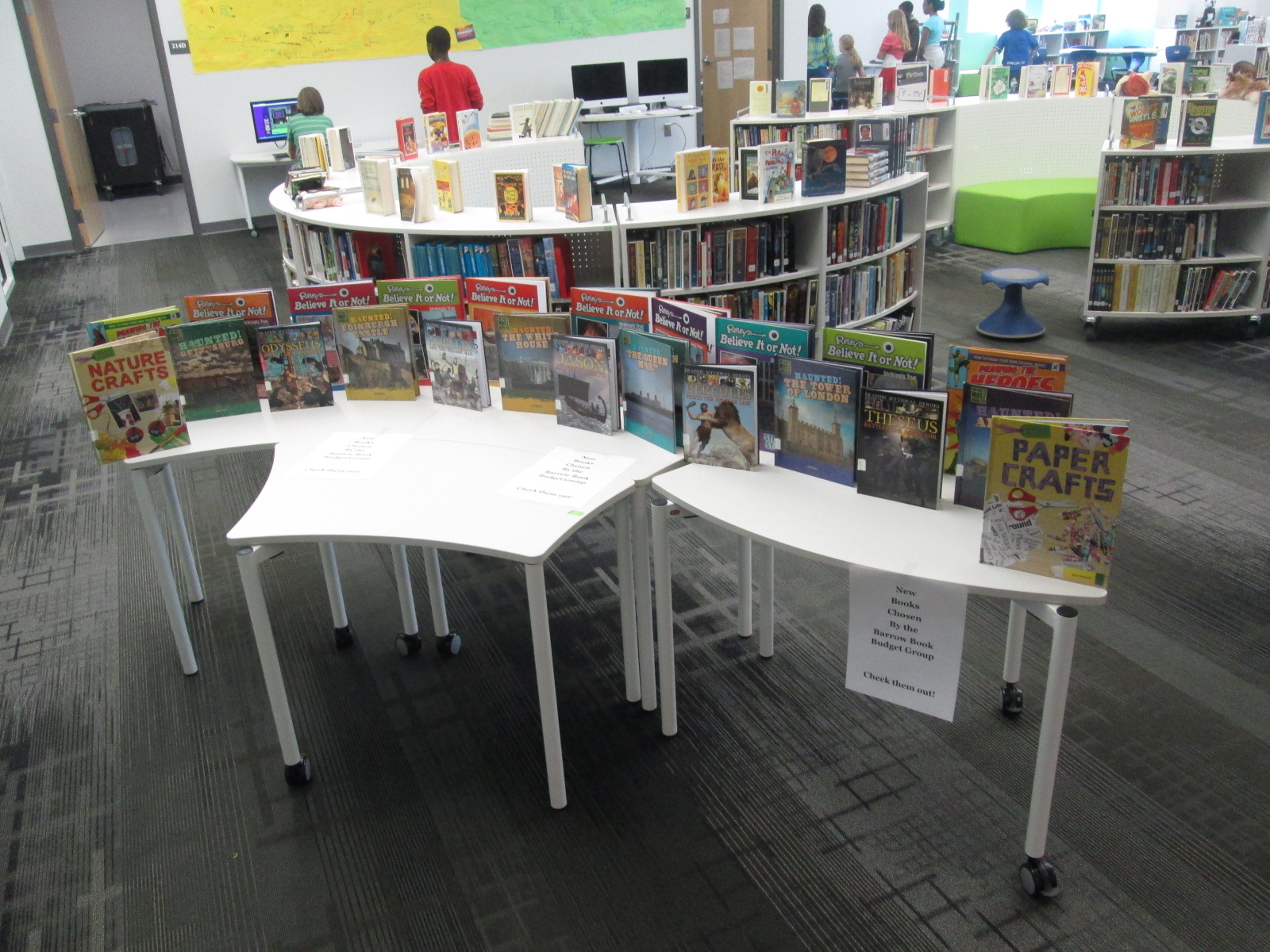
Then, all of the students work on setting up a display at the front of the library.

IMG_3005 IMG_3004 IMG_2999 IMG_2998 IMG_2997 IMG_2946

The students all got to check out one of the books before they were really revealed to the rest of the school.

IMG_3000 IMG_3001

Then they watched their Animoto and had a little dance party to celebrate new books.

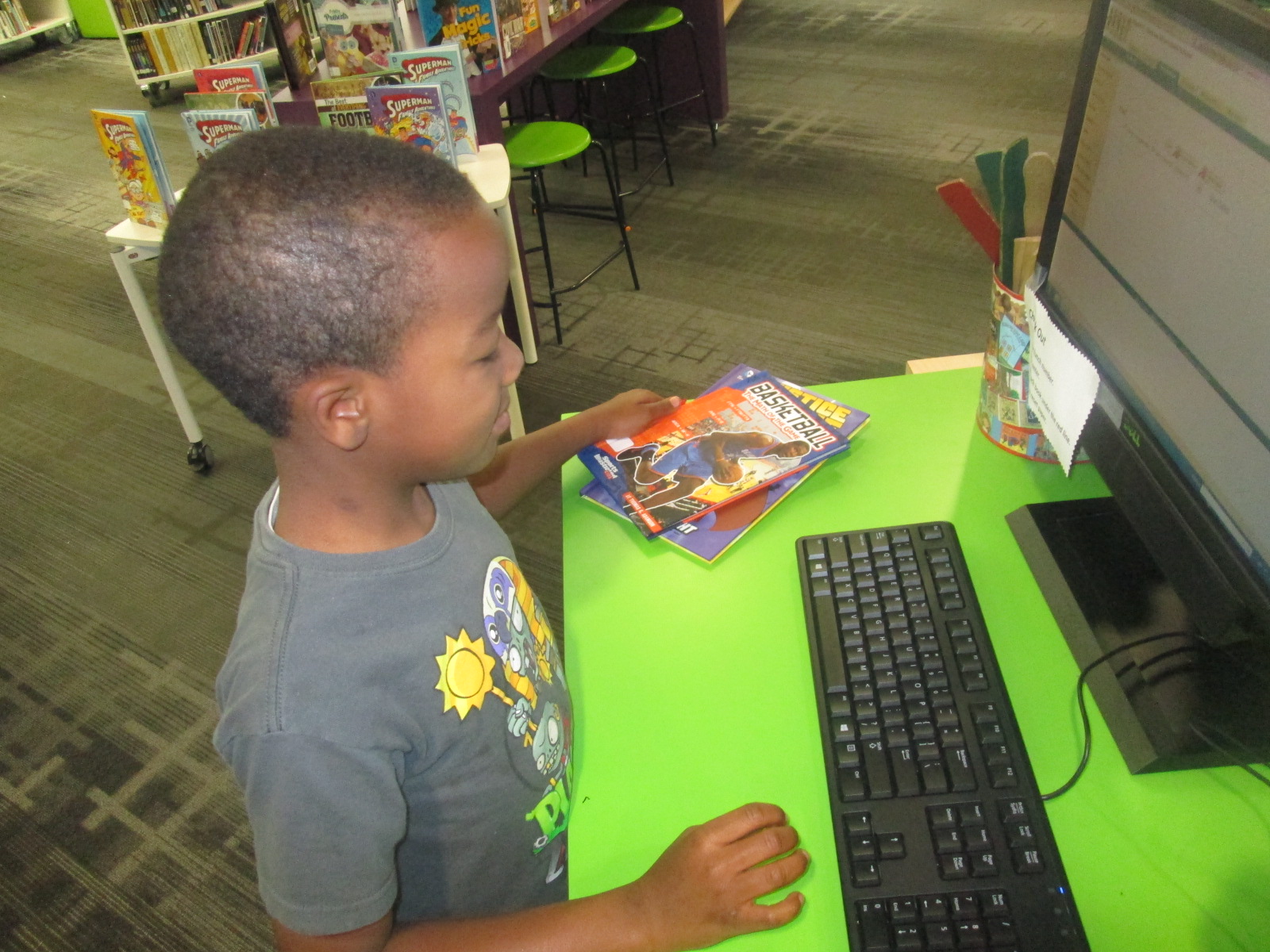
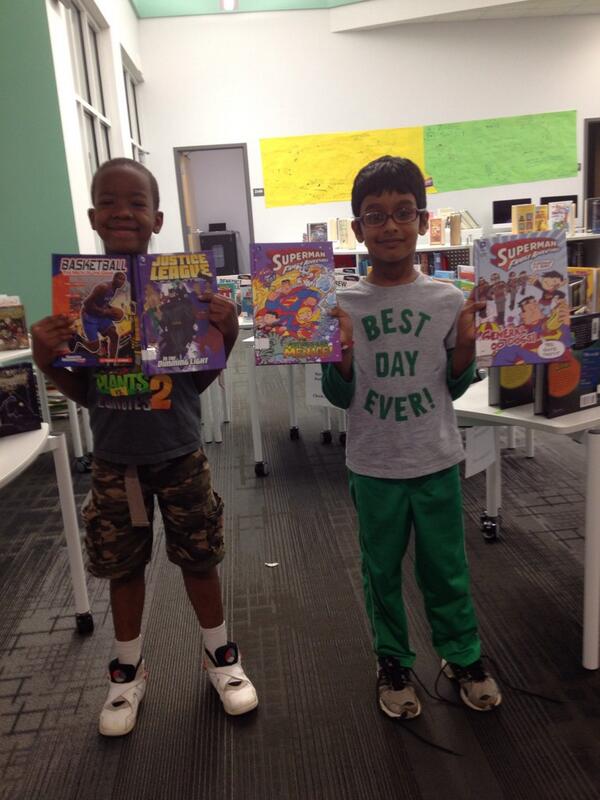
Usually, students start coming in to check out the books before we even get them all setup.  Today was no different.  Some of the DC comics and sports immediately got checked out by 2 eager boys.  I love how one student’s shirt says, “best day ever”.  It sure feels like a great day when we see so many smiling faces for books.

IMG_3012

It was also a little sad to see our project for the year come to an end.  These students have been so dedicated by coming in during their recess time to work.  I smiled when one of them said, “I think I want to grow up to become a library media specialist”.  Other students said, “Please let us do this again next year.”

When I asked them why they like being in the student book budget group, they said things like:

  • who wouldn’t want to buy books for the library
  • we loved making decisions
  • it was fun to spend money for the library
  • people are reading the books that we chose

This process is so empowering for students.  The project has proven again and again that students know how to buy books for other students.  Their books are checked out rapidly and stay among the most popular books in the library.

Thank you Capstone for supporting our project each year.  Your promotions, great selection of high interest books, and book swag gifts, made the students feel like rock stars.

capstone

Unpacking Our Student Book Budget Order from Gumdrop

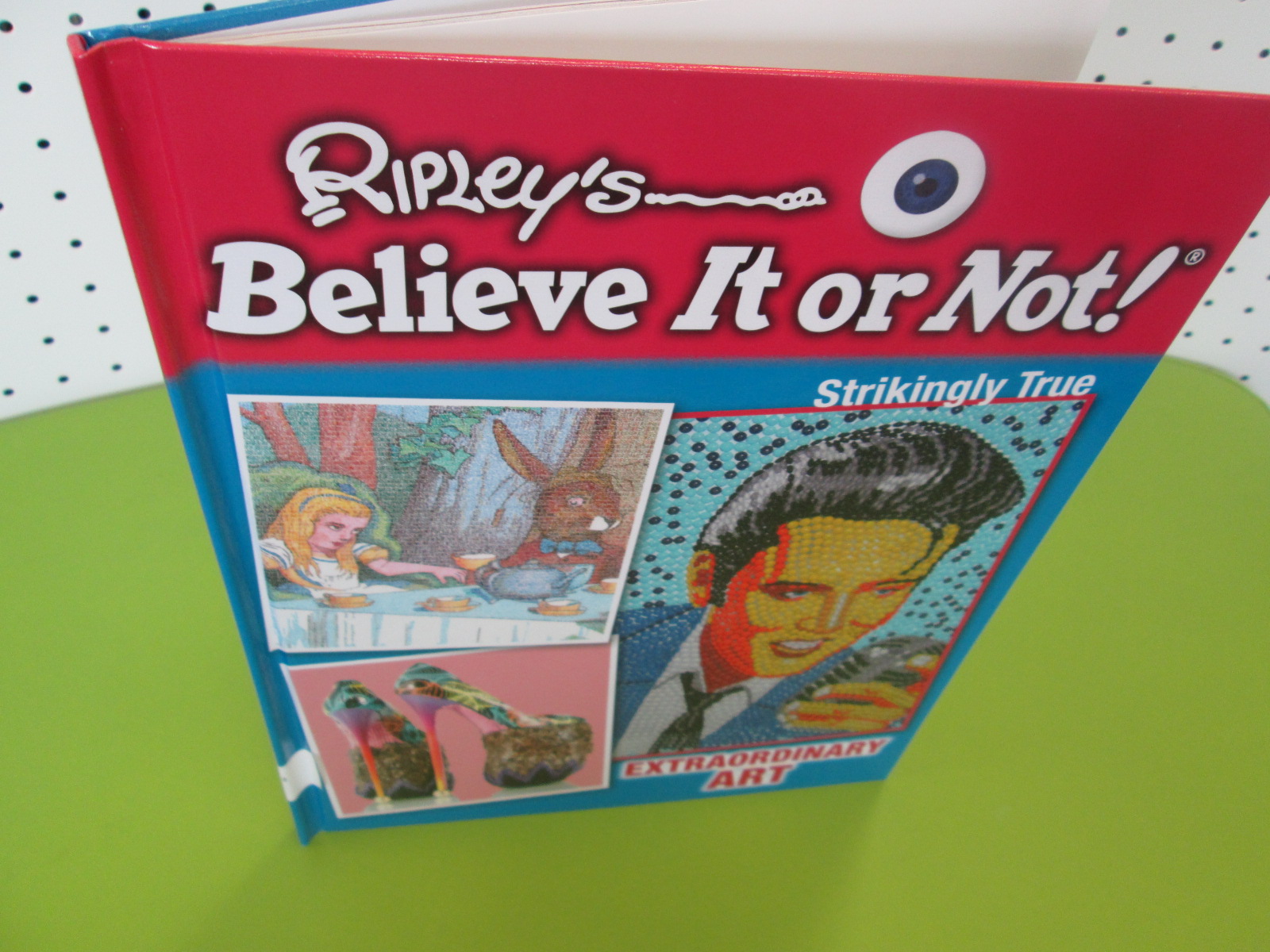
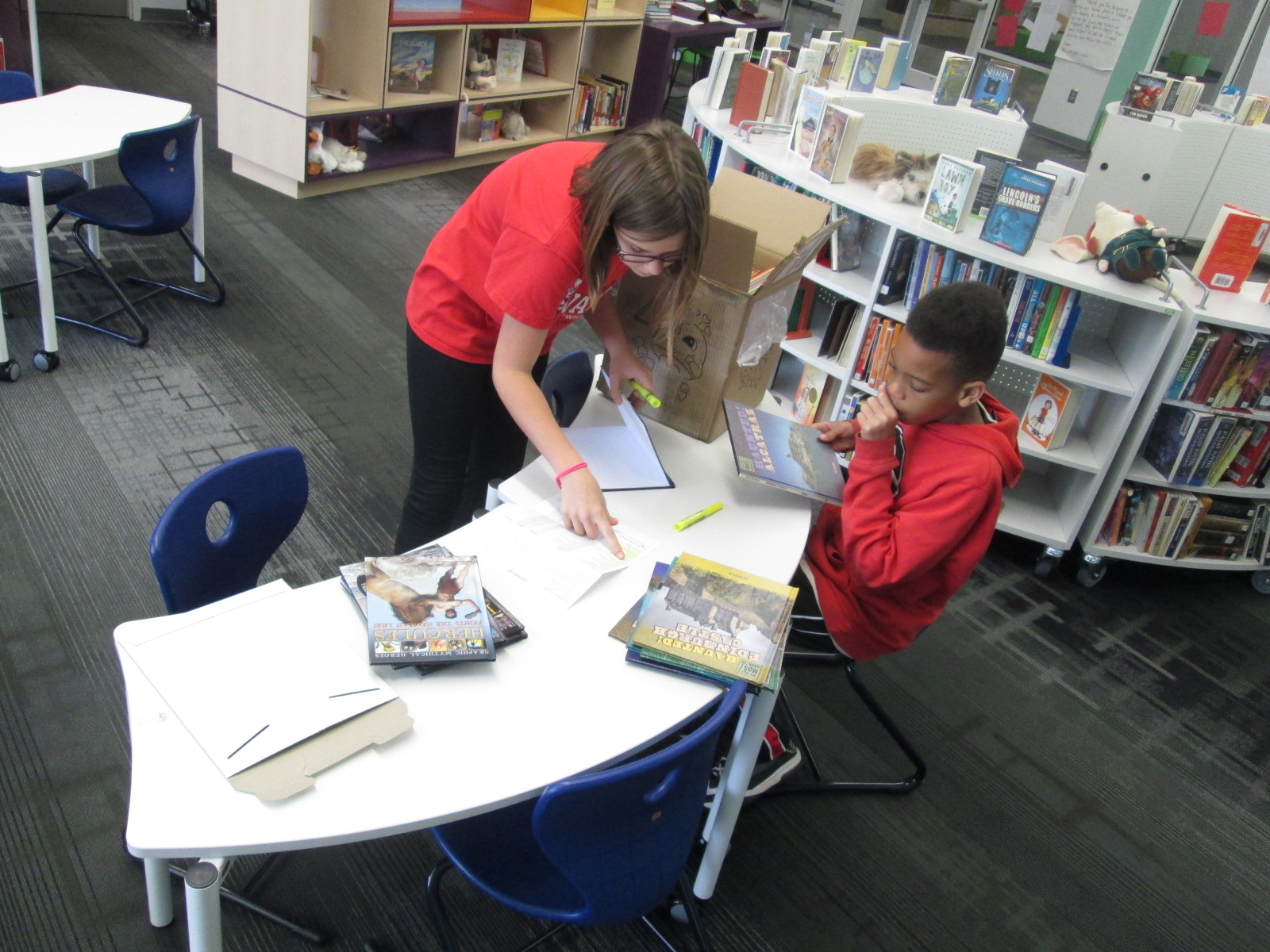
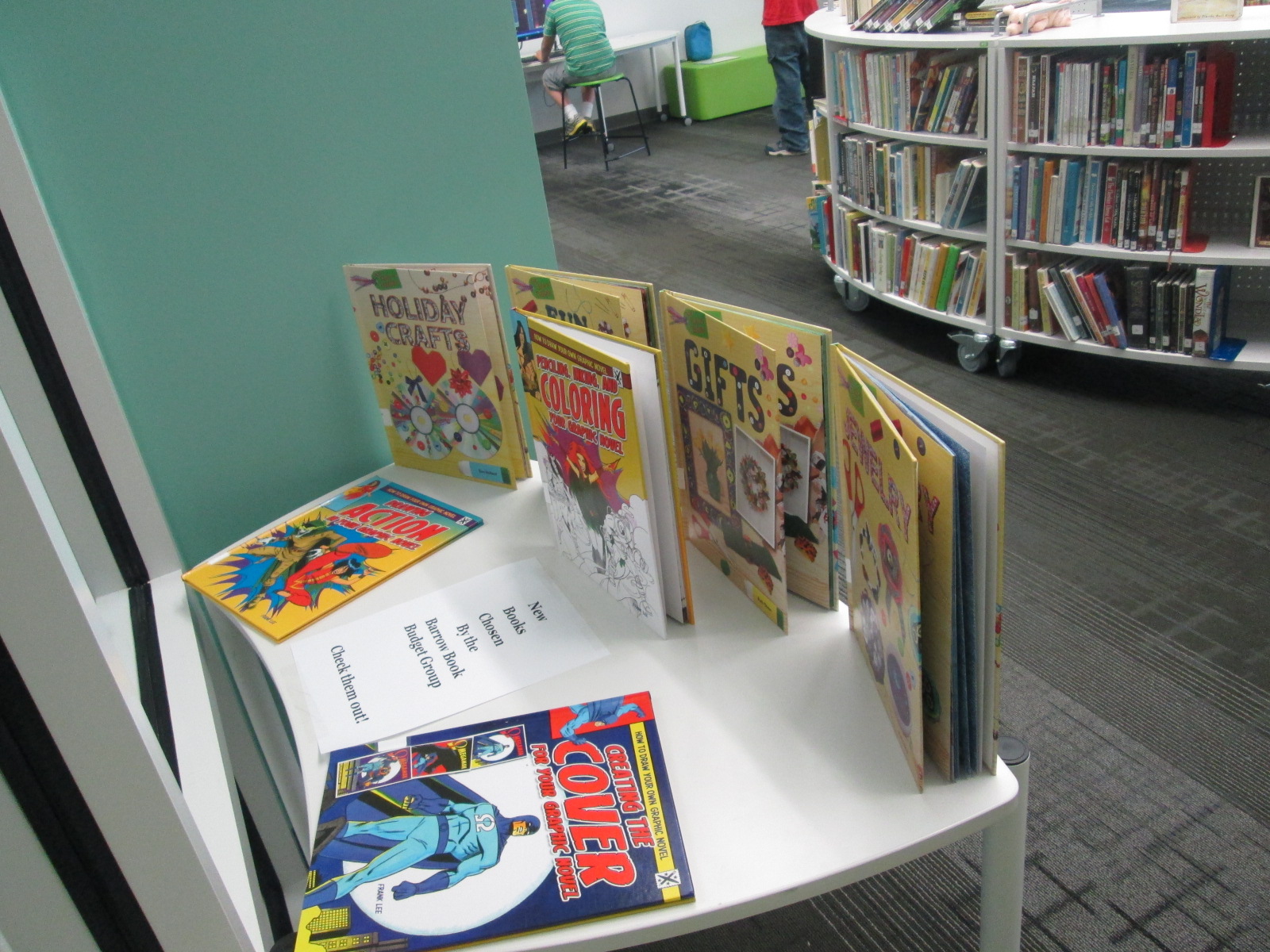
IMG_2827Today, the student book budget group came to the library to unpack our first order.  Most of our books that we ordered will come from Capstone, but there were a few books that they found from Gumdrop.  Gret Hechenbleikner is our Gumdrop rep who brought in several book samples for students to look at.  One of our goals for purchasing books was World Records.  We have several Guinness World Record books, but Gumdrop had some Ripley’s books that were much smaller in size that the students loved.  They also found some haunted history books that I’m sure will be extremely popular.  We are trying to increase the number of books we have about making things, so they found a series of books about making graphic novels as well as making crafts out of various materials.

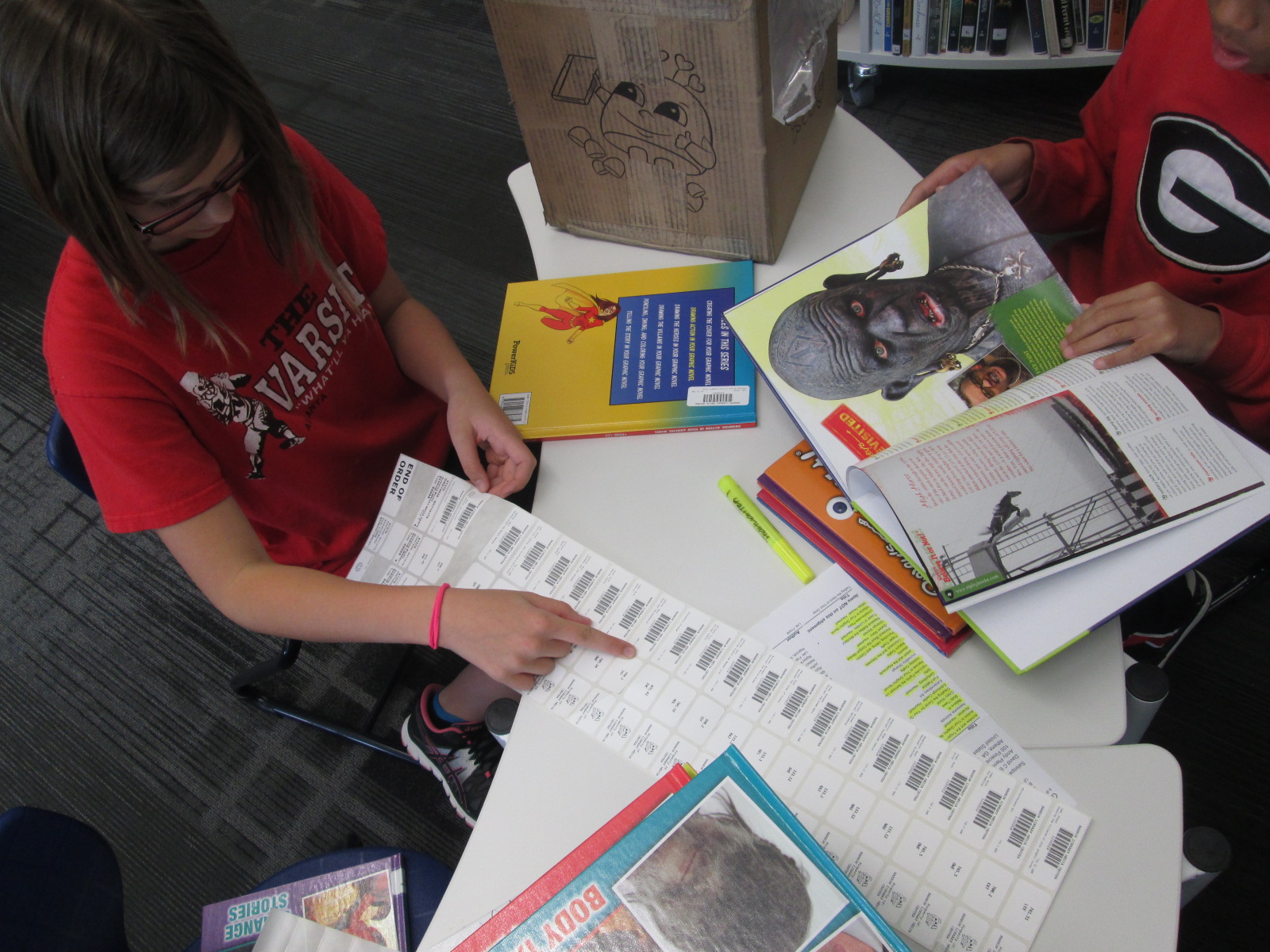
To save a bit of money, we did not purchase shelf ready books.  We did order the barcodes and protectors, though.  Students came in during their recess and worked through several steps.

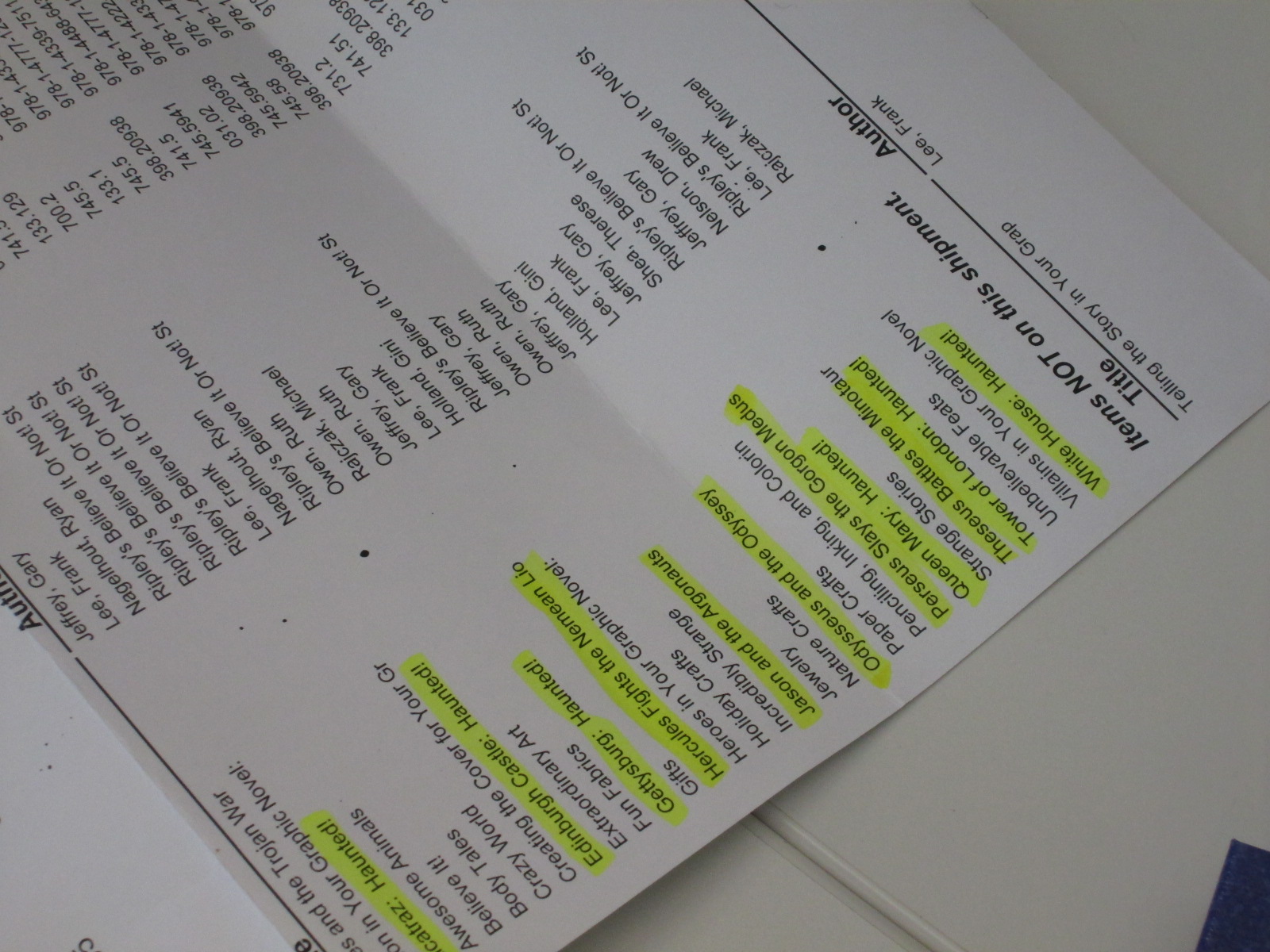
Step 1 was to unpack the box, check off the packing slip, and check the books for damage.

IMG_2807

IMG_2809

Step 2 was to put the labels and label protectors on each book.

IMG_2810

Step 3 was stamping each book with our library stamp.

IMG_2813

Step 4 was to download the MARC records into Destiny.

IMG_2848

Step 5 was to think of how to advertise the books to the school.  Students decided on 2 things.  They wanted an Animoto of all of the books and the unpacking process on our morning news show for Monday.  They also wanted to create a display at the front of the library.  One group of students worked on taking pictures.  Another group worked on making the Animoto.  A final group worked on creating the display.

IMG_2851 IMG_2849 IMG_2850


It was fun to watch them celebrate when their Animoto was made.

The books haven’t even been officially advertised to the school yet, and already several of the books have been checked out.  I won’t be surprised on Monday when there is a stampede to the library to check out what is left.

These students will meet again next Friday, when they will unpack a large order from Capstone and repeat the same process.

2014 Student Book Budgets: Real-World Math Lessons from Capstone Press

decisions (1)Each year, I dedicate a portion of library funding for students to control.  Since the library is for all of our school community, I feel strongly that students should have a voice in what goes into the collection.  Here’s what has happened so far:

  • Students developed a Google form survey and surveyed most of the school on their reading interests
  • Students analyzed the results and developed a list of goals to focus on which included sports, graphic novels, humor, scary, world records, and action/adventure.
  • Students met with Jim Boon from Capstone Press and Gret Hechenbleikner from Gumdrop books to look at book samples and catalogs.

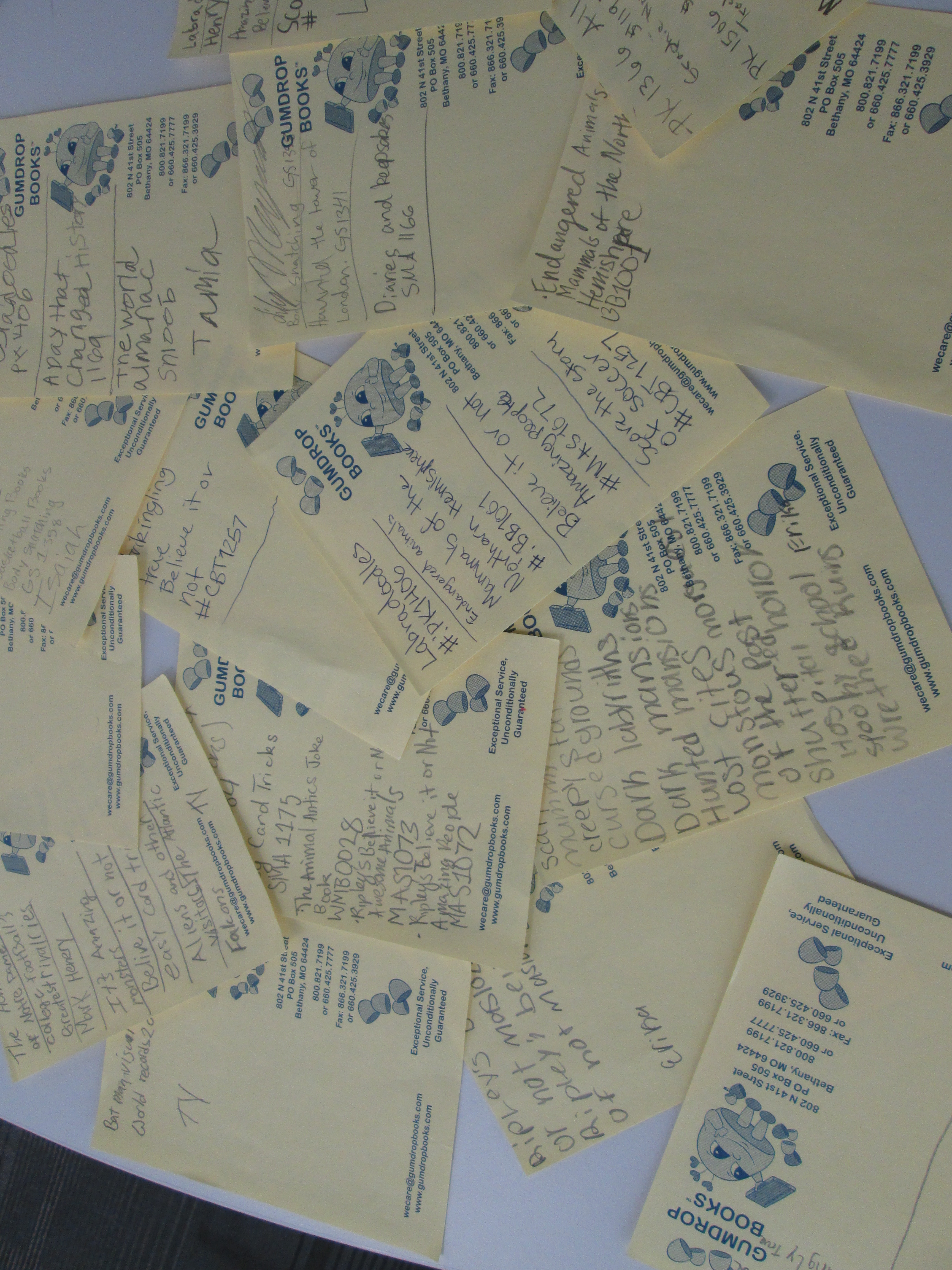
decisions (8)Since the visit with the vendors, the student book budget group has been coming into the library on Mondays and Wednesdays during their recess to continue looking at catalogs.  Much of what they wanted was in Capstone’s catalog, so their first step was to finalize what they wanted to order from Gumdrop.  They decided on a Ripley’s Believe It or Not series, a how to draw graphic novel series, a graphic mythical heroes series, and a history’s most haunted series.

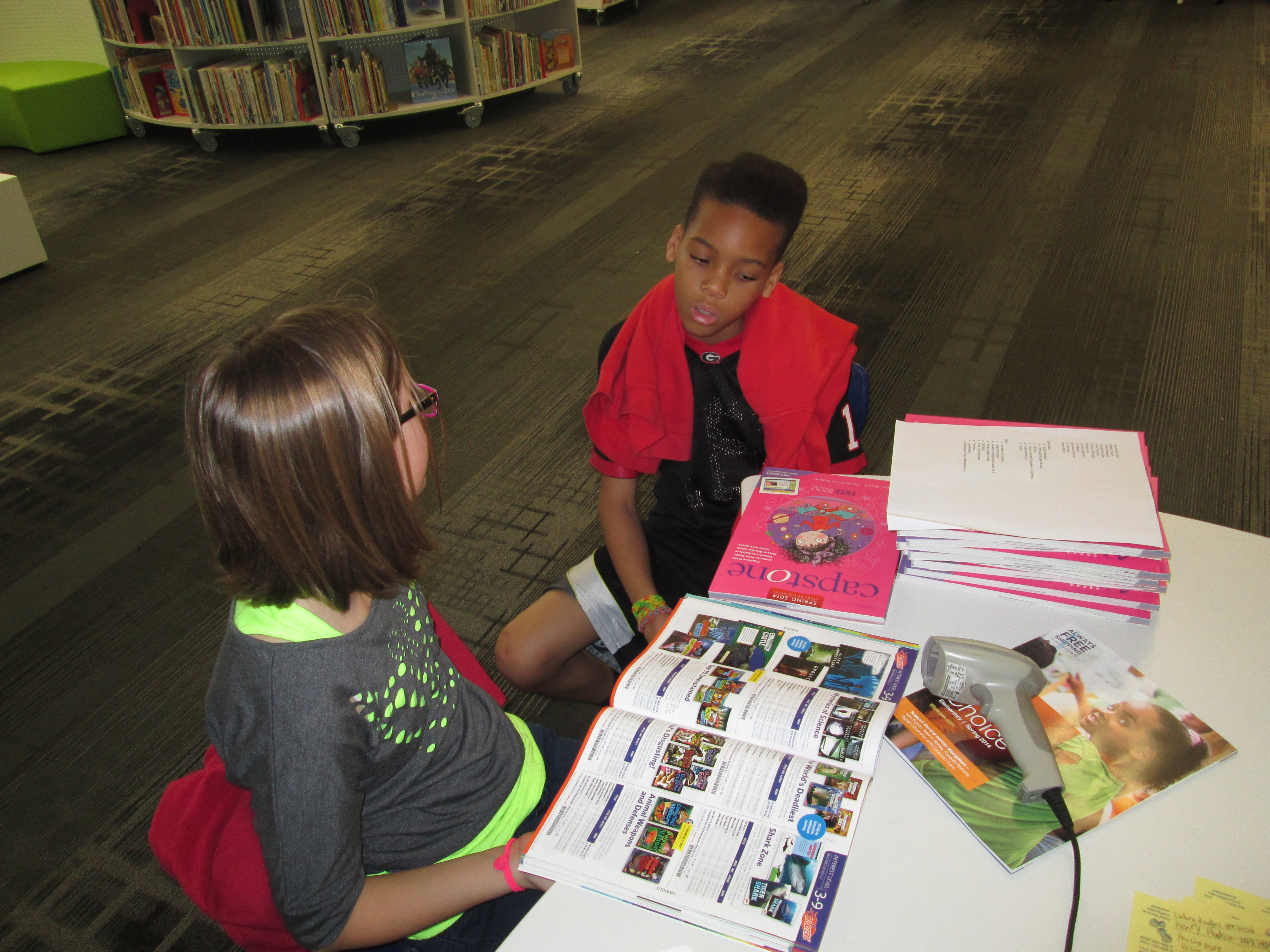
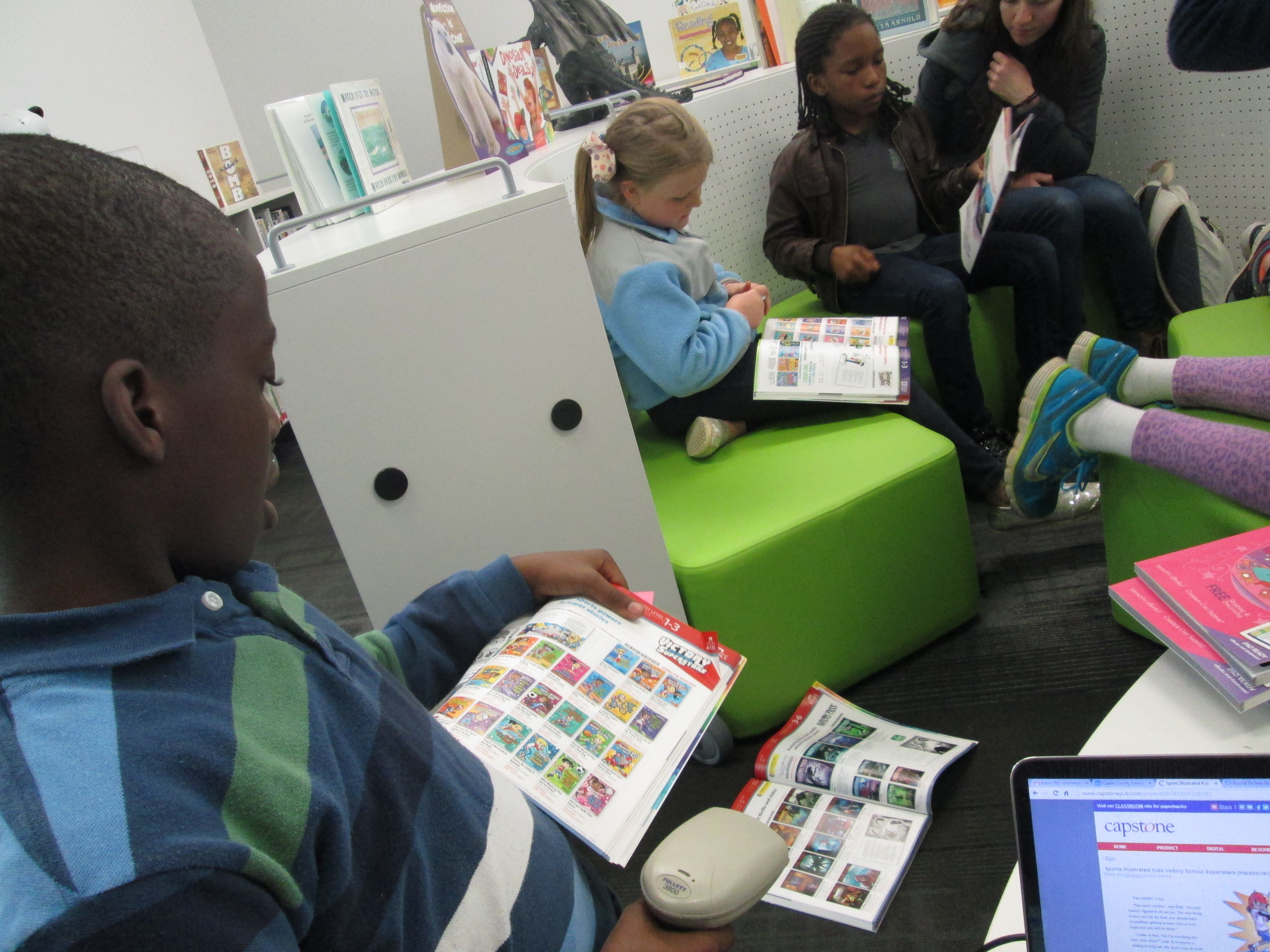
decisions (2)When that was done, I hooked up the scanner to my computer and gave all of the students a Capstone catalog.  Capstone has a great feature where there is a barcode next to each set of books in the catalog.  You can scan the set straight into your cart, or you can scan the set and select the books that you want.  As students found books that matched our goals, they scanned the barcode and told me which books to add.  At that point, we didn’t worry about cost.  We wanted to add all of the books that we were interested in and then start narrowing.  This adding process was so smooth thanks to this scanning feature.  In the past, students have circled items in catalogs, written on pieces of paper, etc. and it took a lot of time to compile everything.  I loved that we were all adding to the same list as we worked.

decisions (6)Right now, Capstone is offering an incentive like they often do.  If you spend at least $1750, you get 30% back in Capstone Rewards.  If you spend less that $1750, you only get 10%.  This was a great math discussion.  Our original budget was $1500 for all of the book budgets.  However, if we spend just $250 more with Capstone, then we get $525 in free books.  I’ve really pushed the group to think about budget, but this was a great real-world example where you sometimes have to spend beyond your budget if it helps you in the long run.  The students unanimously agreed that we needed to spend the $1750 since we already had well beyond that amount in our wish list cart.  I pulled out all of the numbers that I had to think about in order to make this happen.  We looked at the remaining dollar amount in our district budget which was about $375.  Then, we looked at the remaining balance in our local account, which holds profits from our book fairs along with any donations we receive.  I told them about remaining expenses that I knew about for the year such as battle of the books.  We agreed that there was enough money to purchase our list from Gum Drop and extend our Capstone Budget to $1750.

decisions (3)The final task, which we are still working on, is to narrow our cart.  We started with a cart totaling almost $3000.  We knew that we needed to reduce the cart to about $2200 in order to spend $1750 in cash and use $525 in rewards dollars.  By the time we stopped talking about the math, students were all commenting on how hard this is.  One of them said, “You mean this is just a small part of what you do?”  I love that they keep bringing this up.  I love buying new materials, but I’ve been very honest with them about what a small fraction of my time this actually is.  As always, it was interesting to hear them wrestle with decisions about which books to cut from the list:

  • We have 3 books about drawing horses.  Let’s pick the one with the most horses that people are probably interested in.
  • Three of our war books cost $27.  Let’s pick something that doesn’t cost that much.
  • That book looks like it would only be for 5th graders.  It might scare other kids.  Let’s take it off the list.
  • We can’t buy every Jake Maddox book this time.  Let’s choose a few of them.

decisions (5)Every struggle they were having is the same struggles that I go through alone.  I loved being able to share this frustration with them, and they had a much better understanding of how I use math and decision making in my job.  My only wish is that more students could walk through this process with me.  Each year, I find new ways to involve different groups of students, but I would love to have larger groups of students involved in the math aspect.

decisions (6)Once we get our carts narrowed down, we will place our order and wait for the books to arrive.  Since I have extra Capstone Rewards dollars, I’ll also be able to add in some historical perspective books that I’ve been wanting to get for our many social studies projects.  While we wait, students will think about how to advertise the books to the school.decisions (7)

World Read Aloud Day 2014 (Day 5): Final Thoughts

Our final day of Read Across America and World Read Aloud Day was once again filled with special memories.

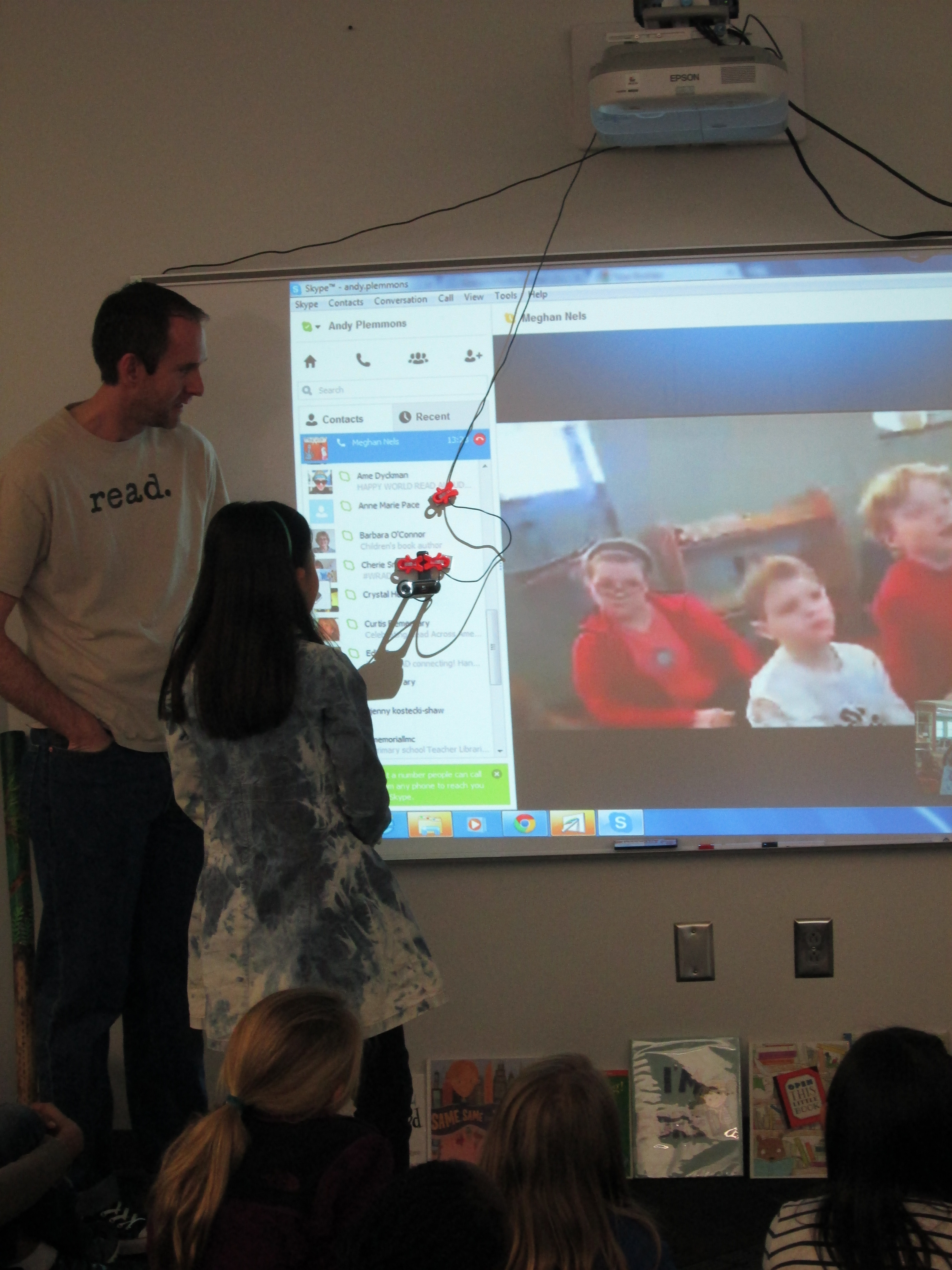
We read Crankee Doodle with Meghan Nels and her students.

Meghan Nels (19) Meghan Nels (4)

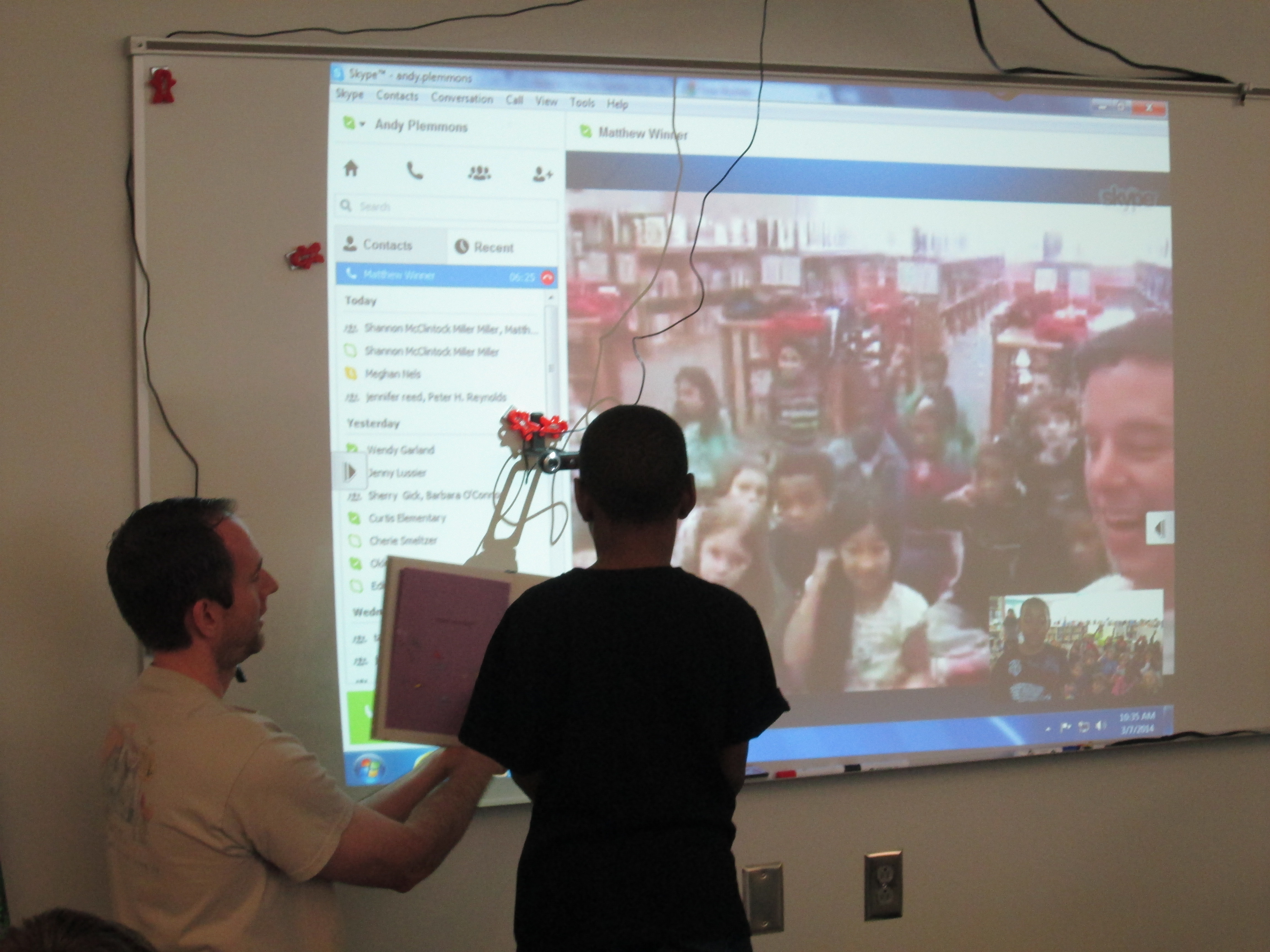
Matthew Winner and I got creative about how to read Open This Little Book with our students.

Matthew Winner (6) Matthew Winner (2)

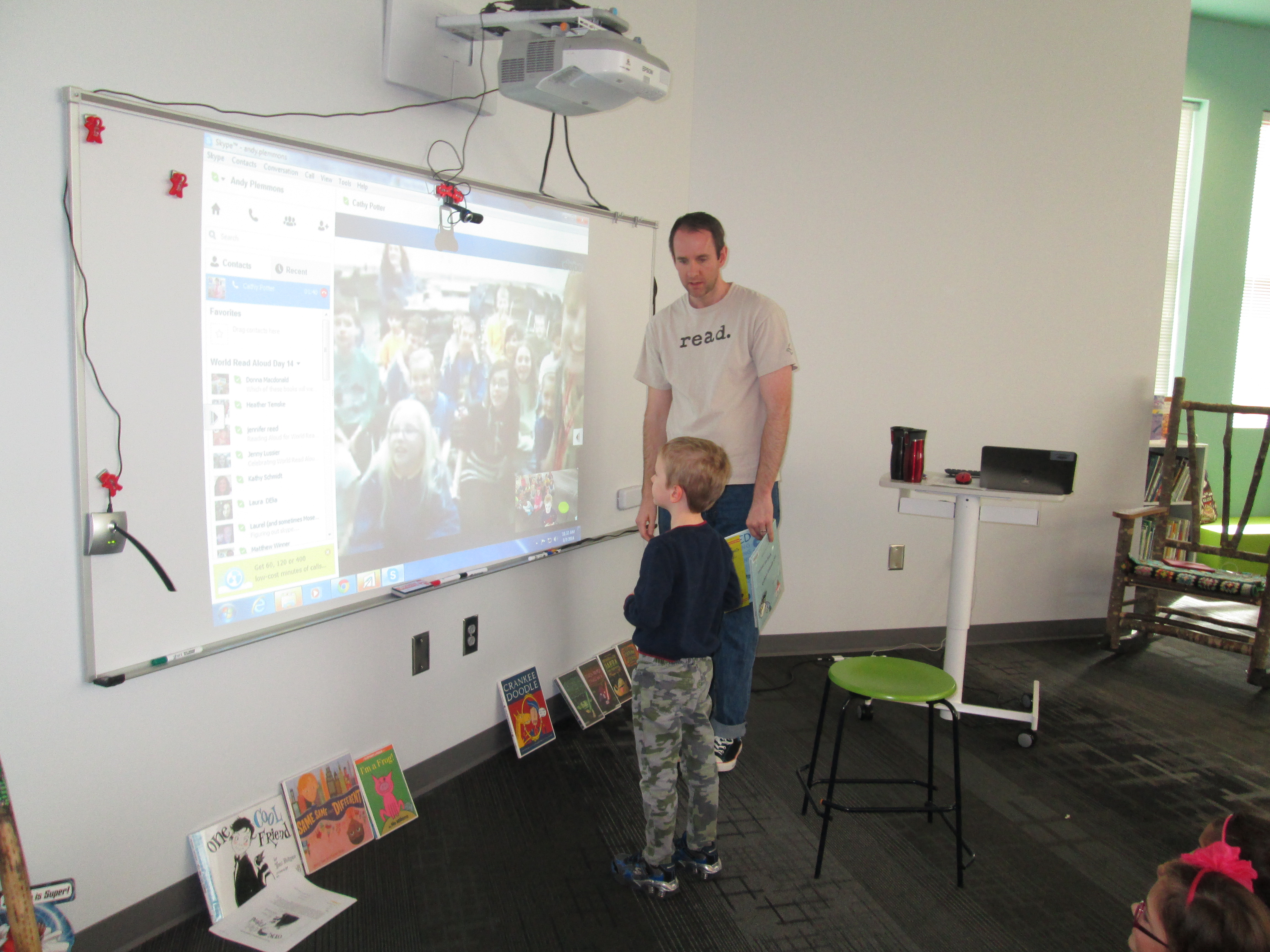
Cathy Potter and I had fun reading I’m Bored and letting our students show the many ways you can say “boring”.

Cathy Potter (3) Cathy Potter (2)

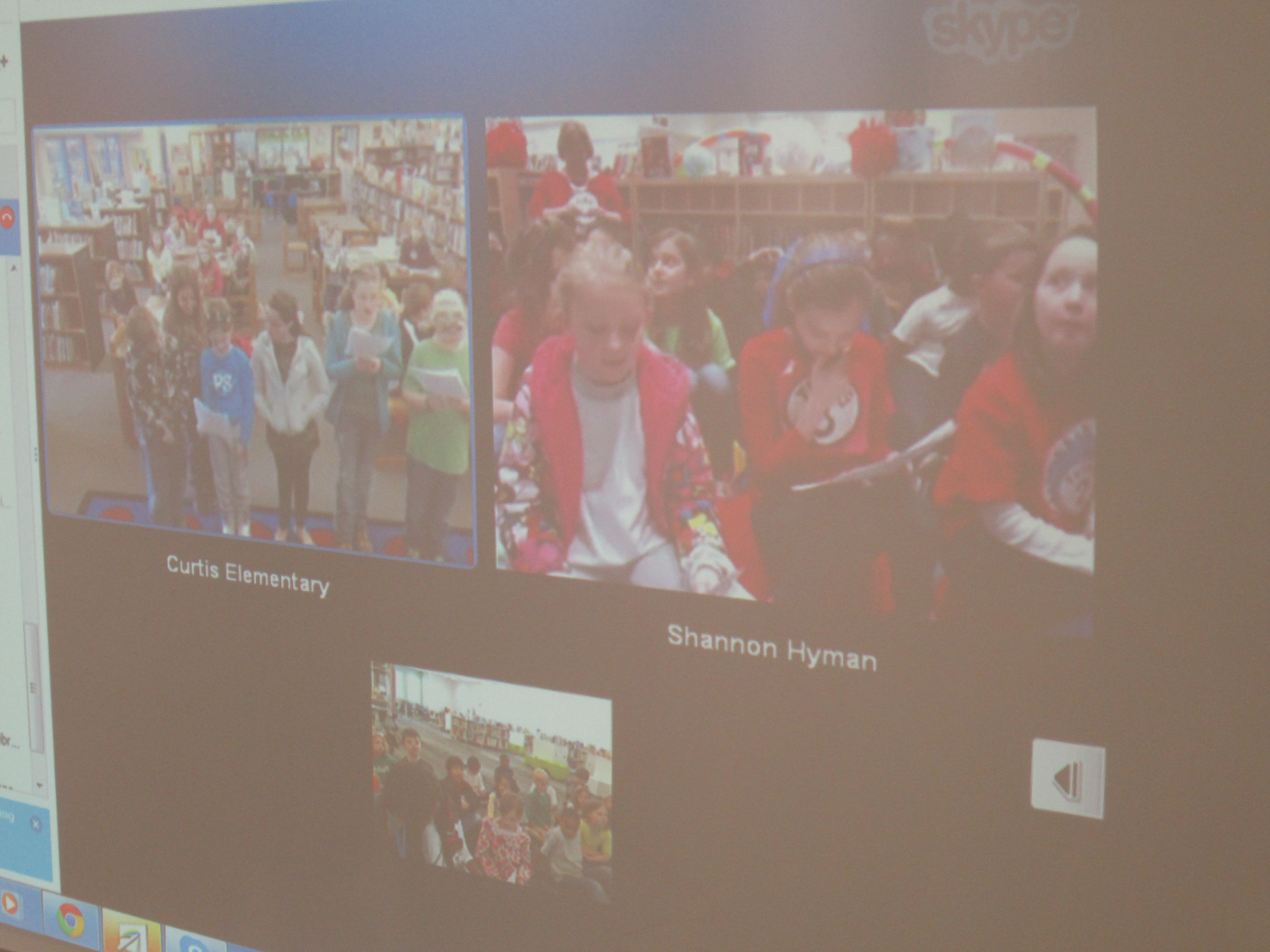
Shawna Ford, Shannon Hyman, and I all found students to read parts of a reader’s theater of One Cool Friend.  We loved hearing voices in 3 states reading the story.

Shawna & Shannon (5) Shawna & Shannon (1)

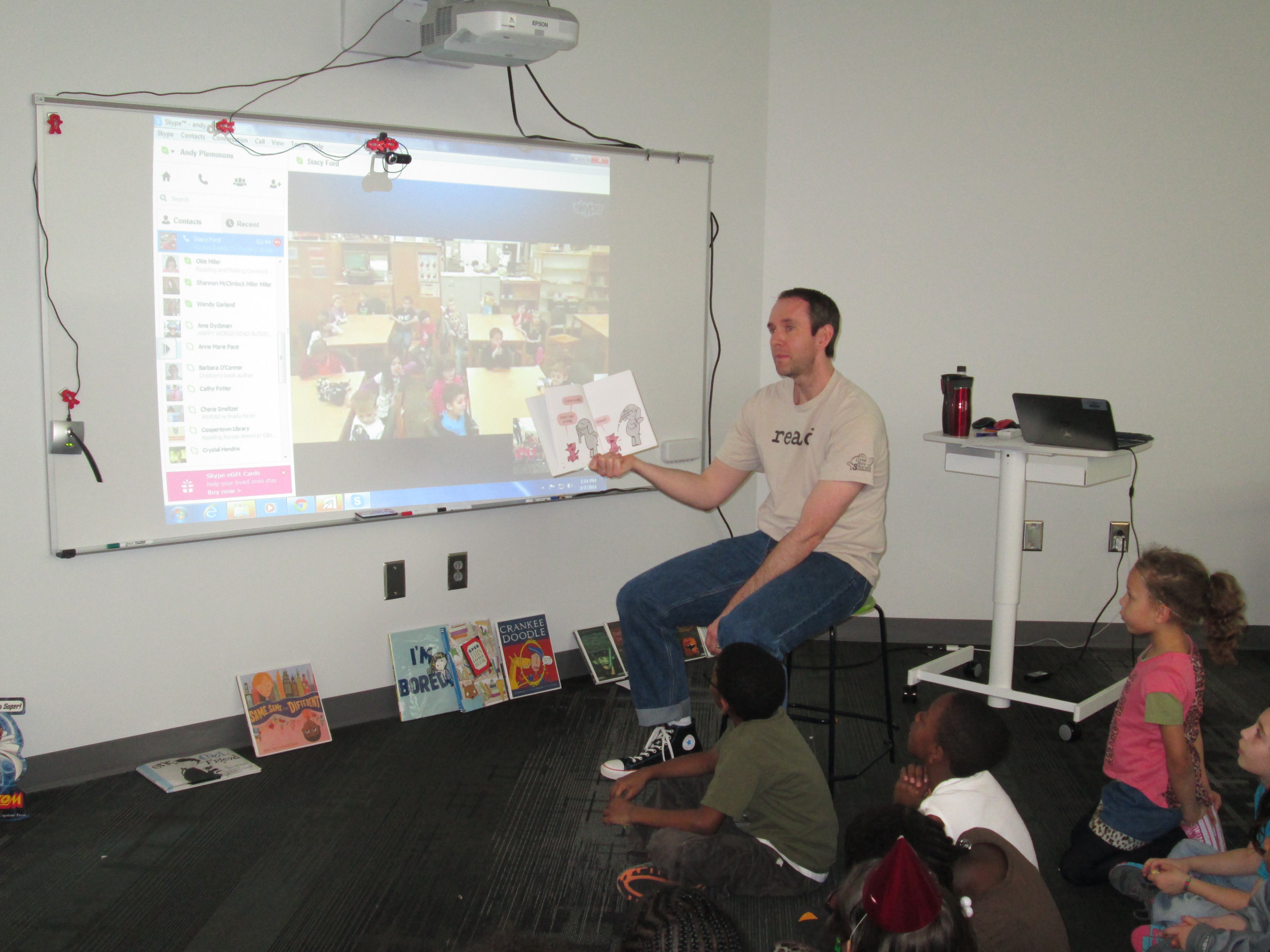
Stacy Ford and I had a great time being Elephant and Piggie with our students as we read I’m a Frog.

Stacy Ford (5)

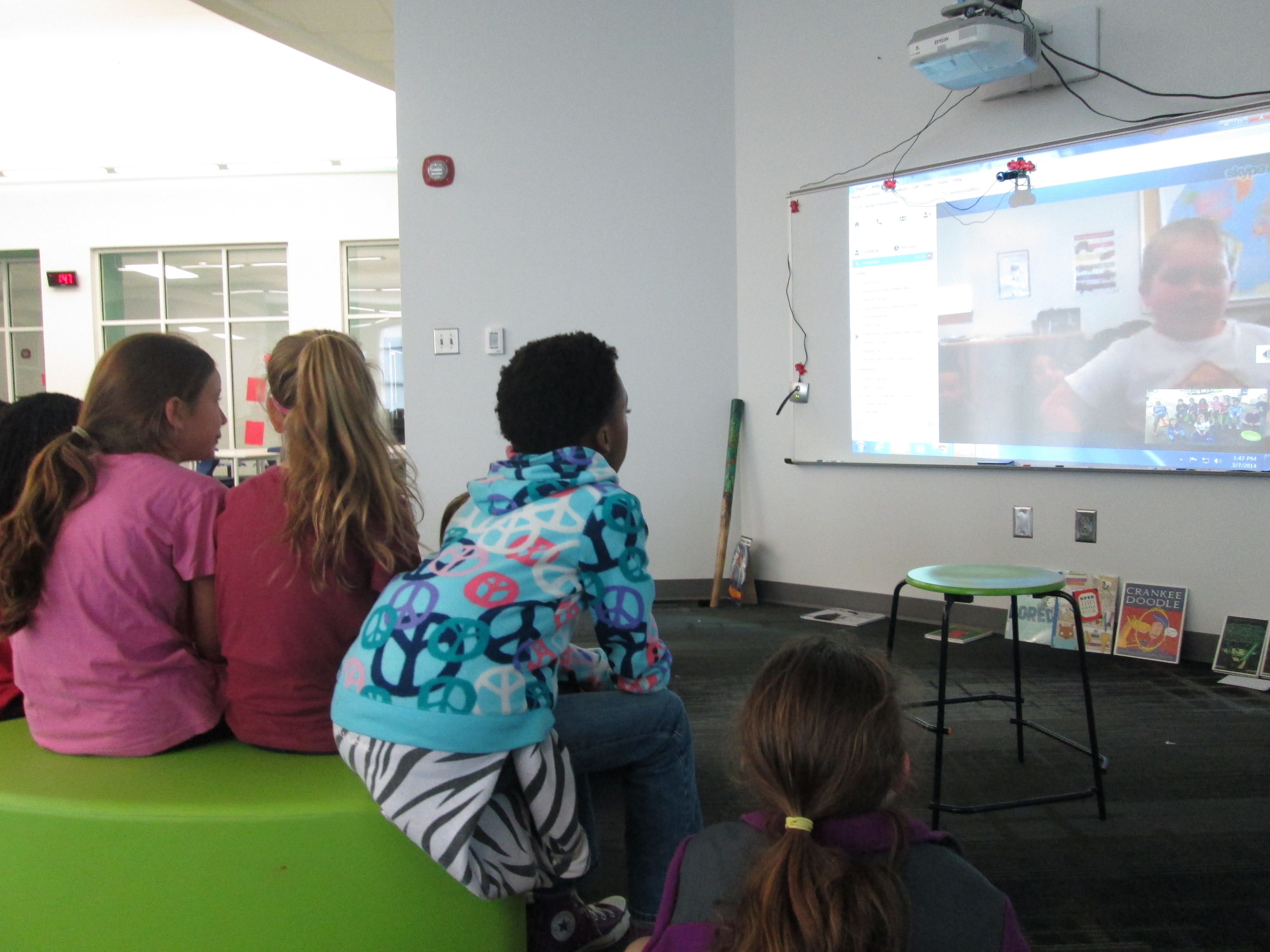
Randie Groden and I had some impromptu skyping as I had a class cancel!  Several 5th graders who were checking out books gathered around the projection area to meet her first graders and read Same, Same but Different.  Sometimes the unexpected is fun!

Randie Groden (4) Randie Groden (2) Randie Groden (1)

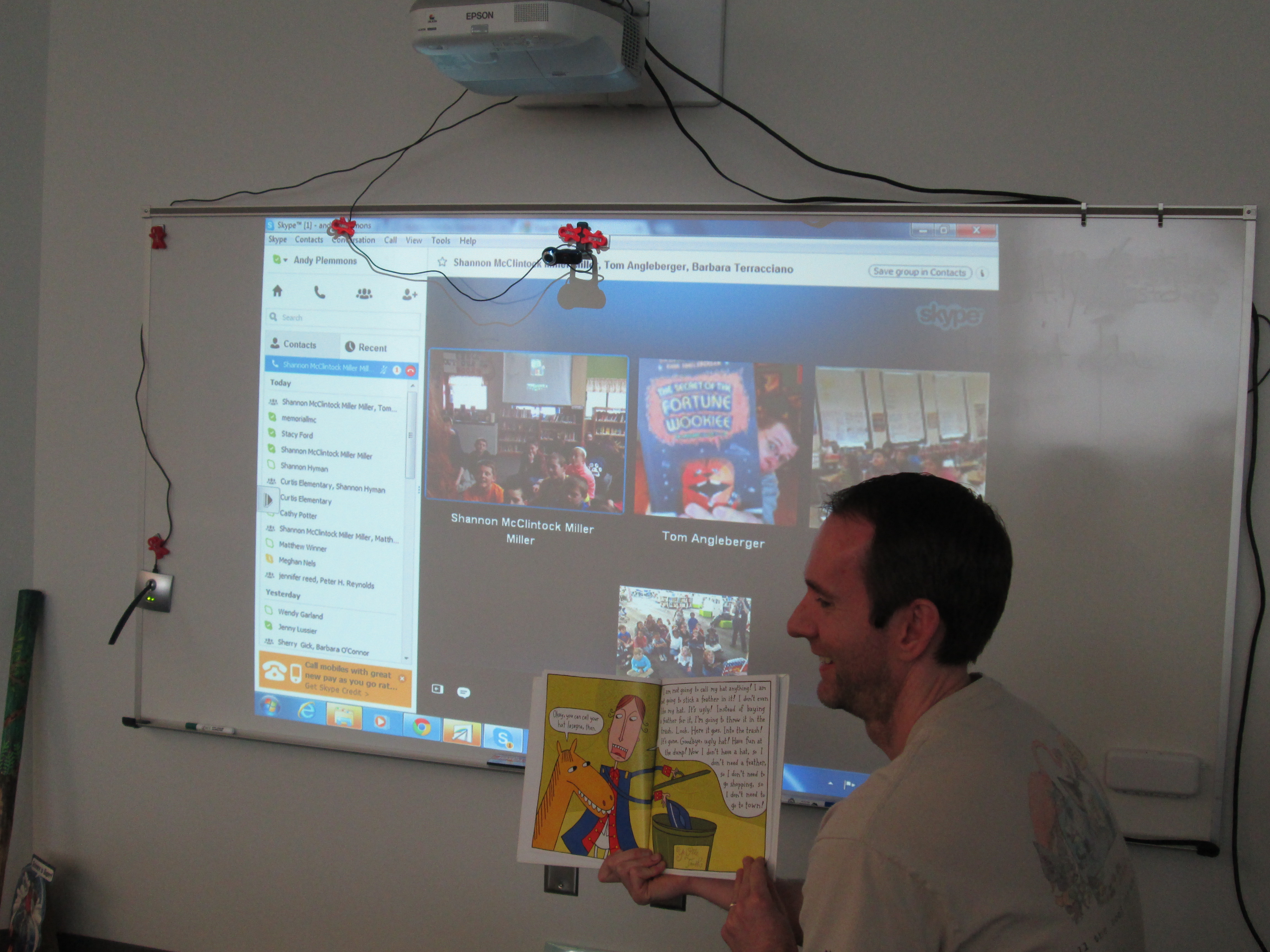
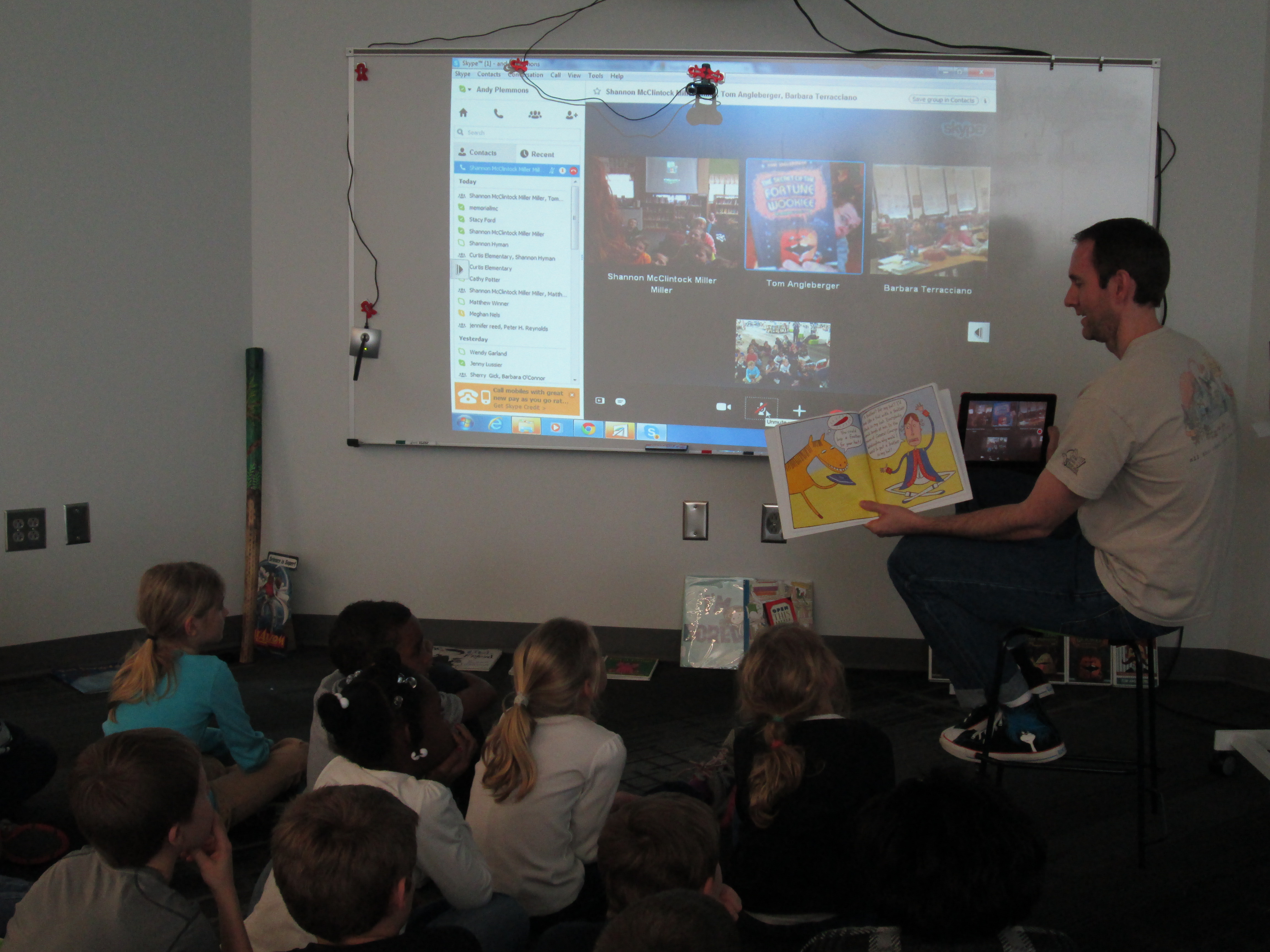
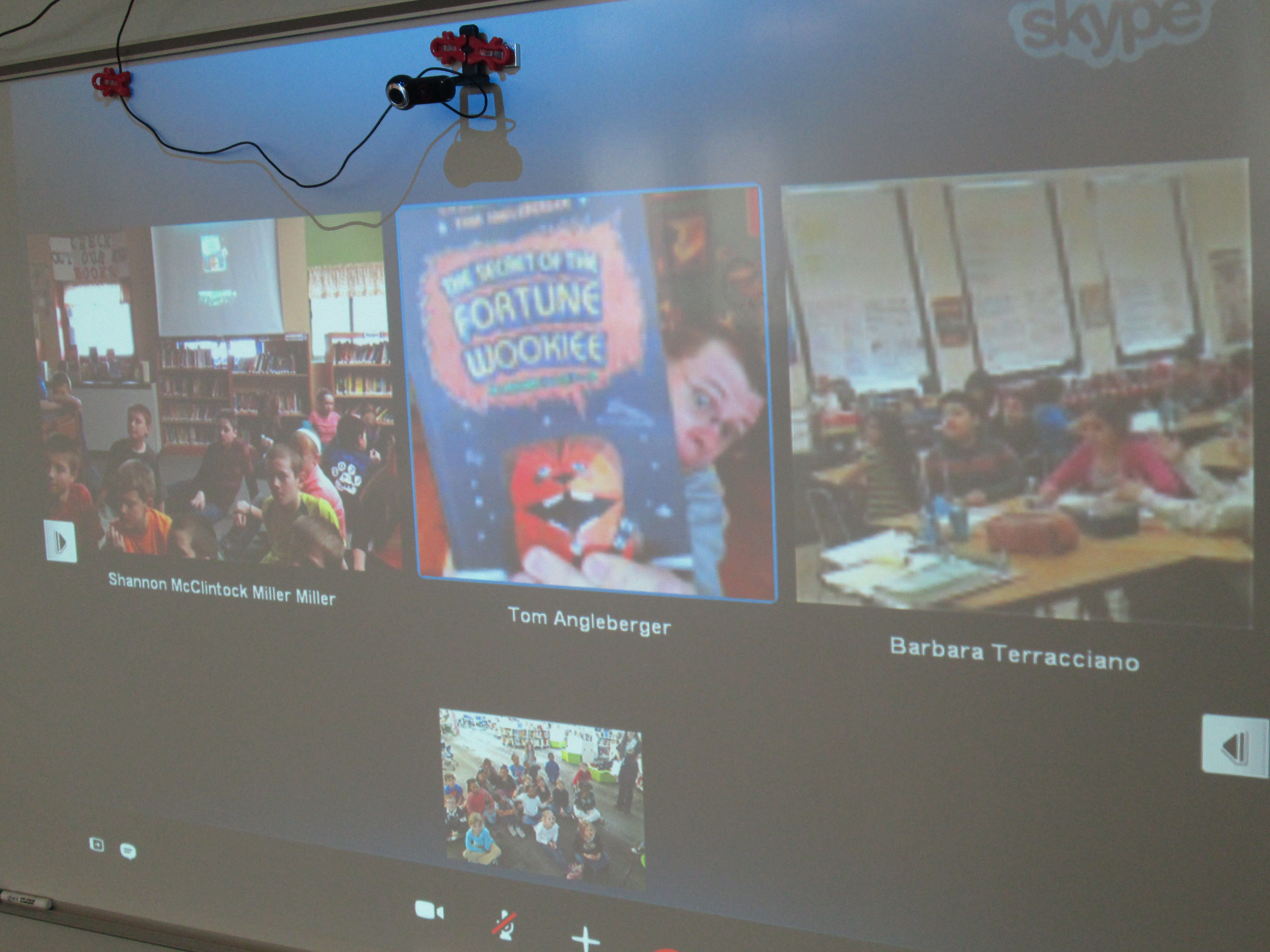
We ended our WRAD week with a connections between Shannon Miller and Barbara Terracciano along with author, Tom Angleberger.  He read aloud the part of Crankee in Crankee Doodle, and it was the perfect ending to our week.

Tom Angelberger (7) Tom Angelberger (2) Tom Angelberger (1)

There is not a day that goes by that I don’t read aloud.  Every day is read aloud day.

When I think of World Read Aloud Day, I think of connections.

Kate DiCamillo, National Ambassador for Young People’s Literature and 2-time Newbery winner, says “Stories Connect Us”.  In Extra Yarn by Mac Barnett and illustrated by Jon Klassen, all of the characters are connected to one another through strands of yarn as the main character knits sweaters for everything and everyone in sight.  In Same, Same but Different by Jenny Sue Kostecki-Shaw, we learn that we really are all connected in the world by common strands of life even if those strands might look a bit different based on our cultures, locations, and beliefs.

World Read Aloud Day is about all of these things.  Even though we should read aloud every day, World Read Aloud Day raises our awareness of the importance of reading aloud.  It reminds us that when we read aloud, we connect.  When we read aloud, we expand our world.  When we read aloud, we learn that the world really isn’t as big as it seems.  We are all united through power of story and spoken word.

This year, our planning for World Read Aloud Day/Week began in December.  My wonderful friend and collaborator, Shannon Miller, created a Google Doc for educators around the world to use as a space to share their schedules and ideas.  The two of us shared the doc through blog posts, twitter, facebook, and conversations.  Over 3 months later, the doc is filled with conversations that each tell a story of a connection between multiple groups of students.  When you look at this single document, you know that students, teachers, teacher librarians, and families around the world are being impacted by powerful experiences of hearing stories read aloud, participating in conversations about books, and building connections to new friends around the world.

Our school:

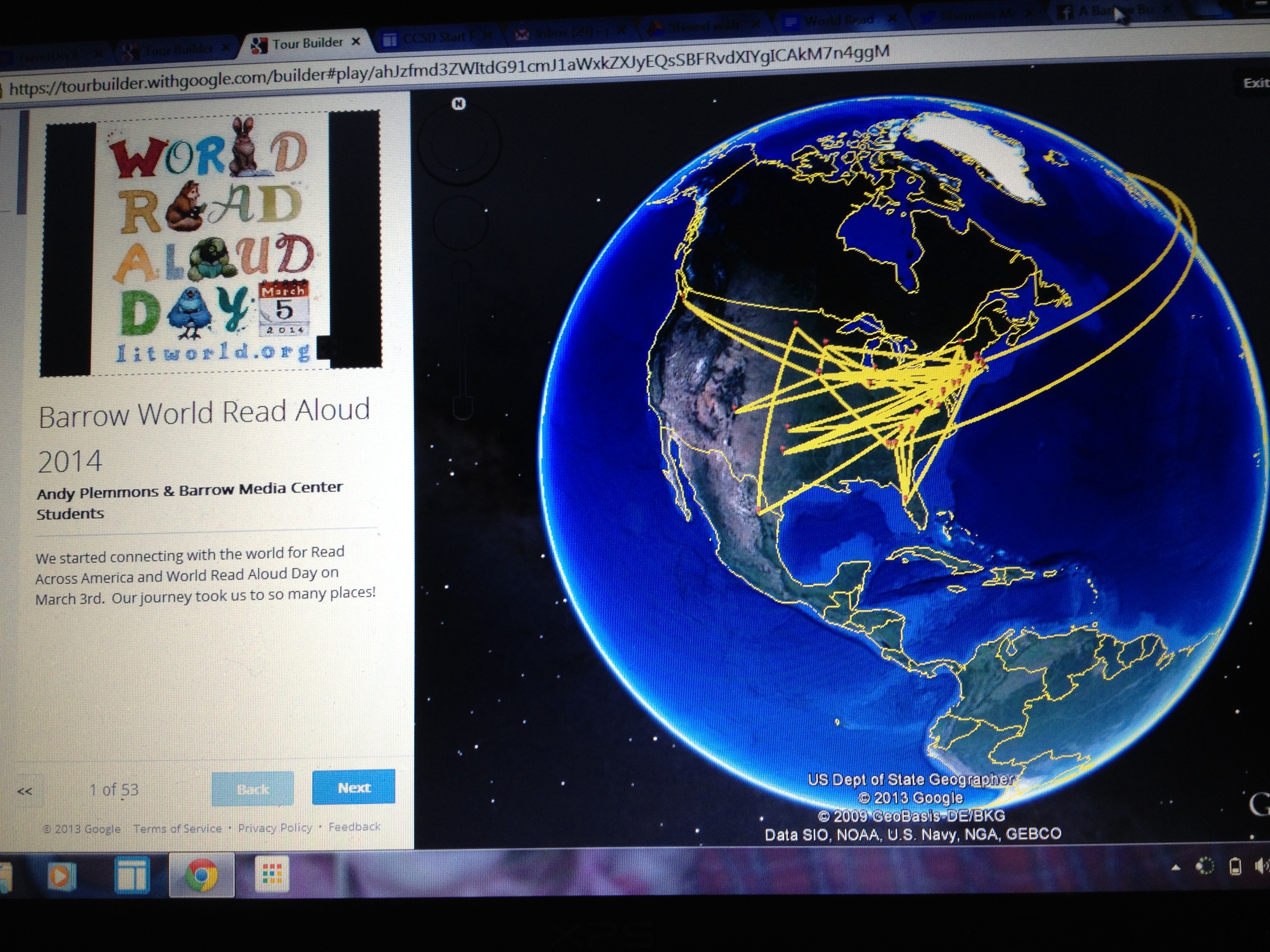
  • engaged in 36 skype sessions
  • made 50 connections in these sessions
  • met new friends in 22 states and 2 other countries

Along the way, we built a Google Earth Tour using Google’s tour builder.  This tool allowed us to quickly add pins to a world map, add photographs and videos, and write a summary of each skype session and what we loved and learned.  I love how at the end of the week, we instantly have documentation that allows us to remember, reflect, and celebrate the fun that we have had during this week.

Google Tour

View our Google Tour Here!

Today, I received several thank you letters from students.  Organizing this many Skype sessions is exhausting.  I won’t lie about that, but the rewards that come from the hard work make up for all of the time I spent organizing this week.  Receiving these letters reminded me why I advocate for World Read Aloud Day and why I believe in the power of connecting with one another through story.  Thank you Litworld for creating such an amazing world-wide event.

World Read Aloud Day Blogging Challenge Week 4: Raising Our Voices with Flipgrid

World-Read-Aloud-Day-2014

I’m participating in the World Read Aloud Day blogging challenge.  Each week, I will respond to a question along with many other bloggers participating in this global celebration of reading aloud.  Our students, teachers, and families will also be involved with these questions each week as I invite them to respond through Flipgrids, Thinglinks, and more.

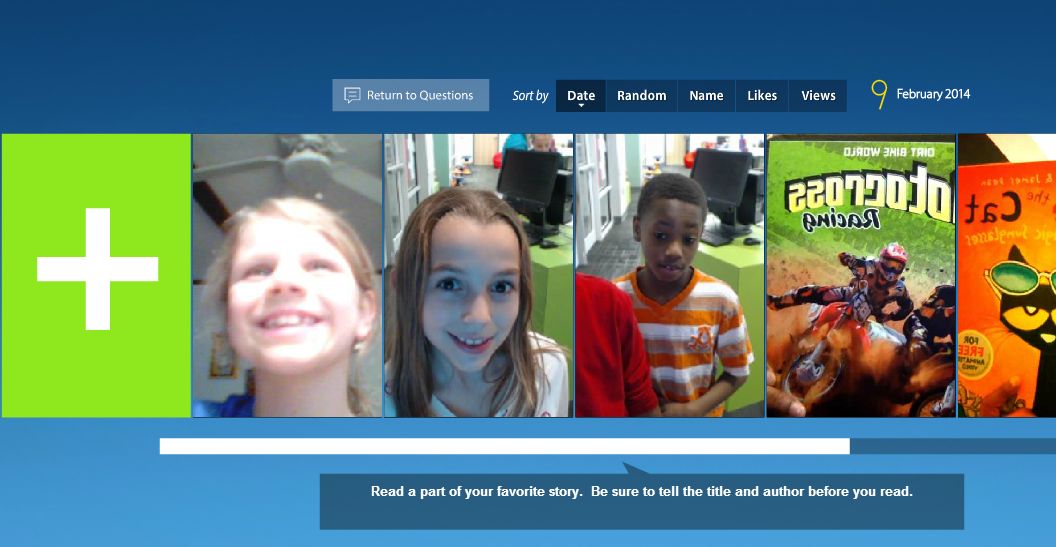
For the final week, I’m asking students, teachers, and families to raise their voices by reading aloud parts of their favorite books.  We are using a Flipgrid to capture these read alouds because it gives students 90 seconds to read aloud.  To get them ready, I made a Youtube video of myself reading my favorite part of this year’s Newbery-winning book, Flora & Ulysses: The Illuninated Adventures.

Kate DiCamillo’s writing speaks to me in so many ways, but this particular part of Flora & Ulysses has proven to be inspiration for our whole school this year as well as our library.  We are expecting the miraculous every day!

Flipgrid Read Aloud

Visit our Flipgrid to hear more readers share their favorite stories, and feel free to try out Flipgrid by adding your own.

http://flipgrid.com/#f4ad9b3e

For more information on World Read Aloud Day visit http://litworld.org/worldreadaloudday 

To connect with other libraries and classrooms, visit our shared Google Doc.

Honoring Student Voices through Student Book Budgets with Capstone Press

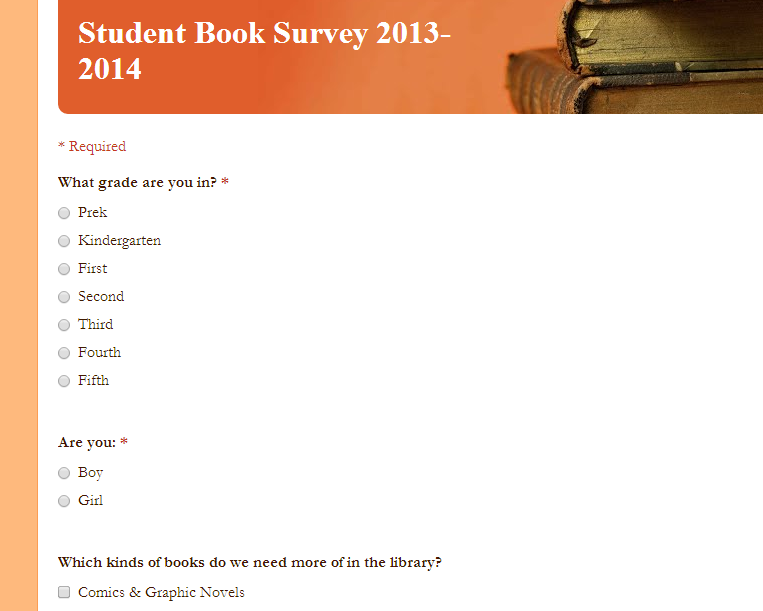
Student Book Survey 2013 2014For the past several years, I have reserved a portion of our library funding to be completely controlled by students.  Over time, I’ve seen student-selected books be among some of the most popular books in the collection.  The library collection is mainly for our students, so why not let their voice be heard in the collection development process.  Part of our library funding comes from the state, and another part comes from fundraisers such as our fall and spring book fair.  Since students and their families shop at our book fairs to build their home libraries while supporting our school library, I see student book budgets as being one small way of giving back to our community.

This year, our book budget process has gone through some changes.  In order to involve a few more students at various stages, I broke the process into parts.  Part 1 was to gather data from the school.  Every Tuesday and Thursday I have a group of five 5th grade boys who work in the library as a service project.  Together, we developed a Google form to gather information from the school.  We wanted to track the number of students we surveyed at each grade level, the number of boys and girls, specific reading interests, and specific requests.

Once the survey was created, we generated a QR code so that they could quickly scan the code and go out into the school to survey students with iPads.  This was mainly needed with our youngest students.  For older students, I emailed the survey to them to fill out.

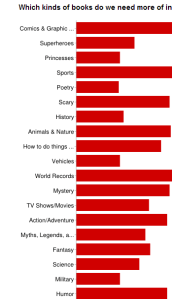
Each year, we tend to see similar results with our data, but I told the students that we can’t assume that we know what people are wanting in the library because it can change.  Here’s a look at the main data they collected.
Student Book Survey 2013 2014   Google Drive

Next, I blocked off some library time during 4th and 5th grade’s recess time and asked for students who would like to participate in an alternative recess for a few days to spend money on books.  I’ve tried doing this during lunch and it is just too complicated to juggle food, catalogs, vendor websites, etc.  I didn’t get as big of a response from students this year, so we’ll see if we return to this model next year.

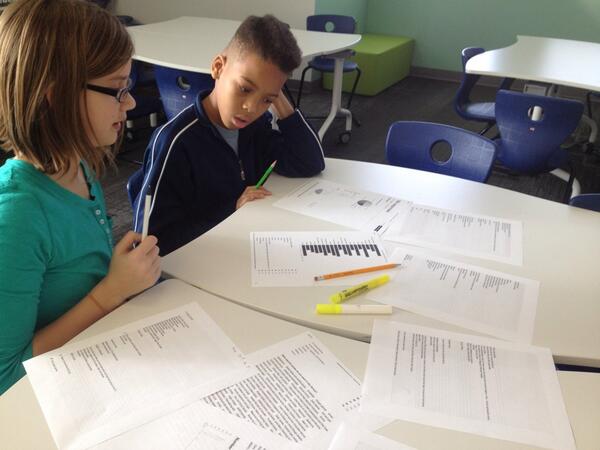
On day 1, the 4th and 5th grade book budget students came to look at the survey results.  They made some decisions to inform how much money should be dedicated to various categories.  I printed the specific requests of students and Savannah and Isaiah spent time highlighting some specific titles that students were asking for.  It was a tedious process for them!  The even got down to searching the library catalog to see how many copies of books we had like Diary of a Wimpy Kid and discussing if there was justification to order even more copies of existing titles.  We finally all agreed on some overall categories of:  Comics/Graphic novels, sports, humor, scary, world records, and action/adventure.
tough decisions

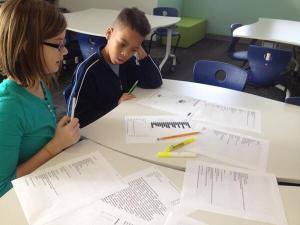
Even on this 1st day, they started having some tough conversation.  For example, they saw that World Records was a highly requested category, but from experience, they know that students are mostly talking about Guinness World Records.  They decided that instead of dividing the budget and giving this category several hundred dollars, they would just buy 2 new copies of the 2014 World Records for about $60.  It’s always fascinating to see how quickly students realize how a budget works and how hard it is to make decisions for the library.  One of them said, “Mr. Plemmons, I know this is only a small part of your job, but it sure is hard!”

jim boon capstone (2)

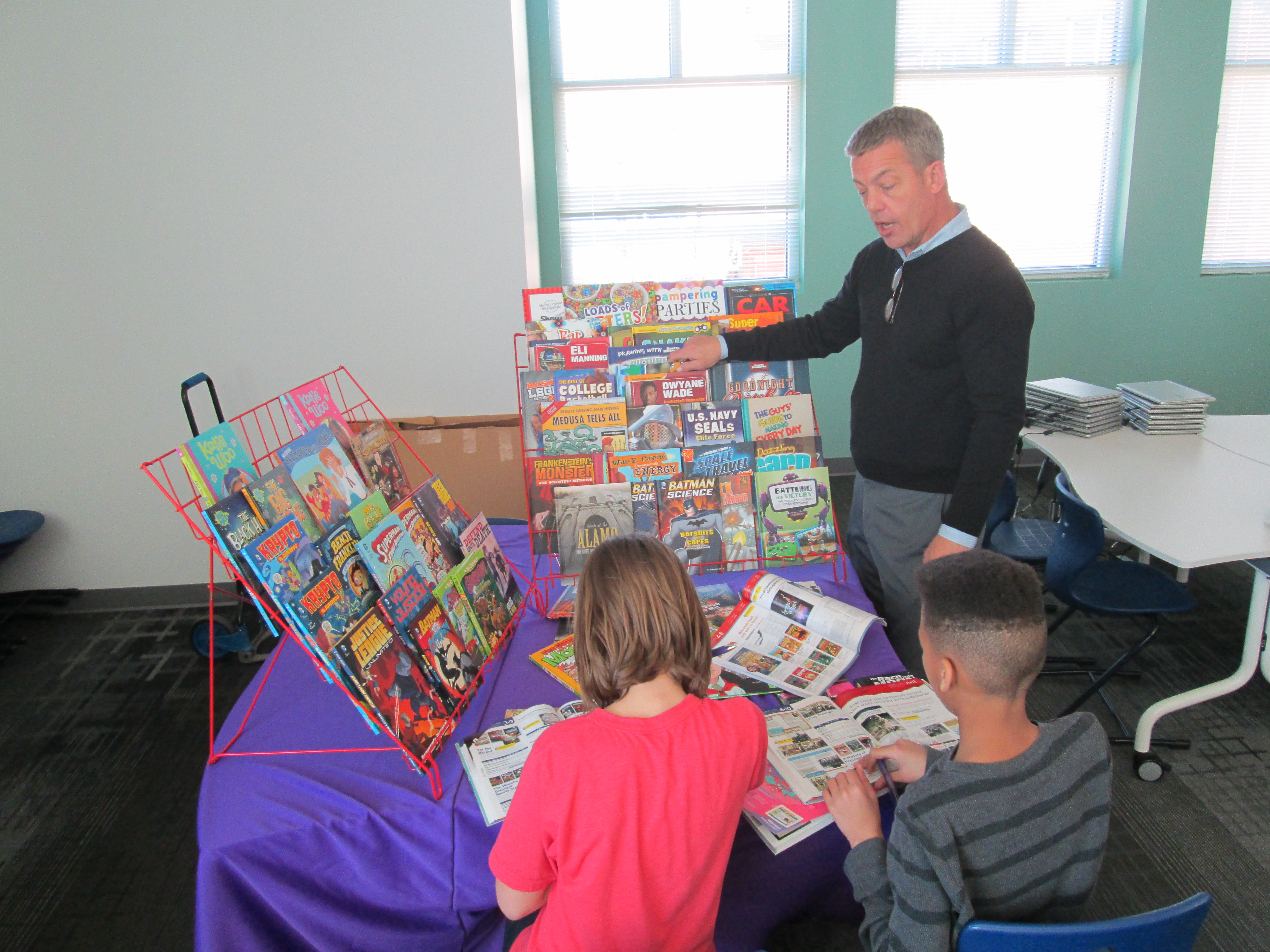
On day 2, we welcomed Jim Boon, Capstone Press Sales Rep.  I love working with Jim because he treats the students like young professionals.  I also love that Jim listens to what students are asking for and tailors his talk and display to the goals that they have.  He setup displays of books that matched their goal categories with a few books that connected to their themes in different ways.  He gave every student a new Capstone catalog and a pen.  As he proceeded to show students various books, he invited students to turn through the catalog, circle books of interest, and fold down the corners of pages.  After he shared some specific books, students came up and started browsing through the books on display.  Jim and I proceeded to have individual conversations with students about the books in the catalogs and help them see where prices could be found.  We also mentioned to students that Capstone offers Capstone Rewards and various incentives.  For example, if we spend $1750 on our order, we get 30% back in Capstone Rewards, but if we spend less than that we get 10% back.  I love the math that comes into this project each year because it is real world application of an important life skill.

I also love that in our individual conversations there are stories that emerge.  Jim had a great conversation with one of our students, Ember.  She consistently asked Jim about the prices of every book.  The budget was weighing heavy on her mind and she was thinking hard about how to get the most books for our money.  In their conversations, there were a few books that Ember desperately wanted in our collection, and I loved that Jim made sure to leave one of those books that she requested for us to add to our collection!  I know Ember will greatly appreciate it.

jim boon capstone (11)

Students were having so much fun that they decided to take their catalogs with them to continue marking titles of interest.  I’m a little scared of seeing what they come back with!  It’s such a hard process to cross books off of the wish list, but it is an important process to choose the very best books for our collection at the current time with the funds that we have.

jim boon capstone (13)

This process is beneficial to me as the librarian too because I get to see books that students are getting excited about.  For the purposes of the project, I remind students to focus on their goals and only purchase what matches the requests.  However, I’m over to the side writing down titles to put on my own ordering list for this year or the beginning of next year knowing that the titles already have a group of readers waiting on them.
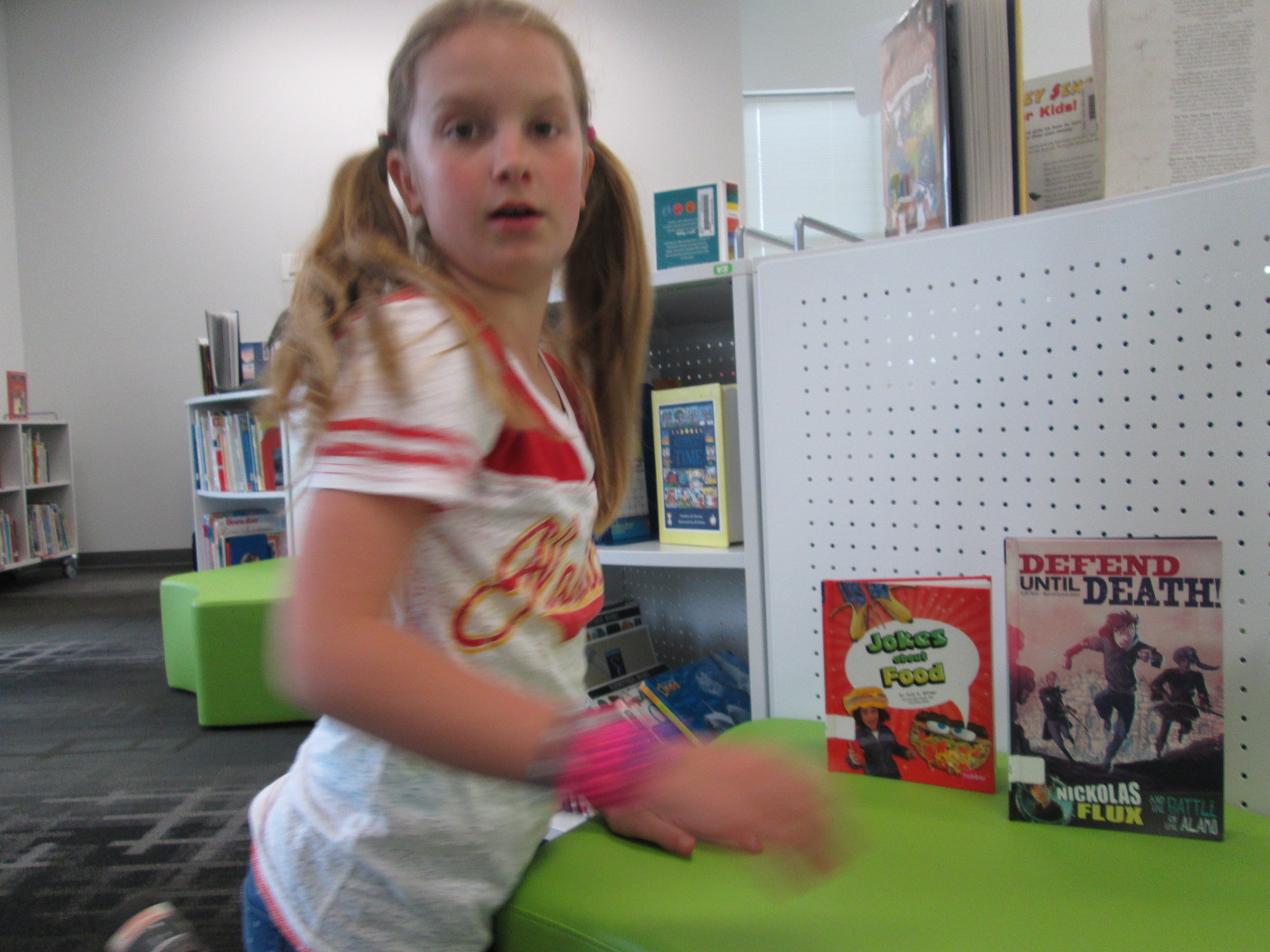
Thank you to Capstone Press for your tremendous customer service, your professional relationship with all of your users including students, and for giving our students a voice in collection development.  You are superstars!

Our next step will be to look at one more vendor to fill in some holes in our wish list, and the we will start the tedious process of cutting books from our list until we have our final order.