Poem in Your Pocket Day is a national celebration of poetry where everyone is encouraged to carry an original or a favorite poem in their pocket and share the poem with friends, family, and even strangers during the day. The official day is April 21 this year, but due to state testing we celebrate early and use this celebration to kickoff Poetry Month and National School Library Month.
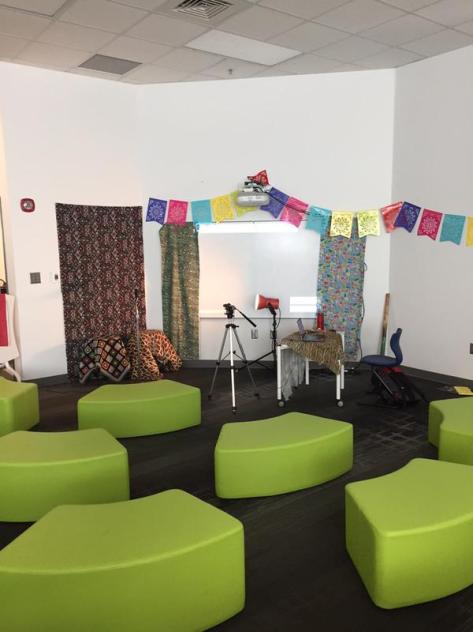
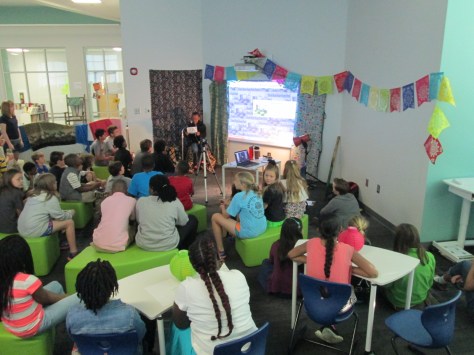
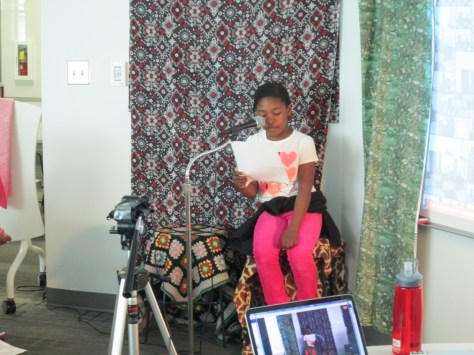
On April 7th and 8th, every class in the school will come to the library for a special poetry cafe. We’ll have special seating, special lighting, an open microphone, and a poet’s stool. Students and teachers are welcome to come to the open microphone during their time slot and share poetry until time runs out. No one is forced to come to the microphone, but what we’ve found is that almost every students and teacher in the school shares a poem on this special day.
Family and community are welcome to attend in person, but we know that not everyone can join us in person. For the past several years, we have broadcast our poetry readings live and encouraged people to leave comments for the poets. Last year, we tried Google Hangouts for our event and encouraged people to tweet comments to our poets using a hashtag.
This year, we are once again broadcasting our poetry and we would love for it to be the best year yet. We would love for you to tune in to any of our poetry readings taking place throughout the day on April 7 and 8. You can even tune in late by watching the archives. Everything you need to know is housed on a special Smore page.
Everything you need to know about our event is here!
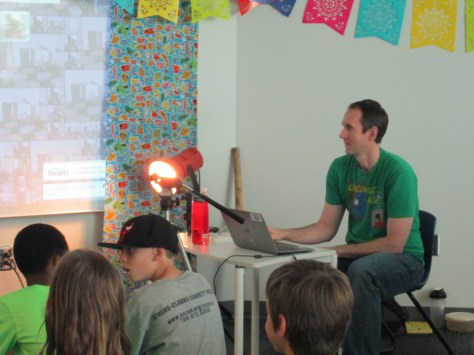
During the event, I will have a special “wall of social” displayed on our projection screen so that students can see any comments that you leave for them on social media such as Twitter and Instagram. Be sure to use the hashtag #barrowpoems so that we see your comments.
Happy Poetry Month and School Library Month! We hope to see you online!
We have an amazing independent bookshop in our community called Avid Bookshop. Our library has been collaborating with Janet Geddis before the storefront of Avid existed, and it has been so much fun to watch how this community-focused bookshop has changed over the years. They have been hosting some dynamic authors and illustrators for children over the past few months. When I saw that Caldecott medal-winning duo Philip and Erin Stead were coming to the shop, I was over the moon excited and didn’t want to miss the chance to see them. Then, I got an email from Rachel Watkins asking if our school might be the site of the pajama storytime. We’ve never hosted an event specifically for Avid that wasn’t an author visit for school, but I didn’t hesitate in exploring how to make it happen.
The opportunity aligned perfectly with my goal of supporting the reading interests and curiosities of students, teachers, and families. I’ve been thinking a lot about the family part. What do I do to support families and reading? It’s something I need to work on, but offering a nighttime event for the community with Philip and Erin Stead was the perfect opportunity to show families at our school and in the community an amazing author/illustrator team they may not have heard of, exploring some new books together, and taking a look at the illustration process. Our students have benefited from many author and illustrator visits thanks to Avid, but I loved that this gave families a chance to have the same experience alongside their child and ask questions and learn together.
Avid and I advertised the event heavily. Students did book talks of one Stead book each day on our morning broadcast along with a reminder about the pajama storytime. An electronic flyer went home to all families. I posted the flyer on the doors of our library. Numerous tweets, Facebook posts, and Instagram pictures were shared. We had no way of knowing how many people would actually show up, and by 6:20PM we were pretty nervous that no one was coming. Suddenly at 6:25PM people started pouring in and they just kept coming. We even delayed until 6:35 and they still kept coming in.
If you’ve never met Philip and Erin Stead in person, they are just a delight. Both are soft spoken, which has a naturally calming effect on the wiggly small ones. Phil did most of the talking, but I loved that at the beginning he started by telling about how Erin is shy and had all the kids say their names aloud to introduce themselves all at once. Erin replied, “It’s nice to meet you”, which just felt right. It showed the kids that it’s ok to be quiet and that you can do amazing things to put your voice into the world without actually speaking the words out loud.
Phil read A Sick Day for Amos McGee and had the kids participating along the way with movements and chants. He knew just how to keep their attention. At the close of the book, they paused for questions. I loved that several parents chimed in with their own questions which were peppered with comments and questions from the kids too. We had questions about the red balloon in Amos McGee and whether it was an homage to Good Night Gorilla. There were questions about the process of creating a book together as husband and wife and whether or not the illustrations or the writing came first.
Next, Phil introduced us to his new book Ideas Are All Around and we found out we were the first group that he had actually read part of the book to. He teased us with just a few of the pages and gave us a taste of how the book takes us into the head of a writer and illustrator on a walk and that ideas are really hiding all around us. Then came probably the most special moment of the night: an art demo.
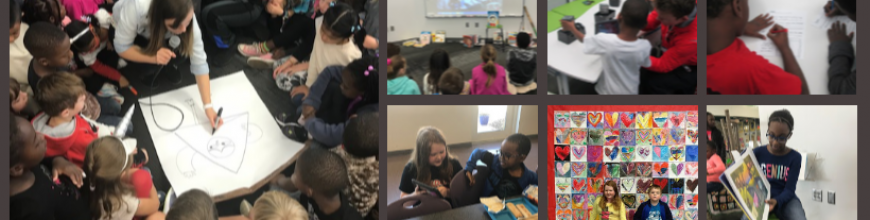
Phil invited all of the little kids to come up and gather around a table where he had his art supplies. Then adults gathered around behind the kids. It was a large group and yet somehow most people found a spot they could see. Kids seemed to be literally on top of the workspace, but Phil worked his magic and made the art come to life. He talked through each step of his art for Ideas Are All Around and modeled it as he went. Some kids even got to help a bit during the process. In the end, he created 3 illustrations of a bear: two he was happy with and one not so great.
I loved this! It connected so well with the book that an artist goes through many pieces of art until the right one is created. Lots of versions go in the trash or at least to a “fail” box.
To close the night, Phil read aloud Special Delivery and we learned that the idea was really something that he dreamed about. Once again, he had the audience participating along the way even while they were bouncing on cushions around the library.
The crowd lingered for a long time looking through the books from Avid, making purchases, and getting autographs. So many families left with new books to take home and share together along with the personal experience of meeting the author and illustrator that created the book.
I’ve often encouraged families to attend Avid events or to go to author events in nearby Decatur such as the Decatur Book Festival, but I don’t really see that encouragement pay off as much. There was something about the familiarity of the school community, a place where we have connections to one another, to host an event like this. I think we’ve tapped into something we need to explore even more in the future.
Thank you so much to Avid for trying something new for an author event. Thank you for bringing the Steads to our community. Thank you to Philip and Erin for your long travels to reach our community and for sharing your inspiring work with us all. Thank you to the Publisher who makes these kinds of book tours and events happen for independent bookshops, schools, and communities. Finally, thank you to our families. Whether you were a Barrow family or a visitor from another school or county, thank you for spending a night with us in the library connecting with one another through art and story.
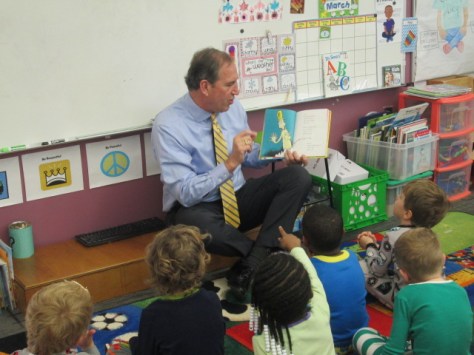
March 2nd is always a special day for our school. We have a long tradition of having guest readers for all classrooms in honor of Read Across America and the birthday of Dr. Seuss. The goal is to have two readers for every classroom. This allows more connections to the community, more books to be heard, and also more people in case we have people who are unable to come.
Courtney Tobin is a parent volunteer at our school who organizes my library volunteers. She also creates a Signup Genius for events like this one. She puts 2 slots for every class, and we start sending it out asking for readers. The link is put in my library newsletter, library facebook page, and grade level parent representatives send it out to lists of parents. I invite district leadership including our superintendent, public relations, and board of education members.
As the event nears, we always have empty spaces still left, so we repeat sending out the link and send it to additional places like the UGA Athletic Association. Usually be the day of the event, the list is full and we have people who show up who didn’t even get to sign up.
It takes a whole community to pull off 2 readers in every class.
We gather in the library, and readers check in with Kim Ness, another wonderful parent volunteer. She does this while I’m helping with morning broadcast. Readers select a Seuss book from our library collection and my personal collection and socialize and practice reading. We gather for a group picture and a huge thank you for taking time to celebrate reading with our students.
It’s always fun to race around the school to try to catch a glimpse of the smiling faces in every class and the community readers having such a great time sharing stories.
For the remainder of the day, we continue our Skype connections with other schools around the country. This is a continuation of our World Read Aloud Skypes.
Today, we connected with:
Shannon Hyman in Glen Allen, VA and her 3rd grade students to read Be a Friend and Mother Bruce. Their teacher was a big UGA fan!
Lisa Lindeman in Babylon, NY and her 5th grade students to read Snappsy the Alligator
Terry Freyou in Coppell, TX and her 5th grade students to read Be a Friend
Sarah Staudt in Mason City, IA to read Mother Bruce
Donna MacDonald in South Burlington, VT and her 1st grade to read Snappsy the Alligator
Dana Susko in Santa Barbara, CA and her Prek to read The Day the Crayons Came Home
Carol Scrimgeour in Essex, VT and her Kindergarten to read Snappsy the Alligator
It is always a magical day connecting on Skype because the kids share a story across the miles and make connections with another school. I love pulling up a map and talking about how technology not only lets us see and talk to people in other places, but it helps us literally connect the dots between our locations and know in real-time how long it would take us to get there. We’ve talked about tolls, traffic accidents, construction zones, megabus, and alternative routes along with our celebration of great stories.
We’ve also encountered technical difficulties. One school had to cancel due to the internet being out in their school, but it was a life lesson that when something doesn’t work, you just carry on. When we connected with Lisa Lindeman, we could not get Skype to connect us. We tried multiple times but communicated in the chat. We finally decided to give Google Hangouts a try. She had never used it, but she was willing to try. It worked like a charm, but more importantly it showed our students and teachers in both states that we weren’t afraid to fail, back up, and try something else. Life isn’t smooth, and things don’t always work out, but we can’t just give up easily when something is frustrating or hard.
This year, the school library media specialists in our district decided to start a new reading competition called Bookapalooza. In the past, we have participated in Battle of the Books, where students read a set list of books and compete on teams to answer questions about specific details from the books. We had lots of discussion about trying a reading competition that offered students more choice in the books that they read as well as gave students a chance to show off their creativity and interests in a variety of categories rather than just answering factual questions about books.
A subcommittee of our group met to work out some logistics of how a new reading competition might work, and a new Bookapalooza website was created.
Students in 3rd-5th grade could compete in the competition. They could choose any book, author, or genre to read and create a project around. Five categories were created to give students a variety of choices to celebrate their own learning preferences: Art, Performance, Trifold, Writing, and Technology.
In the past, teams of students have worked together in Battle of the Books. Bookapalooza did allow for some collaboration but most projects were meant to be done by individuals. I had to think about organizing our school competition in a whole new way. I’m not sure that I really did the best job, but it definitely was a great first try. In November, I started sharing with students about what Bookapalooza was all about. Some teachers brought their whole class to the library while others just showed a short intro video.
I created a Google form where students could sign up for Bookapalooza and indicate the category they were most likely going to enter along with the title of the book. This could of course change, but the form allowed me to get a good ideas of how many students were going to enter the contest and to make sure we had projects in all of the 5 categories. I was also able to make an email list from this form so that I could email the participants with updates on the competition.
In the past, I’ve held practices for Battle of the Books during lunch on Tuesdays and Thursdays, but this type of competition really didn’t lend itself to that structure. Instead, I blocked off various times on the library calendar for Bookapalooza help sessions. Teachers could sign students up to come during these times or they were welcome to just drop by to ask questions or work. Some teachers chose to the do the competition with their whole class so they scheduled time on the library calendar specifically for their class.
I also contacted our collaborating teachers to ask if they would help each grade level with projects. Natalie Hicks, Jan Mullins, and Heather Carlson were instrumental in making sure that each grade level had representation in the competition.
As the deadline approached, I checked in via email with students and teachers and the projects started to come in. I cleared off the library shelves for projects to be displayed. As they came in, I numbered the projects for judging. For digital projects, I created another Google form for students to submit links to projects. I put all of these links on a Google doc that could be displayed on each of our projection boards for viewing. The day after the deadline, we held our school competition, which meant that classes were welcome to come through and look at all of the projects and a team of 5 judges used rubrics to judge and rank the projects. We had to select one project from each category to move on to the district competition at the Athens Clarke County Library.
Some of our technology projects included:
Some of our performance projects included:
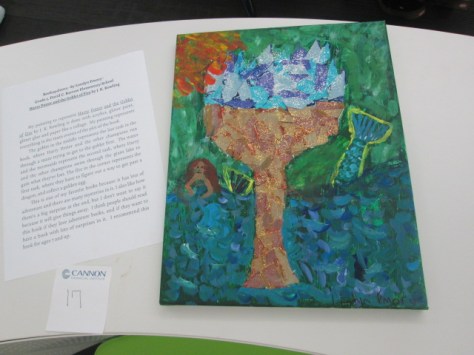
Some of our art projects included:
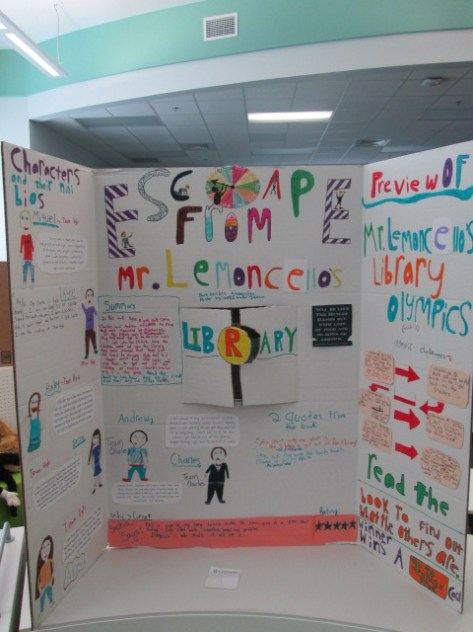
Some of our trifolds included:
Since we had so many outstanding projects, I asked judges to write notes about things that stood out about various projects and we awarded many special certificates and bookmarks to students who didn’t necessarily place “first” in their category.
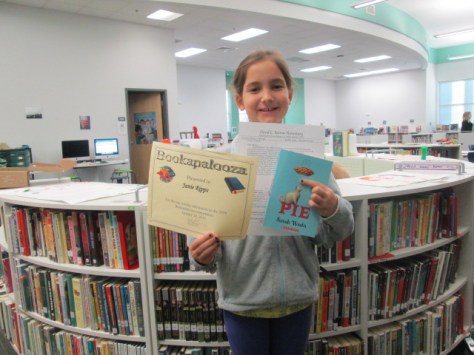
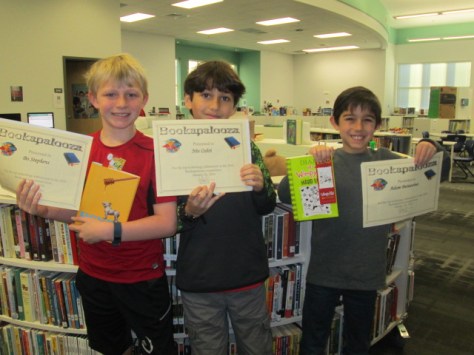
Congratulations to the following projects for moving forward:
Our school level winners moved on to the district competition at the Athens Clarke County library where we were able to enjoy projects from most of the elementary schools in our district. Our school technology project placed 3rd n the district and our school art project placed 1st in the district. Congratulations to all of the students in Clarke County who took time to share their love of books, their personal talents, and their creativity through numerous Bookapalooza projects. We look forward to growing this celebration next year.
Each week leading up to World Read Aloud Day (February 24th) we want to join our voices around the world to celebrate one of the strengths of reading aloud. During the week of January 17-24, we celebrate how reading connects us and makes the world a friendlier place
We have created a Flipgrid for you to share your responses to the following question:
How does reading help us connect and make the world friendlier?
We hope you will share this Flipgrid with other educators, students, and families around the world and record your responses which can last up to 90 seconds. Wouldn’t this be a great way to practice some informational writing in classrooms? Wouldn’t you love to hear stories from the families that you serve? Aren’t you curious about the perspectives on this question from around the world? Let’s join our voices and contribute responses all week long. Can we find a new friend by contributing our voice?
In addition, you might also consider coming up with your own posts in response to this week’s theme on your own blog or site. You might read aloud a book with a friend and post about it on your blog or other social media. You might post a book of your best book friends which might be actual people or covers of books. Whatever additional ways you choose to celebrate “Friendship Week”, please tag your posts with #wrad16 and #friendshipweek as well as mention @litworldsays (Twitter) and @litworld (Instagram, Facebook).
I know one of the stories we will read during Friendship Week is Leo: A Ghost Story by Mac Barnett, but we will read many other friendship stories during the week as well.
Third grade has been hard at work on a Mo Willems art and writing project. Since there is a Mo Willems exhibit at the High Museum of Art, we decided to use Mo Willems as an author/illustrator study to take a close look at how illustrators show emotion through their characters as well as how authors many times have a moral or lesson that we learn from their stories.
In the library in collaboration with Rita Foretich (art teacher), we took a close look at the whole Mo Willems collection of books. We wanted students to spend time looking at the illustration and noticing similarities and differences across series as well as how he creates simple illustrations that show a range of emotions. I pulled all of our library books for this as well as brought my whole collection from home.
In art, students have been working on characters and settings for their own stories which will include a moral of some kind. In writing workshop, students are working on the text of their stories. They will eventually come back to the library to use all of these pieces with the Puppet Pals app on the iPad to tell their stories.
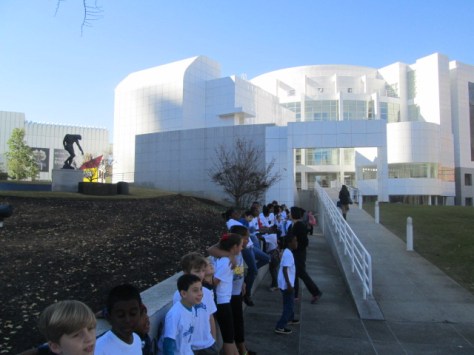
Our art teacher wrote a grant to fund a field trip for the entire 3rd grade to visit the High Museum in Atlanta. Across 2 days, every student had a chance to visit the museum, tour the Mo Willems exhibit, see some additional pieces of art, and participate in an art workshop. The grant funded tickets for all students as well as transportation. We are so fortunate to have an art teacher who works tirelessly to increase access to art for our students. For several students, it was their first time visiting Atlanta and seeing the massive skyscrapers.
At the museum, we split up into two groups. One group went to an art workshop and the other group split in half for a tour with a docent. Our docent tour took us into the main exhibits to stop at key art pieces and consider materials the artist used, the story the piece was trying to tell, and to learn more about how to examine a piece of art in a safe and meaningful way.
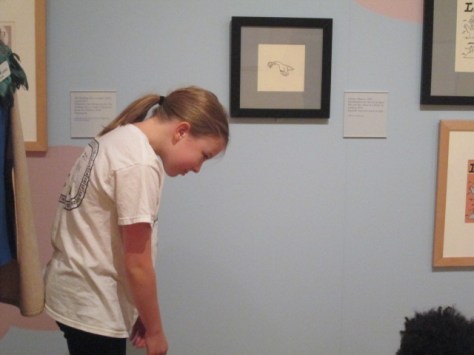
We eventually made our way into the Mo Willems exhibit, and the docent took us to each collection of art and had students sit on the floor. At the pigeon illustrations, we looked at the many expressions of the pigeon and how Mo Willems shows emotion through eye position, movement, and facial expressions.
Students took turns standing and acting out the emotions of the pigeon to see if they agreed with the choices that Mo Willems made. She also pointed out how Mo Willems draws an illustration multiple times before doing the final illustration. Some of the pieces on exhibit showed blue, red, and black lines to show he changes Mo Willems had made along the way. Students loved looking at the final piece and seeing what changed from the original sketch.
We continued to each collection of art doing similar activities to consider emotion and movement. Students had a chance to share their favorite Mo Willems book or tell about the book that various pieces of art came from. Along the way, we learned a bit more about Mo Willems and his work with Sesame Street. Students also loved looking for the pigeons hidden throughout the museum.
In the workshop, students listened to the story Leonardo the Terrible Monster. As they listened, the museum reader pointed out the expressions of the various monsters in the story and continued the theme of having students think about movement and emotion in illustration.
Following the story, students made their own monster out of construct paper, textured rubbings, and various craft supplies. They were once again asked to think about emotion and how they were showing that through their monster. I liked walking around and seeing students and teachers positioning their eyes, mouths, and other body parts to see how it changed the look and feel of the monster. Students continued to add to their monsters right up until we packed up to leave.
It was a fabulous day at the museum and I can’t wait to see how this experience translates into the stories, characters, and settings that they are continuing to work on.
We have been participating in Hour of Code since it started 3 years ago, and it is an event that inspires so many things within our school. This week-long event coincides with Computer Science in Education week each December. Code.org partner with numerous organizations to offer one-hour tutorials that are appropriate for multiple age groups. When we first started Hour of Code, I tried to get students to all try specific tutorials, but many of our students have gained some confidence with coding and problem solving over the years. I wanted to offer more choice this year and continue to focus on perseverance, problem solving, and collaboration in addition to learning some pieces of what it means to code.
On day 1 of Hour of Code, our 3rd grade came 2 classes at a time. This meant 45-50 students in the library with their computers. It’s a big group with lots of energy, but it amazes me how they settle in, don’t give up, and support one another. I also had a 5th grade group and a second grade group during the day.
We started by sharing some things we know about coding. We also talked about how many of us love video games or apps. Pretty much all hands went up, and we pondered the questions: “What if the people who invented Minecraft (or insert any app or game here) gave up before they finished the game?” We also pondered how many games are currently being invented out there that we don’t even know about and how many of the developers will persevere or give up. It was an interesting way to set the stage for our work for the day.
I offered these as a starting place, but students were allowed to go to any tutorial they wanted to attempt. My main rule was that I wanted them to really stick with whatever they picked and give their best try.
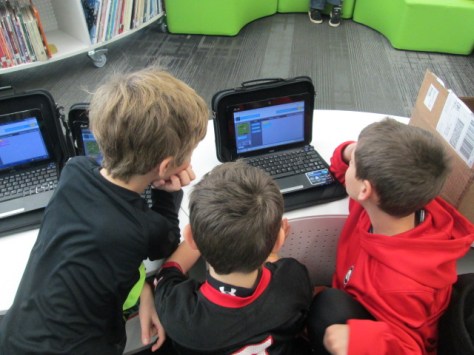
Students spread out around the library and got to work. It took a few minutes to settle in, but all students stayed focused on the Code.org site. I loved how they very naturally got up and helped one another when they got stuck. A few students reached a point of frustration where they needed a break, so I pulled all of our coding books from the library as a place to go and take a break to just read about coding until they were ready to go back to work. At some point, they all went back to their computer.
I also loved that some students who speak other languages saw that they could switch the language on the Code.org tutorials. Rather than flipping back and forth to Google Translate, they could read the site right on their screen, and these students were over the moon with excitement and were extremely successful in their coding.
The Code.org site was very reliable on our first day. In the previous 2 years, we’ve had problems with the site crashing or being slow, but day one went really well. I had some backup plans though. One of the other activities that students were able to do in small groups was visit our Finch robots, which are on loan from Birdbrain Technologies. Students worked alone to use Snap to program the robot to maneuver around the floor. There wasn’t a specific task other than to explore what the robots could do and what each block of code meant. Some students had the robots congregating together on the floor or even doing a dance together. It was fun to see what they came up with in such a short amount of time.
As usual, teachers observed students who struggled in academic areas suddenly find a spark with coding. I hope that seeing some of these students’ excitement will spark ideas for all of us in how we might use this momentum to connect to curriculum content. We can’t dismiss the tools that get students excited about learning. We need to embrace tools like Minecraft and the expertise that our students hold in these tools and consider how these might enrich the work we are doing together in school.
I can’t wait to see what else the Hour of Code week holds for us.
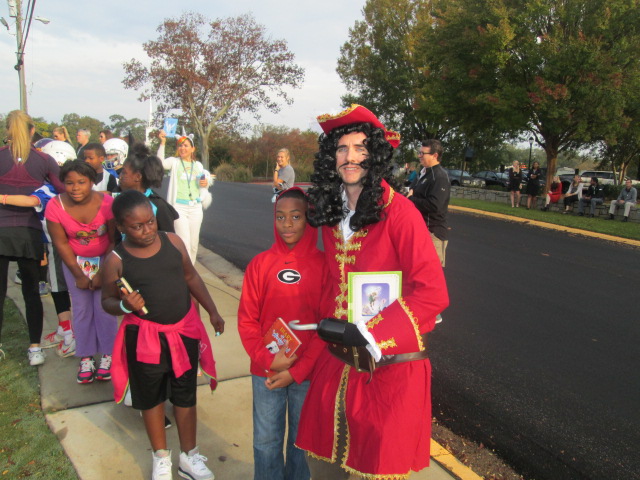
The day before fall break is always a special day at our school. It is our annual Storybook Celebration. Organizing this day takes a tremendous amount of work, but the students have such a great day. Students and teachers are encouraged to dress as any storybook character.
We spent about 2 weeks ahead of the event advertising various costume ideas on our morning broadcast. I wanted to encourage students to think about how they could use things they already had around their house or things they could make in order to create an awesome costume. Some of my BTV crew chose books and shared some simple ideas for creating an awesome costume. An example was Max from Max the Brave where you could just dress in black and tie a red cape, blanket, sheet, or towel around your neck.
Students poured into the library for the past 2 weeks to ask for assistance finding a book for the parade and costume ideas. We had students coming in right up until the parade actually started, which was definitely a little crazy without much help.
Also ahead of the event, I sent out a Google spreadsheet to all of our resource and specials teachers to offer special opportunities during the day for classes to have literature-focused activities and a chance for teachers to have a planning time. Resource and specials teachers blacked out times that they weren’t available and teachers signed up for the rest.
My volunteer coordinator, Courtney Tobin, created a Signup Genius to recruit 2 guest readers for every classroom to kickoff the day. This was sent out to grade level parent representatives who encouraged people to sign up. I also shared the link with my own list of past guest readers as well as CCSD board members and district leaders. I also published it on our library Facebook page. We didn’t quite reach our goal of 2 readers per class, but every class had someone to share a great story with them at the start of the day. These readers gathered in the library, chose from a selection of books, took a photo, and were off to classes to read.
After guest readers, we gathered in the cafeteria for an assembly. We broadcast students onto the big screen as they entered using Google Hangouts.
Evan Bush from the Athens Clarke County Public Library came and told several interactive fall stories to almost 600 students. I loved how he took the energy of the crowd and got them all snapping, clapping, and sharing parts of the stories. It kept them focused. I reached out to Evan about 2 weeks before our event, and he graciously agreed to come. I love that he gave our students a great storytelling experience and also one more connection to the public library and what it can offer.
After Evan, each class stood up twirled around to show off costumes, and sat facing the back of the cafeteria. This prepared us to go out on our actual parade as well as gave students a chance to show one another their costumes.
It was during this time that I found out all my preparation for the parade route suddenly had to be changed. I was so organized this year and provided maps of the parade route to families and community ahead of time. However, Georgia Power had to do some work and closed part of the sidewalk on our route. I had to make a last minute change, but it all worked out.
We took off into the community shouting “Read More Books!” and showing off our costumes. It was fun to see community members, families, UGA students, construction workers, and more cheering us on along the way. Our 1st-5th grade took a longer route and our Prek/K took a shorter route around the school.
Our 5th graders have a tradition of stopping along the parade route for a special treat, and for the past few years we have stopped at the Georgia Center for Continuing Education for hot chocolate. Mimi, our family engagement specialist, organizes this piece for us by having the cafeteria prep the hot chocolate and taking the hot chocolate to setup. Students have some time to just hangout, talk, and enjoy their treats before heading back to school.
Finally, back at school we go to our special classes as well as do more literature activities in class. In the library, we focused on pirate stories since I was dressed as Captain Hook. I also used the great pirate video from All the Wonders.
Students moved to tables and colored a pirate sheet or designed their own pirate using Chromville augmented reality.
Somehow in all the craziness, we also organized a big book giveaway. In the back corner of the library, there were tables of books that had been donated or weeded out of various collections and needed a good home. Courtney Tobin and other volunteers helped get the books put out, and teachers brought classes or small groups of students to pick out new books. It was fun to glance over and see so many students excited to add books to their home libraries. We will keep these tables going next week since there are still books left.
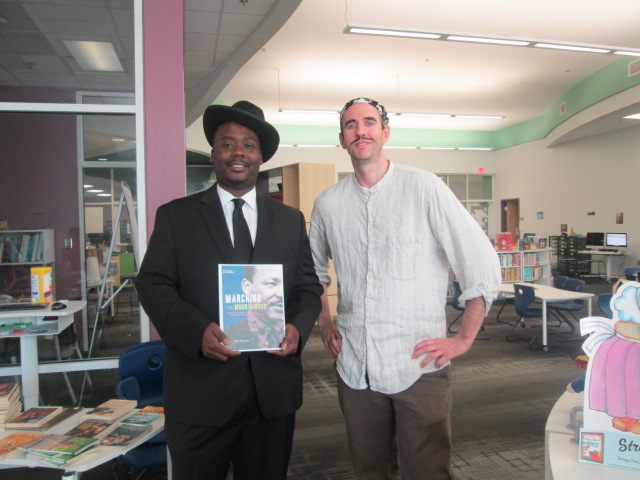
It seems that each year something new comes along for storybook celebration that makes it a little more special. This year I loved seeing so many creative costumes: Little Elliot, the Bird Woman from Circus Mirandus, Minecraft creepers, Martin Luther King, the Very Hungry Caterpillar, and more.
I loved seeing our reflection in the glass of the UGA coliseum.
I also loved that our public library was involved in the day and I want to think even more about how community is represented on this day.
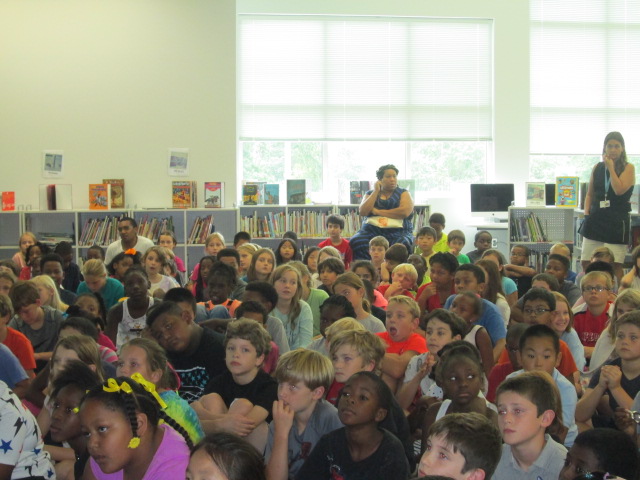
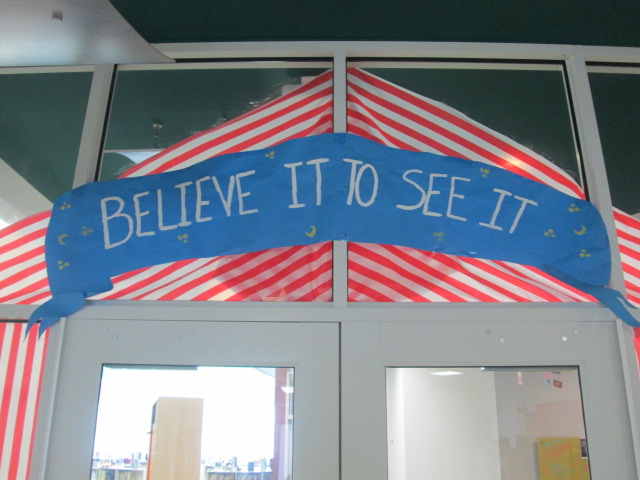
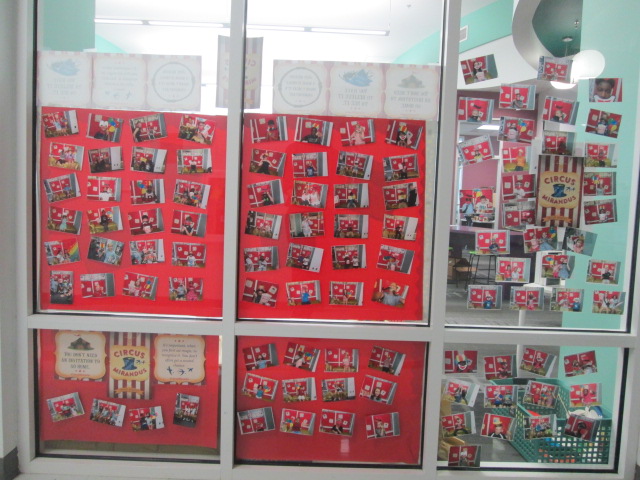
The magical day finally arrived. After 3 weeks of school, lots of circus photo booth pictures, invented tickets to Circus Mirandus, and many pages read, Cassie Beasley came to our school! The students have been buzzing with energy all week long. They’ve repeatedly asked, “Is today the day that she’s coming?”
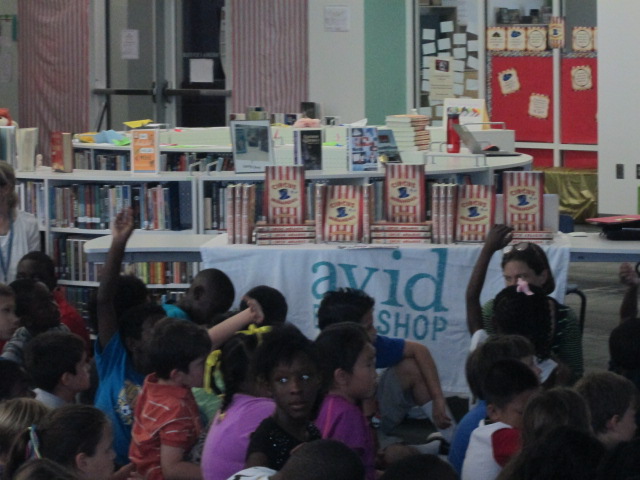
Thanks to our PTA every 3rd-5th grade classroom got a copy of Circus Mirandus and 20 additional copies were given away to students who added their name to our raffle by taking a picture or making a Circus Mirandus ticket. I announced all of the winners on our morning broadcast.
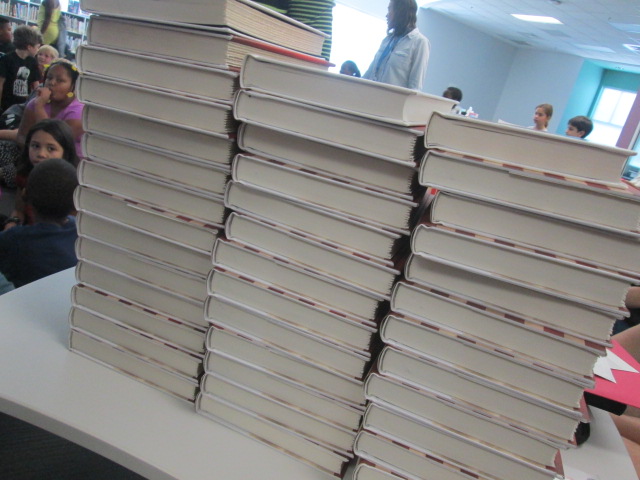
Hannah and Will from Avid Bookshop arrived early and helped setup all of the books for autographing. We worked together to place post its in all of the books to make the signing smooth.
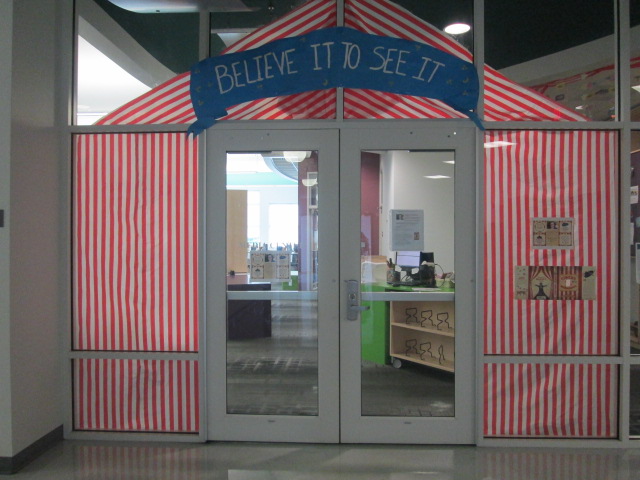
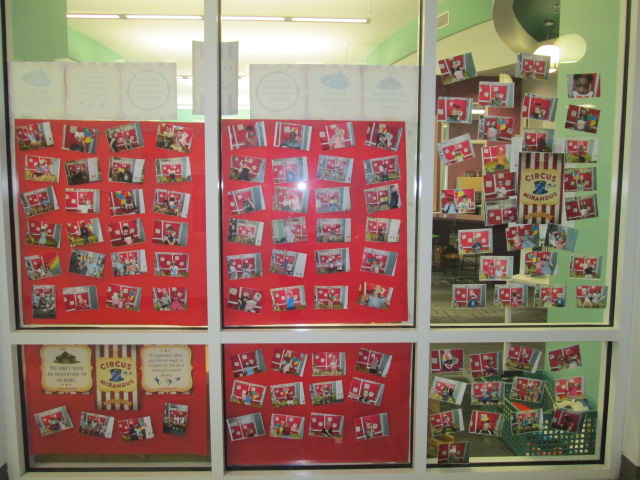
When Cassie arrived, it was so much fun walking her down the halls of our school through our Circus Mirandus tent and looking at our display of photo booth pictures.
We also took time to look at all of the tickets that students submitted and admired the student choices and how long each ticket was valid. We smiled at the crown of Artemis and how the student thought it should be good forever because it was a goddess crown.
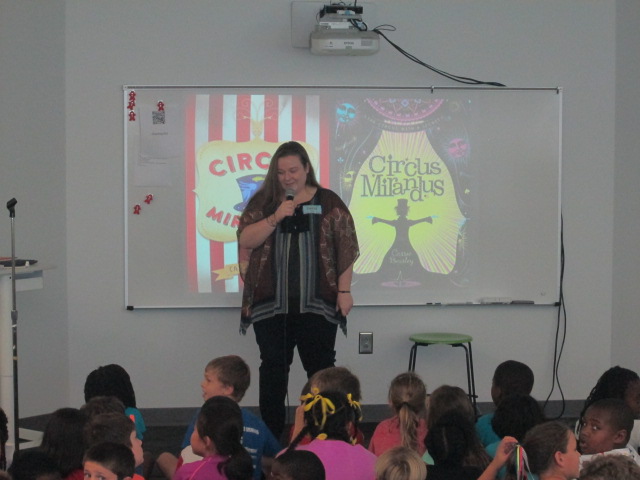
Today was Cassie’s very first school visit, but you would not have known it without her saying it. She engaged the energetic students with a timeline of her life to show how she was a real person who first thought writers looked like people like Gandalf. Students connected with her as she told the story of how she was so engaged in reading while in school that she completely missed a fire drill.
She shared with students how it took 2 1/2 years to write Circus Mirandus, even though the first draft was written in a week. They saw pictures of her overflow bucket of revisions and heard about her filing cabinet which stored all of the drafts and notes. Cassie even showed notes from her sister that were being scribbled onto her manuscript up until the final stages of the book and how she continued to see things she had missed and added them in.
Students saw that even though Cassie has a book in print that is getting tons of buzz she is still working hard. She gave them some insight into the projects she is currently working on and how she covers her tables at home with notecards, ideas, and manuscripts. She wants to think about each character and spends time getting to know each one on a notecard.
Cassie showed students lots of evidence of how her life makes its way into her writing. We saw a picture of her black tea that is just the way Aunt Gertrudis likes it and her parrot which was the inspiration for Chintzy.
There were just so many nuggets of information that Cassie shared with the students to inspire both their reading and their writing lives. I can’t wait t see how this early author visit inspires student work throughout the year.
Cassie left plenty of time for questions, and wow…..students had some profound questions. One student asked about what Cassie does to make herself keep going with her writing. The student explained how she often starts writing but never finishes it. Cassie shared how it is sometimes hard to keep going, but you just have to make yourself sit down and write. She reminded about how she can change what goes onto the paper, but she makes herself get something down.
Our students gave her a thunderous applause, and students who won a book or purchased a book stayed behind to get books signed. These students continued to talk with Cassie. I just love how authors have a celebrity status in the eyes of readers. So many students just wanted her to sign something for them, and Cassie was wonderfully pleasant the whole time.
Before Cassie left, we had a bit of fun in our circus photo booth.
I have to send a huge thank you to Cassie for taking time to visit our school. Thank you Avid Bookshop for working diligently to make this connection happen and for helping the book selling and autographing process go so smoothly. Thank you Dial Books for Young Readers, a Division of Penguin Young Readers Group for supporting Cassie’s visit to our town. Thank you PTA for being such a supporter of our library programming and believing in our students and teachers. We believed in this author visit, and we certainly saw a bit of magic today.
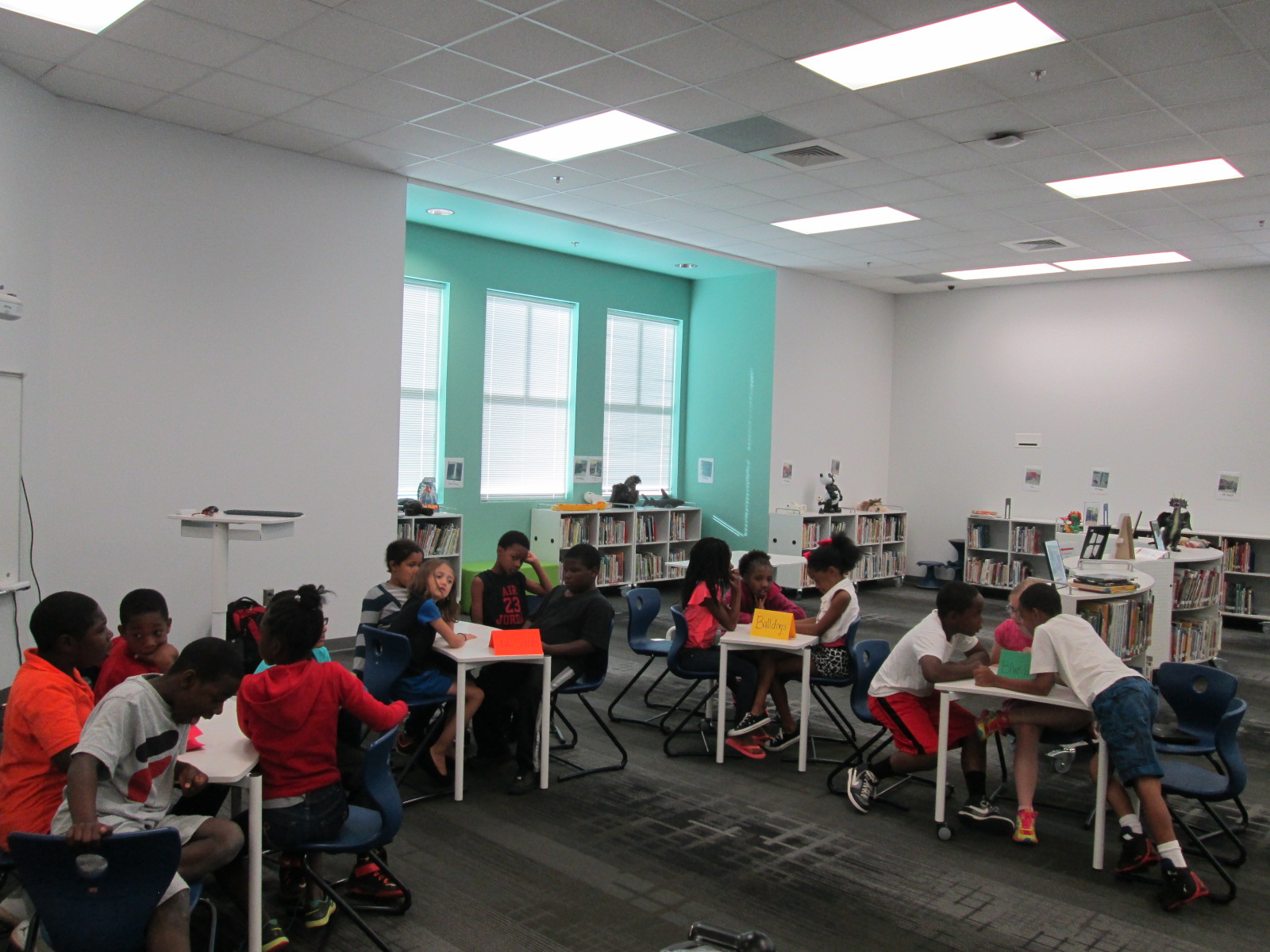
Each year we have a program called Battle of the Books in 3rd-5th grade. This is a reading competition where teams of 5 students read a list of 10 books. They work together to answer questions about the books in several rounds of competition in order to be crowned the Battle of the Books Champion. Each year there are students who don’t participate in battle of the books for many reasons. Sometimes they are unsure if they want to do it and by the time they decide it’s too late. Sometimes they have too many other things going on that they can’t fit it in. Whatever the reason, there are students who are left out. This year, one of our teachers, Ms. Mills, recognized that in 3rd grade and wanted to give these students a 2nd chance to participate.
Since we are near the end of the year, reading the long chapter books that are on the regular list weren’t reasonable to consider, so she pulled several books that students could realistically finish, understand, and compete with. Students read these books in small groups as well as during state testing when they finished their test.
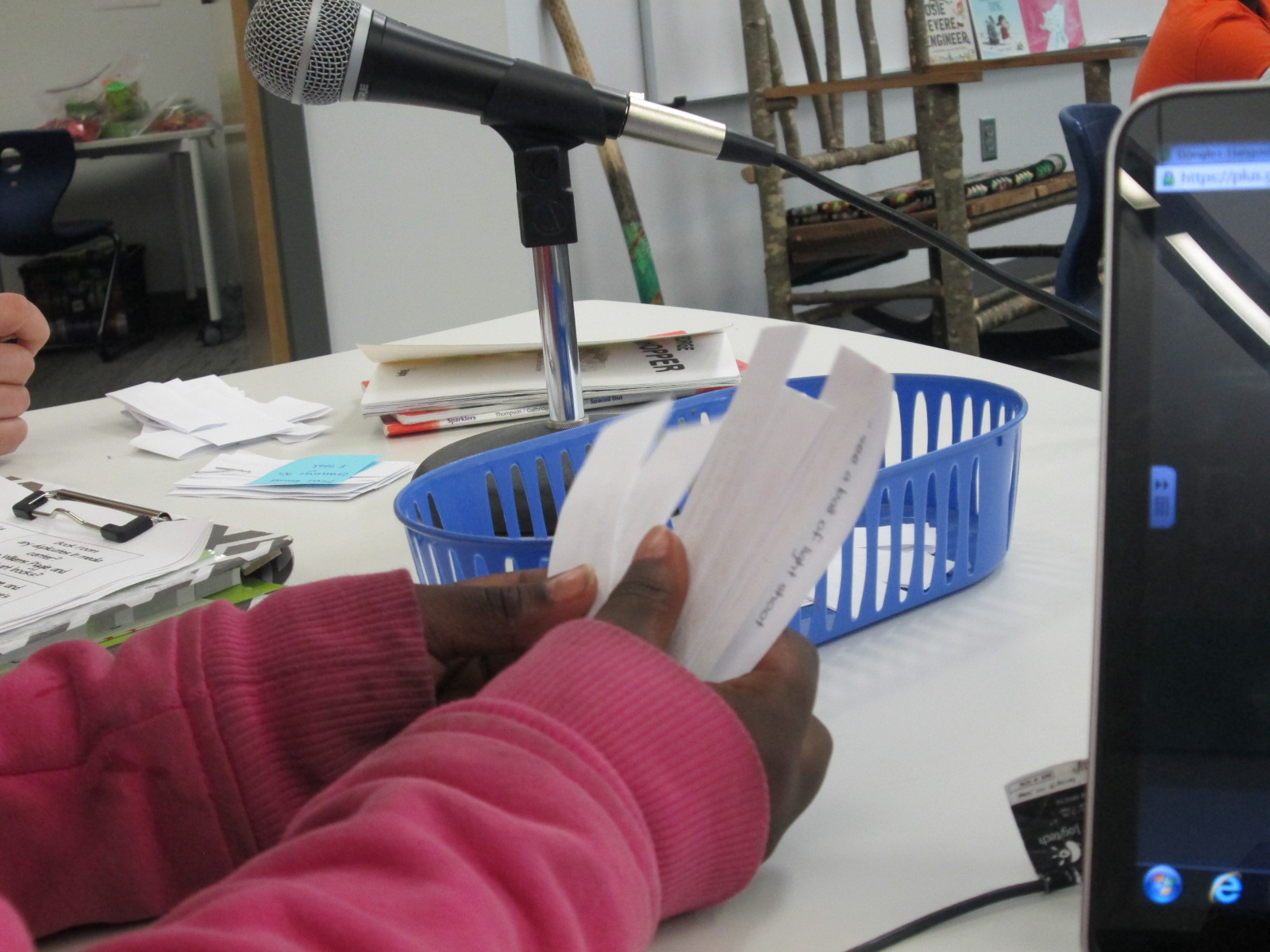
Deciding to choose new books meant that there weren’t questions written for these books, so she knew she would have to come up with every question asked. I love what she decided to do. She took the books to a 5th grade class and asked them if they would read the books and come up with questions to ask the 3rd graders. The 5th grade students worked with their teacher to craft questions and they put their names on each question written. During the competition, Ms. Mills or Ms. Garrett would say who a question was written by.
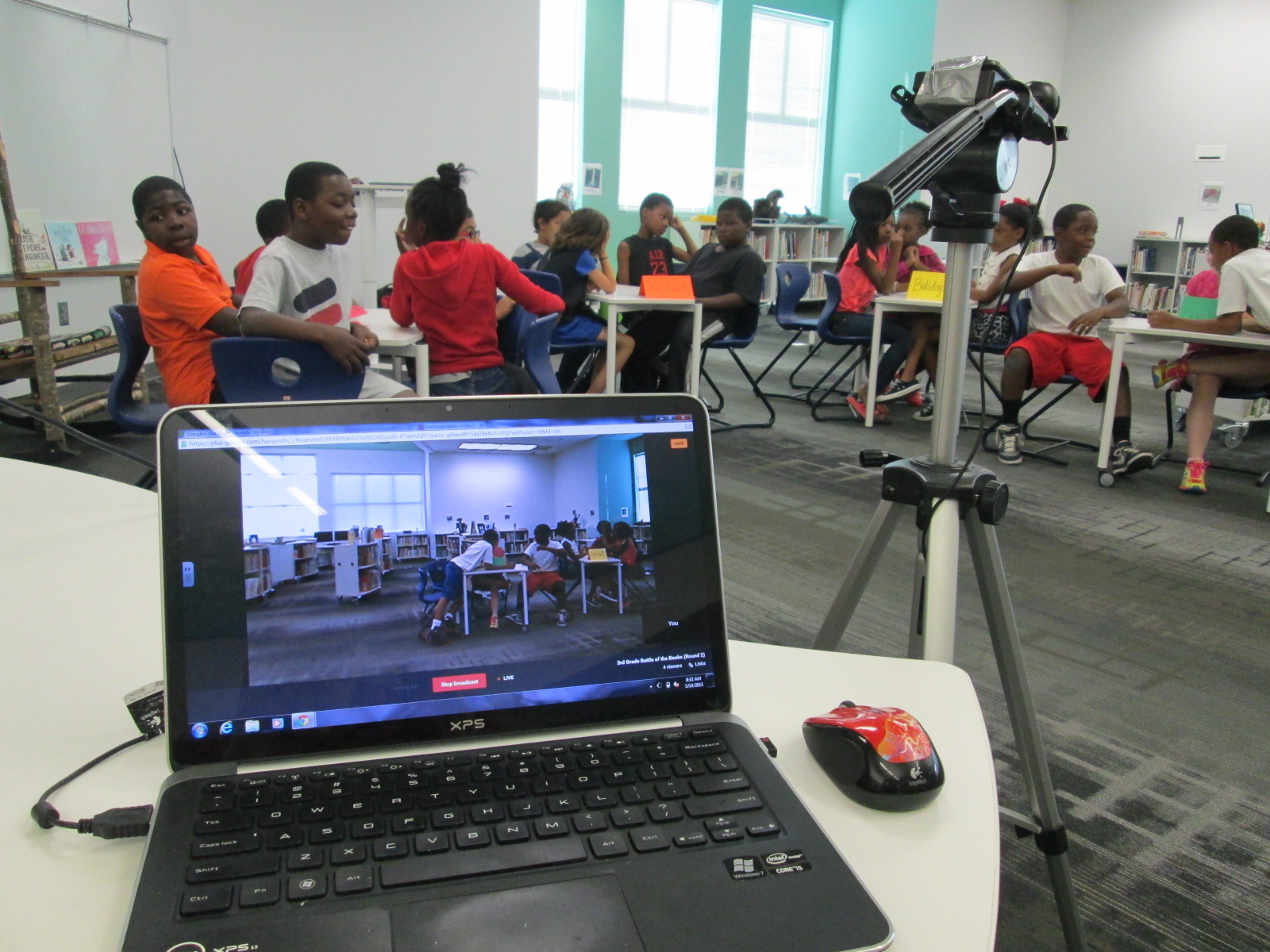
We decided to broadcast the competition through Google Hangouts on Air so that all 3rd grade classes could watch and support their friends. I setup the hangout and emailed the link to all of the teachers, and of course, we now have an archive of our competition for anyone else who wants to watch. Students helped pull the questions from a basket of questions and the teachers asked them. Each team received 8 questions and the teachers kept track of which team got the most questions correct. It was a tight competition because the students knew the books so well.
I take no credit for any of this competition, but I just had to highlight what these teachers and students did. Bravo to Ms. Mills and Ms. Garrett for giving even more of our students a voice in this fun competition during the busy end-of-the-year rush. They all did an awesome job, represented our school well, and showed that they knew their books well!





















 Expect the Miraculous