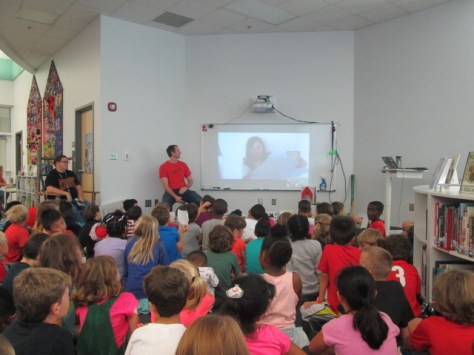
We are nearing the end of November, which means the close of Picture Book Month. In 2013, I started brainstorming with several dynamic librarians across the country a way for us to celebrate the close of the month. Jenny Lussier, Cathy Potter, Shawna Ford, Kathy Kaldenberg, and I created the very first Picture Book Smackdown which was held via Google Hangout on November 21, 2013. Authors Laurel Snyder and Ame Dyckman joined us as well. For one hour, we all shared as many picture book talks as possible. This was the beginning of an annual event that is now in its 5th iteration.
This year, our event will take place on November 30th from 1:30PM-2:30PM EST. We will feature students from:
David C. Barrow Elementary in Athens, GA (facilitated by Andy Plemmons)
Orchard School in South Burlington, VT (facilitated by Donna MacDonald)
Early Childhood Development Center in Corpus Christi, TX (facilitate by Julee Murphy)
We are also very excited to announce that we will be joined by author/illustrator Deborah Freedman. Her books include This House Once, Shy, The Story of Fish & Snail, and many more! You can learn more about her books here.
I’ve put together a Smore that puts everything you need in one place
Click the image to visit our Smore
What to expect:
A live broadcast via Youtube Live or archived to watch at a later time
Numerous student voices book talking their favorite picture books in 3 states
A short talk from Deborah Freedman about why picture books matter in the world
A list of the books we reference
What you can do:
Watch live with your class!
Host your own picture book smackdown in your classroom, library, or district
Share your favorite picture books on social media using the hashtags #pbsmkdwn and #picturebookmonth
Send students a shout out on Twitter using #pbsmkdwn
In Loving Memory of Dianne de Las Casas
We will of course continue reading and sharing picture books all year long, but we want to end November with this special event. This year’s Picture Book Smackdown is dedicated in loving memory of Dianne de Las Casas, founder of Picture Book Month. We lost Dianne this year in a tragic fire, but her legacy of advocating for the importance of picture books in our world lives on.
It’s time for one of my favorite projects of the year: Student Book Budget. Every year, I reserve a part of the library budget that is under complete control by students. This budget comes from many places. Sometimes it’s a grant and other times it is part of our regular budget. This year their budget comes from the profit we made from book fair. The book budget is their chance to make sure that books are added to our library that represent their interests. They go through a long process to make sure that many voices are represented in their purchases. Over the next few weeks, I’ll be sharing their process. Here are some of the steps that are already happening.
First, I created a Google form application for students to apply to be in the group. The form was available for one week for students in grade 3-5. Every student who applied and had a genuine reason for being in the group was accepted. Our group this year is 40 students strong and has a great mix of boys and girls.
Next, we held our 1st meetings. I met with each grade level group separately and answered all of their questions about the group. Then, in small groups or pairs, they brainstormed things that they thought we should ask on a reading interest survey for the whole school.
Then, I took their ideas and put them into a Google form survey.
I sent the survey to all of the students on the book budget team so that they could review it and decide if it matched their comments. We made some minor adjustments and were ready for the school to be surveyed.
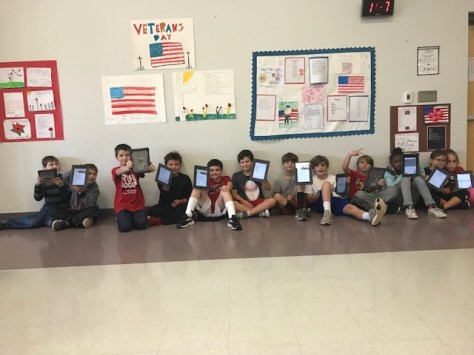
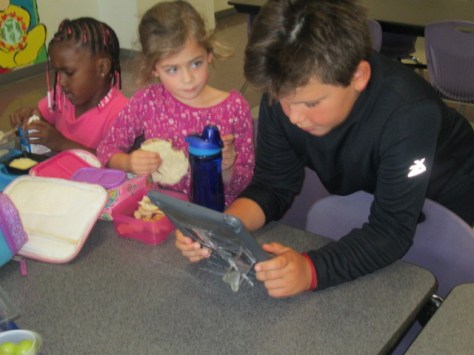
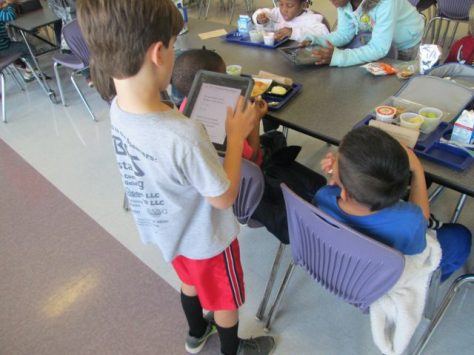
I sent the survey via email to our 3rd-5th grade students who each have their on device. The Student Book Budget Team was responsible for surveying Prek-2nd grade. On our 2nd meeting, we scanned QR codes to get to the survey on an iPad and went to recess and lunch to survey as many people as possible.
The students were so professional and I loved standing back and watching them work. It truly was their project and they were taking it very seriously.
In just one day, we have already surveyed 216 students. We will continue this process and then take the next step of looking at the results. I love how we can check along the way to see which grades need to be surveyed more so that we have a somewhat even distribution of voices.
Be on the lookout for our next steps. We are off to a great start.
Our fabulous art teacher, Ms. Foretich, is always looking for opportunities to take our students to art experiences outside our school. Last year, she attended a workshop at the High Museum of Art in Atlanta and learned that the Wonderful World of Ashley Bryan exhibit was on the way for this school year. We did a quick brainstorm on a grade level we might do a project with and she applied for the Art Access grant which supports transportation and admission to the museum.
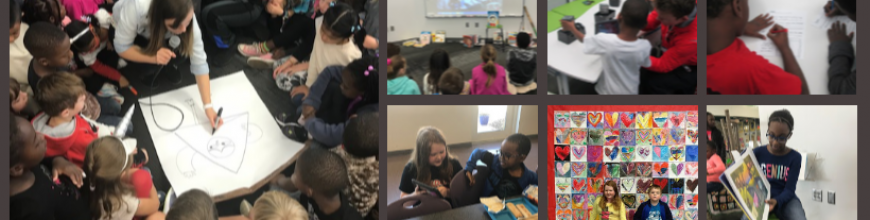
Second grade was the grade we decided to work with and their field trip was planned for 2 days to accommodate all the students. Before the trip, every class came to the library for an introductory lesson and experience planned by me and Ms. Foretich. We made a Google doc and planned out 4 centers that students could rotate to with the goal of making it to at least 2 centers. Ms. Foretich arranged each class into 4 groups.
Before we began the centers, we did a brief overview of the High Museum website and the life of Ashley Bryan. We learned about his life experiences and how he wants to fill the world with as many stories and illustrations of African Americans as he can.
We listened to him read My People by Langston Hughes.
We also gave a brief overview of each center since all students wouldn’t visit all centers. Then, students went to their first center and got started.
Center 1: Ashley Bryan’s Puppets
Students began by watching a video of Ashley Bryan’s puppets. As they watched, we wanted them to consider what characters he created. We also wanted them to notice materials he used and how the puppets moved.
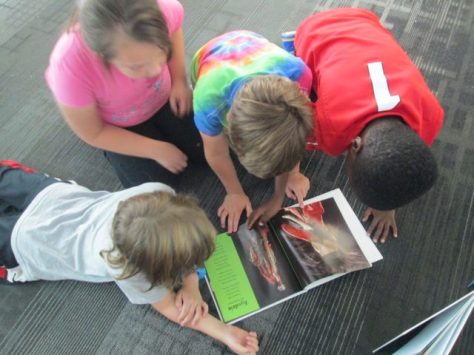
Then, students took a look at the book Ashley Bryan’s Puppets so they could take a closer look at the materials of the puppets.
Finally students used a short readers’ theater script along with my library puppets to act out a script.
Our hope is to eventually have students create their own puppets and scripts for a project in 2nd quarter.
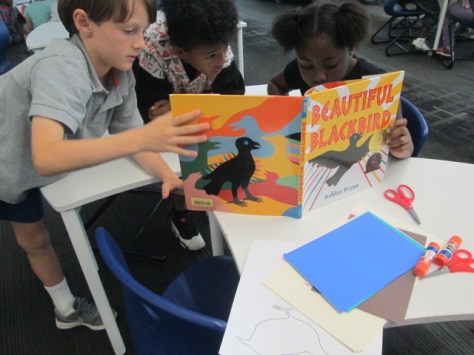
Students read the book Beautiful Blackbird and looked closely at the colors and collage work in the illustrations. Then, Ms. Foretich had stencils, construction paper, glue, and oil pastels so that students could create their own bird collage. Many of the students kept the book open while they worked so they could mimic some of Ashley Bryan’s style.
Center 3: Poetry & Illustration
Students began by looking at the many ways Ashley Bryan illustrates the poetic works of African American poets. Some of the books included Freedom Over Me, Sail Away, and ABC of African American Poetry. Each book had a different style of illustration. Then, students used the Word Mover app on the iPad to create their own poetry. An additional step could have been to craft an illustration, but it was hard to add that in the time frame we had.
Center 4: African American Spirituals
Students looked at Let It Shine and I’m Going to Sing which both include African American spirituals illustrated by Ashley Bryan. Their task was to look at the words of the spiritual and how he took song and turned it into illustration. Then, students listened to multiple African American spirituals from the books that I compiled on Symbaloo.
While they listened, they used various kinds of paper, oil pastels, and black markers to draw what they heard or draw what they felt.
The library was noisy and creative during the centers, and Ms. Foretich and I enjoyed walking between centers and facilitating conversations about what we noticed in the illustrations.
Field Trip
Now, all students have visited the High Museum to see the exhibit of Ashley Bryan and they carried all of these center experiences with them as they went. Unfortunately, I didn’t get to attend the field trip with them so it will be important for me to gather their experiences and visit the exhibit through them so that I can support the next steps of our project. In quarter 2, we will revisit the books of Ashley Bryan, think about storytelling, and create art and puppets to help us tell those stories. I’m excited to see what they create.
Our fourth grade is immersed in the writing process using Lucy Calkins Writing Workshop. They are looking at mentor texts. They are studying author’s craft and developing their own style of taking a story from an idea to a published piece of writing. During this exploration, the fourth grade team reached out to ask if there was any possibility of connecting with an author to talk about the narrative writing process. I immediately thought of the dynamic sister duo from south Georgia, Kate and Cassie Beasley. Both of these talented authors have visited our school in the past for their books, so I reached out to them to consider the possibility of connecting for an informal chat about writing.
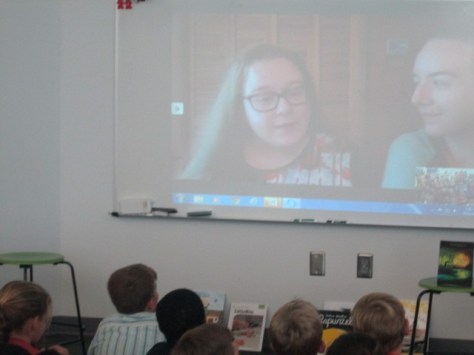
They enthusiastically said yes, and the whole fourth grade came to the library with writing journals and index card questions in hand.
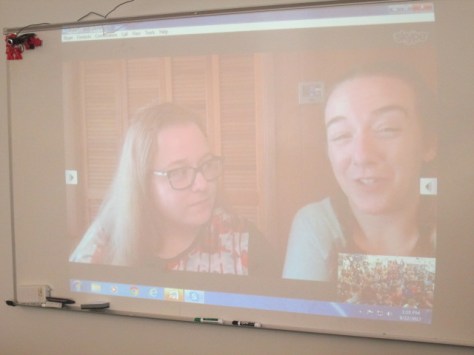
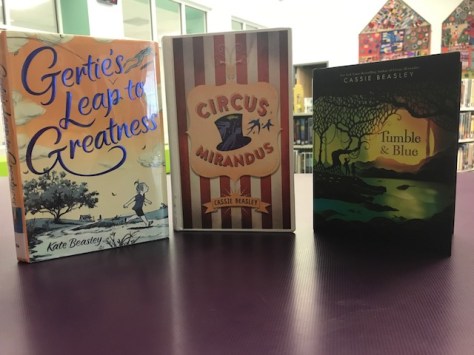
Cassie Beasley is the author of Circus Mirandus and the recently released Tumble and Blue. Kate Beasley is the author of Gertie’s Leap to Greatness and the upcoming Lions & Liars. During our connection, they started out with an informal conversation about writing. They each took turns asking questions about writing process from the beginning to the end. I loved how it was like a mini-interview conversation between the two of them and how we discovered that they both have different ways that they accomplish the same task of writing a story.
Cassie shared that she often starts with an idea for a story and Kate often starts with a character and tries to put that character into a setting and a problem. Both sisters shared that they do a good bit of outlining when they are getting ready to write. One of the most surprising things to all of us was the amount of writing that they do that never makes it into a novel. Circus Mirandus, Tumble and Blue, and Gertie’s Leap to Greatness all went through multiple rewrites. Kate even shared that she thinks that about 75% of what she writes doesn’t get used. After our connection, we spent a bit more time talking about this and came to the conclusion that even though that writing doesn’t make it into the novel it wasn’t wasted work. The 75% was what was needed in order to discover the best story that was hiding underneath everything else.
I’ve heard several authors talk about how much they rewrite, and it’s important for students to hear that too because it’s really hard to start over. I casually asked Kate and Cassie how they feel when they have to start again. I asked if they scream or throw things. I mostly asked because that’s a bit how I feel when I have to start over. I think it’s important that students know that it’s not always the best feeling to start over even when you know it’s the right thing to do. Kate and Cassie both talked about the frustration. They shared how it’s a moment of panic. Cassie relies on Kate to talk her through the frustration so she can start again. Some deep breaths are involved and maybe some chocolate too.
Students had a chance to line up and ask their own questions to support their writing. One of the questions was about “where”. Where do you write? Kate has a very specific place where she writes. It’s a house that doesn’t have phone or internet so that she can stay away from distractions. Cassie also writes in that place but she does writing just about everywhere: a coffee shop, the pool, outside. It was an important reminder to us all that sometimes it’s tricky in the crowded classroom to find writing spaces that feel supportive. I hope we can think more about how to give students a space where they feel productive in their writing process.
Another student asked about how many books they hope to write, and it was so great to hear that they have many more ideas for stories that are waiting to be told or are in the process of being drafted. Even though writing takes time and has frustrating moments, it still comes down to that magic of escaping into someone else’s life or some other magical place on the page. It was so refreshing at the end of our skype to hear students who were excited to go back to class and write after hearing from published authors.
Thank you Cassie & Kate Beasley for taking time out of your writing lives to share your wisdom with us. We can’t wait to celebrate all your future stories.
I’ve written about the magic of Bethan Woollvin’s Little Red a few times on the blog. It’s one of those books that captures an audience when it’s read aloud. The repeating lines, the bold color, the large scary wolf, the shocking images….all work together to speak to so many readers.
Our 2nd grade has been studying Bethan Woollvin’s work by reading Little Red, viewing some of Bethan’s art, and exploring some of the resources on All the Wonders. Students loved acting out scenes from the book using the story shapes from All the Wonders.
Students also loved putting the book over their face or using the cutouts to become the Wolf or Red.
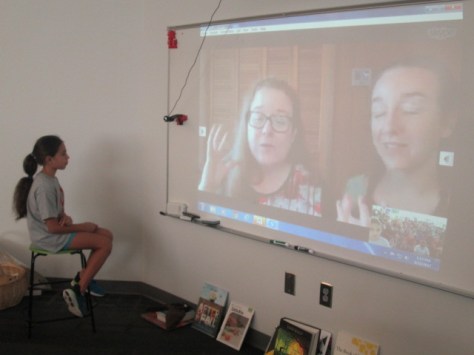
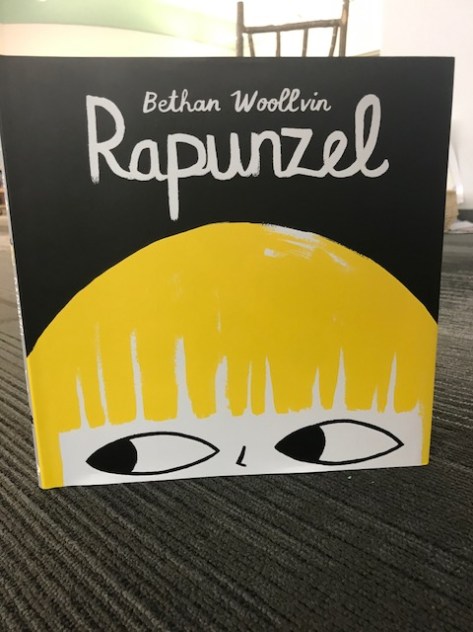
Today, in celebration of her upcoming book Rapunzel, we skyped with Bethan to hear both stories and learn about her art and inspiration.
Rapunzel has some similar magic to Little Red. There’s some repetition of the “snip, snip” of the scissors, and students love to put their scissor fingers up and snip along with the story.
The witch and her polka dot underpants steal the show when the book is read aloud, and you just have to pause and give the students a moment to point and laugh. Without giving anything away, I’ll also say that there are a few images that elicit that same shock from students that they have when reading Little Red. I loved hearing Bethan read parts of both books that had something gruesome or shocking. Her bubbly personality paired with Grandma getting eaten by the wolf was delightful!
I always love Skyping with an author or illustrator because they usually have original art, notes, or other artifacts that they can reach over and grab. Bethan showed us a few early versions of illustrations from Little Read so that we could see how much they changed in the final version of the book. I loved the reinforcement that artists revise just like writers revise.
We saw some panel sketches from Rapunzel. Students immediately made a connection to our current study of panels in graphic novels, and we learned that Bethan thinks a lot in panels when she is working. She also showed us images from Rapunzel that didn’t make it into the book or images that slightly changed after feedback from the publisher.
Near the end of our Skype, students formed a line to step up and ask questions. This is always a special moment because it’s so personal for each student to get to speak directly to an author or illustrator.
I loved that Bethan would often answer the questions and then direct it right back to the student to answer too. For example, a student asked about what her favorite part of writing and illustrating was. After answering, Bethan asked the student what her favorite part of writing and illustrating in class was. It reinforced that we are all working on our craft no matter what stage we are in. We have connections to one another.
At the close, Bethan talked to us a bit about how her books are published in the UK and US. Some of the words and illustrations change depending on the vocabulary or to help the flow of conversation. Since I had a copy of both books, we were able to take a close look while she shared this with us.
We are so excited to now have both Little Red and Rapunzel living in our library for readers. Be on the lookout for Rapunzel coming from Peachtree Publishers on October 1! Many thanks to Peachtree Publishers and Bethan Woollvin for making this Skype possible and to Avid Bookshop for our presales of books.
I’m always trying to maximize what happens during library orientation each year. This year, I asked myself what I really hoped students experienced on their very first visit. Yes, there are many expectations and rules I could go over, but what message do I send if that’s how I spend our time on day 1. Instead, I wanted to focus on the power of reading and give students time to explore the genres of the library.
As students entered, I played a video from Scholastic’s “Open a World of Possible” site. The video had students sharing reasons that they read. Then, I asked students to think about why they read.
I shared a couple of reasons I read. One of those reasons was to be able to walk in someone else’s shoes. I shared books like Wonder and How to Steal a Dog, which gave me a chance to wrestle with something that is different from my own life. I also talked about escaping to another land when I need a break from our world.
I also loved that I had teacher voices to share. At the beginning of the year, teachers recorded Flipgrid videos to introduce themselves. They shared their hopes for the year as well as books that inspire them. I pulled these books and showed them to students with the teacher names posted on the front of the book. I wanted to establish at the very beginning that we are a community of readers and we read for many reasons.
Last year was our first year with a genrefied library. It went really well, but there were some things that I knew I needed to do to help students better understand how the library is now organized. I wanted students to realize that they could spend more time at the library shelves exploring actual books and less time on the computer searching in Destiny.
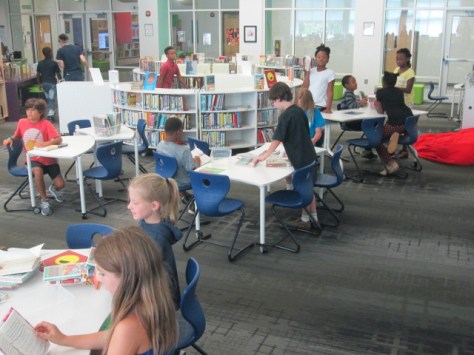
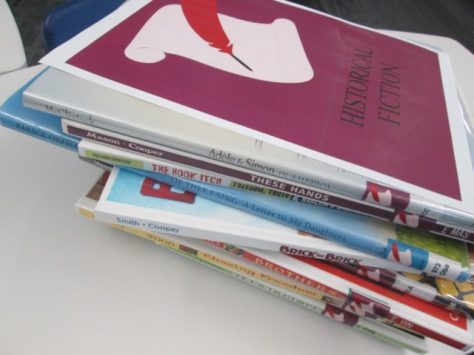
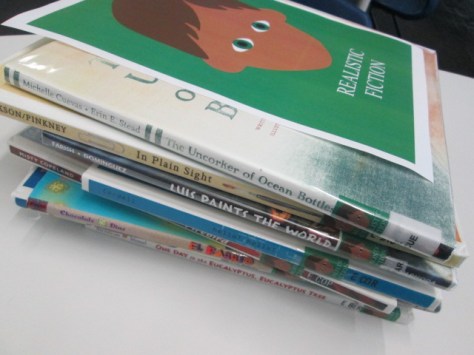
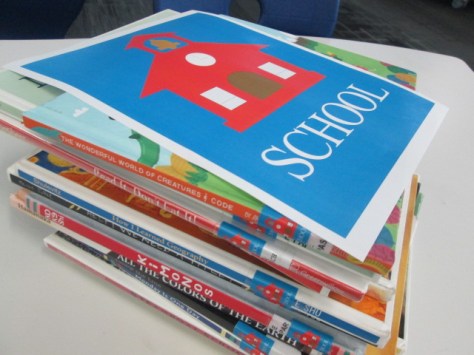
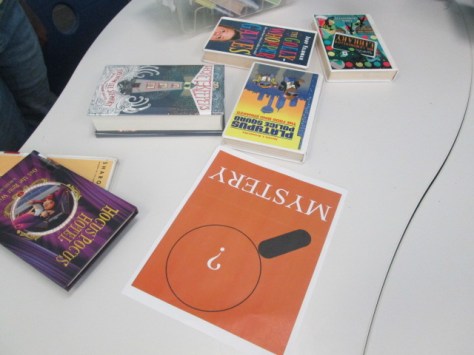
I pulled a few books from some of our genre sections and put them in baskets or piles on tables. Students split into small groups and rotated from table to table every couple of minutes. The purpose was to sample the books in the basket to get a feel for that genre. It was also to show students that when they spent time with the books, they found things they weren’t even expecting to find. Students could keep any books that they found in the baskets and I replenished them throughout the classes.
We ended our time by thinking about how the experience felt as well as taking a look at times when the computer is actually useful for finding a book.
Students then checked out the books they needed. My new rule about checking out books is to check out what you need and what you can keep up with. Some students checked out 2 books and others checked out 6. I never want readers to feel like they are limited by a number that I set.
I can’t wait to see how our year goes as we grow our community of readers. On a side note, I set up a station in the library where students can listen to the teacher Flipgrids and respond to any teachers. I love seeing students interact with Flipgrid and share responses with our community.
There’s a lot going on in the world right now and it’s easy to get overwhelmed by the many current issues being debated and decided on in our country and around the world. As a teacher librarian, it’s challenging because I want to support all students and families knowing that I might not personally agree with their perspectives. I make sure that I step back and listen to the students, support their research and perspectives, and check my own beliefs.
Recently, Ms. Olin, 5th grade social studies teacher, came to me with an idea. She wanted to get students thinking about current US & World issues and considering what their own perspectives were based on the facts of the issues. She also wanted them to know that their voices mattered in the world and that they could get their thoughts out to local, state, and national representatives as well as the general public to have an influence on decisions being made.
Ms. Olin started this project in her classroom by sharing the book I Have a Right to Be a Child by Alain Serres. This sparked discussion about basic human rights and current issues in the world. She also shared news sites with them so that they could start reading current articles about various trending topics, especially if they weren’t familiar with the current topics being debated. Through these sites, students began to choose a topic that they were interested in, curious about, or passionate for. Sites included Newsela, CNN Student News, PBS News Hour, and Time for Kids.
After two days of exploring, students selected their topic.
In the library, we focused on the importance of raising our voices when we have concerns. I read excerpts from Be A Changemaker by Laurie Ann Thompson.
“Don’t wait. Don’t wait to be powerful, to change the lives and communities around you significantly.”
I also read excerpts from It’s Your World by Chelsea Clinton.
“We can–and should–respectfully disagree with others who have reached different answers from ours” and “Even if we disagree with one another, it’s important to recognize what the facts are”.
Ms. Olin and I both encouraged students to look at issues from all sides and to gather as many facts as possible. With those facts, they could form their own opinions on the issues and brainstorm some possible actions they hope are taken.
We took some time to look at the Letters to the Next President project to see letters that were written by students from many location about a variety of topics. Students could sort the letters by their own topic and see what other students were saying.
As students looked at example opinions and continued to gather facts, they started filling out organizers to get their own thoughts together. In class, they began writing letters, protest signs, and editorial cartoons to express the facts and their own views.
Finally, students came to the library to begin sharing their voice. We spent some time talking about how we can make our voice visible. We could of course mail the letters and artwork to their intended recipients, but how else could we share our voice? I was able to talk to the students about my recent recognition as an AASL Social Media Superstar for Sensational Student Voice and how social media and collaborative tools like Flipgrid allow us to spread our voices to an even larger audience.
We hope our voices are heard by our local, state, and national representatives, but even if they aren’t, we can share our voices with others and offer perspectives and actions that might encourage them to support our cause or make the world a better place. As students finished their work, they recorded their voices in a Flipgrid so that others can consider their perspectives and possibly join their collective voice.
We hope you will take time to listen to each student. If one of the voices speaks to you, give them a response. Better yet, if they inspire you, consider writing your own letter and adding your voice to our grid. We invite your students to join our voices as well.
As we were closing our time in the library, some of the students spoke up and said, “I bet Mr. Trump won’t even read our letters.” This was a great opportunity for Ms Olin and I to repeatedly say to the students, “Your voice matters”. We talked about collective voice, and how sometimes a single voice isn’t heard by someone like the president. However, that single voice can inspire other voices who come together collectively around a common cause. This was a great closing because even as an adult I sometimes wonder why I should even take time to call or write my representatives. However, I was reminded that our individual voices do matter and collectively they make impact.
Our 3rd grade classrooms love to mystery Skype. Have you tried it? In a mystery Skype, 2 classrooms connect with one another but don’t say where they are from. The two organizers of course know, but the students don’t. By asking a series of yes or no questions, students try to narrow down to a country, state, city, and even school if there is time. Mystery Skypes work best when students are prepared in advance and every student has a job to do. There are many example of jobs to assign in a mystery Skype such as greeter, researcher, questioner, scribe, and photographer.
Ms. Haley, a 3rd grade teacher, met with me to talk about some skills she hoped the students could work on in advance of a mystery Skype. I started planning a series of 5 centers for students to rotate through. Ms. Maher, our tech integration specialist, worked on scheduling mystery Skypes via Twitter and Skype in the Classroom so that all 3rd grade classes had a connection.
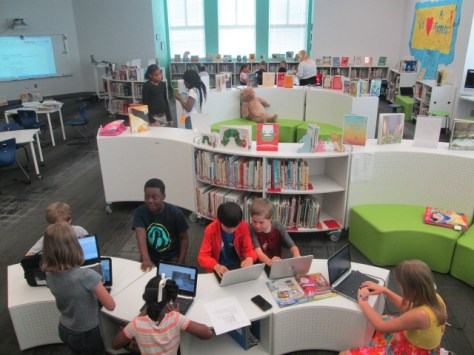
Two classes at a time came to the library to engage in the mystery Skype centers. This meant that me, the two classroom teachers, my library intern, and a parent or collaborating teacher could run one center each. This also meant hat about 8 students would be at each center for 10-ish minutes. It was very fast-paced, but it introduced to students to many aspects of a mystery Skype and they continued the work in their classrooms throughout the week leading up to the connection.
I made a Google doc with all 5 centers and teachers shared the doc with their students through Google Classroom. Each student had a copy to edit. Here’s a look at what happened at each center:
Center 1 Question Writing
I reference Pernille Ripp’s great post on good mystery Skype questions. Students read her examples and then worked on writing their own possible questions from narrow to more specific. My intern worked with students to think carefully about the kinds of questions they were writing.
Center 2 Google Tour Builder
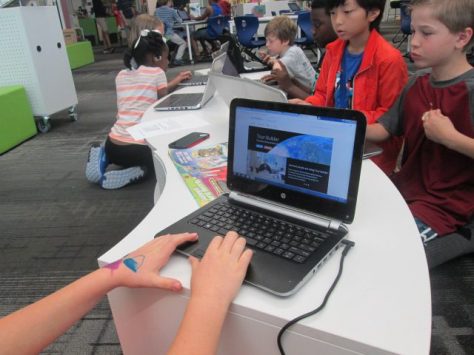
Ms. Haley wanted students to have a sense of where they were in relation with the rest of the world, so I had students start a Google Tour Builder at either their home address or our school address. Then, students built a tour of places they have lived, visited, or want to visit in the world. This allowed them to be able to reference their current place in the world with other locations
Center 3 Georgia
A big part of a mystery Skype is sharing facts about your city and state with the connecting class. Students of course love to learn that there are McDonald’s in multiple places in the world, but it’s also fun to share unique facts that make your state what it is. A pulled a large stack of books about many aspects of our state from Weird Georgia to books about each region. Students gathered facts that they could share with our connecting class at the end of the Skype.
Center 4 The United States
Ms Haley wanted us to review cardinal and intermediate directions. I have a small set of National Geographic Kids Beginner’s United States Atlases. The atlas divides the country up into regions such as northeast, southwest, etc. so I asked students to look at each region and count the number of states in each region, name some of the states, and pick out some facts about those states. My hope was this would give them some familiarity with how the US is organized and lead to questions about specific regions or help them answer questions from our connecting class about the regions.
Center 5 Landmarks
Our 3rd graders study several important rivers and lakes as part of their social studies, so this center included books about all of those rivers and lakes as well as other landmarks around the country. Students used these books to identify landmarks and then write questions that could be asked using those landmarks. Example: Is your school west of the Mississippi River?
This was my first try at doing this kind of preparation for a mystery Skype. Each center was based on past experiences and skills that I saw a need for as well as the skills brought up by the 3rd grade teachers. We will see how this translates into our connections this week.
Looking back, I wish we had more time at each center in the library, but it was also nice to quickly go through the centers to get an understanding of each one and then independently work on them back int he classroom over several days.
A goal I’ve been trying to achieve for awhile in our makerspace is to have ongoing individualized projects. In the fall of this year, the media specialists started brainstorming having a district maker faire to showcase projects from all of our schools. In the spring, Gretchen Thomas, had over 30 students in her UGA class that collaborates with our makerspace. Normally, 4 students from Gretchen’s class come to our makerspace on Tuesdays and Thursdays, but with 30 students, it would be hard for her students to make it to our school multiple times. We started pondering this new dilemma and realized that Gretchen’s dilemma aligned with my long-term goal.
Gretchen divided her class in half. Half of her students continued Tuesday/Thursday makerspace times, and the other half became maker faire mentors on either Tuesdays or Thursday. I gathered students who were interested in making something for maker faire and put them into a Tuesday or Thursday group. Gretchen did the same with her students.
At the first meeting, Gretchen’s students learned more about what students were wanting to make. I supported these conversations too, and we started gathering materials students needed for projects. Each Tuesday and Thursday since February, these maker faire students have worked on an individual project while regular makerspace continued to run simultaneously. It was loud and chaotic but productive. Our makerspace storage also became very unorganized and I realized that I have a lot of work to do in order to store multiple on-going projects.
During our very first school maker faire, we setup tables around the library to showcase projects. I created a schedule for teachers to signup to bring their class. Some times classes came and walked through to look. Later in the day, the maker students were at their tables to demonstrate their products and answer questions. Again, this was loud and chaotic, but it was organized and productive.
Many kids found ideas that they were excited about and wanted to try out. Many kids got to test some of the products that were made. Gretchen’s entire class also came during the day to listen to students talk about their projects, keep tables organized, and introduce students to Ozobots and Cubelets. As usual, miraculous moments happened throughout the day.
Here are a few:
Dominique developed her leadership skills as she ran the robotics table for most of the day. Two students who had made robots were unable to come, so she stepped up and demonstrated their robots for them and kept the table orderly and made sure people had a turn to try out driving a Finch robot.
Speaking of robots, one of the robots had a name: Bob Jello.
Throughout the day, his personality seemed to develop on its own as kids began to talk about Bob Jello rather than just talking about a robot. Before we knew it, the other robots had been deemed the “evil kitties” and a battle ensued between Bob Jello and the kitties. Students were huddled up cheering on the robots and it had me thinking about how much we could do with storytelling and robotics.
My daughter, Alora, made a butterfly sculpture with a 3Doodler pen. She taught group after group about how the pens worked and managed kids taking turns and making very small sculptures. It was fun to see her as a 1st grader teaching kids in much older grades.
Several students made projects with their dads, and it was fun to watch the students share about their work with others. Patrick’s dad came and presented alongside him to talk about catapult gliders. They had a tri-board, video, and several models. It was a popular table that many students were interested in exploring.
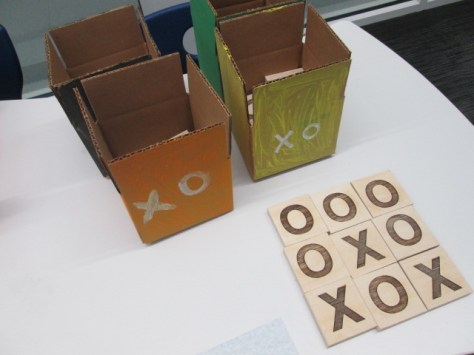
Linden had a freestyle Tic Tac Toe game he made with his dad, and we loved learning the story of how the game originated at a restaurant table using sugar and sweet n low packets.
Finally, Forrest made documentary with his dad about Zepplins. This is a topic that many kindergarten students might not take on, but Forrest was super knowledgeable and shared his expertise along with playing his video.
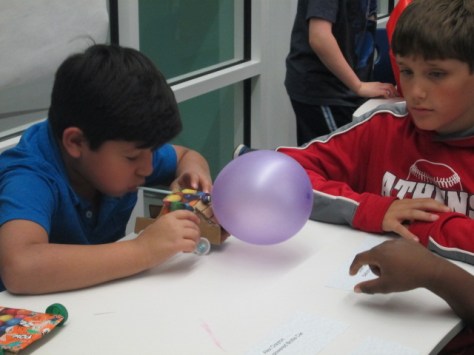
Josie had made a robot from carboard and duct tape, and she really wanted to make it move. She used littebits and fishing line to make its arms move up and down. Rather than just sit at the table the whole time talking, Josie worked! She continuously made improvements to her design so that the arms would move more and more. Students started giving her ideas of what she might do next, and she may even attempt that soon.
Our intern, Jen Berry, worked with four 1st graders to submit maker projects, and all four of them had projects that were of high interest to visitors. Many students wanted to make their own terrarium after seeing Zarema’s 2-liter bottle terrarium.
Last minute entries rolled in like Aley’s handmade wooden guitar he is using for his music project.
It was so hard to capture every moment. It was so exhausting, and I’m already thinking about how I will organize it differently next year to involve more students and more classes touring the projects, while also calling on more volunteers to give me a bit more sanity.
Many of these projects will now be showcased at our district maker faire which will take place on Saturday April 1 from 2-4:30PM at Clarke Central High School. I highly encourage you to attend if you can. There will be over 100 makers featured from Prek-12th grade. It’s a great opportunity to see the amazing creativity we have in our district.
I’m so thankful for Gretchen and her students for supporting our students. It is a great collaboration that benefits many student voices. Thank you Gretchen for staying most of the day to help and to Jen Berry for jumping in the chaos and helping the day be a success.
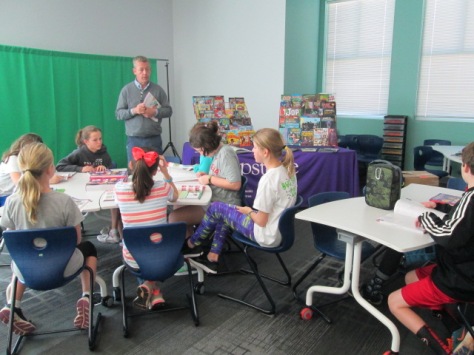
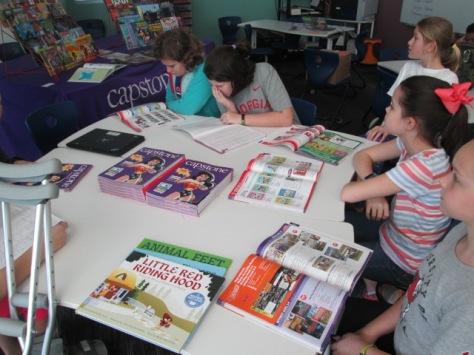
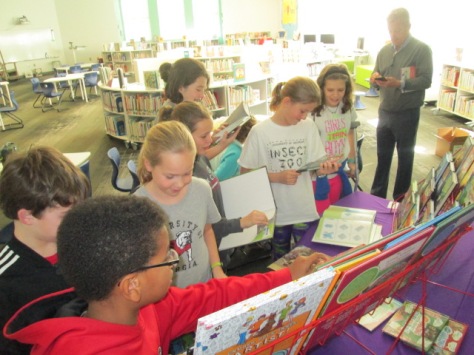
Student voice is important to me. I love to find opportunities where students’ voices are listened to, and even more than that, acted upon. Recently, during a student book budget meeting, we met with Jim Boon from Capstone. Jim always listens to students and makes sure they have what they need in order to purchase books for the library. He lets them guide the conversation and answers any questions they have rather than pushing certain titles that they aren’t interested in.
During his recent visit, he gave students posters at the end as a thank you, and Adaline, a 5th grade student book budget member, asked if there were ever any World War I posters. Rather than just saying “no”, Jim listened to her reasoning that war and military books are popular in our school and that she had a personal interest in them herself. He suggested that she send an email to Amy Cox, Capstone Library Marketing Manager.
Adaline immediately crafted an email to Amy, and the conversation began. Not only did Amy respond to Adaline, she also asked her follow-up questions and genuinely wanted to know the answers. In the busy world of businesses, this kind of personal interaction says a lot to me about the vision and mission of a company. Capstone isn’t just about selling books. They are community and customer focused and want to listen to the very people who they are trying to support.
Here’s how the conversation started:
Dear Amy Cox,
When Jim Boone came to my schools “Book Budget” we got posters with hedgehogs on them. While I was looking at the poster I had an idea! Since I like to read about World War 2 maybe you could make a World War 2 poster! If you take this into consideration please email Mr.Plemmons so he can tell me! Thank You!
From,
Adaline
Then Amy responded:
Dear Adaline,
We would be very happy to consider a poster with a World War II theme. When we make a poster, we try to have it do one of two things:
1) They feature a specific series of books that we think students would like to know about so that they can read them, or
2) Like the hedgehog posters, they don’t talk about a specific book but rather try to show how much fun it is to find something you like to read
Do you have any thoughts about which direction we should take for a World War II poster? I’m always happy to hear ideas from other people. When everyone shares ideas, the final project always turns out so much better.
I was so proud of Adaline continuing the conversation in addition to all of her other school responsibilities.
Dear Amy Cox,
I think the books that the poster could be about could be the series Heroes of World War 2 ! I think that the poster should have something related to the Nazis or maybe even Anne Frank! And yes I have seen the new graphic novels! They look amazing!
Adaline
Amy moved the conversation to the Capstone team.
Dear Adaline,
Thank you for your response. I’m so happy that you like the Heroes of World War II books. I think those stories are fascinating.
The idea of World War II heroes got us thinking here at Capstone—perhaps in a different direction than you would expect, but that is the fun of brainstorming, right? Give us several days and we’ll see if we can come up with something interesting. Can you search your library catalog and see if you already have this book? It has a tiny clue about our idea!
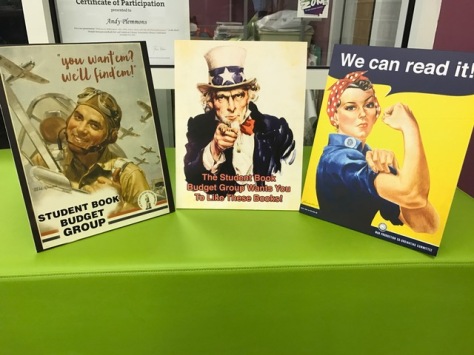
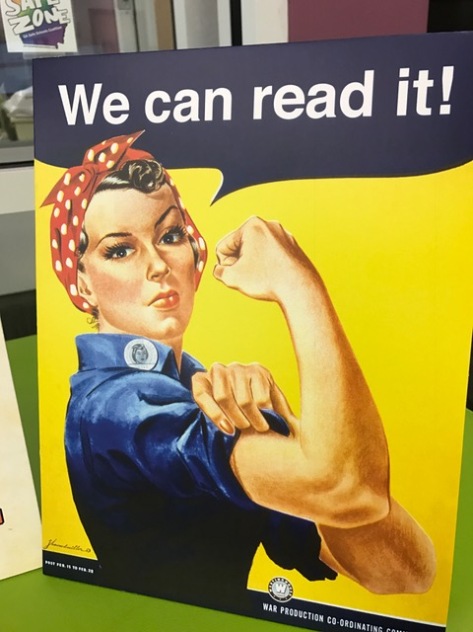
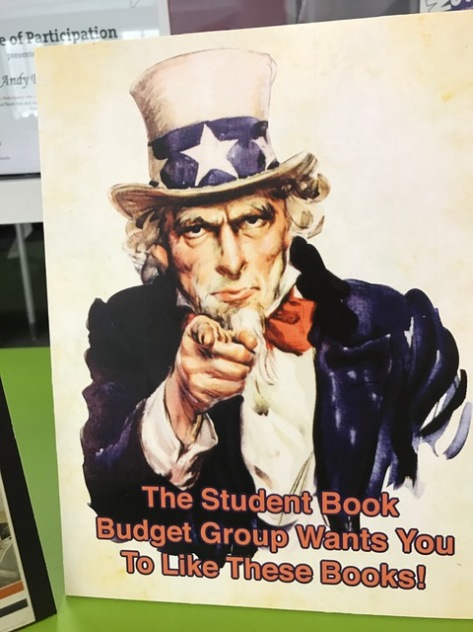
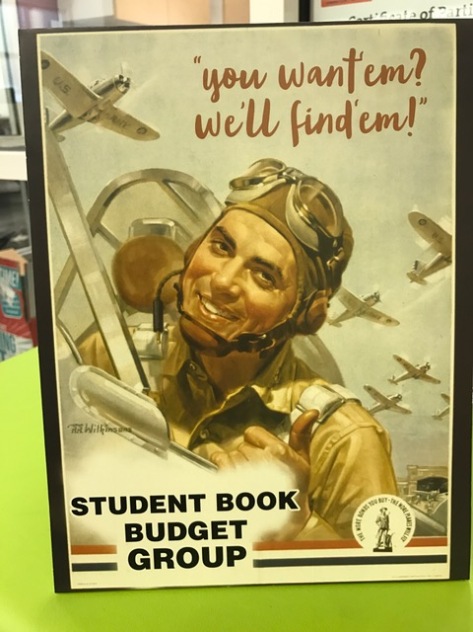
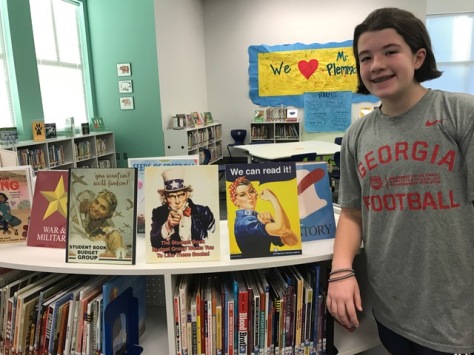
Finally, Amy let us know to expect something in the mail. When the box arrived, I couldn’t wait to see what was inside. To my surprise, Amy had sent 3 custom signs that incorporated history as well as the mission of the student book budget group to get the right books in student hands.
I immediately sent a note down to Adaline so that she could come up and see how Capstone had listened to her ideas and given us something completely based upon her request. She was all smiles. I also loved that her grandmother was here to celebrate the moment with her. Even though she might not want the attention, I think it’s important to celebrate this moment. Now her efforts will be on display as our student book budget books arrive. These signs will be a part of our student book budget display.
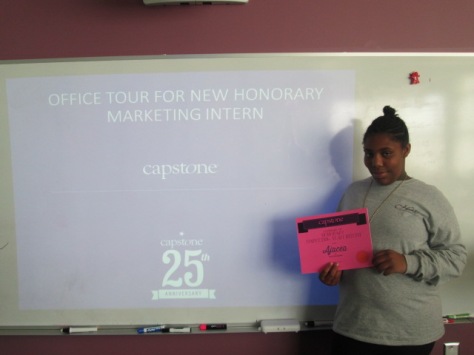
This is not the first time that Capstone has reached out and supported a specific student. Last year, Amy supported Ajacea in her marketing interests.
I hope other students will see this as an opportunity to speak up and make their voices heard when they have an idea, and I hope educators and companies will see this as an opportunity to amplify student voice and make a difference in our world no matter how small.
Thank you Amy Cox and Capstone for always supporting the student book budget project and always listening to (and acting upon) the voices of students.






 Our hope is to eventually have students create their own puppets and scripts for a project in 2nd quarter.





















 Expect the Miraculous