Student Book Budgets 2012-13 (Part 1)

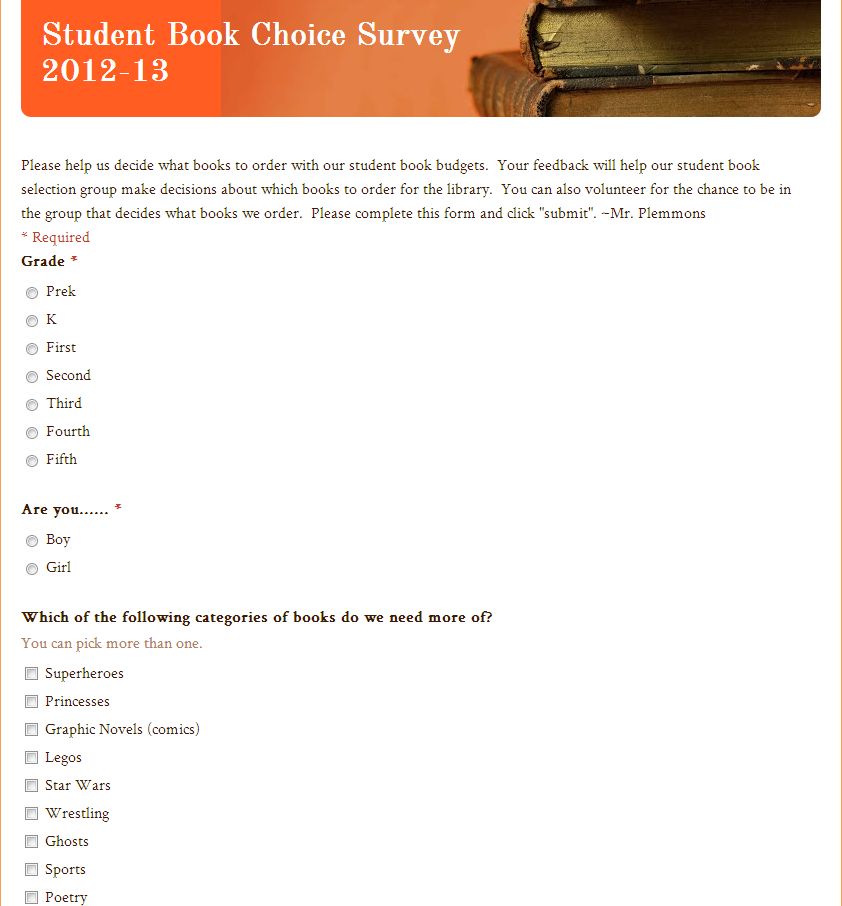
A snapshot of the form that students used to survey other students

A snapshot of the form that students used to survey other students

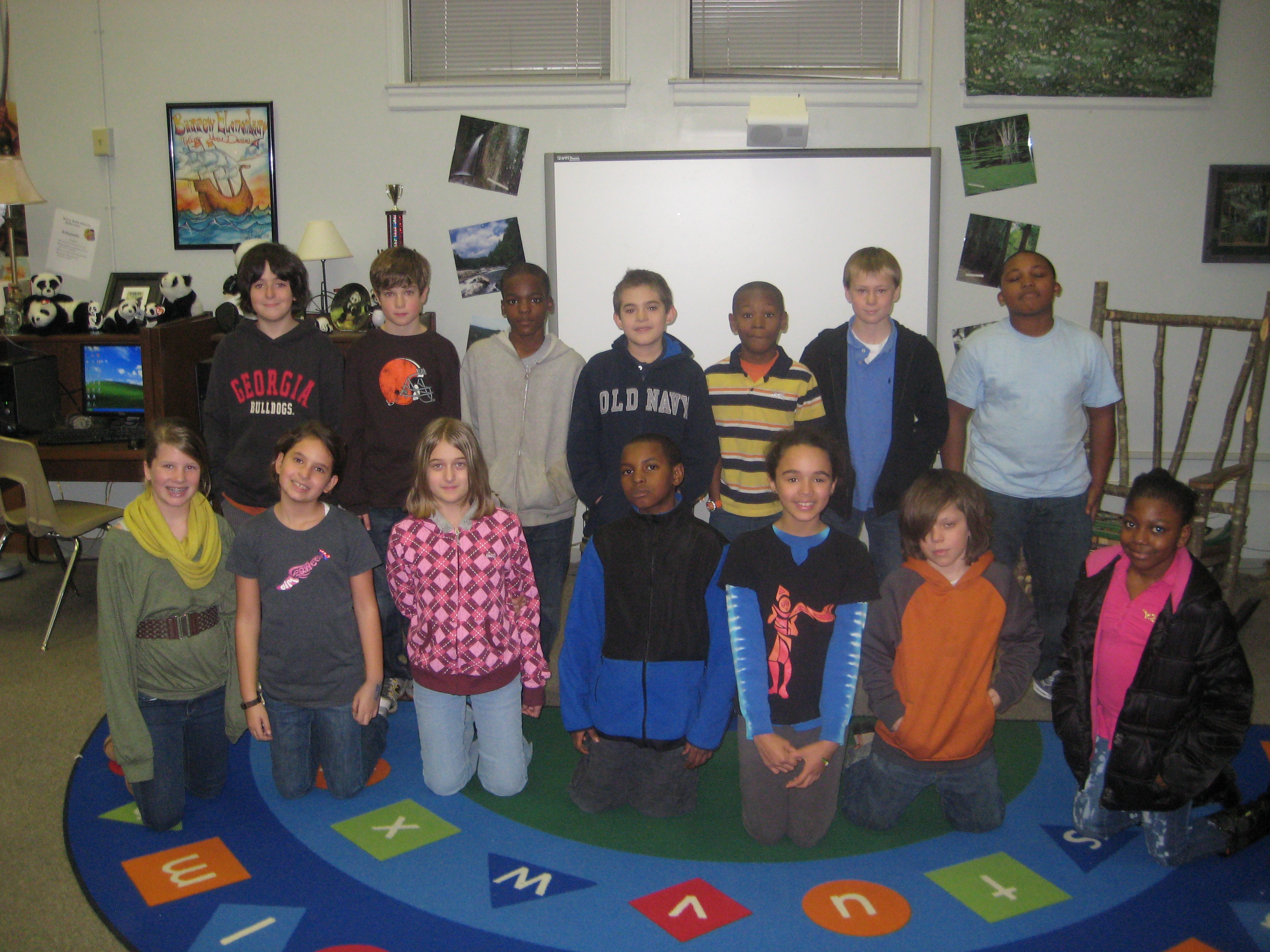
Once again, I have reserved a portion of our library budget for complete student control.  I have done this over the past three years and have come to value it so much that I plan to continue and improve upon the process.  So far, this year is proving to be one of the most interesting so far.  In the past, I’ve worked with groups of students as large as 40 and as small as 12.  This year, we have 27 students in grades 3-5 who have agreed to participate in this process.

This year, I created a Google form asking about some reading interests and gauging student interest in being a part of the book budget group.  I emailed the form to all students in the school.  In general, our 3rd-5th graders are the main students who check their email, so those were the students who responded.  Out of about 60 responses, I had about 40 students who were interested in being in the group.  I went through the list and tried to select a mix of boys, girls, grade levels, classrooms, backgrounds, and reading interests.  This narrowed the list to the 27 students.

I then got permission from the students’ teachers to allow them to be in the group.  Next, I blocked out some times on the library calendar.  Here’s the rough outline of what I did/planned to do:

  • 1/25:  Initial meeting with the whole group to lay the foundation of our work and edit the Google form that I started. We also claimed which grade levels we would each survey. This was done at the very beginning of the day when students would have been doing their morning meeting in the classroom.
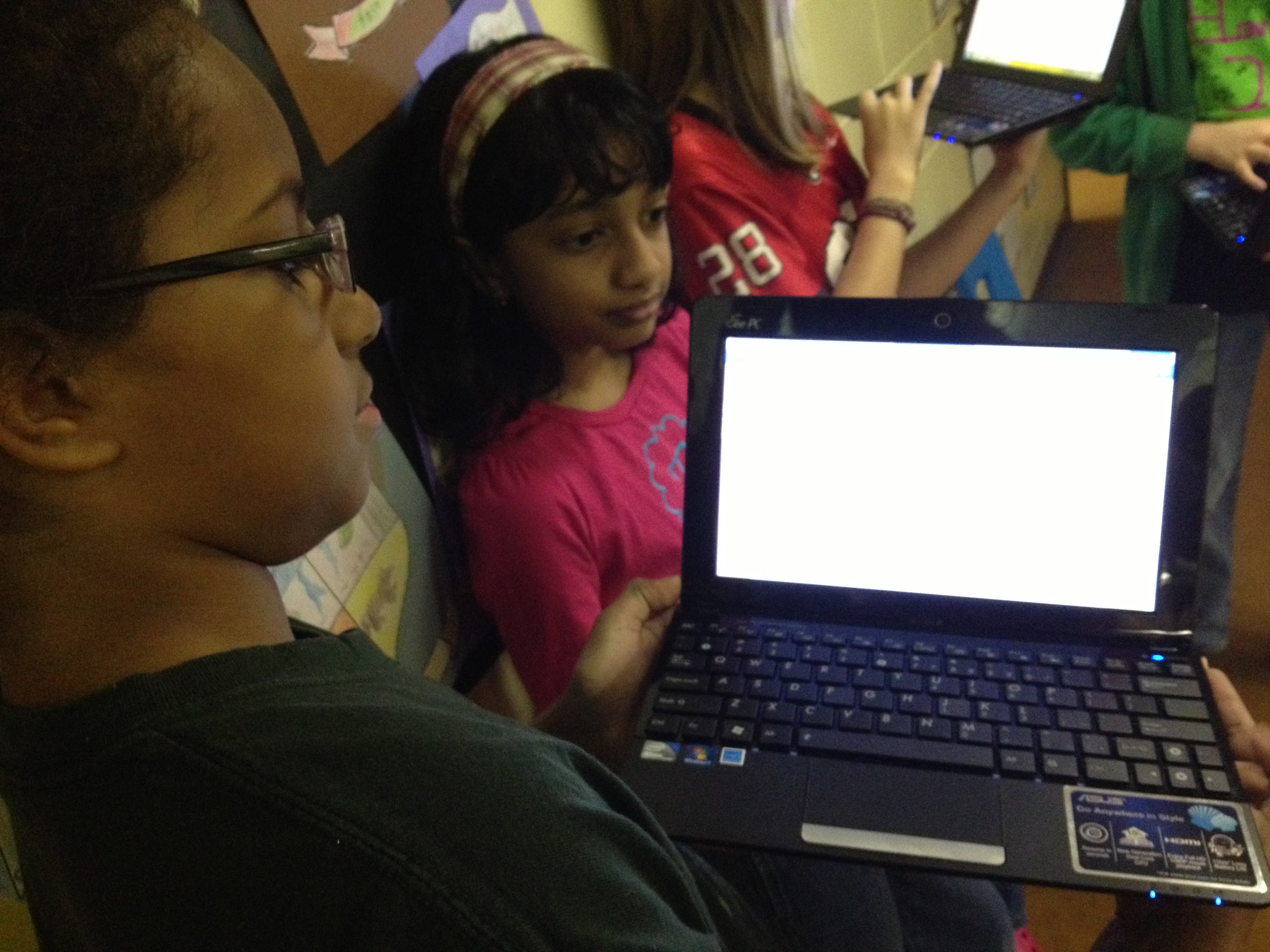
  • 1/28-2/1:  As soon as students arrived at school, they got their netbooks out and pulled up our Google form.  Then, they surveyed their own class as well as one other grade level that they had chosen.
  • 2/1:  After surveying is done, email the results to all of the students so that they can begin looking at patterns.
  • 2/4, 2/8, & 2/11:  Students will meet in the library during their lunch.  We will narrow down the survey results and determine which specific books and categories of books we want to focus on.  Then, students will begin creating lists of books with our favorite vendors including:  Bound to Stay Bound, Capstone Press, and Follett
  • 2/12:  Finalize the lists and order the books.
  • While we wait on the books to arrive, some students might choose to work on some marketing strategies, but I won’t do this with every student in the group.
  • When the books arrive, schedule a meeting to unpack, stamp the books, and double check the packing slips.
  • Advertise the books on BTV and put them into circulation.
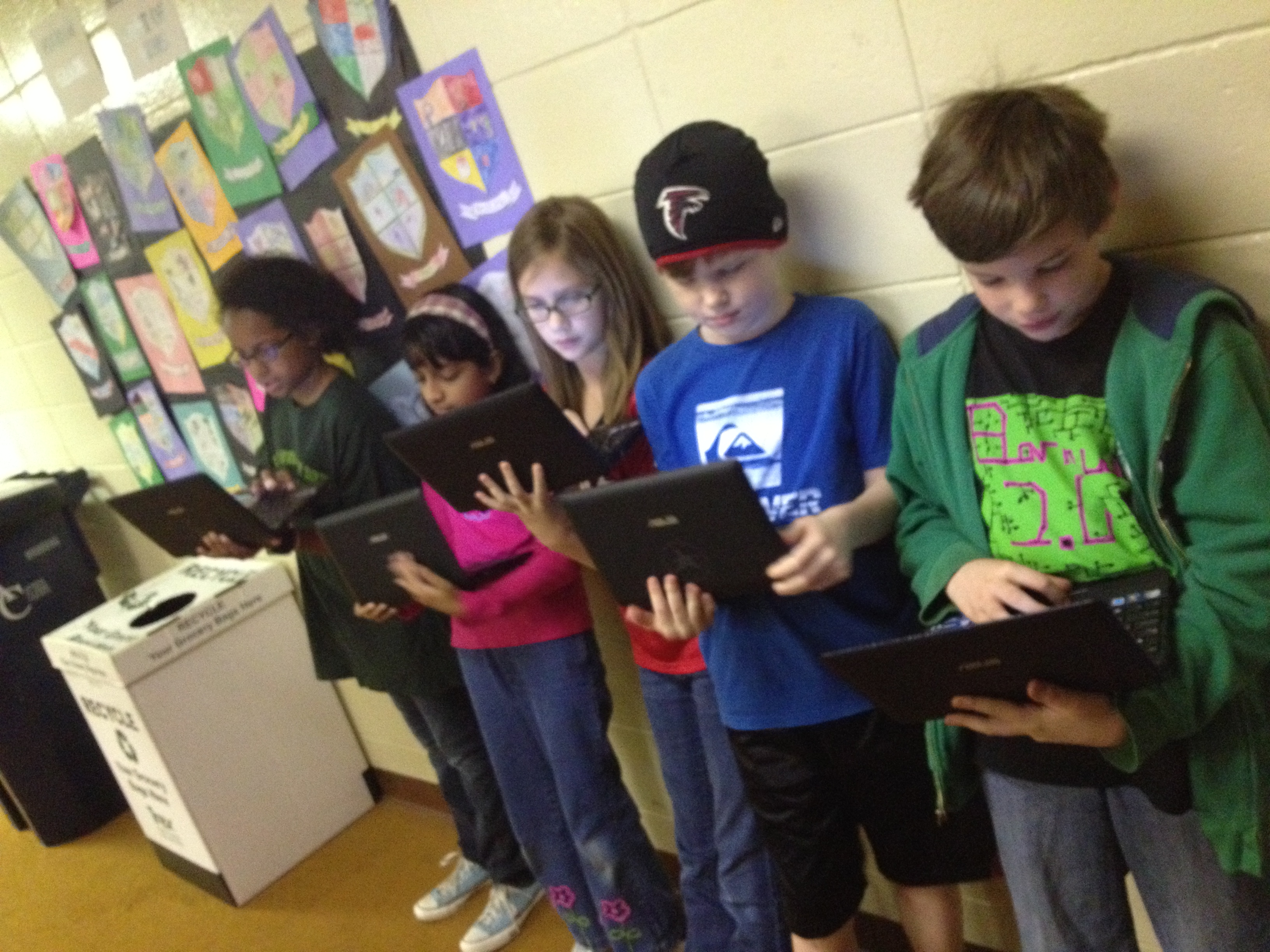
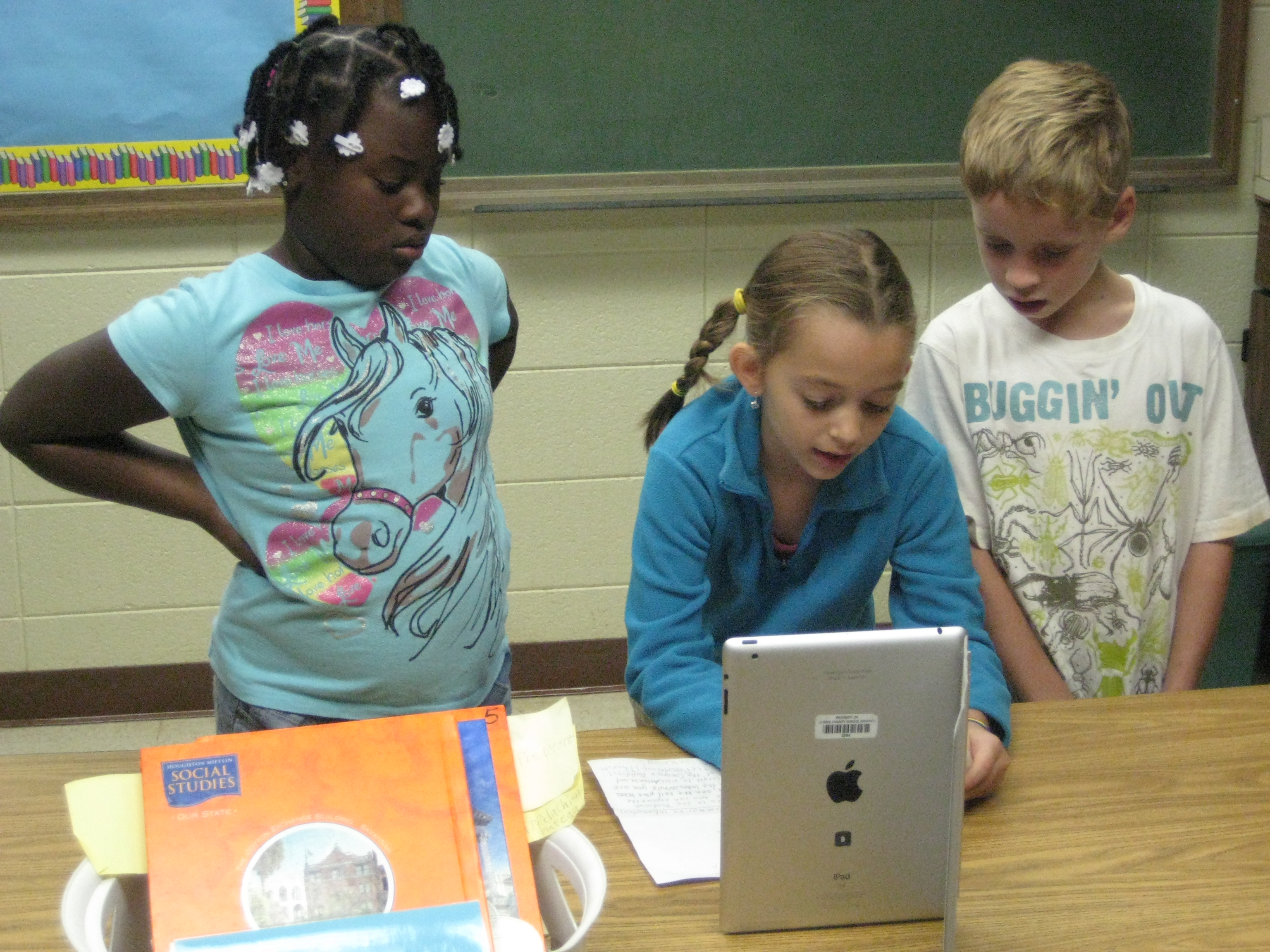
Students pulling up their Google Form to begin roaming the school.

Students pulling up their Google Form to begin roaming the school.

At our initial meeting, students did a great job adding to the form I had already started.  In the form, I asked about specific series of books, genres of books, and created a space for students to list specific books.  This was all based on what students are constantly asking for in the library so there were things like:  The Hunger Games, Diary of a Wimpy Kid, World Records, Rainbow Fairies, Ninjago, Lego, Princesses, etc.  The students decided to add a question about grade level and gender so that we could balance how many boys, girls, and students from different grade levels we surveyed.  They also added their own series and genres that I completely missed.  This is what I love about this participatory aspect.  It’s impossible for one person to know the reading needs of the entire school.  It has to be a collaborative effort.

During the week of 1/28-2/1, students surveyed as many students as possible.  I was amazed that by the end of the week they had surveyed over 400 students, which is almost every student in the school!  This is highest amount of students we have ever been able to survey in this project.  Almost every day, I emailed the students an update on how many students in each grade level we had surveyed.  This helped them focus their time.  I was also amazed by the decision making of many of the students.  They were careful not to disturb a classroom if the teacher had already started a morning meeting or a lesson.  They also came to the library to ask me my thoughts about where they might go next.  In the library, I watched the number of surveys steadily climb in the spreadsheet that Google Forms automatically creates.IMG_1689
On 2/1, I emailed the students the final results so that they can hopefully look over it before we  begin the messy process of making decisions this week.  I’ll do another post about the decision making process and book ordering, but for now here’s what we have to work with.  How would YOU narrow this down?

Prek 42 10%
K 58 14%
First 69 16%
Second 73 17%
Third 46 11%
Fourth 45 11%
Fifth 33 8%


Boy 207 49%
Girl 159 37%


Superheroes 129 31%
Princesses 92 22%
Graphic Novels (comics) 170 40%
Legos 172 41%
Star Wars 141 34%
Wrestling 96 23%
Ghosts 165 39%
Sports 206 49%
Poetry 124 30%
History 145 35%
Animals 232 55%
Paper airplanes 149 35%
Cars 144 34%
World Records 201 48%
Drawing 197 47%
Mystery 167 40%
TV shows 149 35%
How to 126 30%
Action 159 38%
Scary 177 42%
Myths & Legends 159 38%
Picture books 187 45%
Movies 185 44%


Hunger Games 161 39%
Rainbow Fairies 113 27%
Diary of a Wimpy Kid 211 51%
Guinness World Records 168 40%
Ninjago 174 42%
Disney Princesses 87 21%
Sisters Grimm 59 14%
Mo Willems books 90 22%
Captain Underpants 145 35%
Geronimo Stilton 104 25%
Magic Tree House 191 46%
Junie B. Jones 168 40%
Lunch Lady 141 34%
Babymouse 139 33%
Goosebumps 100 24%
Dr. Seuss 190 46%
Fashion Kitty 114 27%
Bad Kitty 142 34%
39 Clues 109 26%
Eragon 73 18%
Bone 111 27%
Genius Files 75 18%
Nancy Drew 95 23%
Corduroy 89 21%
Hardy Boys 114 27%
Percy Jackson 100 24%
Archie Comics 92 22%


More Kindergarten Storybirds

These cards were used prior to moving into Storybird.

These cards were used prior to moving into Storybird.

You may remember from earlier in the year that Ms. Hocking’s Kindergarten class worked on a sequence of lessons in the library and in their classroom to eventually produce their own story inspired by art using Storybird.  Now, even more of the Kindergarten classes are working on a similar sequence of lessons.  We have spent time on the common core standard:

ELACCKRL7:  With prompting and support, describe the relationship between illustrations and the story in which they appear (e.g., what moment in a story an illustration depicts).

This has been done through wordless picture books, picture books where part of the story is told in text and part in pictures, and picture books where the pictures support the text.  Students read these books in class lessons as well as in the library.

To prepare for Storybird, we started by using storytelling cards from a set of cards called “Tell Me a Story“.  I chose a sequence of cards and then had the kids begin telling the story and linking the story from one card to another.  As we transitioned to Storybird, I told them that it was like pulling illustrations from a big deck of cards and figuring out how the story connected together across cards.  We wrote a Storybird together as a class to model the thinking it takes to select a sequence of pictures as well as create text that ties together the pictures.

Finally, in small groups with an adult, students wrote their own storybird. The role of the adult was to lower the barriers to artistic expression by helping students with things like typing, taking turns, etc.   Today, Ms. Seeling’s class (Mrs. Boyle’s Class), created their stories in small groups.  We had 5 groups led by me, Ms. Seeling, the parapro, a student teacher, and a parent volunteer.  Here are their final stories:

They Are Friends

The Rabbit and His Friends

A Porcupine Babysitter

The Mean Gorilla

The Porcupine Dream

Ms. Seeling also hopes to have some students make individual stories and then use Screencast-o-matic to record the students reading their stories.  I love how each teacher and class is learning from what previous classes did and building onto what was accomplished.


Regions of Georgia Commercials

For the past 4 years, I’ve collaborated with 2nd grade on a Regions of Georgia center rotation.  We usually setup one center for each region of Georgia and the teachers and I lead each region.  Over a several days, the students rotate through the stations, and the main goal has been for students to gain more understanding of the regions.

This year we decided to try something new.  As a culminating project, students were placed into groups in every classroom and assigned one of the regions of Georgia.  The goal was for students to work together to create a commercial advertising their region.  They included things like land features, attractions, animal life, plant life, and persuasive reasons to visit their region.

Once scripts were written and a few props were made, students came to the library to record their commercials using the iPads.  Our temporary media center has several small rooms attached to it, so 3 groups at a time were able to record their commercials.  We used students to do the actual filming as much as possible, although a few student teachers and the classroom teachers did some of the filming.

Since our district decided to open Youtube to both teachers and students, uploading the videos took a matter of seconds rather than the hours it took when we would have to download the videos onto a PC, convert the videos to WMV, and then edit the videos in Movie Maker, and upload to Youtube at home.

Instantly uploading the videos also allowed me to show the next classes what the previous class had done.  As they watched videos from their peers, they critiqued them by thinking about what they would congratulate the class on and what they would want to improve about the videos if the groups had a chance to record again.  This surfaced a lot of the reminders that I would have given anyway, but it meant more coming from the active thinking of the students.

This was 2nd grade’s first time using the iPads to film.  It certainly wasn’t perfect, and there were many logistics that could have been better.  However, overall I would call it a success that will hopefully inform the future video projects we do together in 2nd grade.

This slideshow requires JavaScript.

Take a look at their work below.

George Washington Carver: A Digital Product

Students view their first attempt at a video and give one another feedback

A group of 1st and 3rd grade students have been collaborating with one another to learn about George Washington Carver.  They used print and internet resources to gather research to learn about him.  They also along the way decided that he deserved to be represented on some of our US currency, so they incorporated their knowledge of persuasive writing to explain why he deserved to be on the $1000 bill. These students used an inquiry approach and were facilitated by various adults including their classroom teachers, gifted teacher, and me (the media specialist).  The goal was to let these students guide the process and make decisions about what to create.  As adults, we offered possibilities, but tried to leave decisions in their hands. Today, these students came to the media center with all of their final pieces and used an iPad to record their final presentation.  They used art, informational writing, persuasive writing,  and solo and choral reading to present their information.  After a practice video, they made some minor adjustments and recorded their final piece.  They learned how to import their video from the iPad into their documents on the computer.  They will continue to make decisions about how their final video is used, but for now, I have uploaded their video on Youtube for you to enjoy.

Fourth Grade Folktale Collaboration

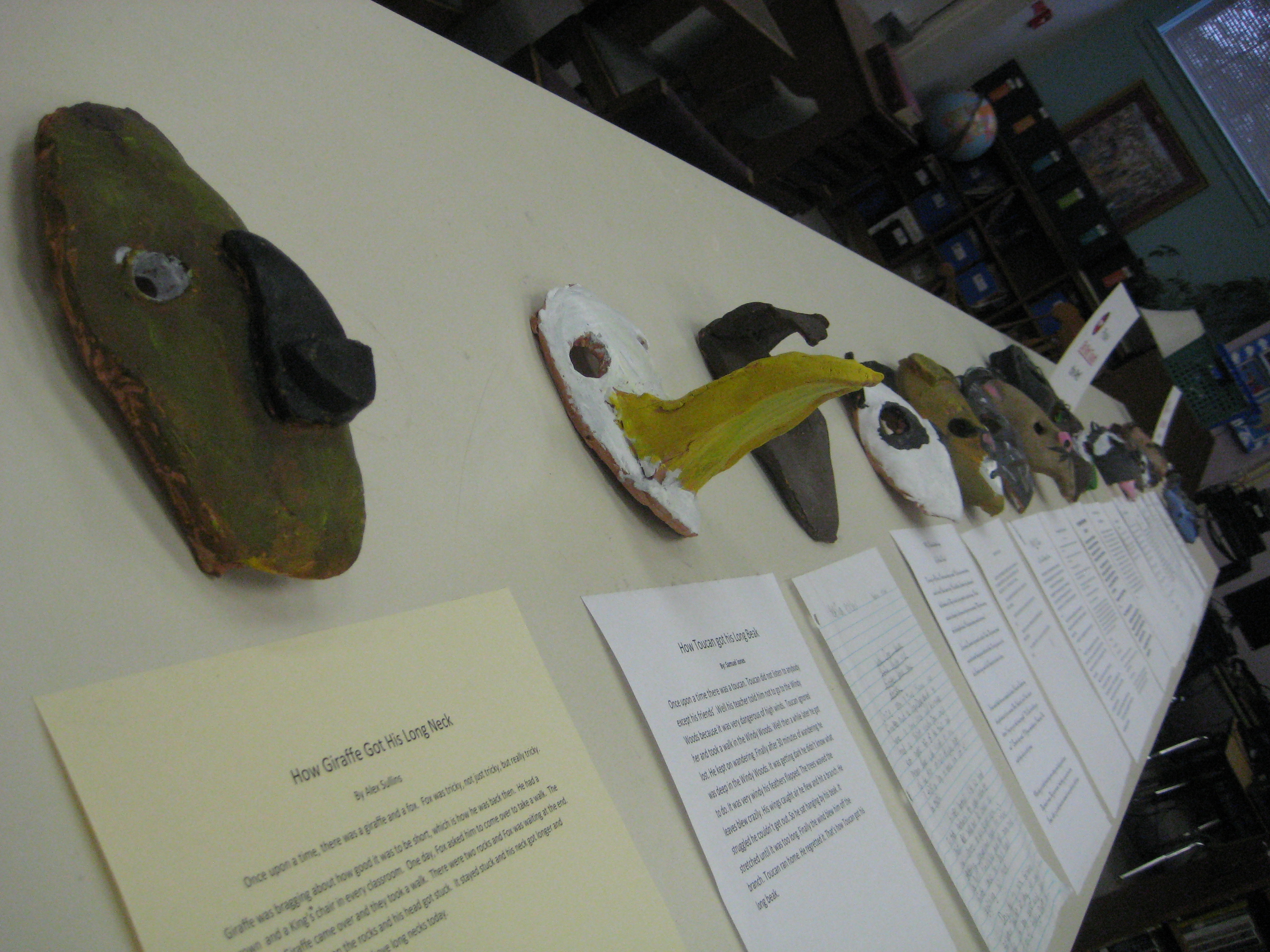
Each mask was created in art and is accompanied by a student-written story developed in class

As a part of 4th grade’s Native American unit, they studied folktales.  They spent weeks reading a variety of folktales from around the world as well as Native American folktales.  In the media center, they used Google Earth on the iPads to examine the regions of the United States where the Native Americans are found.  They noticed what landforms and water features were in each area.  Then, I told folktales from each tribe and they noticed how the land and regions came into each story.

In class, students continued to read folktales and examine the elements of each kind of folktale.  They began to develop their own story and implement these elements into the stories.

In art, the students designed masks that accompanied their tales.

The process was long and spread out over several months, but we are excited to finally have the finished products on display in our media center.  If you happen to be near Barrow Elementary in the coming weeks, feel free to stop in and read some of these stories and examine the beautiful masks.

This slideshow requires JavaScript.

Book Choice Champions Final Steps

The Book Choice Champions, a group of 11 boys in 2nd-5th grades, finalized their project today.  Their job has been to use a budget of $1500 to purchase books for the media center that are about topics that students are interested in.  They’ve been through a long process, including surveying 199 students at our school.  Last week, they finalized their book order and now we are waiting on it to come in.  Today, the boys made some final pieces to advertise the books as well as show people the process they went through.  Some worked on posters.  Others made a commercial for BTV, while others worked on an Animoto of the process.  Even though today was our last official meeting, several of the boys want to continue meeting to plan ways to promote the books to the school.  One idea was to take pictures of all of the books and make another Animoto for BTV.  Here is the Animoto that they made today to show the process that they went through.

Book Choice Champions.

Becoming Blind

Students in Mrs. Slongo’s ELT class became blind last week, but not like you might think.  For the past two years, Mrs. Slongo has taken her 5th grade class on a journey of exploration and empathy through blind sculptor Michael Naranjo’s work.  Students watch a YouTube video about his work and philosophy.  Then, students are blindfolded and given a lump of clay to sculpt what they picture in their mind.  Last year students wrote letters to Naranjo and sent them to him, but this year Mrs. Slongo wanted the letters to be in a format that was more connected to Naranjo.  After students wrote letters about their experiences “being blind” and how they were inspired by his work, students came to the media center to record their letters using Audacity. Their work will be burned onto a CD and taken to one of Naranjo’s art exhibits that Mrs. Slongo’s sister will be attending.  It was so inspiring to listen to these 5th grade students share how they were inspired by Naranjo’s passion to keep doing what he loves even though he can’t “see” his work.

You can listen to each students’ letter here.

4th Grade Colonial Wax Museum

Each year, the entire 4th grade works on a huge project called the Colonial Wax Museum.  This project incorporates all of the social studies standards related to Colonial America.  Students spend many sessions in the media center and in their classroom researching one historic figure from the Colonial period.  Some of these people are well-known, but some are very obscure, so it makes for a very interesting search online for information that is reliable.  Students used many search engines found on our research tools pathfinder that was created by the great Joyce Valenza.

The culminating project is to host  a wax museum.  Students dress up in costume and pose around the media center and in classrooms.  They place a construction paper “push” button in front of them.  Teachers, students, and community members come and step on the push buttons and the characters come to life and recite a short speech about themselves that comes from their extensive research.  This is always a fun project to be a part of in the media center.  The 4th grade teachers and students did an outstanding job in this year’s museum.

Check out a glimpse of what the museum looked like here.