Let’s Show Our Work with the #PowerOfPublicSchools

img_7649

Created by Kristina Holzweiss

When I speak at conferences or lead workshops, one of the ideas that I try to stress to educators is the importance of showing our work.  It’s something I’ve always believed in but my belief has strengthened each year.

One of the books that I got a lot of encouragement from is Austin Kleon’s Show Your Work.

So many of his ideas resonate with me. As educators, we truly have an opportunity to show the world what is happening within the walls of our schools.  I share at least one thing every single day on Twitter, Instagram, and/or Facebook about the work that is going on in our public school library.

I do this for many reasons.  The biggest reason is that it amplifies the work of my students, teachers, and families.  It shows that the work that they are doing matters and deserves to be seen and heard by a global audience.

Another reason I share is to inspire other educators to take risks and try something new.  I’ve gained so much from reading the tweets, pictures, and blog posts of fellow educators around the world. People like Jennifer LaGarde, Tiffany Whitehead, Matthew Winner, Sherry Gick, Kathy Burnette, Nikki Robertson, George Couros, Todd Nesloney (and many more than I can list) inspire my thinking.  They push me to innovate, to try something new, and to offer more opportunities to my community.  By sharing my work, someone else out there will see something we are doing and twist that idea into something new.  Someone out there will try something they weren’t even thinking about.

Finally, I share my work because it defines for the world what is happening in a public school library.  Without sharing, many assumptions are made about what happens in public schools.  It shouldn’t be a mystery to the public.  You can look through my blog posts, Instagram pictures, and Tweets and see that our library and school are filled with miraculous things.  Everything isn’t perfect, but it has value.

Usually, when I share my work, I add hashtags like #edchat, #edtech, #studentvoice, #tlchat, #istelib, #makered, and more.  This sends our work to specific audiences.  This week, a new Secretary of Education was sworn in. There has been a lot of controversy around Betsy DeVos and her views of public education.  There has been a lot of controversy about her lack of experience with what actually happens within public schools. So…I decided to occasionally share with her on social media some of the things happening in our public school library.

When I did this, several people in my professional learning network started having a conversation around showing the great work of public schools. Sherry Gick, Rebecca Flowers, and more started brainstorming a hashtag.  Many suggestions were offered but the brilliant author/illustrator Matthew Cordell offered this one #PowerOfPublicSchools


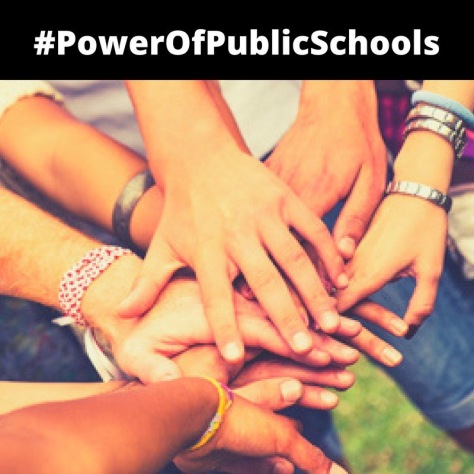
Kristina Holzweiss created a graphic, and we all started sharing it along with our posts of the great work of public schools.

https://twitter.com/SherryGick/status/829888648074113024

https://twitter.com/barberchicago/status/829876530100711424


I hope that you will join us.  Show the powerful things that are happening in your school and use the hashtag #PowerOfPublicSchools


Use our graphic within your networks to encourage others to share.

img_7649

Also, consider tagging people who need to see the power of public schools.  Perhaps it’s local, state, and federal government.  Perhaps it’s businesses in your community.  Perhaps it’s someone else.

Regardless of who you might tag, show your work.  You never know who it might inspire, influence, or change.


Design Challenge Makerspace

img_7614-1

I’ve said it before, but I’ll say it again. We are so fortunate to have the University of Georgia right next to our school and even more fortunate to have instructors like Gretchen Thomas who collaborate with local schools.  Gretchen and I have been collaborating for about 3 years now, and each year we try some new things.  We’re always looking for ways to improve the makerspace time at our school as well as the opportunities available to students.

Gretchen teaches an undergraduate course at UGA all related to maker education, design thinking, STEAM, and more. Every Tuesday and Thursday, at least 4 of her students come to our library to work with students who sign up for our open makerspace time.

This semester we are once again trying something new. Rather than try to do something new on Tuesday and Thursday, students sign up for a 2-day makerspace that gives them time to work toward finishing a project rather than feeling rushed. In addition, we are thinking about design challenges as well as seeking solutions to authentic problems.

This week, we had our first UGA group of the semester and they offered a chariot building design challenge.  Students had access to Strawbees, popsicle sticks, cups, straws, tape, paper, scissors, and anything else in our maker supply cart.  Students from 1st, 3rd, 4th, and 5th grade came to the sessions.

The UGA group started out my explaining what a chariot is.  Then, they gave students the task.  Design a chariot that can be pulled by a Sphero robot.  Students grouped themselves in groups of 2-4 and brainstormed designs on paper.

Next, students started construction of their chariots.  There was a lot of trial and error during this process.  Designs on paper didn’t always translate to physical designs so adjustments were made.  The UGA students also got out some Spheros so students could check their design to make sure the Sphero fit in the right places.  No driving was done on day 1.

Students left their designs on the table in the makerspace so they were ready for day 2.  On day 2, students finished designs and began testing their work with a Sphero.  Most designs did not work out on the first try, so students brainstormed modifications and got to work. I loved listening to their thought process in deciding what was problematic and how they could fix that aspect of the design.

I also saw students considering the settings of the Sphero to change the driving speed in order to navigate an obstacle course of coffee cans and ramps with their Sphero.

I really loved this two-day model because I saw students able to finish a project and actually take time to redesign.  Students loved coming to makerspace 2 days during the week rather than just one.  We’ll keep considering how this supports students creation and how it might get in the way of opportunities.

I also have a group of students who are wanting to work on individual projects and Gretchen is going to help me pair UGA mentors with these students as a 2nd piece of makerspace.

We’ll see where this goes, but the potential is looking pretty miraculous!

Student Book Budgets: A Walk to Avid Bookshop

avid-bookshop-2

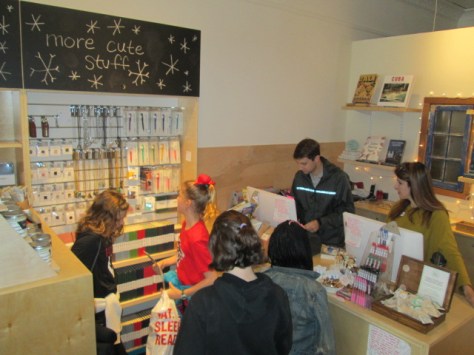
We are so excited to have the second location of Avid Bookshop just a few blocks from our school.  Avid was recently named one of the top 5 finalists for the 2017 bookstore of the year by Publisher’s Weekly.  Since our students have walking field trip forms on file, it was easy for this year’s student book budget group to plan a walking field trip to the new Avid.  This group of students has a library budget that they have complete control over.  Through surveys, they have set purchasing goals to buy new books for the library that kids want to read.

avid-bookshop-18

Ahead of our visit, I sent Hannah DeCamp, school specialist, a list of the major genres the book budget group is looking to purchase books for.  She pulled together some books to show us, found some “Best Books for Young Readers” magazines, and dug out some advance reader copies of books for students to review.

On the day of our walk, I met with 11 of our book budget team and reminded them about the purchasing goals we had set.  We also reminded ourselves that Avid would be open for business so we needed to stay out of the way of customers as well as keeping the store organized during our browsing.

It was a great morning for a walk and it only took us about 15 minutes to arrive.  Hannah greeted us and showed us how the store was organized.  She showcased a few books in each section and then allowed students to browse the store.

Since the store sells books for all kinds of readers, students really had to ask themselves if they were looking at a book that would best fit an elementary library.  Some books were of interest, but they were really more for adults.  As students found books that they liked, they came to me and we wrote the titles down in a notebook.  I originally wanted to type them as we worked, but I didn’t want to lug around a computer.

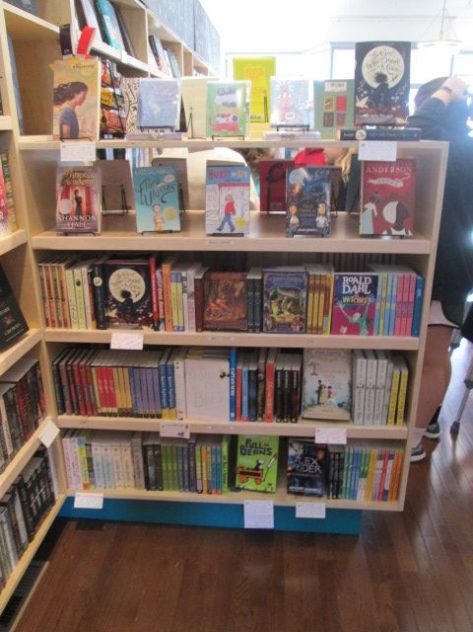
What I noticed right away was that when books were presented in smaller sections like the shelves in Avid, students noticed the books better.  There were several books our students got excited about that we actually have in our library, but they haven’t seen them. It made me start to wonder how to make books more visible to students.

When Hannah let students look through a stack of advance reader copies, they again got excited about many of the books. It reminded me that I need to get more students involved in perusing the ARCs that I get in the mail or pick up at conferences.  I can’t read them all, but students can help read and make decisions.

I kept sending students back to the shelves of Avid and making them take books off the shelves to read a few pages or at least read the back.  I feel like they spent a good amount of time digging through what was in stock.  In all, we spent about an hour browsing.

Several students brought money with them, so they made some purchases.  We gathered outside the shop for a bit and took time to look through the catalog that Hannah had given us.  Again, we added to our list before walking back to school.

avid-bookshop-14

Avid Bookshop is going to be such a great resource for us being so close to our school.  There were so many life skills and standards that we explored on this trip.  We learned about the publishing industry, independent bookshops, community helpers, budgets, adding money, and taxes.

avid-bookshop-6

Now, I am typing up the books that we loved, and students will make a final decision to send back to Hannah at Avid for a quote.  I know this is just the beginning of how we will utilize having Avid right here in our school community.

Weaving Together Social Studies and Makerspace

inventors-24Our 5th grade is currently studying the impact on American life that several famous inventors had. When I was brainstorming with Shelley Olin, 5th grade social studies teacher, we began to wonder about connections these standards had to makerspace.  It started as an idea seed and grew into a set of experiences for all 5th graders to engage in.

I wanted students to put themselves into the shoes of an inventor so that they could begin to understand the perseverance and curiosity that inventors have. We focused on 3 of the inventors: Thomas Edison (electricity), Alexander Graham Bell (communication), and the Wright Brothers (flight).

I prepared 3 centers on electricity, communication, and flight.  Each center included a biography about the inventors, instructions for an activity, and a clipboard to leave wisdom for the next group to learn from.

For flight, I selected some paper airplanes that could be made from a full sheet of paper.  I also included books about other paper airplanes.

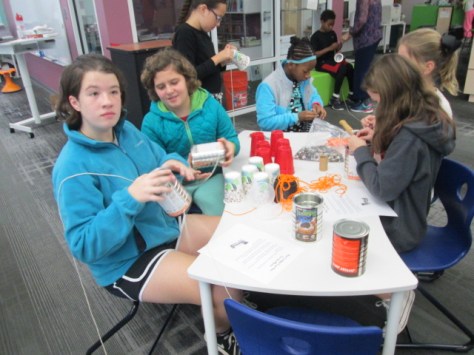
For communication, I created 2 choices.  One was to use littlebits to create a tool for communicating using Morse code. I included a buzzer and LED bit as well as button, pulse sensor, and slide dimmer bits.  The other experience was to create a tin can phone.  I provided coffee cans and cups and various kinds of string.

For electricity, I copied instructions for making a simple paper circuit using a coin battery, led light, and copper tape.  I put materials in Ziploc bags so each group would have what they needed to create a circuit.  I added extra led lights for tinkering beyond an simple circuit.

It took a long time to prepare all of the materials for 3 back-to-back 5th grade classes.  I had to have everything ready for an immediate turn round between classes.

Before coming to the library to engage in some makerspace activities related to these themes, students read about each inventor in textbooks and on PebbleGo.  They gave Ms. Olin their top 2 interests out of the 3 themes so that she could put them in groups.

inventors-22

In the library, we started by looking at the littlebits invention cycle.  There’s not just one place to start in the cycle and it doesn’t necessarily follow a linear sequence.  We talked about how students could start with “create” by following the directions that I had given. Then they could play with their creation and begin to remix ideas to create an improved version or an alternative invention.  By the end, I hoped that they would have something to share with the rest of their class or group.  It really seemed like it could be linear in talking about it, but I quickly saw that it is very fluid.

After our quick intro, students sorted into their chosen task and got to work. Luckily, Ms. Olin and other collaborative teachers joined the class during this session. At times, we had me and 3 teachers supporting students around the library.  It was 3 very different activities, so having the extra support was beneficial.

What I quickly saw was how much students wanted to just jump in and put things together without reading directions.  At paper airplanes, students started folding paper in all sorts of folds and testing them out.

inventors-25

At paper circuits, students were sticking down tape and connecting the led to the battery without reading  the instructions or even formulating a plan.

inventors-1

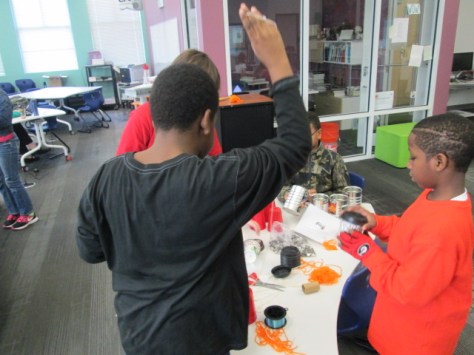
At tin can phones, students immediately started connecting cans.

inventors-3

But…as I stepped back and thought about it, isn’t that really what inventors do?  They don’t necessarily have a set of instructions to follow. They just try things out to see what happens.

After some initial tinkering, several students did in fact try to read the instructions and many said that they wished they had read them at the beginning. It was an important lesson that we talked about and learned from. It’s hard to read all the instructions before putting something together when all you want is to see the finished product.  I do that myself as an adult.

inventors-17

One thing that was really interesting was when students finished their first prototype and they started remixing. One example at the tin can phone center was when 2 groups decided to combine their two phones and see if they could make a four-way call.

inventors-26

At the paper airplane center, students started combining their planes together to see if a combination would create a better flying plane.  They were truly embracing the idea of remixing.

inventors-20

When we came back together at the end, I asked students to think about what it was like to be an inventor.  We had some great conversation about perseverance, staying calm through frustration, trying again, problem solving, and taking plenty of time to invent. We circled back to our inventors and considered how much time, frustration, and perseverance they each put into their inventions.  I think the experience gave the students a greater appreciation for the inventors they were learning about rather than just passively reading about them.

inventors-14

We even had a moment to talk about continuing inventions in our makerspace or at home and entering them into our school maker faire coming soon.  I loved how a simple idea from a social studies standard was able to weave together growth mindset, literature, social studies, and makerspace all into one experience.


Polar Express 2016

polar-express-69

Every year that we have our Polar Express Day, I’m reminded of the power of community. School-wide events are so rewarding, but they take a lot of work to pull off.  The library hosts multiple school-wide events every year.  A team of special elves come together to make Polar Express Day a special event for every child in our school.  It is often one of the big memories that students have about their year and their experience at Barrow.

Many schools ask us what goes into our Polar Express Day, so here’s a little peek:

  • Our principal creates a schedule so that every class in the school gets a time to come to the library to hear the Polar Express. Most 30-minute sessions 2-3 classes at a time
  • Janice Flory, our library volunteer coordinator (a PTA role) buys bells, string, hot chocolate, cups, and candy canes through PTA.  She also organizes volunteers to help each Polar Express session during the day
  • A group of volunteers works on stringing 600 bells so that every student in the school gets a bell.  This year it was a wonderful troop of Girl Scouts
  • I work on setting up the library with special decorations, chairs, and banners.  I make sure the technical side of Polar Express is working such as the train sounds, read aloud, and special music.  I also work with our volunteer coordinator to make sure all of the pieces are running smoothly.
  • A team of teachers come overnight the night before Polar Express Day and create special hallway decorations such as a train track, ticket booth, and ornaments
  • Our lunchroom makes huge batches of hot chocolate
  • On the day of the event, teams of volunteers help pour and serve hot chocolate as well as hang bells around each student and whisper “Always Believe”.  Kim Ness, parent volunteer extraordinaire & Janice Flory, library volunteer coordinator, help keep the volunteers organized all day.
  • Teachers do special activities in their classrooms such as making Polar Express tickets. They also hold the book as we listen to the story over the library speakers
  • Our family engagement specialist organizes a nighttime Polar Express for Barrow alumni
  • On the day of the event, there’s always lots of odd and ends that have to be done and we all work together to get it done. It is a tight schedule and takes quick moving in between sessions to reset everything for the next group
  • This year we added a green screen photo booth to take a picture with the book as the background. Teachers helped a lot with this as well as our principal.  Next year, we’ll need to have someone stationed here to help it run smoothly


Our green screen was a favorite activity this year.  Many teachers jumped in to help with this one because it was a little bit tricky if the app stopped working.  We’ll keep thinking how to make this station a little bit better next year.  Even with some glitches, we got some fun pictures of classes.

Each year holds special memories for Polar Express.  There are special little moments from students all throughout the day. I’m so thankful to have  community who comes together to create this magical event of always believing.


Closing Out Fall with a Makerspace Recess

makerspace-recess-1

The fall semester is coming to a close at UGA, which means our open makerspace times on Tuesdays and Thursdays is about to take a small break until January.  To close out the semester, the entire Maker Dawgs class returned to Barrow to host a makerspace recess.

makerspace-recess-14

Setting this time up take a little more work than having makerspace in the library, but each time we take our makerspace beyond the library, I’m reminded about how it makes the opportunity visible to students.

makerspace-recess-4

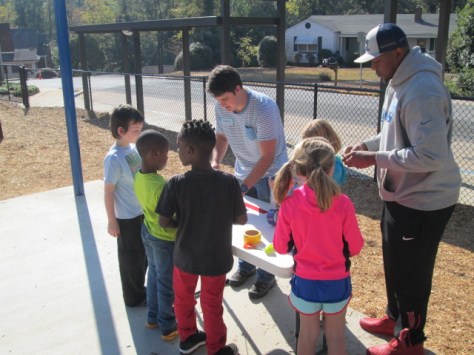
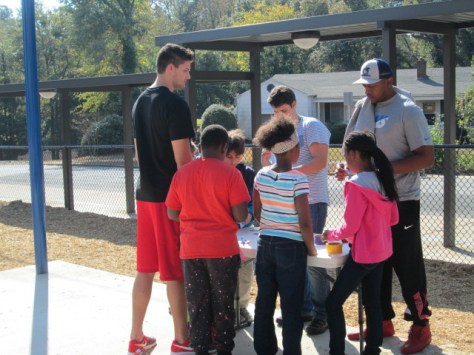
Gretchen Thomas arrived early and started setting up tables under our pavilion on the playground. Each table featured something we’ve done in makerspace across the semester.

  1.  Duct tape bows and bow ties
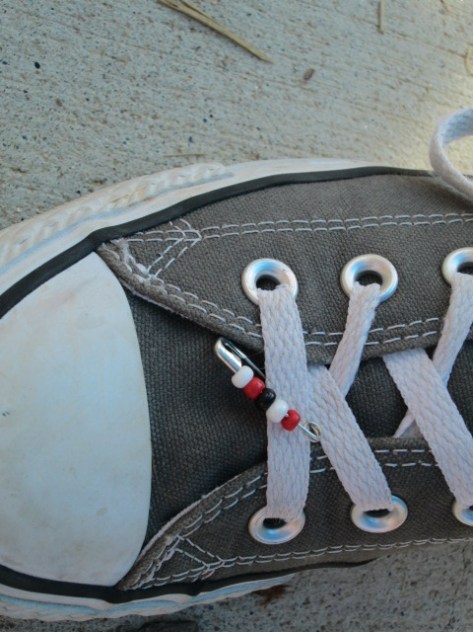
  2. Kindness pins and necklaces
  3. Buttons
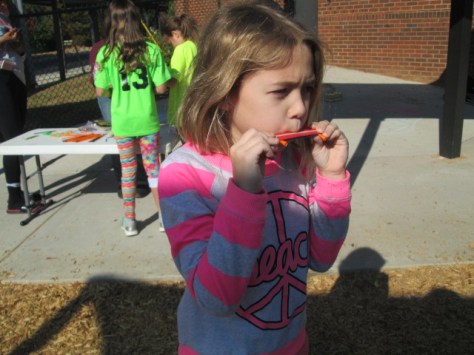
  4. Popsicle kazoos
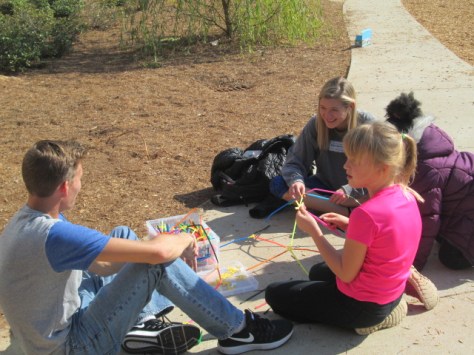
  5. Strawbee architecture
  6. Cubelets

makerspace-recess-7


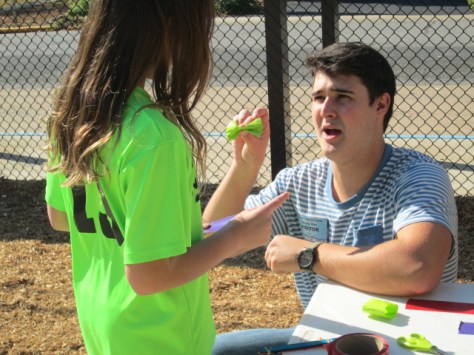
Since we were outside, we could also have stations that are more difficult to do inside like sidewalk chalk art.  As UGA students arrived, they each took a station to facilitate any students who wanted to try that activity.  When students arrived at recess, they immediately gravitated toward the makerspace to see what was going on. One of the most common things I heard was: “I didn’t sign up”.  It was so fun to say that the makerspace was open to all.  Since we had numerous helpers and could spread out, it didn’t matter how many students wanted to participate or how loud they were.  Because of this, we saw students who had never been to makerspace suddenly get to experience what we do.

I know that I can’t do the scale of makerspace that we did today by myself, but I do want to think about how I can offer small opportunities to tinker with our makerspace tools in spaces where students are already gathered.  The tricky piece comes with managing the library while I’m in another space. Without a helper, I have to think about the best times I can do this while I have a volunteer or our computer technician in the library.

As typically happens in makerspace, we saw big groups of students who might not play together on the playground suddenly crowded around the same table sharing materials, collaborating, chatting, and sharing their creations. There’s something magical about the atmosphere of a makerspace and the community it builds among makers.

makerspace-recess-30 makerspace-recess-31

I need to keep this thought at the front of my mind as I move into the 2nd half of the year. How can I maintain the makerspace opportunities we have as well as expand the opportunities to students who haven’t had a chance to participate?

As always, thank you to Gretchen Thomas, her Maker Dawgs students, and UGA for exploring this complex topic with me each semester. We’re doing great work together.

Community Collaboration: Book Making in the Makerspace

book-making-27

I love opportunities to connect with community and bring expertise, talents, and interests to our students.  Recently, a parent contacted me to tell me that her child’s grandmother was traveling to Athens to visit and would love to do book making with some students at our school.  I immediately responded back that we would love to have this opportunity in our makerspace, and the planning began.

Grandmother Kathleen sent me a list of supplies we would need, so I ordered those from Amazon in advance.  She packed everything else on her flight from Texas.

I also communicated with Gretchen Thomas at UGA to let her know that her students could help Kathleen during this makerspace time.  I let teachers know the topic of the makerspace in advance and students signed up to participate across two days (Tuesday and Thursday).

When Kathleen arrived, her enthusiasm for art was contagious.  You could tell that she was an amazing art teacher in Texas.  She had multiple examples of books she had made from instruction found in Making Books that Fly, Fold, Wrap, Hide, Pop Up, Twist, and Turn.


She had a different kinds of book planned for each group who visited the makerspace: 1st & 3rd grade, 5th grade, and 4th grade.

Before each group arrived, she put materials at each chair with the  help of Gretchen’s UGA students.  She gave very clear, step-by-step instructions for each group and me and the UGA students went around assisting students as needed.

Because each project took more than 30-minutes, we reached a stopping point and then stored the projects for Thursday.

Each book had its own purpose and made me and the students think about so many possibilities. One book allowed you to record things from different perspectives. Another book allowed you to write your own Choose Your Own Adventure story with pull out cards.  Another book fanned out like a flower and allowed you to put poems, photographs, and more within the folds.

Each time Kathleen showed us a book, my mind was swirling with connections to each grade level’s curriculum.  Students were focused, productive, and buzzing with excitement about today’s makerspace.  I bet that when students are involved in the process of creating their own published books, they are more likely to fill those books with productive writing.  I know that when I personally made my own book during the final 30-minute session, I really wanted to go home and fill it with writing and photographs.

I was reminded once again about how many interests and talents are hiding within our students, families, extended families, and community.  Alone, I would not have thought much about book making or how to attempt it with groups of students.  However, now that the expertise of a grandparent was shared with me and our students, I’m considering new possibilities with projects.

How many more talents and interests are just waiting for us within our communities?  How do we tap into these resources? This was an opportunity that was given to me, but I know that if I had a way of unearthing and organizing the wealth of talents and interests in our community that more opportunities like this would make its way to our students and teachers.


Exploring Chefs and Food Trucks with Cantata Learning’s Harmony Project

chef-jason-4

We love getting involved in global projects that connect us with different careers, cultures, and people. Last year, we shared what winter is like in our community of Athens, Georgia by contributing to an interactive ebook.

This fall, Cantata Learning’s Harmony Project is called “Give a Shout Out to Your Community“.  It will feature live connections with several community helpers such as chefs, authors, doctors, and farmers.  As students learn from these live connections, they are encouraged to explore their own communities and create videos that showcase their communities.

Students can also get involved in a service learning project in their community.  All of these products can be shared with Cantata Learning on their Harmony Project page so that they can be shared with the world and we can all learn about one another’s communities.

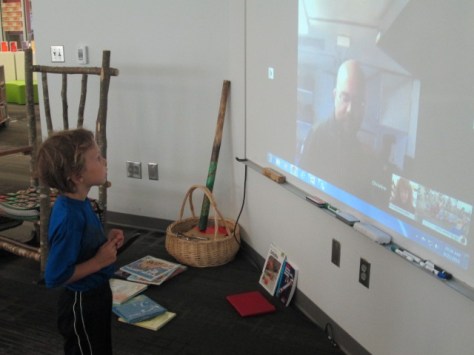
Today, Ms. Kelly’s Kindergarten class connected with Jason De Baca who is a chef and owner of a food truck in Denver, CO.  Through a Google Hangout facilitated by Shannon McClintock Miller, we were able to go inside the food truck, see a recipe prepared, and learn how a food truck works.

Ms. Kelly’s class also got to ask questions which was a very special part of our connection.  Students asked about how to become a chef, where to get recipes, where ingredients come from, what tools are used in cooking, who drives the food truck, and how much it costs to get started with a food truck business.

Jason was happy to answer all of their questions.

After we disconnected, we were able to look at a map to learn where Denver, CO is and how long it would take to get there.

Another exciting thing that happened was that a student in Ms. Kelly’s class shared that his dad owns a food truck. We hope this might lead to an opportunity for us to actually go inside a food truck or sample some food truck food.  It was also a special connection to see how food trucks are a part of our community in Athens, Georgia and Denver, Colorado too.

chef-jason-1

This connection also allowed me to highlight our cooking and food section of the library.  This section includes cookbooks as well as books on where food comes from and how kids can get involved in growing their food.

chef-jason-8 chef-jason-7

Ms. Kelly’s class is always dreaming up something exciting, so I look forward to what they will dream up after exploring food trucks with Jason and Cantata Learning.

Take a look at our whole connection.

Athens, GA & Seodaemun, South Korea: A Global Art Collaboration

korea-flipgrid-6

In June 2015, the mayors of Athens, GA and Seodaemun, South Korea signed a Memorandum of Understanding.  This MOU calls for both cities to exchange leadership programs in private and public sectors that promote economic development.  That basically means that our cities have a friendship to exchange ideas.


https://www.youtube.com/watch?v=KDDLVIV45Sw

As a part of this collaboration, the 2nd graders at our school are engaging in a collaborative art project with students in Seodaemun.  This has been an exciting and challenging undertaking for our students and teachers, but it has been full of rewarding experiences.  The classroom teachers, art teacher, and media center all supported the students at Barrow in carrying out the project.

korea-research-4 korea-research-1 korea-research-3

In class, students read the book Same, Same but Different by Jenny Sue Kostecki Shaw.  This set the stage for students thinking about how our city of Athens is the same as Seodaemun and how it’s different.  My wife, Denise Plemmons, in the Athens-Clarke County Economic Development Department, shared several websites with us to learn more about Seodaemun. I added some additional sites for students to visit that included resources from our state-funded Galileo databases. These were all housed on a Symbaloo page for students.

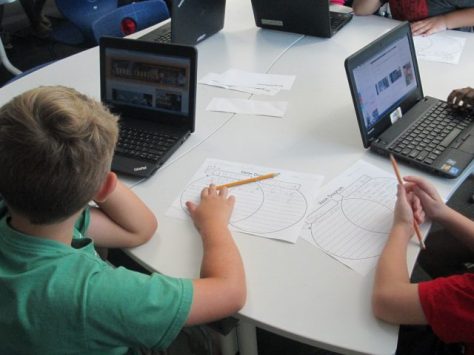
Teachers paired students within their rooms to research and create art together.  Students used a Venn diagram to write brief notes on what was the same and different between our cities. For example, students learned that we have an arch at UGA and Seodaemun has an arch at Independence Park. They saw that we go to school for 7-8 hours per day and Seodaemun may go up to 16 hours per day.  Research was done in the library, and prior to letting students search on their own via the Symbaloo, I provided some tangible examples like these to put into the diagram.

korea-flipgrid-9

The research was a challenge.  One reason was just the lack of resources on a 2nd grade level. The other big challenge was that students are 7 and 8 years old. There are currently studying regions of Georgia, so adding in a country on the other side of the world was hard to grasp within that context. We found that some students thought they had been to South Korea when in fact they were thinking of South Carolina. It may seem humorous, but it was valid conversation that we worked to clarify in the library, art room, and classroom.

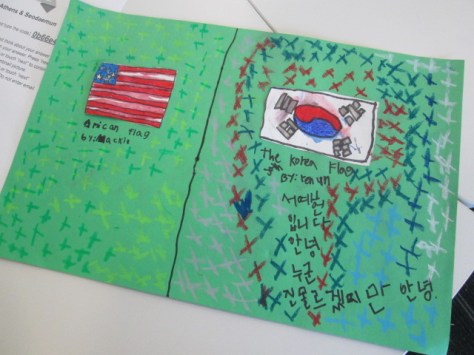
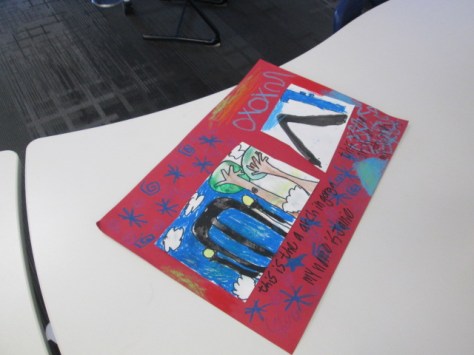
After an hour-long session of research, students took their work to Ms. Foretich in the art room.  They used their Venn diagram to decide what art they would create that would show something that was the same or different between our cities.  One of the partners painted the Athens side of the art, and the other partner painted the Seodaemun side.


In classrooms, teachers continued to share maps and facts about our two cities. Mrs. Yawn, the 2nd grade team leader, worked to plan a morning of rotations for all of the 2nd graders. Some of our students are from South Korea, so she invited the parents of those students along with support from UGA to offer rotation topics on culture, games, and food.

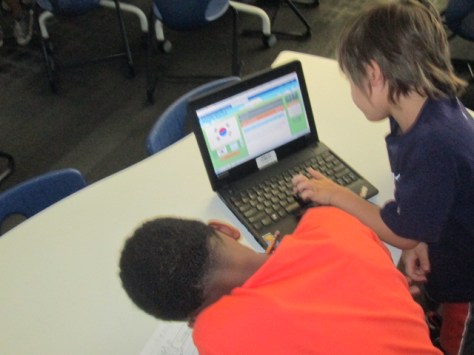
Another part of the rotations was for each class to come to the library and record a Flipgrid video explaining what each pair of students learned about Athens and Seodaemun and what they created in their art.

Our goal is to send these Flipgrid links to Seodaemun so that the Korean students can respond back when they create their own art.

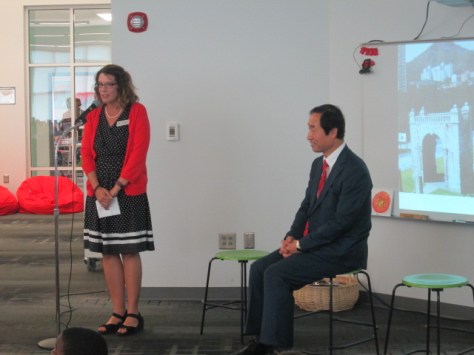
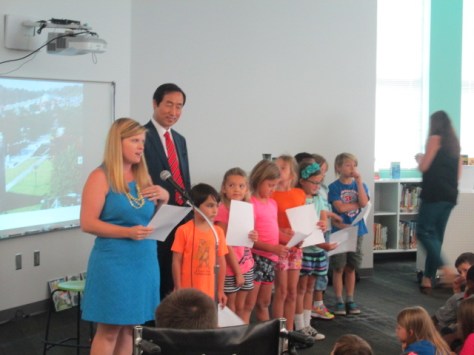
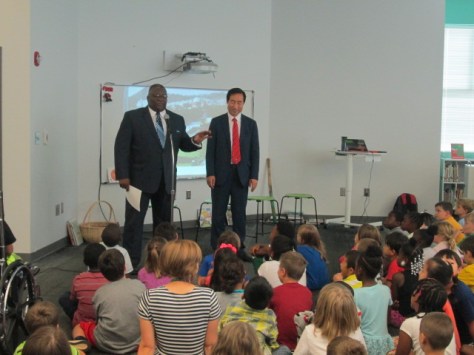
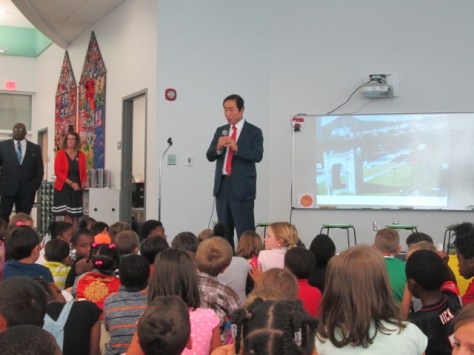
To celebrate the end of our portion of the project, the mayor of Seodaemun visited our whole 2nd grade along with members of the Athens Clarke County government.

Dr. Ellen Sabatini, principal, welcomed everyone.

athens-seodaemun-8

Ms. Yawn, 2nd grade team leader, explained the project to our visitors and families.

athens-seodaemun-9

Students shared pieces of the project that they worked on.

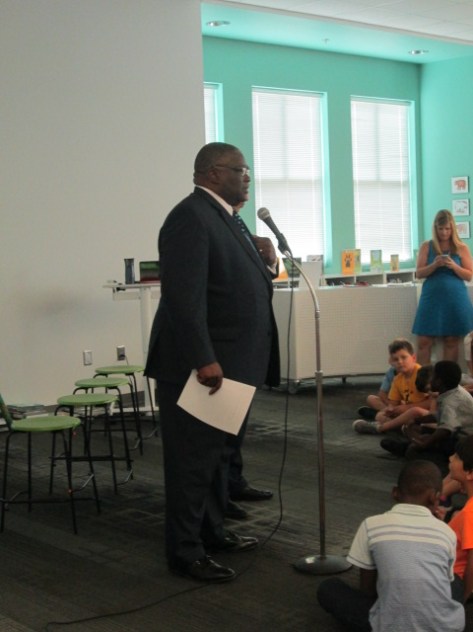
Commissioner Harry Sims spoke about how the students’ art work would now be a world traveler as it goes across the ocean to South Korea.

athens-seodaemun-14 athens-seodaemun-15

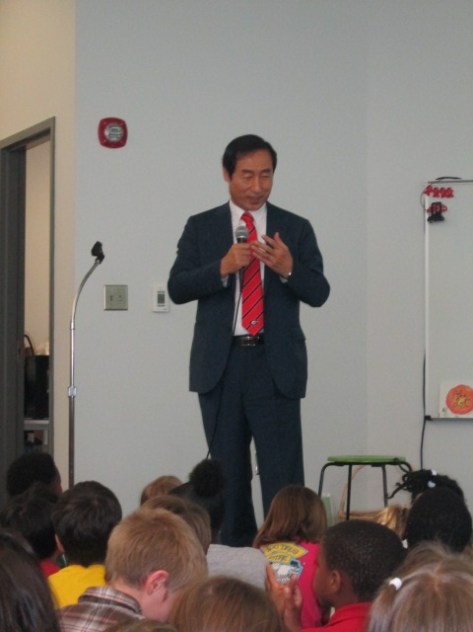
Finally, Seok-Jin Mun, the mayor of Seodaemun, spoke to students about how we are all connected to one another because we are all mankind. Even though we have different beliefs or different skin color, we are all connected.

athens-seodaemun-19 athens-seodaemun-18

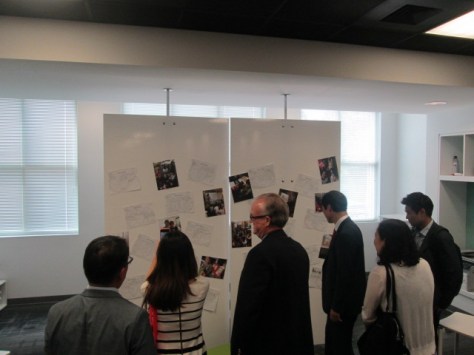
To conclude the visit, Mayor Mun, teachers, and all guests explored the student artwork on display in the 2nd grade collaborative space.

athens-seodaemun-26

Mayor Mun pointed out his observations of what stood out to our students and clarified some facts from our research.

It was inspiring to think with him and the members of our Clarke County government about how we can continue to build upon this friendship between our two communities.

Now, our artwork is preparing to make its journey, and we look forward to seeing what our new friends in South Korea learn and draw about Athens, Georgia.  We thank the Athens Clarke County Economic Development Department for this opportunity to connect our students with our global community.


The Makerspace Is Open with a New Badging System

img_8887UGA is back in session which means our makerspace is cranking up again.  We already have some curriculum connections planned for special projects, but our students look forward to the weekly open makerspace times on Tuesdays and Thursdays from 11-12:30.

Gretchen Thomas and her UGA class collaborate with us to provide a weekly time where students can signup to explore various tools and projects in our makerspace.  Four UGA students come each time and lead up to 15 students every 30 minutes in the makerspace so that I can also teach classes at the same time.

img_8875

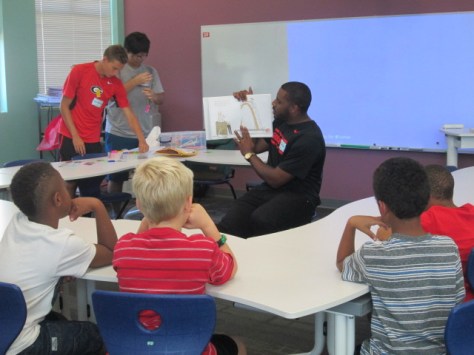
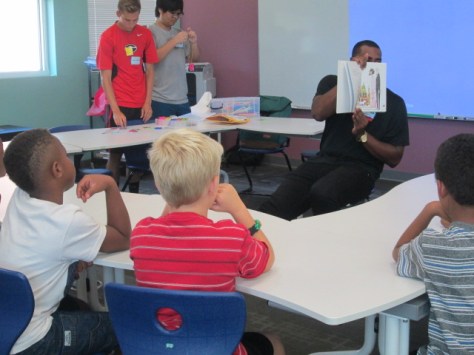
Gretchen and I are have learned a lot during our collaboration together, and I love that she’s always pushing her class to try something new.  For our first few sessions this year, the UGA students are presenting a maker-related book to the students and an activity to accompany that book.  There’s not really enough time to read the entire book and still make something, but they at least are able to show the book, talk a bit about it, and then make something with the students.

img_8874

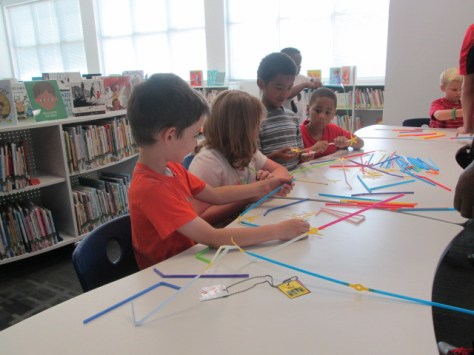
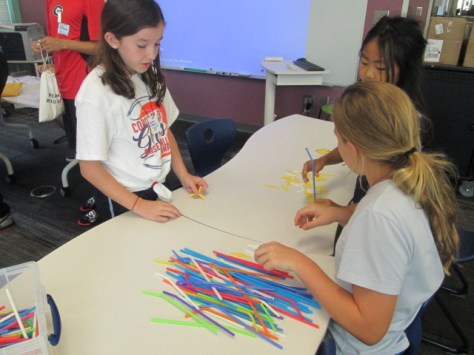
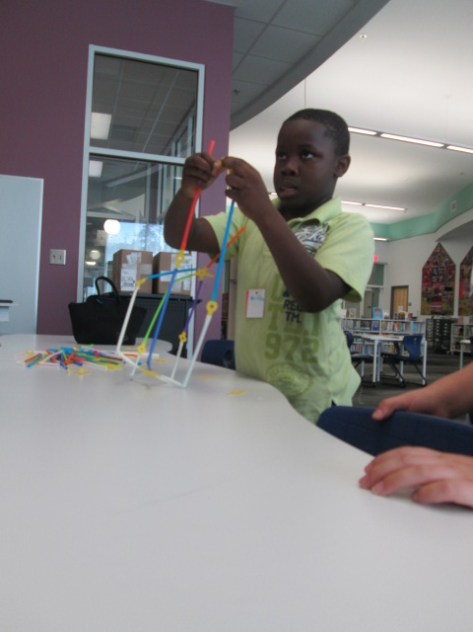
For our first session, the UGA students read or showed Iggy Peck Architect.  At the end of the book, they invited our students in 1st, 3rd, 4th, and 5th grades to become an architect and use Strawbees to build the tallest free standing tower.

img_8873

I loved watching the UGA students decide how much information to give the students versus when to let them discover things on their own.  In one group, they just gave them the Strawbees and straws and said “build”.

Then, in another group they gave some examples of how the straws and Strawbees could connect to one another.  The amount of guidance definitely impacted the type of structures made.

img_8881

I don’t know that we have a firm answer on how much structure to offer to the students, but I’m glad that we are always thinking about how much is too much.  I think we certainly stayed conservative on how much we told the students.  Every structure was different and students found things that worked really well and things that failed miserably.  In the end, the important thing is that we really didn’t have students who gave up or who even got extremely upset because they didn’t “win”.  That’s the true spirit of making.

img_8895

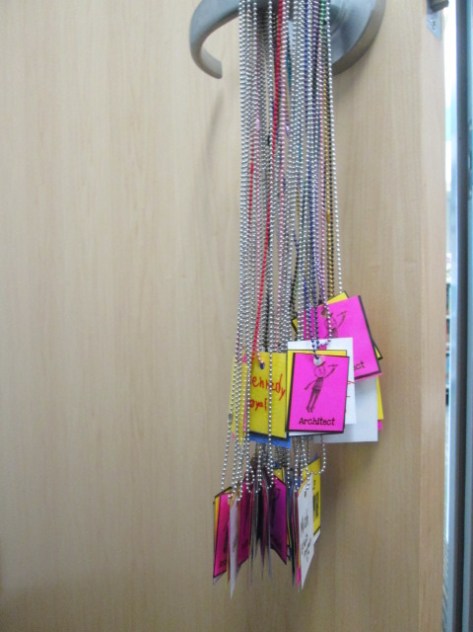
One new addition this year is something we’ve talked about for a long time.  So many students come to the makerspace, that it’s hard to track who has learned what tool or skill.  I really wanted a badging system but didn’t think I had time to make it.  Gretchen and I have talked through this many times and discussed the idea of badges for specific tools like Sphero, Duct Tape, LittleBits, etc and badges for skills such as problem-solver, thinking outside the box, teamwork, etc.

Gretchen took it upon herself to make this happen for us.  She started making badges that students would attach to chain necklaces.  Students would earn a badge for the tool they explored and the group they worked with as well as have an opportunity to earn rare badges for skills or qualities.  Gretchen and her students will continue to design badges and add them to the collection.  They will be stored in plastic drawers in the makerspace.  Students will hang their necklaces on a hook in the space and grab them when they come to makerspace.

img_8896

We’ll easily be able to look at badges and see which students have learned which tools and which students have demonstrated the skills of a maker.

I can’t wait to see where this goes, and I’m so thankful for Gretchen and her class making this happen!