A Visit with LeUyen Pham

leuyen-2

The American Library Association just held its annual Midwinter Conference in Atlanta, and that meant that some amazing authors and illustrators were in town.  One of the speakers at ALA Midwinter was LeUyen Pham.  Who has worked on over 80 picture books!  Her current picture book is The Bear Who Wasn’t There and it is one she wrote and illustrated.  We were so thankful when her publisher, MacMillan, reached out to Avid Bookshop to offer a visit with a local school to celebrate her new book.
leuyen-8

The Bear Who Wasn’t There is a hilarious tale that invites the reader along to look for a bear who has gone missing from the book. There’s evidence of a bear along the way, but the reader and the animals in the story just can’t seem to find him.  Meanwhile, the duck in the story uses the bear’s absence to show off some magic tricks and try to sell his own books.  This book has a lot of mischief and laughs along the way, and readers might just discover a bear if they look very carefully.
leuyen-6

We didn’t learn about the opportunity to host LeUyen until late December, so the prep time for this visit was very short. Normally, I try to have students make decorations, but it was tricky to pull off this time. Instead, we really focused on reading the books. I pulled all of LeUyen’s books from our library and showed lots of classes the huge range of illustrations she has created from Freckleface Strawberry to Vampirina Ballerina to Alvin Ho to Princess in Black and more.  We read several of her books as well including The Bear Who Wasn’t There.  Every class laughed out loud on every single page.  We also took time to learn how to pronounce LeUyen’s name by listening to it on TeachingBooks.net

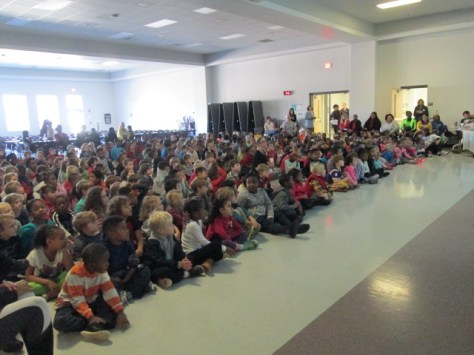
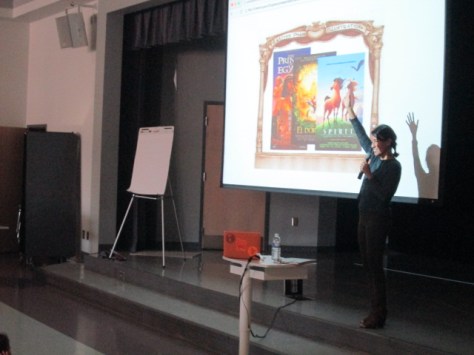
With over 350 K-3 students in the audience, LeUyen was magical!  With her twinkle fingers, she sprinkled the room with focus and students were hanging on every word.  She took them on a journey by looking at some of her very first drawings to the drawings she does as an adult. Students learned about movies that she worked on before she became an illustrator such as Prince of Egypt and Spirit.  She did some storytelling as she recounted her journey to Africa sketching scenery and animals.  LeUyen pulled out one of her many notebooks and showed students how she sketches everywhere she goes.

One of the moments I loved, was when she told students that she doesn’t spend too much time on one drawing. In fact she shared some pretty amazing drawings that she created in less than 15 minutes. She always draws in pen.  With a pen, you can’t erase your mistakes, so you can look back at those mistakes and learn from them.  That one statement has so many connections within and beyond art.  I want to bring that idea back up with students as we create together.


Next, LeUyen read A Piece of Cake, which is a perfect story for a big group read aloud.  There are so many unexpected things at each page turn and the kids had a blast shouting out what they thought mouse and bird would trade cake or objects for.

To close her time, LeUyen created some illustrations.  Students were selected from the audience, and she turned each of these models into an animal version of themselves reading a book.  While drawing animals with the features of our student models, she also took questions from the audience about her inspiration, her longest and shortest books, and more.

It was during this time that we heard about how a student at a school could suddenly become the inspiration for an illustration as one student did for Grace for President.    You just never know where your next idea may come from, so LeUyen is always watching, listening, and sketching her world.

leuyen-26

Our young readers listed to LeUyen for an hour, and I was so proud of their excitement for her.  She is such an inspiring and sweet person who is insanely talented at illustrating.  I know her books will fly off our library shelves, and I can’t wait to see what students create and talk about after exploring her books.

As she left, LeUyen signed lots of books.  She lovingly included an illustration in each book she signed.  If you didn’t get a book at the visit, we have many books for checkout in the library or you can visit Avid Bookshop to purchase one.  As always, we are thankful to publishers like MacMillan for sending authors and illustrators to independent bookshops and schools.  Thank you, LeUyen, for spending part of your travels with us and sharing your talents and stories.  Thank you to Avid Bookshop for connecting with your community and enriching the reading and creative lives of students.


Exploring Pigloo with Anne Marie Pace

anne-marie-pace-8

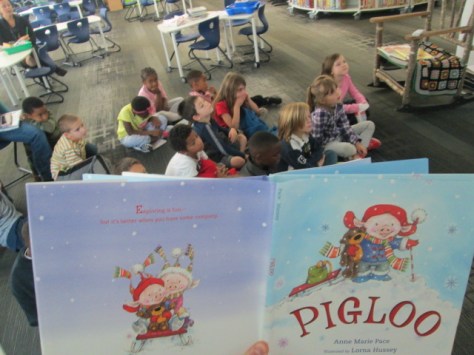
Today Ms. Skinner’s 1st grade class had the great fortune to Skype with Anne Marie Pace to celebrate her new picture book, Pigloo. This book began when Anne Marie was in 1st grade, and now it is a beautiful picture book for our readers to explore. Pigloo dreams of going on an exploration to the north pole, and thanks to some snow, his sister, and some imagination, he is able to make his dreams come true.

This Skype was made possible through a contest that Anne Marie Pace held for librarians and teachers of 1st grade.  Prior to our Skype, students watched the book trailer to get familiar with where the idea for the book came from.  Anne Marie also sent us coloring pages for the students to color.

During our Skype, Anne Marie had students think about times they have waited on something just like Pigloo waits on the snow.  We heard stories of waiting on pizza and Pokemon cards.  We also talked about weather in Virginia where Anne Marie lives and in Georgia where we live.  We certainly don’t have as much snow as Anne Marie has, so it was fun for the students to think about opportunities to get out and play in the snow which is rare here.

Next, Anne Marie read through the entire book.  She held it up for students to see, but luckily a copy arrived in the mail for us just in time for the Skype.  I held up the book so that students could see it on the screen or on the physical pages.

One of the things I love about connecting with authors is the chance for students to chat with them one on one.  Anne Marie took time to let students step up and ask a question.  Many wanted to ask more questions about Pigloo.  Why did his sister “trick” him?  Where did he get his sled and hat?  However, we also got to ask about writing.  She encouraged students to keep writing even when it’s hard.  She explained that sometimes writing has fun parts and sometimes it has hard parts.  She wanted them to always listen to their teacher and realize that feedback was a teacher’s wish for them to each become better writers.  This affirmation is always powerful for students to hear and realize that we all need to push ourselves to do better.

Pigloo will now be available for checkout in our library, but students have a chance to order it from Anne Marie’s local bookshop, The Sycamore Tree.  She will sign each one and the bookshop will mail them to our school.

Connecting with authors in person and virtually is always a treat for our readers. Each experience reminds students that there is a person and lots of hard work behind the pages of each book on our shelves.  Thank you Anne Marie Pace for stepping into our school for the morning.

Community Collaboration: Book Making in the Makerspace

book-making-27

I love opportunities to connect with community and bring expertise, talents, and interests to our students.  Recently, a parent contacted me to tell me that her child’s grandmother was traveling to Athens to visit and would love to do book making with some students at our school.  I immediately responded back that we would love to have this opportunity in our makerspace, and the planning began.

Grandmother Kathleen sent me a list of supplies we would need, so I ordered those from Amazon in advance.  She packed everything else on her flight from Texas.

I also communicated with Gretchen Thomas at UGA to let her know that her students could help Kathleen during this makerspace time.  I let teachers know the topic of the makerspace in advance and students signed up to participate across two days (Tuesday and Thursday).

When Kathleen arrived, her enthusiasm for art was contagious.  You could tell that she was an amazing art teacher in Texas.  She had multiple examples of books she had made from instruction found in Making Books that Fly, Fold, Wrap, Hide, Pop Up, Twist, and Turn.


She had a different kinds of book planned for each group who visited the makerspace: 1st & 3rd grade, 5th grade, and 4th grade.

Before each group arrived, she put materials at each chair with the  help of Gretchen’s UGA students.  She gave very clear, step-by-step instructions for each group and me and the UGA students went around assisting students as needed.

Because each project took more than 30-minutes, we reached a stopping point and then stored the projects for Thursday.

Each book had its own purpose and made me and the students think about so many possibilities. One book allowed you to record things from different perspectives. Another book allowed you to write your own Choose Your Own Adventure story with pull out cards.  Another book fanned out like a flower and allowed you to put poems, photographs, and more within the folds.

Each time Kathleen showed us a book, my mind was swirling with connections to each grade level’s curriculum.  Students were focused, productive, and buzzing with excitement about today’s makerspace.  I bet that when students are involved in the process of creating their own published books, they are more likely to fill those books with productive writing.  I know that when I personally made my own book during the final 30-minute session, I really wanted to go home and fill it with writing and photographs.

I was reminded once again about how many interests and talents are hiding within our students, families, extended families, and community.  Alone, I would not have thought much about book making or how to attempt it with groups of students.  However, now that the expertise of a grandparent was shared with me and our students, I’m considering new possibilities with projects.

How many more talents and interests are just waiting for us within our communities?  How do we tap into these resources? This was an opportunity that was given to me, but I know that if I had a way of unearthing and organizing the wealth of talents and interests in our community that more opportunities like this would make its way to our students and teachers.


Students as Teachers: Exploring Text Structure with Flipgrid

text-structure-17

At the beginning of the year, I started talking with Melissa Freeman, 5th grade teacher, about exploring text structure in the library.  The very 1st unit in 5th grade language arts starts with text structure which explores the following standard.

ELAGSE5RI5  Compare and contrast the overall structure (e.g., chronology, comparison, cause/effect, problem/solution) of events,ideas, concepts, or information in two or more texts.

Melissa was wondering how to make the topic more engaging and wondered about the possibility of a library scavenger hunt.  We really weren’t sure where to go with the idea so we kept bouncing around possibilities over email and in person. She even came to the library and worked with me to pull books out of the nonfiction section and start sorting them into stacks.

text-structure-16 text-structure-15

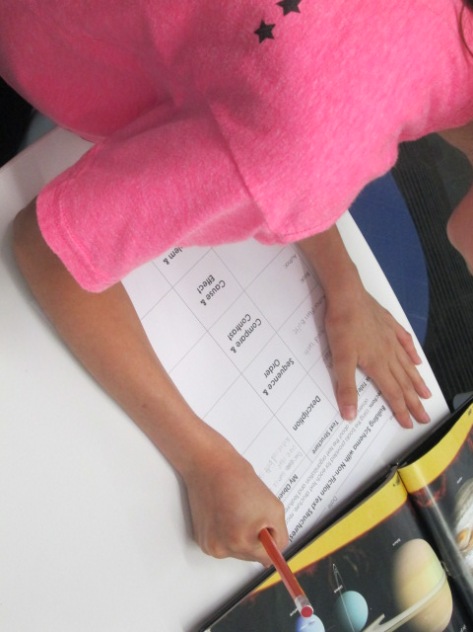
I continued this process so that we knew we had examples of compare/contrast, description, sequence/order, cause/effect, and problem/solution.  Then, I mixed them all up.  We knew that even though we personally picked a book for a specific structure that students might find other examples of text structure within the book.  We were also excited that students would have some one-on-one time looking through some nonfiction books that they might not know that the library has.

text-structure-14 text-structure-13

In one of our brainstorms, I thought about the possibility of students recording their findings in a digital way that could be shared with one another and also other grade levels. I originally thought it would be a good way for them to agree or disagree with examples that were discovered, but we expanded the idea to be a way that students could teach other students in our school and other schools about ways text can be organized.

We decided to use Flipgrid for this task.  I created 5 separate questions: one for each type of text structure.  Then, I linked them all on a Symbaloo that Ms. Freeman could share with her students via Google Classroom.

In class, Ms. Freeman introduced each kind of text structure and students started exploring books on Tumblebooks for each structure.

text-structure-12 text-structure-10

Each class came to the library for a 50-minute session.  We did a quick mini-lesson to review the structures, show how to use Flipgrid, and share what we hoped students would include in their video. This included things like the book title, author, text structure, and a concrete example from the text to justify the structure chosen.  We also setup the idea that these videos could be a teaching tool for the rest of 5th grade, the school, and other schools.

text-structure-8 text-structure-7

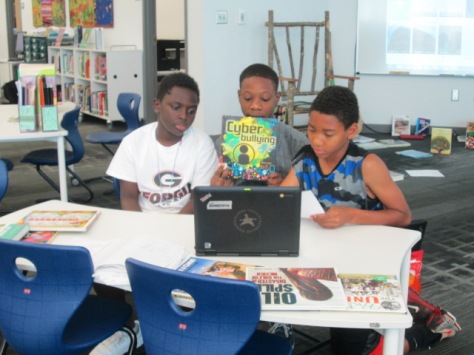
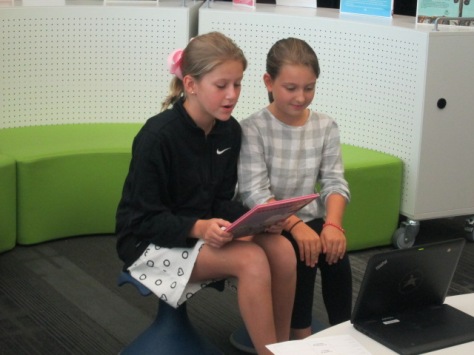
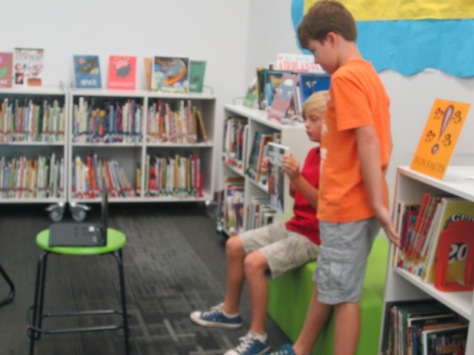
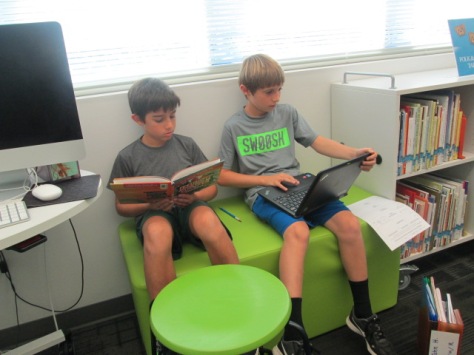
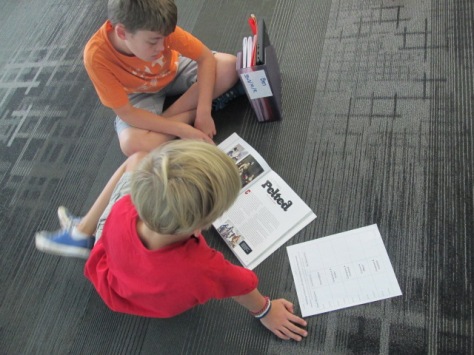
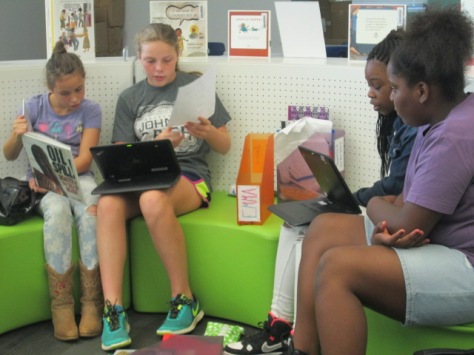
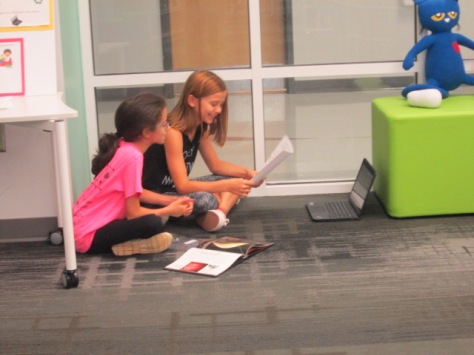
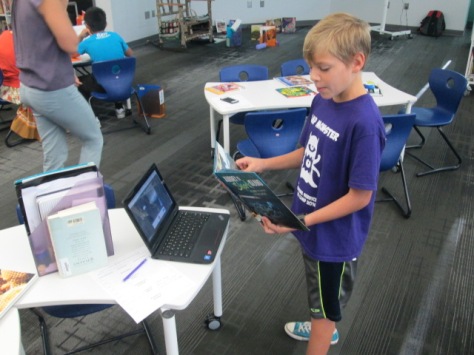
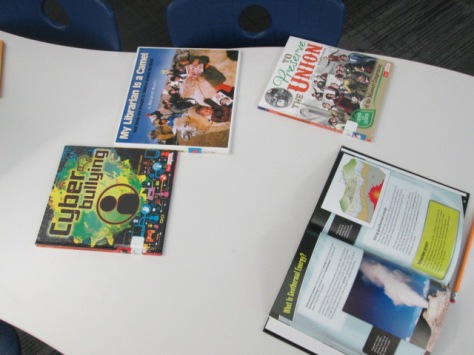
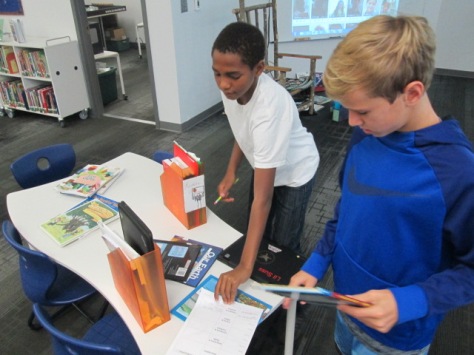
I spread the books out at tables and students worked in partners to browse the tables for a book to start with. As they discovered one of the 5 text structures, they prepared to make a video.  Students used their own computers to record a Flipgrid, and then continued exploring for their next book example.

Ms. Freeman, Ms. Mullins (gifted teacher), and I all walked around and chatted with students as they searched through books.  One of our immediate noticings was that students were guessing the structure simply based on the title, topic, or cover of the book.

They weren’t even opening the book to read the text.  While this was a great predictor of what kind of structure might be inside, students were missing the point about looking at the organization. We clarified this in conferences and adjusted our mini-lesson with each class to put a stronger emphasis on explaining.

To close each class, we showed a few of the videos and had student offer noticings about what they heard. I love that in the new Flipgrid, you can actually respond to each video response.  I showed students how the comments they were making could actually be added right onto our Flipgrid.  I also encouraged each person who made a video to think about how they might add to their original video by posting a new video as a response.

The plan is for students to continue using these Flipgrids in class to post additional examples and respond to one another. We hope that eventually there will be some strong examples that can be shared with other classes in our school as well as with schools we collaborate with.

In the meantime, it’s a work in progress.

text-structure-4 text-structure-3


Celebrating Poetry Through Book Spine Poems

book spine poem

One of our favorite kinds of poetry to create each year is book spine poetry. It is a kind of found poetry where the words found on the spines of books create the lines of a poem. Every 2nd grade class came to the library for a one-hour session to create book spine poems individually or in pairs.

To begin our time, I briefly explained found poetry and then told a story about how I created my own book spine poem. The story was meant to serve as a model for how students might craft their own poem, but they certainly didn’t have to go about the process the exact same way as me.

I started in the everybody section of the library and started reading the spines of all the books on the shelf from the beginning. I was looking for a title that jumped out at me as a starting place. I happened upon Quest and Journey by Aaron Becker. I loved how those two words sounded together and I decided to start looking for titles that seemed to go with those two words, which meant looking for titles that were about traveling in some way. I passed by many titles that didn’t fit, so I left them on the shelf without pulling them off. I continued this process until I had found I Took a Walk, In My Dreams I Can Fly, and Goin’ Someplace Special. I also had the book The Ride but I decided that I didn’t like the sound of those words with the others in my stack so I put that book back on the return cart. Next, I tried several ways of arranging the books until I had a sequence I was happy with. After practicing a few times, I recorded my poem with my phone and uploaded it online to share with the world.

After my short story, we went back through the steps and put them into a concise list on the board for students to reference. Then, students got to work. They wandered the shelves looking for that first book and then went from there. As was expected, some of them found their own strategies for creating the poems. Some struggled with finding that first book. Some wanted the support of someone walking with them to look for books. The teacher and I wandered around too and talked with individual students until they started reaching the recording phase.

Once students recorded using an iPad, they brought the iPad to me and we immediately plugged the iPad into my computer and uploaded to Youtube. They also went to the teacher to take a photograph of their book stack that could be printed and put into their poetry books they are creating in class. All books that were used went onto a cart parked in the middle of the library, and students were welcome to read those books while they waited on classmates to finish.

When students finished, I pulled all of their work into Youtube playlists which I emailed to teachers to share with families. We concluded our time by sitting together and snapping for each poem on our playlist. I hope you’ll take a moment to listen to, enjoy, and snap for the poems from each 2nd grade class.

2016 Poem In Your Pocket Day 2

Today we wrapped up our 2016 Poem In Your Pocket poetry cafe with 13 more classes reading poetry into our open microphone. It was another day of many special moments.

5th graders wrote many original and powerful poems.

https://twitter.com/TeachFreeman/status/718416353355546624


Students read poems written by other students.


Memorized Sylvia Plath


Awesome costumes were worn.


Teachers and families helped us document the day.

https://twitter.com/TeachFreeman/status/718436388618821632

https://twitter.com/TeachFreeman/status/718432534078582784

https://twitter.com/micaheIise/status/718496173955354624


Take a moment to watch today’s archives.  You can still Tweet about our poems using the hashtag #barrowpoems


Here’s a collection of scenes from today:

Until next year…

Poem in Your Pocket 2016 Day 1

Poem In Pocket (47)

Day 1 of Poem In Your Pocket Day is a wrap. Fourteen classes came to the library for 20-30 minute sessions of poetry reading. Each student had an opportunity to step up to our open microphone and read an original or favorite poem. It is truly amazing to see some students step out of their comfort zone to speak in front of their peers for a very short amount of time. Poetry is so accessible to so many people. It opens opportunities for students that sometimes other kinds of writing can’t. As always, there were magical moments during the day.

A student folded his poem into a piece of origami.

A student who wouldn’t read his poem on camera shared it with me instead, and it was a poem about me.

Ms. Kelly’s class created asemic writing and truly showed us what it means to perform and interpret poetry.

Take a look at some of the magical moments from today.

Also, take a look at Instagram and Twitter and search the hashtag #barrowpoems to see even more. We had several special posts and messages from people all over.

https://twitter.com/ShawnasLewis/status/718086098426040322

Finally, take some time to listen back to some of these amazing poets.

The Magic of Poetry

I love reading poetry and creating poetry with kids. I’m always amazed at the freedom that many kids feel when they express themselves through poetry and give themselves permission to abandon some of the “rules” we must follow when we write in other forms.  While there are many “rules” in poetry too, I’ve noticed that many kids aren’t intimidated by writing a poem when they realize that poetry is painting a picture with words and not necessarily writing in a complete sentence.

I’m happy to work with students on poetry all year round, but we of course do our fair share of lessons in April for poetry month. Recently, Ms. Lauren’s Kindergarten class came to the library for an introduction to poetry leading up to our annual Poem In Your Pocket poetry cafe.

Rather than read a bunch of poetry, I chose to read one poem that is a full length book called Black Magic by Dinah Johnson and illustrated by R. Gregory Christie.  The text is filled with vivid similes about the color black such as “black is loud like my best tap shoes making happy noise with every move.”

Prior to reading the book, I wrote “Green Magic” on the board and asked students to think of a list of things that they thought of when they thought of the color green.  Their list looked like this:

  • green flags
  • green leaves
  • green books
  • green beans
  • green stickers
  • green turtles

Then, we read the book.  We paused along the way and paid attention to the language.  I wasn’t specifically focusing on similes with them but instead just noticing the unusual descriptions or the vivid descriptions.

Following the book, we revisited our list.  I asked them, “How can we take each of these things in our list and make it more vivid or unusual?”  Students took turns offering suggestions.  Sometimes we went with the first thing a student said, and other times we listened to several suggestions before deciding what to add.  I let the students come up with the words, and I wrote them for us on the board.

To close our time, we read the poem twice. First, I read it aloud, and then we did a choral reading.

Green Magic

By Ms. Lauren’s Kindergarten Class

Green flags waving in the sky

Green leaves falling from the trees

Green books sitting in the library

Green beans dancing in my mouth

Green stickers sleeping on my hand

Green turtles minding their own business

Now, many of these students want to go back into the classroom and try writing their own color poetry modeled after this one. This time of writing really seems like magic to me.  Students come in with a blank screen in front of them and we unite our minds and voices to create something together as a community that just seems to spark when it is spoken into the air. We did this without any fancy technology or bells and whistles.  It was just us, our imaginations, an inspiring text, and a dry erase board and marker.

What poetry magic have you created this month?

American Symbol Research in Kindergarten

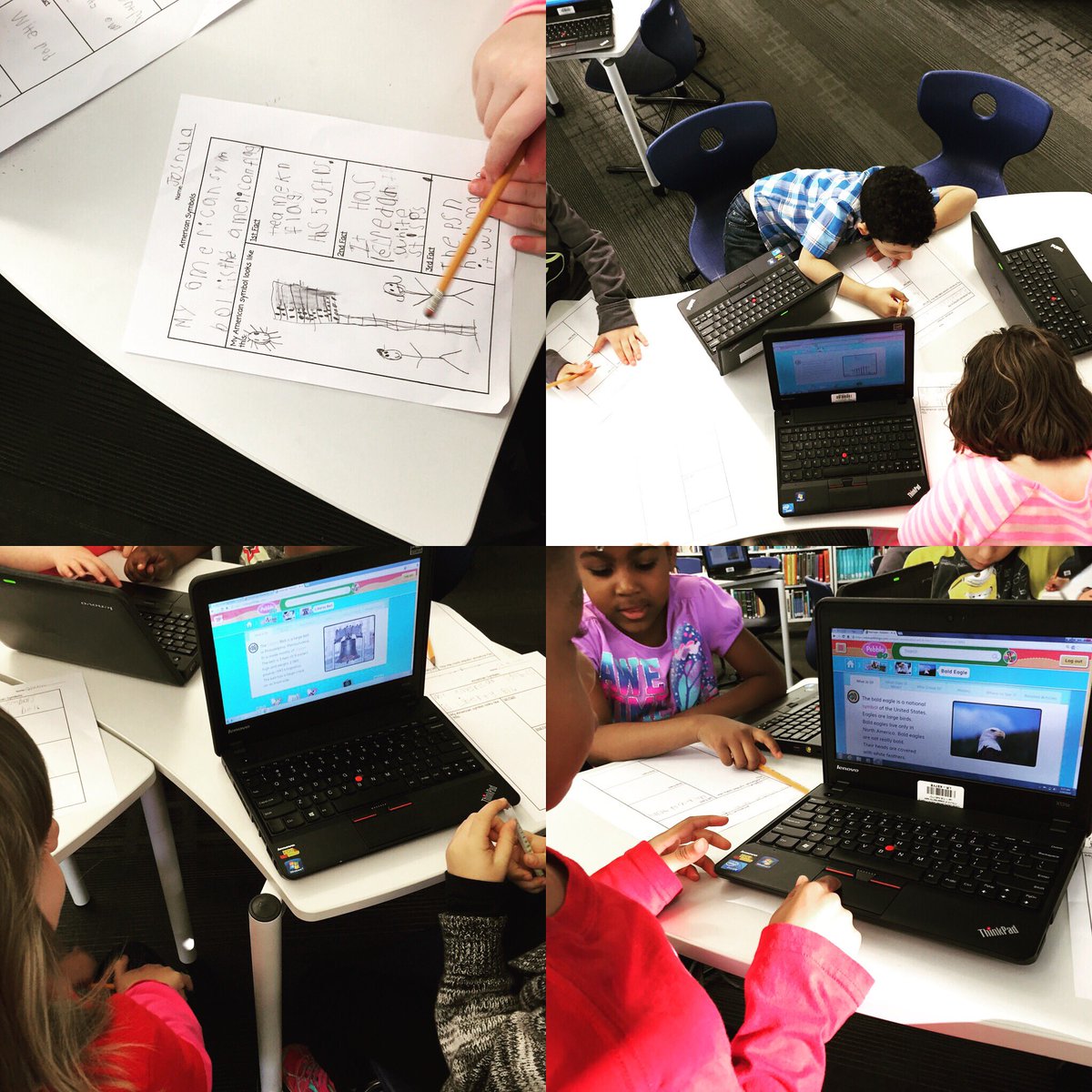
Students in 2 Kindergarten classes have been hard at work researching American symbols as part of their social studies standards. Doing research projects with the youngest learners in our school doesn’t look like it does in the upper grades. We think about what some of the biggest barriers might be for our young creators and put pieces in places to support students in getting over those barriers.

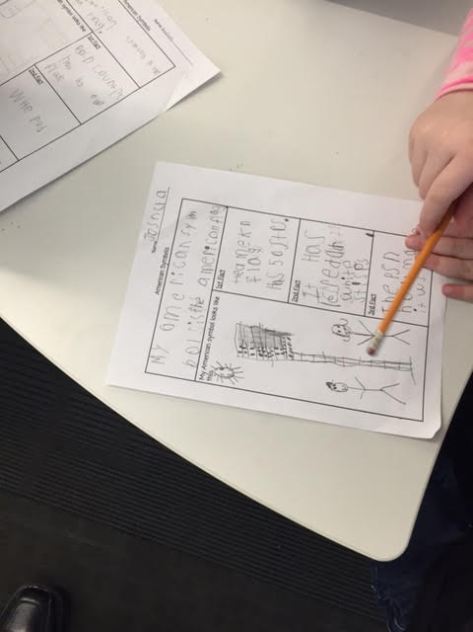
First, students chose one of four American symbols to research: American flag, statue of liberty, liberty bell, and bald eagle.  In the library, we introduced students to a graphic organizer for collecting 3 facts about their chosen symbol. I learned from another Kindergarten teacher a few years ago during research to set an expectation that allows all students to succeed or exceed during the first research session. We asked students to have a goal of writing at least one fact during the first work session, but if they still had time, they should keep going.

research 1

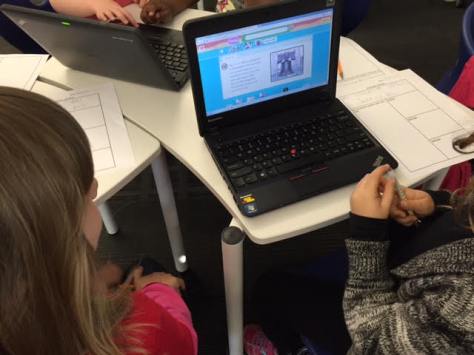
Students used Capstone’s PebbleGo for their research. We love this database for many reasons but mostly because it breaks information down into manageable pieces and reads the text in a human voice for students. I modeled for students how to listen to a portion of the text and then think about what they had learned by listening. Then, we talked about what we would write on our organizer. This modeling was done with a different American symbol than the one students were researching.

At tables, I setup computers for students to use in pairs. We chose pairs because it gave students one more source of support as they worked. Also at each table, we tried to place an adult for support. The teacher, classroom paraprofessional, and me all worked at tables. If a parent volunteer or student teacher was available, they stayed at the 4th table. Otherwise, the adults took turns checking between tables.  We found that we had to continue modeling for students how to listen, ponder, and then write rather than just copying a sentence off the screen. However, some students still chose a sentence to copy.  All students left with at least one fact but many left with 3 or more.

research 2

After this initial work session, students continued their research in centers in the classroom.  Then, they returned to the library for another work session in small groups. Each group came for 15-20 minutes. We did a short tinkering session with Chatterpix Kids to see how you can take a picture of something, draw a mouth on it, and then record that picture talking. Ahead of time, I chose creative commons images of the symbols for kids to use for their pictures. Rather than having every student create their own Chatterpix, each group created one Chatterpix video with the iPads. Each student chose one fact from their research to read.

Before recording, students chose their fact. We decided the order students would read and practiced a few times. Students helped take the picture of the symbol and draw the mouth. Then, we pressed record and passed the iPad to record. If we needed to record a few times, we did. Then, we uploaded our videos to Youtube and created a playlist to share with the class, families, and you.  I hope you will take a moment to listen to their work.

I love building foundations of research in our early grades and seeing where these students end up by the time they are in 5th grade. We have a lot of work to do, but we celebrate the work of these Kindergarten students and what they have created.

Ms. Lauren’s American Symbols:

Ms. Boyle’s American Symbols:

Kindergarten Green Screen Animal Interviews

animal interview green screen (15)

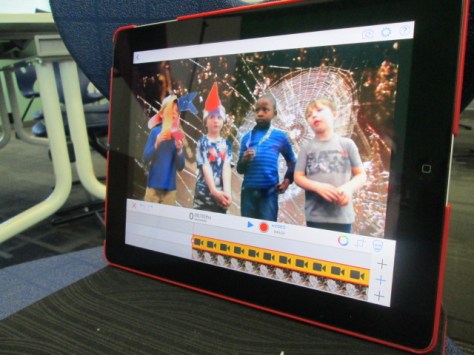
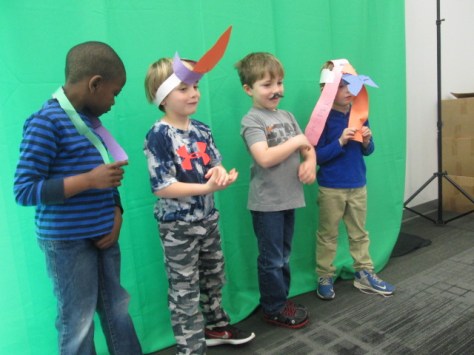
Ms. Kelly’s Kindergarten class has been hard at work on an animal research project that is unlike any other I’ve been a part of.  For the culmination of the project, students recorded an interview of an animal in its habitat using our green screen and the Do Ink app.  There were many layers to the process that students went through the create their final product. The class has been to the library throughout the project to initiate various pieces and then moved forward with the project work in class.

animal interview green screen (17)

It’s hard to even go back to where the project began, but eventually each student came to be in one of 4 groups researching an animal of interest: crows, sharks, spiders, and alligators. Students checked out both fiction and nonfiction books about their animals in the library during one piece of the project. During another piece, students spent time researching their animals and gathering facts.

animal interview green screen (16)

In another lesson, students came to the library to talk about crafting great interview questions. We looked at the Story Corps great question generator and practiced interviewing one another in a way that would elicit extended responses from the person being interviewed.

Students took this skill and went back to class to write questions that they would ask to their animals if they were doing an interview of the animal they researched.  Using their research, they thought about the answers to their questions.

animal interview green screen (13)

In another session, students came just to learn about how the green screen worked.  We watched a tutorial video from Do Ink as well as a video that had been made on our green screen.

Finally, students came back for one more work session in the library to prep for their interview project. This was a work session because students were in all kinds of stages of their completed project. The teacher, parapro, and I all worked with groups of students at the point they were at. My group was getting close to ready for use of the green screen, so we took some time to experiment a bit with what students hoped to do. Instead of a static picture of the animal’s habitat, students wanted a video of the habitat. We searched creative commons Youtube videos for nature scenes that matched where an animal would be found and used the iPad to record snippets of those videos. This helped us think about what we would need to accomplish before recording.

animal interview green screen (11)


Back in the classroom, students made final preparations for their animal interviews. They made props. They wrote our their script on cue cards and assigned parts to each person in the group.  The teacher made copies of these cards for students to practice with in class as well as sent them home for weekly homework practice.  Students also decided exactly what they hoped to have a video of for the background of the green screen. The teacher sent these to me in advance, so that I could pull some videos from Youtube for us to use.

Each group came individually to the library to record. We did a practice run of the script.  The teacher held the cue cards and I ran the iPad.  I flipped the screen so that students could see themselves as they talked. This helped them know to be in the right place, but it also tempted them to wave at the camera and make faces.

Once students finished recording, they had a chance to watch their video back. I uploaded the videos to Youtube so that we could share them with families and authentic audiences.  I encourage you to take a look at the work.

animal interview green screen (3)

Pulling off Kindergarten projects like this takes some creative thinking. Anytime that we can break the project into pieces, work in small groups rather than the whole group, and do recording within single groups makes the project run much more smoothly. I also love when a project flows in and out of the library and classroom.

animal interview green screen (5)


Ms. Kelly is an awesome teacher to collaborate with because she finds so many connections to the standards students are working on but also weaves in student interest and expertise.  She dives into a project and trusts that along the way she is going to realize just how many standards a project based in student interest and curiosity can actually included. She also thinks about how to reinforce the project so that students are fully prepared before jumping in to creating the final product. I thought it was genius (and time consuming) to create so many cue cards and give students copies to practice for homework.

I’ve been doing several technology computer projects lately, and I’m so thankful for the flexibility of our schedule so that we can get creative with how to break the projects down into pieces as well as smaller groups.  Bravo Kindergarten for another awesome project.