Digital Book Talks and Exploring How We Belong for #WRAD16

Belonging Week (8)Ms. Tesler’s 4th grade class has been exploring how they can be leaders within our school community.  Back in the fall, they started writing shelf talkers and displaying them on shelves at the front of our library. After all of their suggested books were quickly checked out, they are looking for ways to expand their leadership.  They have decided to take the “7 Strengths of Reading” challenge leading up to World Read Aloud Day and explore each week’s question.  They have also decided to take their shelf talkers and make them digital.

Belonging Week (7)

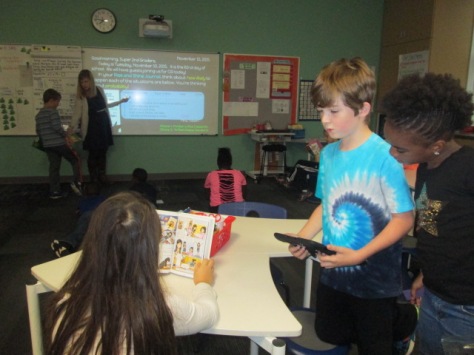
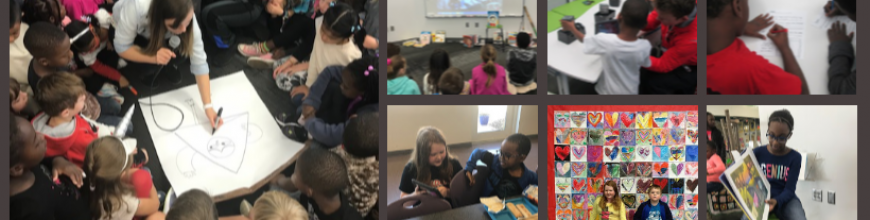
Across 2 days, the class came to the library to work on their next steps of this project.  We began by talking about our memories of being read aloud to.  I shared about my 2nd grade teacher, Ms. Deloache, and how she read Brer Rabbit stories to us with so many voices that I can still hear in my head today.  Ms. Tesler shared an experience of being read aloud to in college and how that stuck with her even as an adult.  Many other students began to share their own memories of being read aloud to.

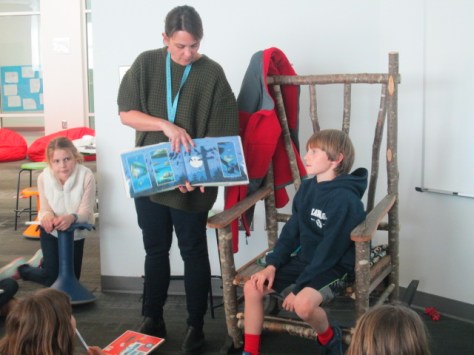
We used this to launch into a new purpose of exploring the read aloud.  We are thinking about books that others might enjoy reading aloud.  We are also thinking about books we might read aloud to our buddies in other classrooms. Along with this, we started discussing how reading aloud builds community and how certain books help us feel connected with a community. To close, I shared my own example of a book talk and a reflection on the #belongingweek #wrad16 question on Flipgrid.

Belonging Week (15)

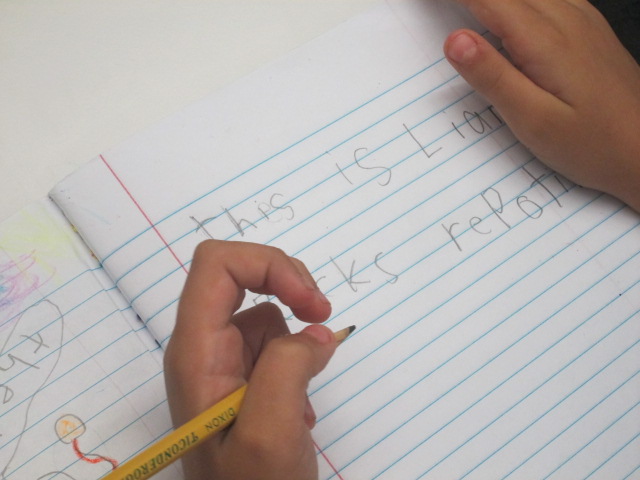
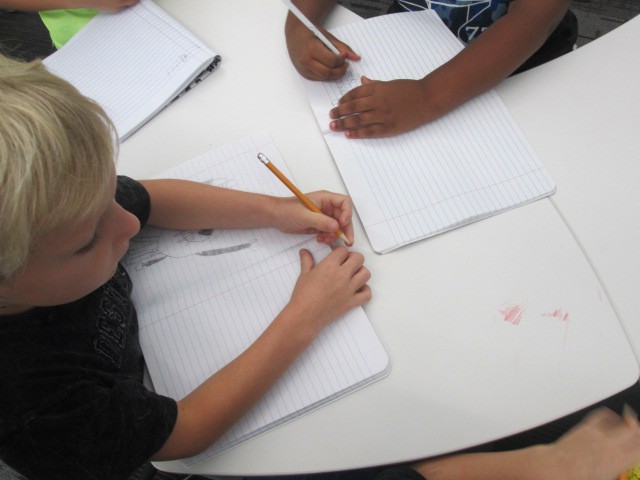
The first task was for students to select a book or books to read.  We wanted them to choose a picture book for this first book talk and question.  I pre-selected some books that had a theme of belonging, but students were welcome to choose any picture book.  Once students chose a book, they sat down to read it.  If they finished, they could start writing their shelf talker or their reflection on this week’s #WRAD16 question: “When has reading helped you feel like you belong to a community?”

Belonging Week (13)

In class, students continued to work on their reflections and they returned to the library with their completed writing.  I’ve been sharing the belonging week Flipgrid a lot on social media in the hopes that other schools would contribute.  When the students arrived to record their own, I was happy to share with them that Donna MacDonald in Vermont and Kathy Schmidt in Georgia had students who contributed to the Flipgrid.  We started by taking time to listen to them.

We used these contributions to consider pieces that were included as well as what we needed to do when we recorded our own.  Students pointed out things like speaking clearly and loud enough to hear.  They pointed out how there wasn’t a lot of movement behind the students who were recording, and that they introduced themselves.

Students spread out all over our library and recorded two Flipgrids.  One Flipgrid was a digital book talk sharing a new book.  This set of answers will be displayed on a monitor in the library and put in slideshow mode.  This will cause the videos to constantly scroll through and advertise books in our library.  We also hope that other schools will contribute their own book talks.  Renee Cunningham in North Carolina is already planning to do this with her students.

http://flipgrid.com/#b9bd04f0 

Finally, our students reflected on the belonging week question for World Read Aloud Day.  I loved hearing students make connections to their own lives and the sense of belonging.  I also loved hearing students pick out parts of a book and how a character felt like he belonged to a community.  It was a natural way to collect some analysis of text from students.

I hope you will take a moment to listen to some of their thoughts.

http://flipgrid.com/#8e21e4e6

We are just getting started, but I hope to see many more schools contribute to both our book talk Flipgrid as well as our weekly 7 Strengths of Reading grids.  If you are interested, feel free to add your students’ voices!
Polar Express 2015

Polar Express (33)

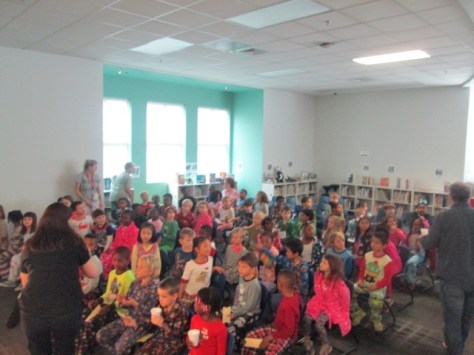
Our school is filled with tradition, and one of the favorite ones every single year is Polar Express Day.  It takes a huge team of volunteers to pull off this schoolwide event, but it is always a magical day for our students.  Every student hears The Polar Express read aloud while sipping hot chocolate in their pajamas.  Every child receives a bell with the message of “always believe” whispered in their ears.  Each child also receives a candy cane on the way back to class.

Ahead of the event, volunteers purchase supplies to make bells for 600 students.  They spend a morning stringing the bells and prepping them for quick delivery to students on event day.  Another volunteer list is created to help on the day of the event as we have every class in the school come through the library.  A schedule is created and approved by the teachers.  This year, that schedule was very tight due to our increasing size.  Some sessions had 3 classes in them.

The day before the event, the lunchroom gets the hot chocolate so that it is prepped and ready to go.  A special spirit committee meets late at night and transforms the school into the north pole with train tracks, crackling fires, ornaments, and lights.  It is a magical arrival to school.

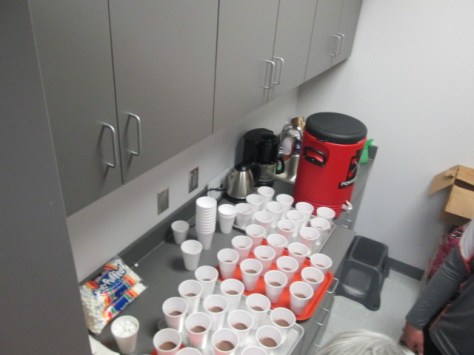
The first team of volunteers pick up the hot chocolate and start getting it ready for the first group.  At that point, things repeat every 30 minutes.  Music is played as students enter. Hot chocolate is passed out during the hot chocolate song by a team of 3-6 volunteers.

Polar Express (59) Polar Express (60)

We listen to the story while a teacher holds the book.  Then, the same team of volunteers put the bells around all the students’ necks.  Immediately, there is a chorus of bells ringing around the room as students check to see if their bells actually ring.  As always, there were special moments such as a former Barrow buddy returning to hold the book for a grade level.

https://www.instagram.com/p/_ZzZ_FxSh8/?taken-by=fourthgradebarrow

This year, we even had a spontaneous sing along of Jingle Bells.

Thank you to each and every person who made the 2015 Polar Express day another great success.


Coding Partners for Hour of Code

Hour of Code Day 2 (17)

Each year our 2nd-5th graders in all Clarke County Schools attend a UGA basketball game.  The game is within walking distance to our school so it doesn’t take us long to venture that way.  I’m usually a chaperone on this trip. This year, the game fell during the week of Hour of Code. Our departure time kept moving up on the calendar and it started to interfere with some classes who signed up to code. With each conflict comes an opportunity.  One of the classes affected was a fourth grade class and another was a first grade class, so we just decided to combine them together.  This allowed both classes to have a full hour of coding, and it allowed the 1st graders to try some coding that they might not be able to attempt on their own.  Many thanks to these 2 teachers who worked together along with me to come up with a solution that worked for everyone!

Hour of Code Day 2 (19) Hour of Code Day 2 (18)

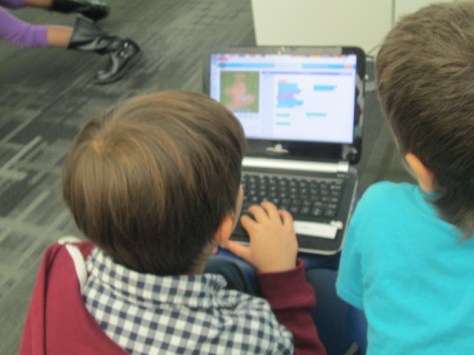
We started on the carpet to lay the foundation for coding and Hour of Code.  We also talked about working with a partner.  Many of the 1st grade students don’t quite have the fine motor skills to navigate the mouse and keyboard, so the 4th graders were ready to help with this barrier.  We also talked about how we are all in this together.  One person shouldn’t just sit and watch.  Instead, both partners should talk out loud about what each coding puzzle offered and share ideas for what to do.  We took a look at Made with Code as well as Code.org as possibilities for what to work on, and each buddy group had to decide which coding puzzle interested them the most.

I sent the 4th graders off into the library to find a spot, and then the 1st graders walked to find a buddy.  The teachers and I helped students who couldn’t find a buddy on their own.  Students immediately got to work, and I was pleasantly surprised by how well they worked together.  I saw numerous 4th graders encouraging 1st graders to take a turn in dragging over blocks of code.  I heard them ask the 1st graders what they thought they should do in the puzzle.  I also saw 1st graders taking the lead and telling the 4th graders exactly what they thought should be in the coding sequence.

Many of the students chose Star Wars, Minecraft, or Frozen, but a few ventured out to parts of Code.org that I didn’t show such as Flappy Bird.  I was surprised by how complex some of the coding puzzle were this year, and students loved that when they reached the final level of a puzzle, they could create their own game.

As I walked around, I listed to a lot of conversation.  I was very proud to see students not giving up and really working to find solutions to their problems.  I heard things like:  “where is our problem?” and “I think we have something wrong in the bottom part of this code” and “Let’s put this in and see what happens.”  I wanted to bottle up all of these quotes to remind students that this type of language and perseverance should spill over into all other areas of our lives.  I pondered why students were so comfortable with starting over and looking for solutions to problems in coding, even though they might get extremely frustrated with other things.  I’m not sure I have an answer, but it’s something I’ll continue to think about.

I really like the potential of partnering different grades together for projects.  I really think it could be done more often if we take a close look at the curriculum and how topics overlap or support one another.  When students work with different age groups, their leadership skills naturally start to come out and their confidence in themselves grows as well.  I’ll continue to think on this.  It’s yet another great thing that the Hour of Code surfaces in education.


Hour of Code 2015 is Here!

Hour of Code Day 1 (11)

We have been participating in Hour of Code since it started 3 years ago, and it is an event that inspires so many things within our school.  This week-long event coincides with Computer Science in Education week each December.  Code.org partner with numerous organizations to offer one-hour tutorials that are appropriate for multiple age groups.  When we first started Hour of Code, I tried to get students to all try specific tutorials, but many of our students have gained some confidence with coding and problem solving over the years.  I wanted to offer more choice this year and continue to focus on perseverance, problem solving, and collaboration in addition to learning some pieces of what it means to code.

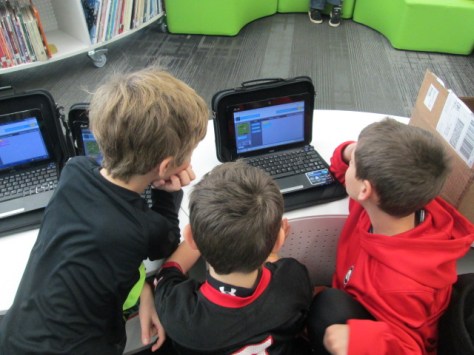
On day 1 of Hour of Code, our 3rd grade came 2 classes at a time.  This meant 45-50 students in the library with their computers.  It’s a big group with lots of energy, but it amazes me how they settle in, don’t give up, and support one another.  I also had a 5th grade group and a second grade group during the day.

We started by sharing some things we know about coding.  We also talked about how many of us love video games or apps.  Pretty much all hands went up, and we pondered the questions: “What if the people who invented Minecraft (or insert any app or game here) gave up before they finished the game?”  We also pondered how many games are currently being invented out there that we don’t even know about and how many of the developers will persevere or give up.  It was an interesting way to set the stage for our work for the day.

We watched the official Hour of Code video.

Then, I showed students the Hour of Code website and the 4 main tutorials that were featured: Star Wars, Minecraft, Frozen, and Angry Birds.

I offered these as a starting place, but students were allowed to go to any tutorial they wanted to attempt.  My main rule was that I wanted them to really stick with whatever they picked and give their best try.

Students spread out around the library and got to work.  It took a few minutes to settle in, but all students stayed focused on the Code.org site.  I loved how they very naturally got up and helped one another when they got stuck.  A few students reached a point of frustration where they needed a break, so I pulled all of our coding books from the library as a place to go and take a break to just read about coding until they were ready to go back to work.  At some point, they all went back to their computer.

Hour of Code Day 1 (1)

I also loved that some students who speak other languages saw that they could switch the language on the Code.org tutorials.  Rather than flipping back and forth to Google Translate, they could read the site right on their screen, and these students were over the moon with excitement and were extremely successful in their coding.

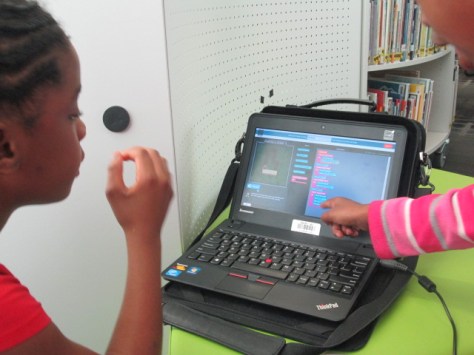
The Code.org site was very reliable on our first day.  In the previous 2 years, we’ve had problems with the site crashing or being slow, but day one went really well.  I had some backup plans though.  One of the other activities that students were able to do in small groups was visit our Finch robots, which are on loan from Birdbrain Technologies.  Students worked alone to use Snap to program the robot to maneuver around the floor.  There wasn’t a specific task other than to explore what the robots could do and what each block of code meant.  Some students had the robots congregating together on the floor or even doing a dance together.  It was fun to see what they came up with in such a short amount of time.

As usual, teachers observed students who struggled in academic areas suddenly find a spark with coding.  I hope that seeing some of these students’ excitement will spark ideas for all of us in how we might use this momentum to connect to curriculum content.  We can’t dismiss the tools that get students excited about learning.  We need to embrace tools like Minecraft and the expertise that our students hold in these tools and consider how these might enrich the work we are doing together in school.

I can’t wait to see what else the Hour of Code week holds for us.

Student Book Budgets 2015-16: Getting Started

surveying (1)

For several years, I have dedicated a portion of our library budget to be completely controlled by students.  This project has come to be one of my favorite ways of empowering the voices of the students in our school.  It’s so much more than just asking students what they think I should buy for the library.  It gives students a voice in every aspect of the decision making and purchasing process.  Each year is a bit different, so here’s a look at how we started the project this year.

Where did we get the money?

Some years our budget comes straight from my state budget.  Some years it’s part of book fair profits.  Some years it’s a grant. This past spring, I applied for the James Patterson Partnership grant where he gave $1.75 million dollars to school libraries.  I was one of the lucky libraries to receive this grant in the amount of $5,000.  This will be our budget this year along with rewards dollars that I have collected through Capstone Rewards.

How did I choose students?

This year I created a Google form and emailed it to students.  I primarily pull students from 3rd-5th grade for this project and these students regularly check their email.  I kept the form open for 5 days for students to apply.  The beginning of the form included some details about book budgets followed by a video intro.

For students who marked that they might be willing to give up some recess time to participate, I followed up with individual emails and conversations.  I accepted every student into the group unless they decided they didn’t want to do it.  I created a group of all of the students in my email contacts so that I could easily send messages to them all.  On my initial emails to the group, I included the teachers so that they were in the loop with what they were doing and why they were coming to the library instead of recess.

First Week

On Monday, students came to the library at 11, 11:30, and 12:00 depending on their grade level.  I did a quick overview of the purpose of the book budget group and the steps that we would most likely go through across the course of the project.  They also had a chance to ask questions.  Then, we jumped into the work.

Our first goal was to gather reading interests from every grade level in the school.  We made a copy of last year’s Google form.

Then, students talked about each question and whether or not they wanted to make changes to the wording from last year.  Each grade level added to and revised the form until it was ready.

They made several changes, including asking students about their preferences in types of books such as picture book, chapter book, and informational books.  They added some new categories of books and revised the language to be more clear.

During the 5th grade group, we went ahead and emailed the form out to students to begin collecting responses.  We also created a QR code so that students who were surveying younger grades with iPads could easily pull up the form.

I emailed an update to the entire group to let them know that surveying needed to begin, and they started coming in before school, during lunch, during recess, and during any extra moments of the day to start surveying.  All along the way, we could check our progress.


Throughout the week, I emailed updates to the group as well as sent reminders to teachers to let students fill out the survey.  We will meet one more time this week to examine our results so far and decide if we have enough data to set goals or if we need to survey more people.

I’m very proud of this year’s group already and I know they are going to do miraculous things this year!

Beginning Our Winter Around the World Projects

Winter 002

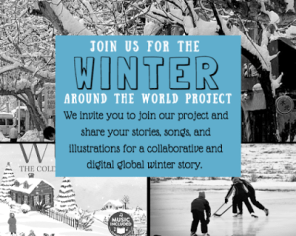
I’m so excited about a current opportunity we have with classes around the world to think about winter where we live.  Shannon Miller and Cantata Learning recently invited schools to research winter in their areas and for students to work together around the globe to create a collaborative e-book filled with information, personal narratives, poems, illustrations, and songs.

All classes participating in the project started by reading and listening to the Cantata Learning book Winter the Coldest Season of All.

From there, different classes branched off to do different types of projects.  In Ms. Ramseyer’s 2nd grade class, we focused on winter in Athens, GA using notes from her husband Craig, who is studying to be a meteorologist.

Winter 001

He gave us facts about the average temperatures and snowfall in Athens each winter.  I think we all think of snow for winter, but in reality, we really don’t get much snow or even cold here in Georgia.  We were trying to get students to think about that.

After gathering our facts, we had students reflect on their own experience since that is a big part of the research process, especially about your own community.  I had students turn and talk to a partner about a variety of winter topics: clothes, events, food, school, sounds.   Each time they talked, I ran around with the keyboard and typed the ideas into a shared doc that could be used for our project.

Ms. Ramseyer let students group themselves into groups of 4.  Each group needed 2 authors and 2 illustrators. They could decide what kind of text they wanted to write such as personal narrative, poetry, or informational.  They had to make a plan before they could start working.  I spread out materials for them to use such as white paper, pencils, and crayons.  It was a lot of fun to walk around to tables and talk with them about their decisions while they worked.  I often found myself asking the illustrators to check the text that the authors were creating so that their illustrations were matching or extending the text.  There were a few arguments along the way, but each quarrel was an opportunity for a connection back to how books are created.  As usual, there were unexpected moments that were priceless, such as when a student noticed that the illustrators were only drawing boys into the illustrations.  She called him out and said he needed to add some girls. We talked about diversity in illustration and what that might mean and why that might be important.  It was fascinating.  The priceless moment came when the second grader said:

Students will continue working on this project in writing workshop in the classroom before they come back to me to digitize the work and add it to the collaborative Google slide ebook.

Kelly Hocking’s Kindergarten class is planning to write a song about winter in Athens. She often uses ukuleles in her class and incorporates song writing.  After listening to the book, students explored a tool called Beatlab to tinker with creating a beat. They will use this tool to establish a beat for their song about winter.

In the library, we also explored the book Hip Hop Speaks to Children collected by Nikki Giovanni.  I selected a few poems from this book that had an established beat such as Things by Eloise Greenfield as well as poems that had actual music with them on the accompanying CD such as Ham N Eggs by A Tribe Called Quest.  For poems without music, we clapped or snapped along with the rhythm of the poem to see that there was in fact a beat there.  For the poems with music, we listened once and then closed our eyes and tried to focus on the various instruments we could hear layered over one another in the background and how they repeated.

beatlab (1)

We even looked at a video by the famous Kishi Bashi, who is also a parent at our school.  He accompanies himself by recording a layer of beats live onstage and looping them with pedals.  He performed at our school last year, and the Clarke Central Odyssey crew filmed this song that we used for inspiration.

After the library visit, Ms. Kelly’s class used a Capstone Library book called Winter: Signs of the Season Around North America.  They gathered various winter words that might inspire their song.  Once the song is written, we will record in the library as well as perform at a school assembly.

I love how student voices from around the world are coming together around a common topic, and I can’t wait to learn about winter through the eyes of students.


Get Ready for Picture Book Smackdown 2015! #pbsmkdwn

IMG_4421

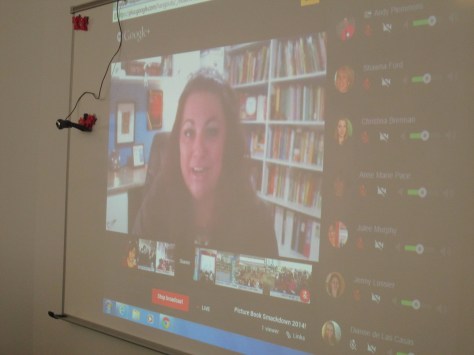
For 3 years, I have organized an online picture book smackdown in honor of Picture Book Month.  Over those 3 years, our Google Hangout event has grown stronger thanks to the collaboration of librarians, students, and authors around the country.  We are busily planning this year’s event, but you can go ahead and put it on your calendar now!  It will be November 19th from 1:30-2:30PM EST.

We made a Smore to host all of the content of the event:

During the smackdown, you can expect to hear:

  • An introduction and welcome from Picture Book Month founder, Dianne de Las Casas
  • Students from at least 5 states share favorite picture books and why picture books matter in a fast-paced format
  • Authors such as Laurie Ann Thompson share her favorite picture books along with our students
  • An ongoing doc of picture books that we share!

Everything will broadcast through a Youtube link:

We would love for you to watch the event with your students or share with classrooms.  You can even participate by tweet about the event or tweeting your own picture book recommendations during the event using the hashtag #pbsmkdwn

recite-942htj

Even if you can’t join us, we hope you are inspired by our event and consider having your own Picture Book Smackdown online or in your own space.  Feel free to use our hashtag to connect our events together. Happy Picture Book Month!

P.S.  If you can’t wait for this year’s event, here’s a little taste of what we did last year:

Celebrating Stories with Our Annual Storybook Parade

storybook parade (6)

The day before fall break is always a special day at our school.  It is our annual Storybook Celebration.  Organizing this day takes a tremendous amount of work, but the students have such a great day. Students and teachers are encouraged to dress as any storybook character.

storybook parade (62)

We spent about 2 weeks ahead of the event advertising various costume ideas on our morning broadcast.  I wanted to encourage students to think about how they could use things they already had around their house or things they could make in order to create an awesome costume.  Some of my BTV crew chose books and shared some simple ideas for creating an awesome costume.  An example was Max from Max the Brave where you could just dress in black and tie a red cape, blanket, sheet, or towel around your neck.

Students poured into the library for the past 2 weeks to ask for assistance finding a book for the parade and costume ideas.  We had students coming in right up until the parade actually started, which was definitely a little crazy without much help.

Also ahead of the event, I sent out a Google spreadsheet to all of our resource and specials teachers to offer special opportunities during the day for classes to have literature-focused activities and a chance for teachers to have a planning time.  Resource and specials teachers blacked out times that they weren’t available and teachers signed up for the rest.

My volunteer coordinator, Courtney Tobin, created a Signup Genius to recruit 2 guest readers for every classroom to kickoff the day. This was sent out to grade level parent representatives who encouraged people to sign up.  I also shared the link with my own list of past guest readers as well as CCSD board members and district leaders.  I also published it on our library Facebook page.  We didn’t quite reach our goal of 2 readers per class, but every class had someone to share a great story with them at the start of the day.  These readers gathered in the library, chose from a selection of books, took a photo, and were off to classes to read.

After guest readers, we gathered in the cafeteria for an assembly.  We broadcast students onto the big screen as they entered using Google Hangouts.

Evan Bush from the Athens Clarke County Public Library came and told several interactive fall stories to almost 600 students.  I loved how he took the energy of the crowd and got them all snapping, clapping, and sharing parts of the stories.  It kept them focused.  I reached out to Evan about 2 weeks before our event, and he graciously agreed to come.  I love that he gave our students a great storytelling experience and also one more connection to the public library and what it can offer.

After Evan, each class stood up twirled around to show off costumes, and sat facing the back of the cafeteria.  This prepared us to go out on our actual parade as well as gave students a chance to show one another their costumes.

It was during this time that I found out all my preparation for the parade route suddenly had to be changed.  I was so organized this year and provided maps of the parade route to families and community ahead of time.  However, Georgia Power had to do some work and closed part of the sidewalk on our route.  I had to make a last minute change, but it all worked out.

We took off into the community shouting “Read More Books!” and showing off our costumes.  It was fun to see community members, families, UGA students, construction workers, and more cheering us on along the way.  Our 1st-5th grade took a longer route and our Prek/K took a shorter route around the school.

Our 5th graders have a tradition of stopping along the parade route for a special treat, and for the past few years we have stopped at the Georgia Center for Continuing Education for hot chocolate.  Mimi, our family engagement specialist, organizes this piece for us by having the cafeteria prep the hot chocolate and taking the hot chocolate to setup.  Students have some time to just hangout, talk, and enjoy their treats before heading back to school.

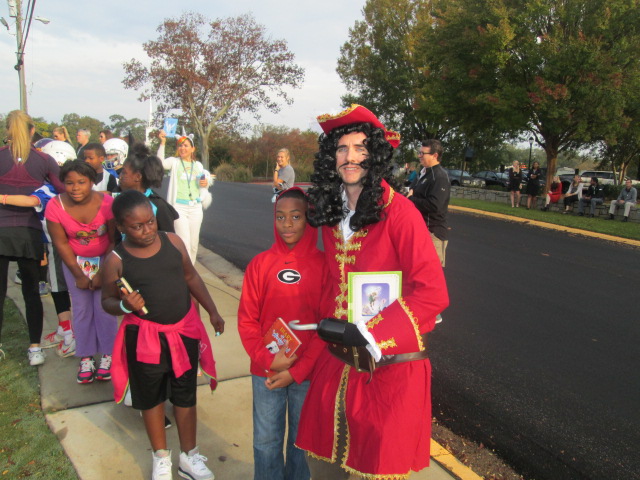
Finally, back at school we go to our special classes as well as do more literature activities in class.  In the library, we focused on pirate stories since I was dressed as Captain Hook.  I also used the great pirate video from All the Wonders.

Students moved to tables and colored a pirate sheet or designed their own pirate using Chromville augmented reality.

Somehow in all the craziness, we also organized a big book giveaway.  In the back corner of the library, there were tables of books that had been donated or weeded out of various collections and needed a good home. Courtney Tobin and other volunteers helped get the books put out, and teachers brought classes or small groups of students to pick out new books.  It was fun to glance over and see so many students excited to add books to their home libraries.  We will keep these tables going next week since there are still books left.

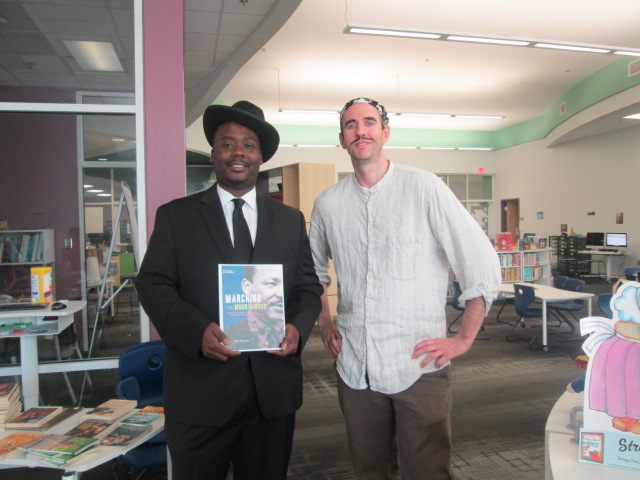
It seems that each year something new comes along for storybook celebration that makes it a little more special.  This year I loved seeing so many creative costumes: Little Elliot, the Bird Woman from Circus Mirandus, Minecraft creepers, Martin Luther King, the Very Hungry Caterpillar, and more.

I loved seeing our reflection in the glass of the UGA coliseum.

storybook parade (67)

I also loved that our public library was involved in the day and I want to think even more about how community is represented on this day.

Until next year…

storybook parade (120)


Read for the Record 2015

Each year, Jumpstart  sponsors a day for readers all around the globe to join their voices in reading the same book. A different book is chosen each year, and this day has become a day that we love to connect with other schools to read the book together.  This year the featured book was Not Norman: A Goldfish Story by Kelly Bennett and illustrated by Noah Z. Jones.  Jumpstart puts the book online during Read for the Record so that readers can easily access the book to read aloud.  I love having a large full screen version of the book for students to look at while we read alone and with our Skype partners.

Ms. Sandifer’s Kindergarten class started our day by reading the book with me on our projection screen.

I loved hearing the students make noticings about the images that weren’t included in the words.  We also had fun making predictions before we turned the pages such as when a tree branch is making a noise outside but we got to guess before we found out.  One student thought it would be a zombie!

Next, Ms. Kelly’s Kindergarten class (my daughter’s class) came and connected with Jennifer Reed and her 3rd graders in Newton, MA.  We had fun looking at a map before the call and learning that we were connecting with students over 1,000 miles away. Our students also got to introduce themselves to one another.

Jennifer’s students did choral readings of pages, while I read most of our pages with Kindergarten students joining in for words they recognized.  Students were amazed that Jennifer Reed and I know each other in real life and will get to see one another at the AASL conference in Columbus this November.

Finally, Ms. Choate’s Kindergarten class came to the library to enjoy a live Google Hangout with Kelly Bennett reading Not Norman and sharing the answers to several questions about being an author and getting ideas for writing.

This was a great addition to the event to allow many classes to enjoy hearing the author.  We wish there had been more interaction between students and the author, but it was fun listening in to her voice and ideas.

There’s still time to participate in Read for the Record.  You can read the book for free online today and count you and your family in the numbers toward the record.

First Grade Wizard of Oz Meteorologists

weather (2) - Copy

Our amazing 1st grade team and students have been working on their Wizard of Oz unit.  I love this unit because they weave in so many content standards with Wizard of Oz as their guiding text. A part of this unit is the weather standards from science.  Students have to know various kinds of weather as well as how to dress in that weather.  Since this is a part of what meteorologists do, we decided to try something new this year by looking closely at the role of meteorologists.  The goal was for students to write a weather report for the Wizard of Oz regarding the cyclone and to record the forecast in front of our green screen.

weather (4) - Copy

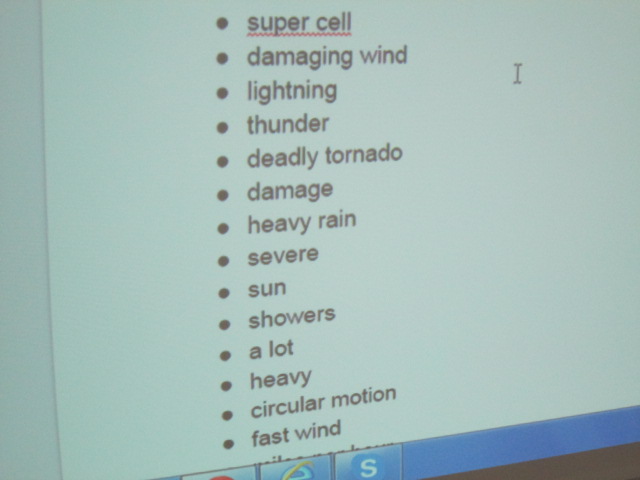
Students came to the library and we looked at a few videos of meteorologists reporting on severe weather. As we watched, students noticed things about the posture and speech of the meteorologist.  They also pointed out many of the weather words he/she used.

As weather words were noticed, we added them to a shared Google doc.

weather (3) - Copy

This doc was shared with all classroom teachers to continue to add to and use in class.  We also looked at another student-made video and noticed how the student introduced himself in his weather forecast and pretended to be outside in the story.

weather (5) - Copy

In the library, we also spent some time beginning the writing process of creating a weather report.  Students continued working on this in class during writer’s workshop.  The list of weather words continued to be used and added to. They also did a bit of rehearsing.

Finally, students returned to he library and one by one recorded themselves in front of the green screen with a tornado or other weather behind them.  As students were recording, the rest of the class practiced, looked at weather books, and searched for the current weather in our area using apps on the iPad.

They loved seeing the weather magically appear on our iPad using the DoInk app on the iPad.  We took all of the videos from the iPad and uploaded them to class playlists to share back with the class.

You can enjoy the variety of videos in each of these lists.

One of my favorite parts of this short project was how it tied to a real career and gave students experience with a real-world job related to the standards they were studying in science.  They were each able to be a bit creative in their forecasting, and each student had a chance to use a cool technology to make their voice heard at such an early age.