In the new year, I wrote a post about expecting the miraculous in 2014. I can honestly say that the expression “Expect the Miraculous” has taken on a life of its own in our school. Let me tell you how it happened.
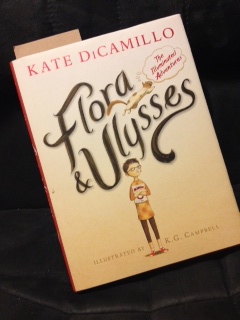
To kickoff the second half of the year, we held a schoolwide assembly. The purpose of the assembly was to review goal setting, celebrate our unique talents, and to give ourselves permission to have dreams. It really was an amazing assembly. We had student performances, a teacher who played her violin, a youtube video from Kid President, and Martin Luther King Jr contest winners. The assembly was also a space for me to talk about expecting the miraculous. I read the excerpt from Flora & Ulysses: The Illuminated Adventures.
“All things are possible,” said Dr. Meescham. ”When I was a girl in Blundermeecen, the miraculous happened every day. Or every third day. Actually, sometimes it did not happen at all, even on the third day. But still, we expected it. You see what I’m saying? Even when it didn’t happen, we were expecting it. We knew the miraculous would come.” ~Kate DiCamillo
I also shared synonyms for the word “miraculous” such as “extraordinary”. Finally, I told my own story of expecting the miraculous. My story involved our new 3D printer. From the day I heard about 3D printers, I expected that one day our library would have one. I wasn’t sure how or when, but I felt in my heart that this incredible piece of technology was something our students should have access to in school. About a year ago, our district considered purchasing a 3D printer for our school. It was all the way down to the ordering process, but something happened over the summer and it didn’t get order. Still…..I expected the miraculous. I wrote grants and began advertising the idea of purchasing a 3D printer. I publicized that a portion of our book fair profits would go toward 3D printing. However, this was a slow process and I knew it would take time to raise almost $3000 for a printer and supplies. Still….I expected the miraculous. Then, in October, Makerbot announced their partnership with Donors Choose. I immediately submitted my project and hoped for the best knowing that much of the available funding would most likely go to Brooklyn schools. Still…I expected the miraculous. Miraculously, our printer was funded overnight!
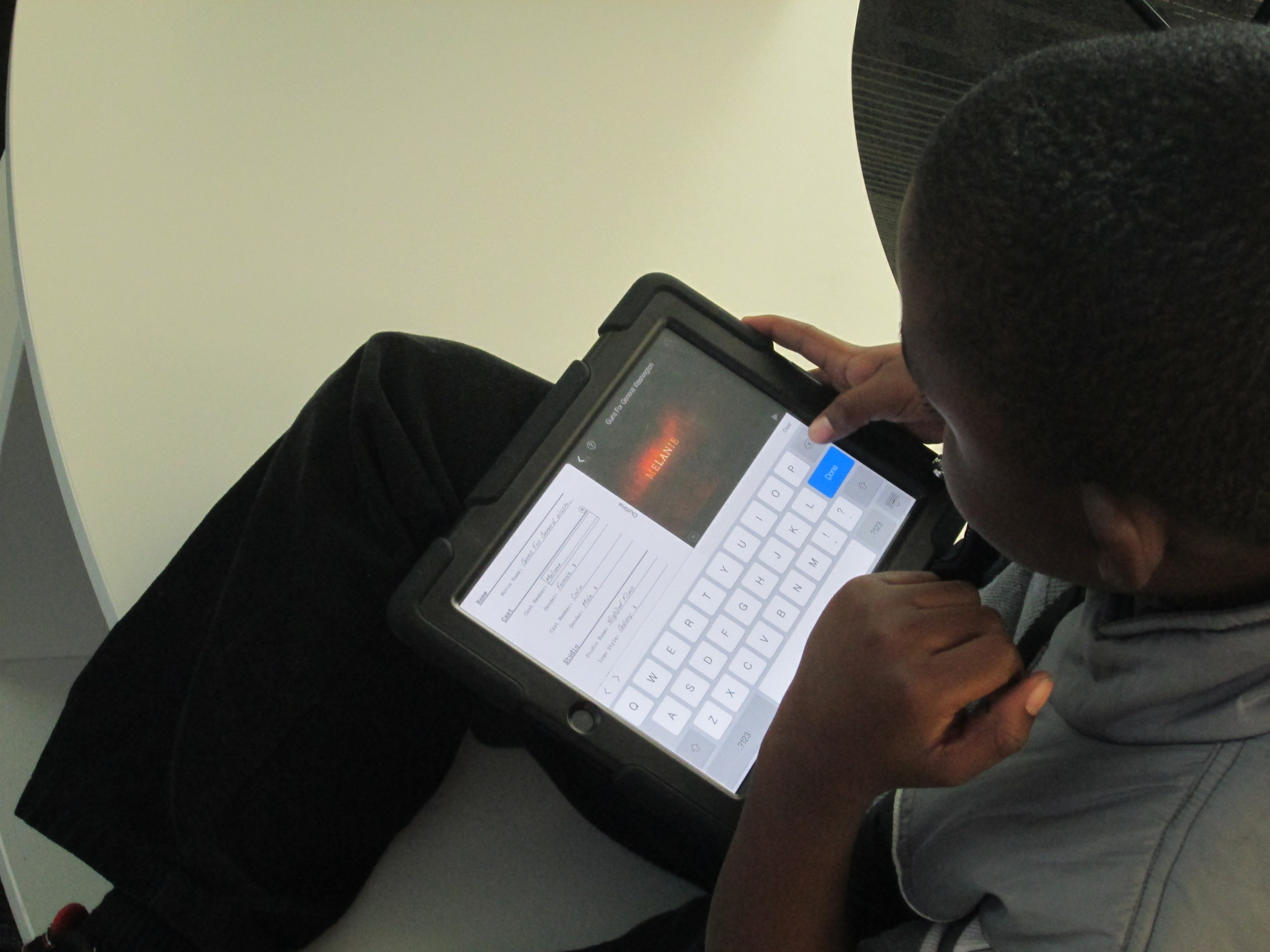
This is the story that students heard. I followed this with an invitation for them all to “Expect the Miraculous” with me. To capture our goals, dreams, wishes, and expectations for 2014, I created a Flipgrid. I gave them a quick tutorial on how to record a video into the Flipgrid by walking them through screenshots of the process. Then, I setup a Flipgrid recording station in the library.
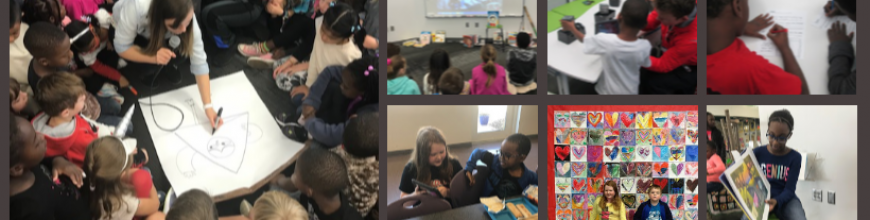
Over the past 2 weeks, students have written about their hopes and dreams in class and visited the library to record. It has been an amazing process to watch. Goals have ranged from reading goals to behavior goals and from school-related to extra curricular related. I encourage you to spend some time listening to their miraculous expectations and feel free to click the + and add your own. Students have enjoyed coming into the library and listening the the videos on our touchscreen computer at the front of the library. I can put the Flipgrid on slideshow and it flips through each video throughout the day.
I’ve heard so many kids, families, and teachers using the word “miraculous” in conversations. Some students have even recorded their videos at home with their family. Our school embraced the phrase so much that we even put it outside on our sign.
One more miraculous thing happened. Kate DiCamillo posted an opportunity on her facebook page to ask questions about her books. I asked, “What miraculous things have you expected that actually happened and what miraculous things are you still expecting?” Here’s her reply!
A few weeks ago, Okle Miller, a librarian near Tampa FL, shared a great iPad app with me that she had discovered on Richard Byrne’s site iPad Apps for School. Chatterpix allows you to take a photograph with your iPad, draw a mouth on that photo, and record up to 30 seconds of dialogue for the photo. The mouth moves in sync with your voice. This app could have many implications for short classroom projects from historical figures to summarizing strategies to book talks and more.
I recently sent out an email to teachers with some ideas for technology projects that we might do together. Each of the ideas was based in the subjects and standards that classrooms are working on with some suggestions of technology tools that might support those standards. Many of the classrooms are currently working on opinion writing about books along with persuasive techniques. I suggested Chatterpix as an option for students to quickly tell about a book, give an opinion, and try to persuade a reader in less that 30 seconds.
Second grade had already worked with me on writing book reviews for their blogs, so Caitlin Ramseyer, 2nd grade teacher, decided to incorporate Chatterpix into this mix. Her students each chose a book, read the book, and used an index card to write a script that they could finish reading in less than 30 seconds.
Today, they came to the library so that Caitlin and I could work with them on using the iPads. Students brought their index cards and books with them. First, we watched this video.
Then, we looked at my Chatterpix example.
Next, students dispersed throughout the library to use the iPads. Caitlin and I walked around and helped as needed, but the students were very capable of figuring things out and helping one another.
One student didn’t have her book, so she pulled up the book in Destiny on the computer and took a picture of the screen. Other students had very tiny people on their covers, so they put the iPad close to the cover in order to take a closeup picture of the character. There was a lot of problem solving going on as students tried to figure out how to create the best video. Many of them quickly figured out the different filters that they could use on their picture, but most chose not to explore the stickers (this time!).
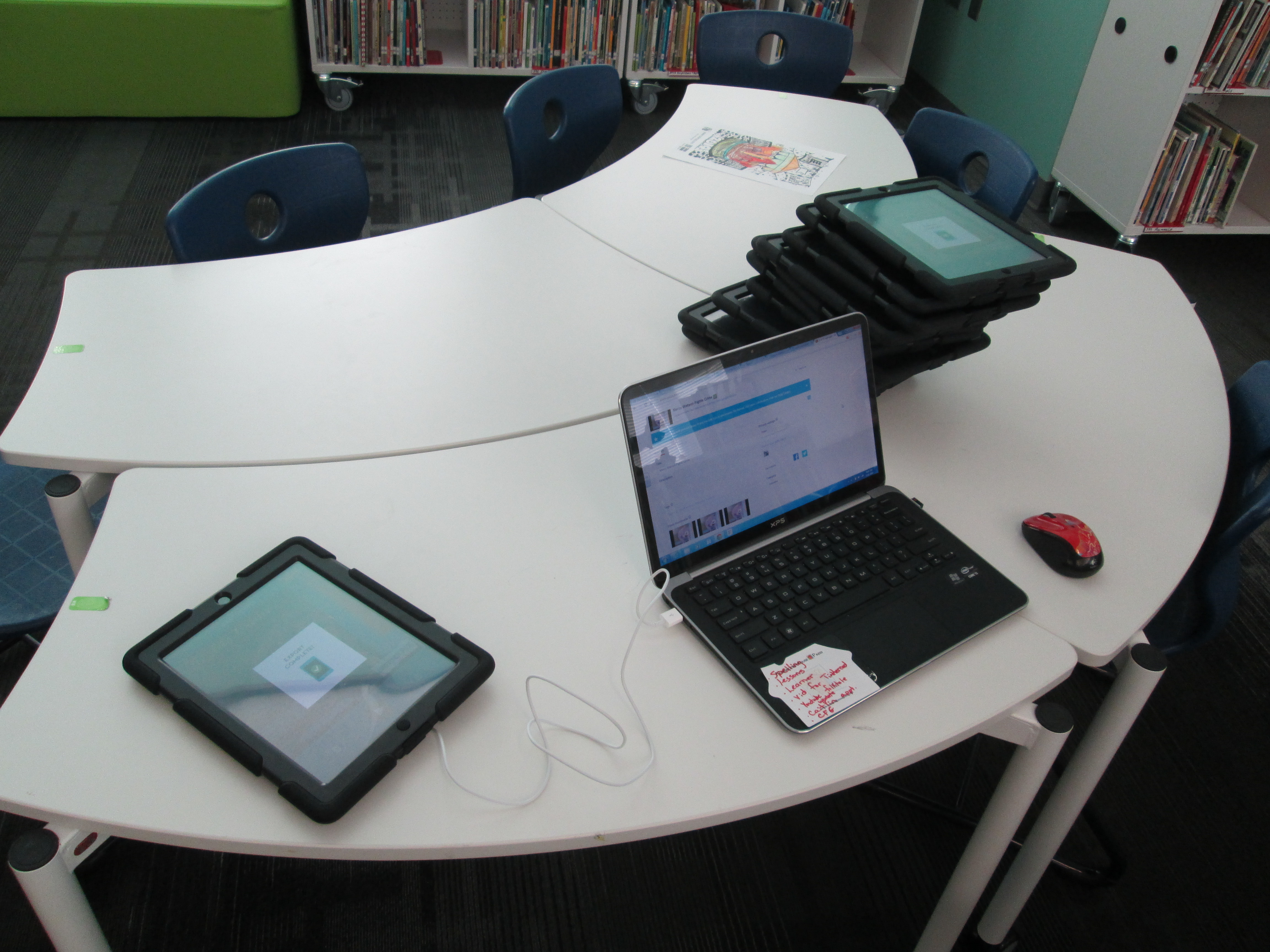
Once they were finished, they saved the video to the camera roll on the iPad and brought it to me. At first, I was trying to login to each iPad and upload to Youtube, but it was taking too long. Instead, I plugged a cord into my laptop and imported the video straight into Youtube. Caitlin helped them make sure their video was exported to the camera roll and I uploaded to Youtube.
Finally, we gathered on the carpet to view our videos. During this time, we paused a lot and students gave tips for future use of Chatterpix. They suggested things like:
Since Chatterpix reverses words, try to take a picture of a character on the cover and avoid the text
Have your script written down
If you finish before 30 seconds, don’t forget to press stop
Rustling your paper makes the character’s mouth move, so be still
If you have trouble drawing the mouth with your finger, use a stylus
Hold the iPad in portrait view rather than landscape
We reminded them that they had developed some expertise with this app and that we might call on them sometime to help others. Even this list of tips is a way for them to pass on their expertise. Now that we worked out some logistics with how this type of lesson can flow, I think Chatterpix will be an app we will revisit many times.
We are a little over halfway done with our enrichment clusters this year. Every Friday, students across the school go to an interest-based cluster of their choosing for one hour. During this time, students explore a topic and develop products or services related to their topic. My cluster is called Makerspace Maniacs. So far this year, we have explored making with duct tape, building with cardboard, lego robotics, and 3D printing. After lots of explorations, students are making decisions about where they want to focus.
A small group of students is focused on lego robotics. Monica and Omarion are both committed to building a robot and programming it. They both have varying levels of expertise. Today, I asked another student, Ludwig, to come and work with them. Ludwig has a lot of experience with Lego Mindstorms. During clusters today, he worked with them to build a robot and program it. Although they didn’t get far with the programming, he was able to show the students some tips and tricks to get the robots to work the way they wanted to. I love using students as experts. They hold so much knowledge that we don’t even know about. Ludwig just happened to talk to me one day about Lego Mindstorms because he knew that I bought some. He used Lego WeDo and Lego Mindstorms in other settings and told me he was willing to help me any way he could with them. How exciting that a student offered his expertise without even being asked!
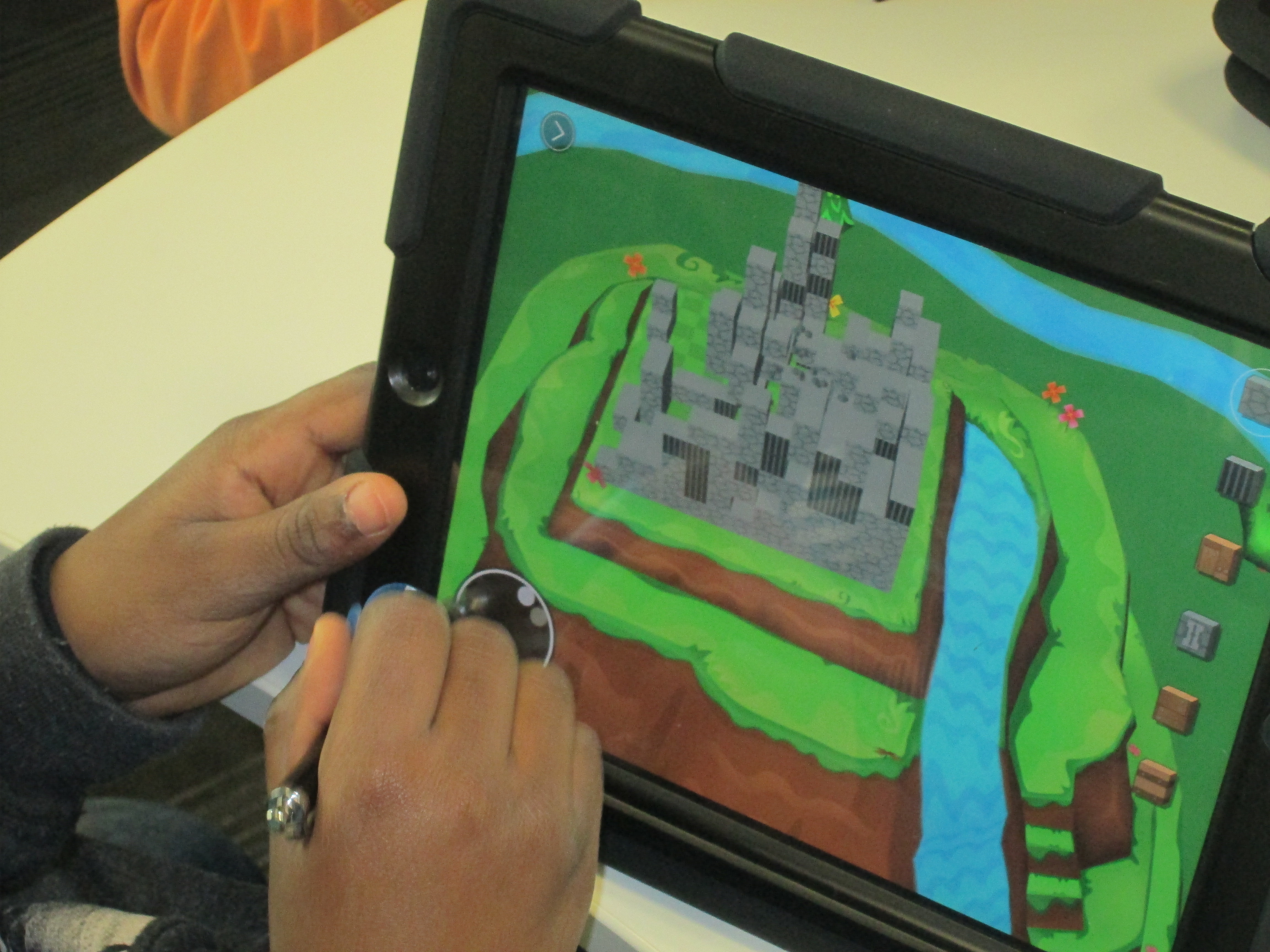
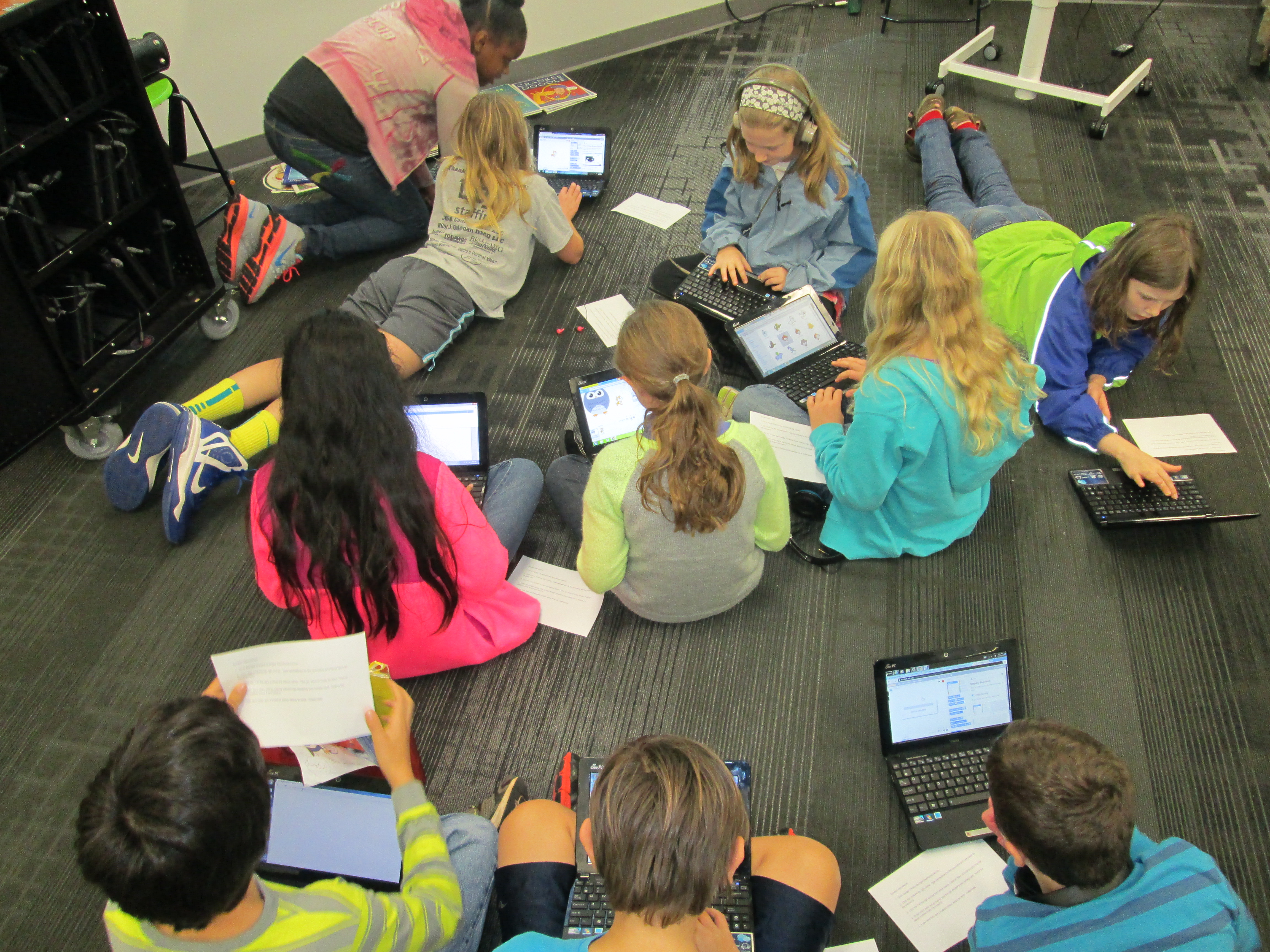
Other students in the cluster have decided to work on 3D printing. Over the past 2 weeks, they have used a new iPad app called Blokify. This app uses blocks to build a 3D object. It is very user-friendly to build a 3D object in very little time. Once built, the object can be ordered or emailed for 3D printing on your own device. Today, students really focused on coming up with an idea and using the blocks to build. While they were using the app, I started a Google Doc, which I will share with them, to collect what we love, wonder, and want to change about the app. One service they will offer as a part of the cluster is to share this info with Blokify.
Today, we were also tweeting with Blokify and students were able to respond to their tweets. Such fun!
Students prepared several files that they emailed to me. I have them ready to go for 3D printing next week. We’ll be printing a pirate ship, a Trojan pig, and a castle among other things. As we progress, these students will also think about how they see this app fitting into what they are already doing in class. We’ll come up with some lesson ideas for teachers to consider.
We only have a few weeks to go, but our speed is picking up and our focus is narrowed. I know incredible things are going to happen with these students.
Today Mrs. Rogers and her 4th grade ELT group came to the library to explore book trailers. They are currently reading a novel together and had the idea to create book trailers for each chapter of the book. I guess we should really call these chapter trailers. For our lesson, we looked at three trailers:
Our purpose in watching these three trailers was to think about how different each trailer could be. Students talked about what they noticed about each trailer after watching it.
For Carnivores, students noticed that:
1 actor was used 🙂
music was used throughout
text was used at the beginning to set the scene
there were lots of clips put together
the funny tone of the book came through in the trailer
the trailer didn’t give away all the details of the book
For Boy + Bot, students noticed that:
questions were posed for the reader to consider
images from the book were used in between the questions
music was used throughout
the trailer was very short
For Wonder, students noticed that:
there were multiple actors
there were multiple shots that needed a lot of direction
there was text, live action, and music
the character’s face was never shown
Students even spent time thinking about the difficulty level of these 3 trailers and what they were each willing to commit to for their own project. They also thought about why each type of trailer might have been picked for each book. We talked a lot about purpose.
After this great discussion, students spent time exploring iMovie on the iPads. This is the tool they will most likely use for their trailers. Most had no experience with iMovie, so I invited them to spend about 20-25 minutes messing around and figuring out some of the features. I encouraged them to share what they learned with each other, and it didn’t take long for collaboration to begin. As soon as students figured something out, they were eager to show and help others.
Ludwig, a 4th grader, really jumped into the trailer part of imovie. He began planning out a quick trailer and sprang into action filming it. He didn’t make it all the way through, but you can see what he figured out here:
Reid, another 4th grader, explored the movie part of iMovie. He put together a little idea and started filming clips to put a quick sequence together.
We closed our time together by showing these videos and setting the stage for students to begin planning their own trailers. Once again, I was amazed by what kids could figure out and share when given the space to explore. I reminded them to continue to share their expertise with one another as they progress through the project. They will continue work in their classroom, but I will also collaborate with them at various stages of the project.
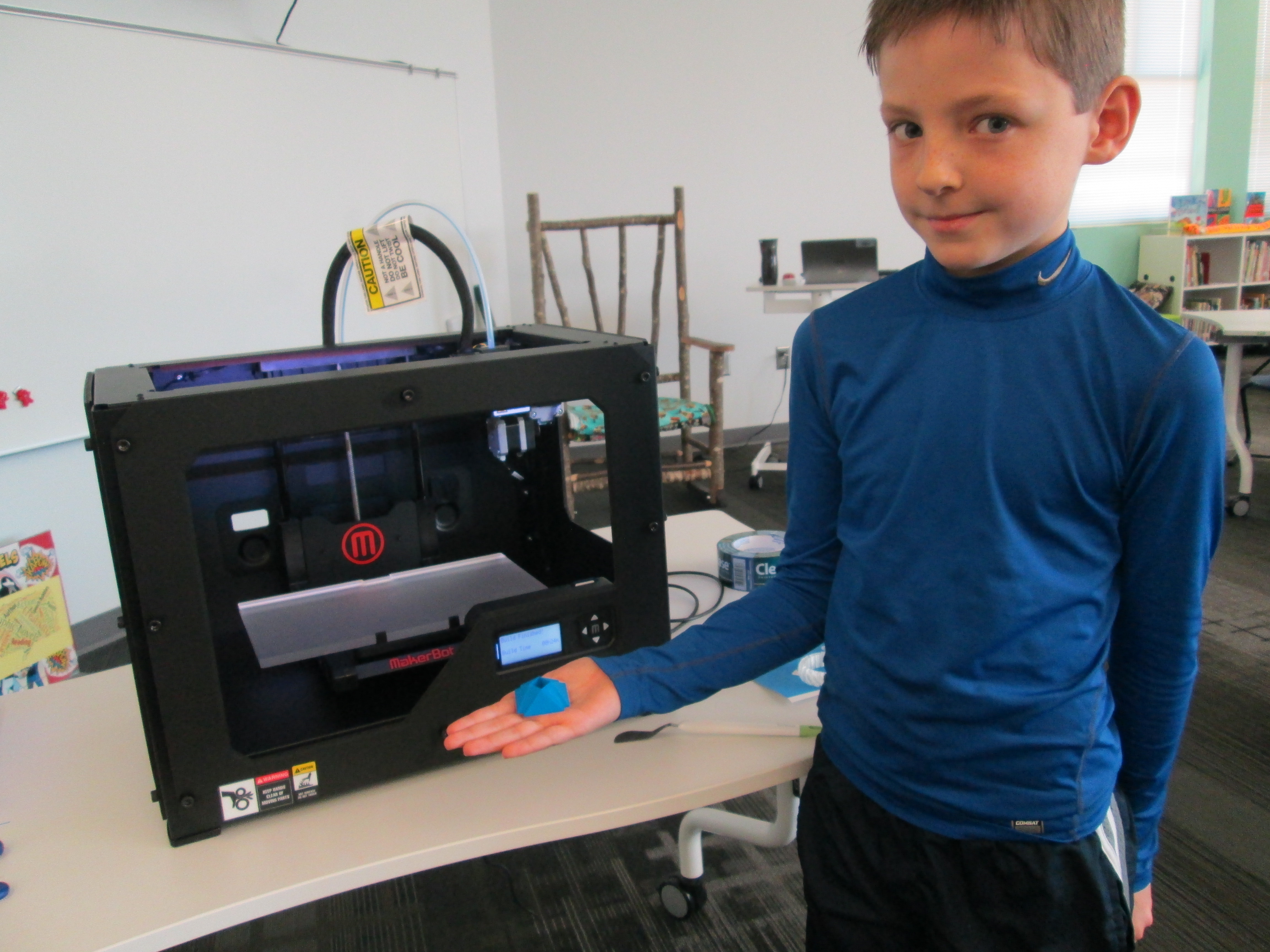
Today, the second student who designed a gem using Sketchup was able to print his gem our our Makerbot replicator. In case you missed the 1st print, you can read about Grant’s history-making print here.
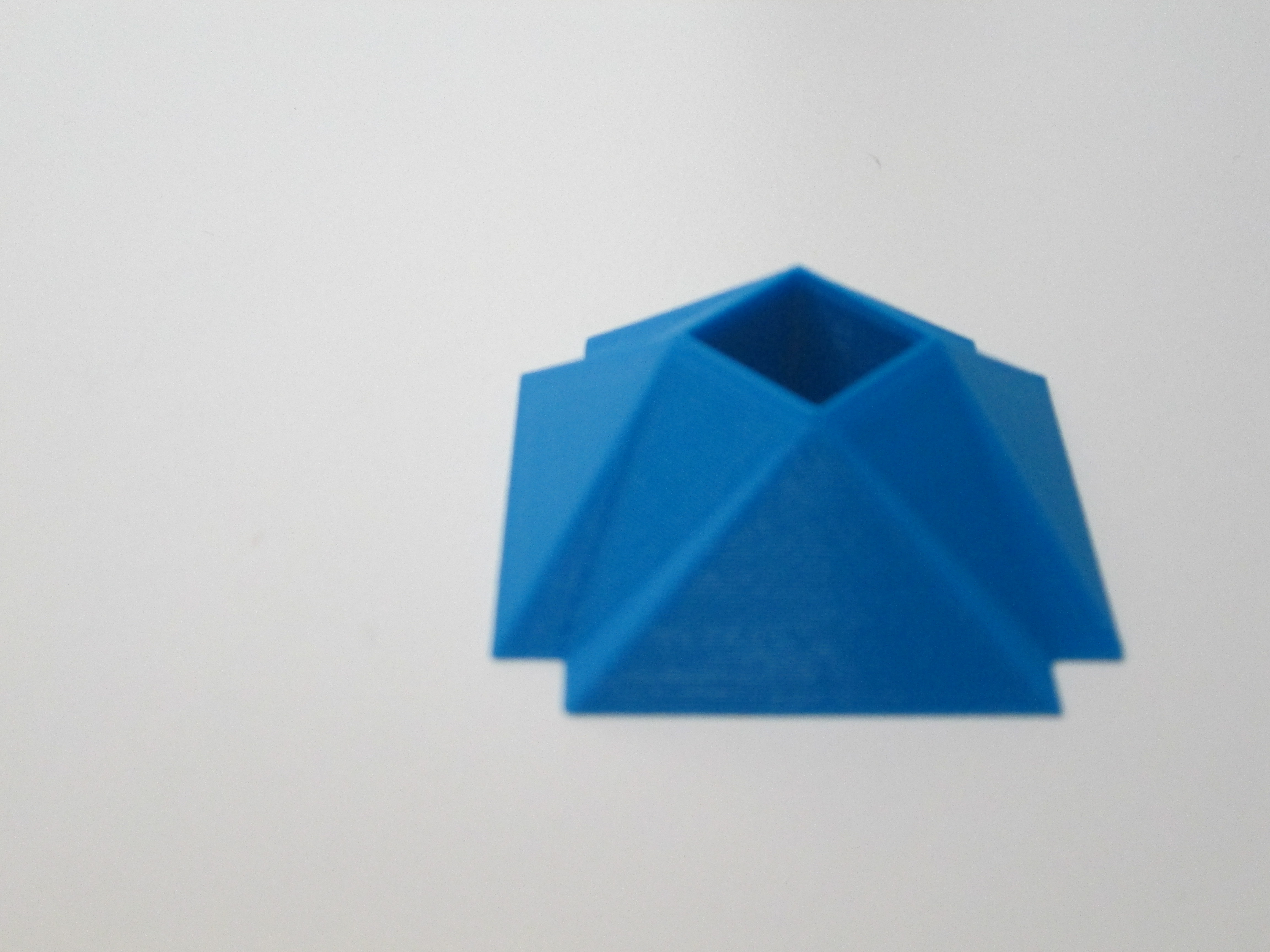
Danny’s gem was quite different from Grant’s. Danny figured out how to make a square hole right through the middle of his gem. It was something we had wondered how to do, and he figured it out. This again brings to my mind the importance of letting go of the feeling of being an expert in everything before we allow our students to explore. Because Danny was given the freedom to explore Sketchup, he figured out how to do so much more than his teacher and I could have ever figured out on our own. Now his expertise can support others who want to try a similar design.
Before Danny pressed the bright red M to start the print, we made sure he got to choose the filament color that he wanted. We now have a selection of filament to choose from: blue, red, white, clear, black, yellow, orange, green, purple, and black. Danny’s gem took about 24 minutes to print. Now that we have an approximate time frame for printing these gems, we are going to try to get 2 printed during each class period over the next few days. Once again, students flocked around the printer and begged for their gem to be next.
You can watch is gem print process here:
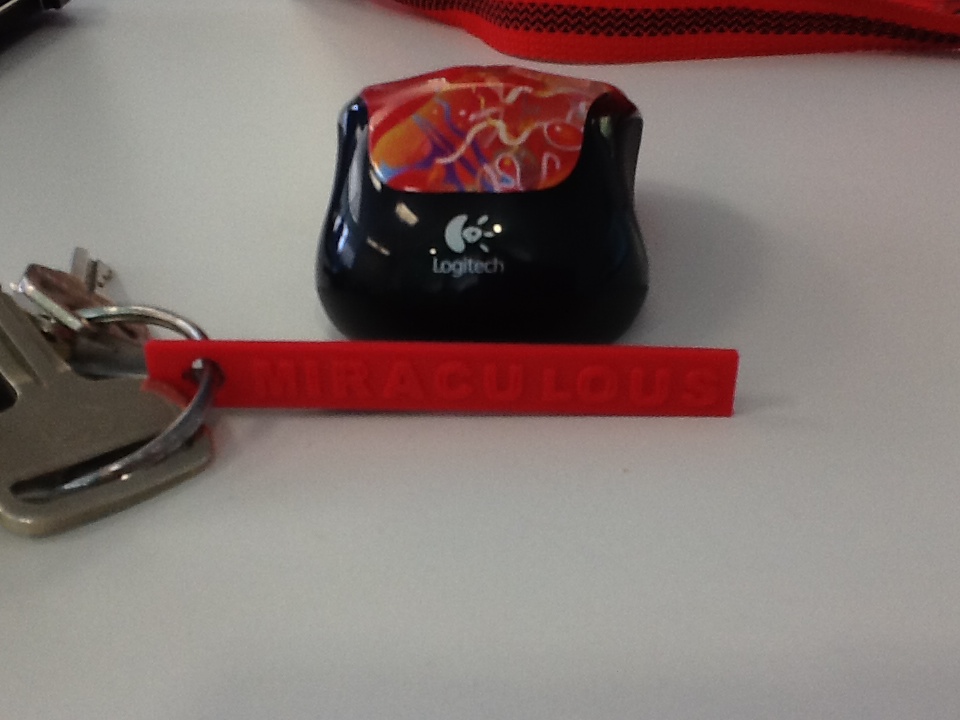
I’ve also been experimenting with a couple of tools that will hopefully inspire some new projects with several classrooms. One tool is Tinkercad. I recently used Tinkercad to make a words with wings keychain. In her new book, Words with Wings, Nikki Grimes has some incredible poems that detail how a single word can help us take flight through its meaning in our lives. I hope that I can share this poetry with students, have them select their own “words with wings”, and create backpack pulls using Tinkercad.
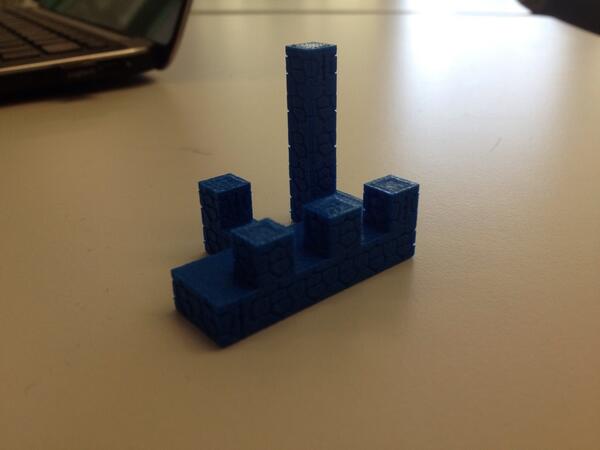
Another new tool is Blokify. With this easy-to-use iPad app, students use a series of blocks to make pretty much anything they want. While the blocks are designed to look like a castle, space ship, or pirate ship, they can really be stacked into anything in a Minecraft-like style. The files can be emailed from the iPad to be imported into Makerware. I hope to do storytelling projects with teachers around student-designed settings and/or characters. With the blocks all being the same size, there is also great potential to use this for perimeter and area in math.
I love how ideas keep naturally surfacing within our standards and explorations. It’s not about what we can 3D print. It’s about what we are learning about, what we want to create, and how 3D printing might support that.
The WordPress.com stats helper monkeys prepared a 2013 annual report for this blog. Here’s an excerpt:
The concert hall at the Sydney Opera House holds 2,700 people. This blog was viewed about 35,000 times in 2013. If it were a concert at Sydney Opera House, it would take about 13 sold-out performances for that many people to see it.
We will actually celebrate all week long….March 3rd through the 7th.
One of my favorite connected educator friends, Shannon Miller, and I have been planning our collaboration and teaching plans for 2014 so of course World Read Aloud Day was a very important part of this. We decided to write this post and start planning, connecting, and sharing the excitement for this day.
This is always such a special day for celebrating the power of literacy….and one of the best for our libraries, schools, and students too.
This year we are excited for even more of these special connections.
If you are interested in connecting with others on this day, please add your name, schedule, and ideas to the information in the Google Doc that we started. This will begin to fill up with others around the world as they want to connect their students and schools too.
We plan to celebrate throughout that entire week….March 3-7th.
Also, check out all the wonderful activity ideas and resources that LitWorld has included on their website here.
The classroom kit is great! We love how it contains suggestions for read-aloud, suggestions for group activities, and a fundraising guide to support LitWorld and their programs.
Let us know if you have any questions on how this works. One of the fun parts is collaborating and throwing around ideas with each other.
Have fun and get connected for World Read Aloud Day this year too.
Over the summer of 2013, I was fortunate enough to receive an advance reader copy of Flora & Ulysses: The Illuminated Adventures by Kate DiCamillo. She is by far one of favorite authors because her words always seem to speak to me in some way beyond just the story. On p. 130, I came across a quote that I have honestly carried with me in my heart and mind since reading it. In fact, it has become a motto that I embrace in our school library because it exemplifies the brand that our library represents.
“All things are possible,” said Dr. Meescham. “When I was a girl in Blundermeecen, the miraculous happened every day. Or every third day. Actually, sometimes it did not happen at all, even on the third day. But still, we expected it. You see what I’m saying? Even when it didn’t happen, we were expecting it. We knew the miraculous would come.” ~Kate DiCamillo
Expect the miraculous. It’s the phrase that I cheezily say to myself as I enter school each day. It’s what I remind myself of when I sit down to plan with teachers. It’s what I whisper to myself in the midst of a technology fail. It’s what came out of my mouth in a recent interview with School Library Journal:
For wary school librarians, Plemmons adds, “My philosophy is, if we don’t expect miraculous things to happen in our libraries, then we’re just limiting ourselves. Why totally shut a door when we don’t know where it leads to?”
I don’t want to put limits on what kids are allowed to do just because I might not be an expert in a particular tool or concept. I’m willing to try anything new with any age of students and expect that something great will happen even if it’s not what I imagined happening in my head. In Invent to Learn, Sylvia Martinez and Gary Stager say,
“It is unacceptable and unnecessary to deny children the opportunity to work on something they are passionate about because the teacher is not an expert in that particular field.”
Looking back through my posts of 2013, I see so many incredible things that happened in our library because we (myself, students, teachers, families, connected educators, and special guests) expected the miraculous. Here are just a few:
5th graders working together to design, plan, persuade, collect, paint, and dedicate during the Little Free Library project. We now have 2 Little Free Libraries thanks to their hard work. We went into the project with so many unknowns, but we always expected that the libraries would exist in our community. Check out the posts!
2nd graders developing their writing skills through blogging and connecting with students in Van Meter, Iowa. This project included a miraculous connection with author/illustrator Jenny Sue Kostecki-Shaw. Check out the posts! Post 1Post 2Post 3
3rd graders engaging in action research to solve a real-world problem at our school. Their investigations included webcam observations, indoor and outdoor observation, skyping with Cornell University and a former Barrow Buddy via Skype, and email communication with other experts. Their work resulted in many attempts at saving birds from crashing into our school windows. Post 1Post 2
1st graders using Twitter to write persuasive messages about our environment. Check out the post!
Students purchasing books for our library with their very own student book budgets. Check out the post!
Students from throughout the school crowd-sourcing a poem using Google Forms for Poem In Your Pocket Day. Check out the post!
Our annual Poem In Your Pocket Days live on Adobe Connect with viewers in multiple states and countries. Post 1Post 2
Kindergarten students becoming experts inTux Paint and making an informational video to teach others to use the program. They even connected with students in Van Meter, Iowa to share their expertise. Post 1Post 2
Moving into a brand new library and working together to learn how to use it. Check out the post!
The entire 4th grade working together in the library over several days to research explorers and Native Americans as well as challenge their thinking about heroes and villains. Check out the post!
A Picture Book Month Smackdown with 2 authors and schools in 5 different states. Check out the post!
After our district decided not to buy a 3D printer, we continued expecting the miraculous. Miraculously, Donors Choose and Makerbot created a partnership and overnight a 3D printer was funded for our library! Check out the post!
Classes in every grade level committed to exploring computer programming during the Hour of Code. I’m expecting more miraculous things to come out of this one hour experience. Post 1Post 2
Our very first student-made design was printed on our 3D printer. Grant and I expected the miraculous (even though we were prepared for failure). Check out the post!
When we give kids the space to explore, the tools to create, the connections to expertise and collaboration, and a global audience to share with, miraculous things will happen. I know that not everyone believes this. Recently, an article was published in the Athens Banner Herald highlighting out Hour of Code activities. In the article, I was quoted saying:
“I encourage them to think about how coders aren’t afraid to make mistakes,” Plemmons said. And when they do make a mistake, they work with their peers to fix it.
Even though I try to avoid reading online comments (and I wish I had used the word failure instead of mistake), I was disturbed by one commenter’s post. She said:
Such a lax attitude is not acceptable in my book. I am afraid to make mistakes in my work so I make sure all possibilities are considered and all details are addressed and included. I also make great effort to anticipate any questions my clients may have and am ready with an answer before I sit down at a meeting. I don’t need to ask others to help me fix any problems; I’ve already fixed them.
It’s good to tell kids to relax and not worry about making a mistake as they learn, but that real work for hire must be near perfect without wasting a lot of people’s time or your own.
The most disturbing part of this comment to me was the notion that giving kids space to fail, step back, re-evaluate, and try again is having a lax attitude. Many major companies encourage their employees to fail early and fail often. This allows their employees the freedom to be innovative and take risks knowing that those risks are what unveil the latest great ideas. By failing early, learning from failure, and fine tuning their products, companies are able to release the best quality product that they can. In the digital world, companies continue to listen to the consumer and push out updates to improve any mistakes or ideas that they missed. This is the same kind of situation with students. They aren’t publishing final products online that are full of mistakes. Rather, they are attempting to make the computer do what they want it to do, trying some code, seeing what works and what doesn’t, and fine tuning their work. No one sits down and makes a perfect product without first failing. Expecting the miraculous certainly doesn’t mean that you are expecting things to be perfect on the first try.
I was reminded of the importance of failure when I was recently reading Presentation Zen by Garr Reynolds. Reynolds says:
“The fear of making a mistake, risking an error, or being told you are wrong is constantly with us. And that’s a shame. Making mistakes is not the same thing as being creative, but if you are not willing to make mistakes, then it is impossible to be truly creative. If your state of mind is coming from a place of fear and risk avoidance, then you will always settle for the safe solutions–the solutions already applied many times before.”
“Children are naturally creative, playful, and experimental. If you ask me, we were the most human when we were young kids. We worked on our art, sometimes for hours without a break, because it was in us, although we didn’t intellectualize it. As we got older, fears crept in along with doubts, self censoring, and overthinking.”
In 2014, I am going to continue expecting the miraculous with my students, my collaborators, my families, and my peers. We will embrace our failures, learn from them, and continue to create innovative work together.
I am going to start 2014 by asking my students, “What miraculous things do you expect in 2014?” They will record their responses on a Flipgrid. I invite you to add your own expectations to the same Flipgrid. Go ahead. Give it a try. Expect the miraculous.
A favorite day for Barrow students is our annual Polar Express Day. This year was our first year back in our new building, so of course, this day brought new surprises for students. All of the favorite traditions were there, too:
All students wore pajamas. Our counselor, family engagement specialist, and PTA made sure that all students had pajamas.
Every class came to the library to listen to the Polar Express read by William Hurt
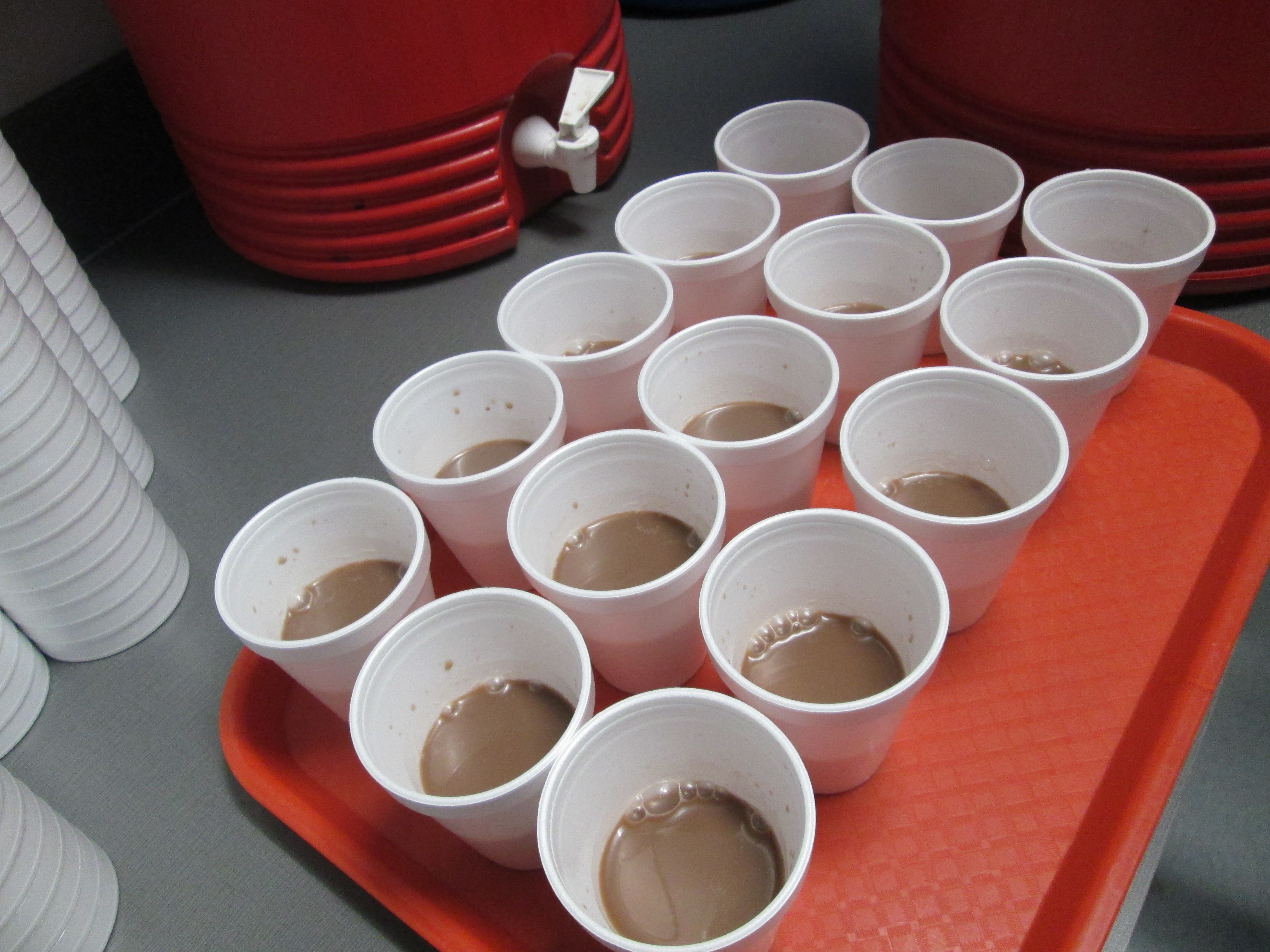
Students were served hot chocolate with marshmallows by several fantastic volunteers.
Each student received a bell placed around their neck with the word “Always Believe” whispered in their ear.
Each student received a candy cane as they left the library.
Some new surprises this year:
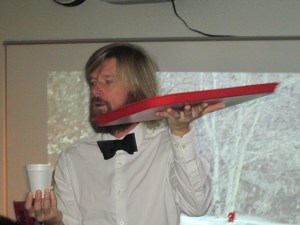
Kevin O’Neil, Barrow Dad, dressed up as a waiter to serve the 1st 2 groups hot chocolate
Our school was decorated in several collaborative spaces for multiple holidays, not just Christmas
3 sets of train tracks brought kids to the library
Our display wall outside the library was transformed into a train. The tv screens all displayed images from Polar Express
Holiday music was played throughout the halls
The projectors in the collaborative space played a crackling fire
The projector in the library played falling snow
This year our hot chocolate pouring and bell prep was in a separate room so it wasn’t as distracting to the kids
The train schedule of classes was posted outside the library
This is truly a magical day. It takes a huge team effort to pull this off. There are so many hands in this day that it’s hard to list them all. Many thanks to:
Our lunchroom staff for fixing chocolate for 500 on top of fixing breakfast and lunch
Our principal for organizing volunteers through Signup Genius, creating a schedule, and making sure supplies were bought
Volunteers who went out to search the stores for bells, string, hot chocolate, cups, napkins, and candy canes. It was quite a big search!
Our PTA for helping string 500+ bells
Sarah Britton Vaughn, Mimi Elliott-Gower, Allision Griffith, and several others who stayed late Tuesday night to put up some extra magic in the hallways
Multiple volunteers who poured hot chocolate, put bells around necks, and cleaned up spills
Todd Hollett for working long hours to figure out our hallway technology
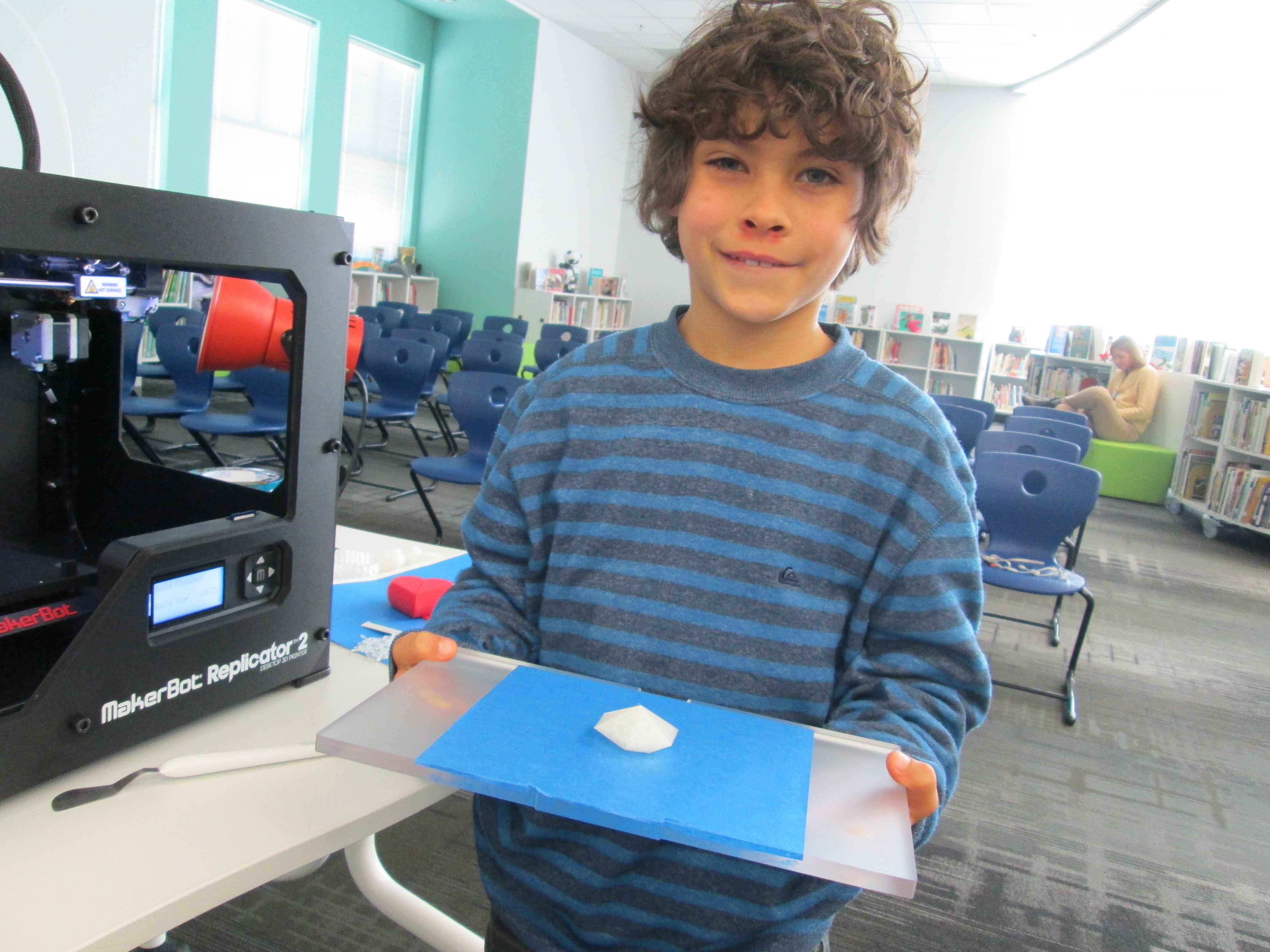
Today was a Barrow milestone. Grant, a 3rd grader, became the 1st student to print his own design on our new Makerbot Replicator 2. Grant’s class has been studying rocks and minerals. As a part of the study, they skyped with Aurum Studios, a jewelry store in downtown Athens. During the Skype, Aurum toured students through the design process of a piece of jewelry. One piece of designing is to use 3D software to create a model.
Students used a free tool called Sketchup and began to design their own gems with all of the cuts that they would design into a piece of jewelry. Ashley Maher, Spectrum teacher, worked with these students and gave them space to explore the many functions of Sketchup. Many of them figured out several functions of the tools within Sketchup by just exploring on their own. The students started this project before we even knew we were getting a 3D printer, but when we did, they had an ultimate goal of holding their gems in their hands.
Ms. Maher took Grant’s Sketchup gem as an experiment to see if we could print it. We used this post for guidance. Basically, a plugin had to be downloaded into Sketchup in order to save the Sketchup files as an STL file. Next, the STL file was imported into Makerware. The gem was rotated so that the flattest side was on the build plate. We set the file to a 15% infill with no raft. Finally, the file was loaded onto the SD card ready for Grant to print.
Today, I checked in with Grant to see what color he wanted his gem to be. I had his natural filament loaded and ready when he came to the library for ELT. He was eager to see what happened. I reminded him before we started that this was all an experiment. If it didn’t work, we would look at our mistakes and try again. We pulled up his file on the Makerbot and he pressed the red M to begin. The rest of his classmates were in the library working and they frequently came over to visit. We watched as the 3D printer built layer upon layer perfectly. It took about 35 minutes for his gem to print. Along the way, we made some video and Grant talked about his design as he watched it appear. As the gem neared completion, Grant was bouncing around shouting out the percentage because he knew we were so close to finishing the print without a mistake. When the build plate lowered and his gem that he designed was sitting their, he was ecstatic. His classmates rushed over and everyone wanted to hold it. He passed it around and then took it to show a few adults in the building.
Immediately, all of his classmates began asking when they would get to print. We probably won’t print any more until January, but now we know that the process works. After winter break, students will continue designing and printing. I have a feeling that now that students have seen the final product, they are going to get even more creative with the cuts in their gems. I’m also excited that we have so many young experts in our building that will be with us for 2 more years. These students will be leaders in teaching others how to use Sketchup and other modeling tools. This is only the beginning. It’s exciting to think about what is to come. I am so grateful to the donors, Donors Choose, and Makerbot for making 3D printing a reality in our school
 In the new year, I wrote a post about expecting the miraculous in 2014. I can honestly say that the expression “Expect the Miraculous” has taken on a life of its own in our school. Let me tell you how it happened.
 Over the past 2 weeks, students have written about their hopes and dreams in class and visited the library to record. It has been an amazing process to watch. Goals have ranged from reading goals to behavior goals and from school-related to extra curricular related. I encourage you to spend some time listening to their miraculous expectations and feel free to click the + and add your own. Students have enjoyed coming into the library and listening the the videos on our touchscreen computer at the front of the library. I can put the Flipgrid on slideshow and it flips through each video throughout the day.
![IMG_1810[1]](https://expectmiraculous.com/wp-content/uploads/2014/01/img_18101.jpg)






















 Expect the Miraculous