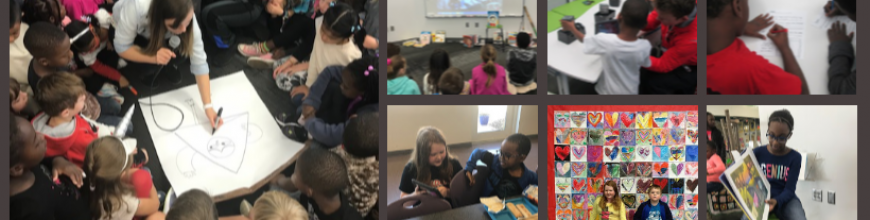
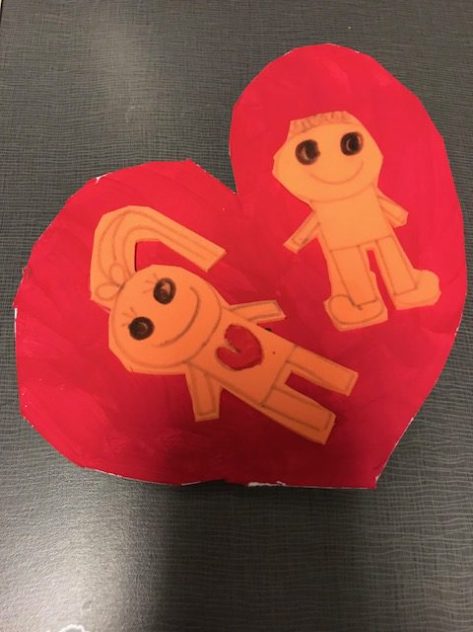
When, Kindergarten finished reading Love by Matt de la Pena & Loren Long, they took time to design heart symbols of love. Ms. Foretich gave them several options for drawing a heart. They could freehand their drawing or they could use one of many heart stencils. She modeled how to trace as well as how to use crayons to fill in all of the space with color. She also gave them examples of how to design their hearts. They could fill the heart with patters or draw things that they love inside.
Students began these hearts in the library. Ms. Foretich and I walked around and talked with students about their designs and helped students think about designs, drawings, or colors.
We displayed the hearts in 3 x 3 blocks on the windows of the library.
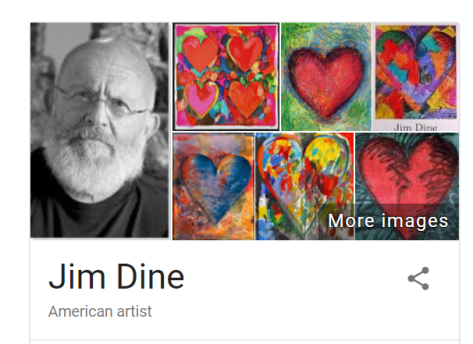
In first grade, students studied the work of pop artist Jim Dine after reading Love. I was unfamiliar with this artist, so it was fun for me to go online and see some of his work.
First graders created hearts inspired by the work of Jim Dine in the art room. We took all of these hearts and pieced them together into a backdrop to hang in the library. This space will be a photo booth for students, teachers, families, and guests to take their picture. I posted photo booth instructions along with an iPad so that photos can be taken over the next few weeks.
One of the things I love about these 2 grade levels is how their work is created individually but it comes together to create larger collaborative pieces that make an eye-catching impact on each person that sees them.
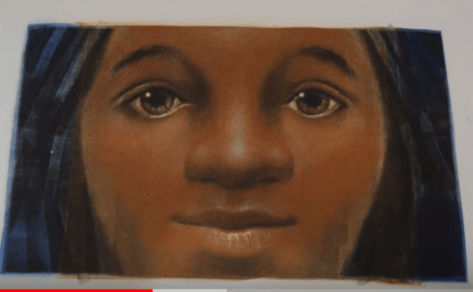
When Ms. Foretich (art teacher) and I finished sharing Love by Matt de la Pena & Loren Long with our 3rd graders, we flipped back to one image in the book.
This image always surprised students when I read the book aloud. It’s the only image in the book that is zoomed in so close. There was always a collective gasp or audible reaction, and we often had to stop and talk about what this image was all about. I was so glad that Ms. Foretich chose to focus on this image with a whole grade level.
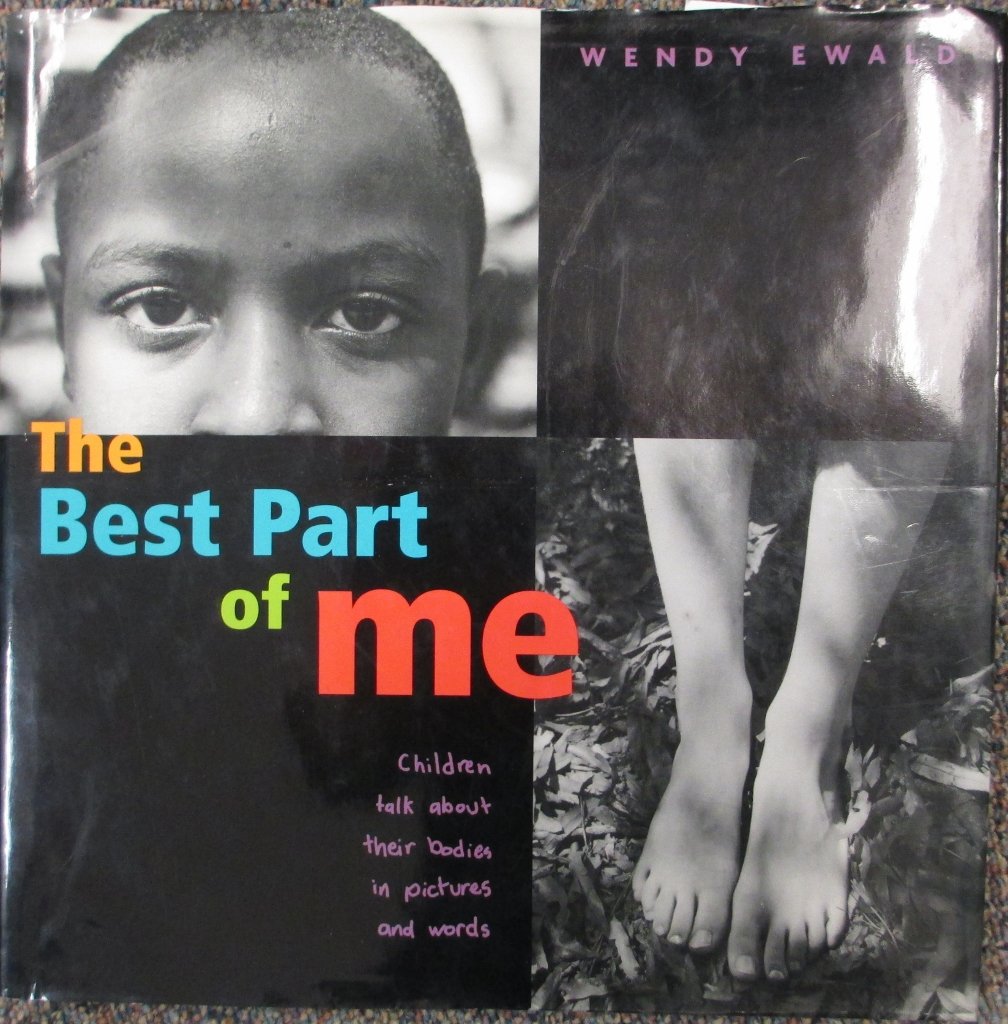
We paired this image with another book called The Best Part of Me.
This book features voices of children as they talk about the favorite parts of their body and why. Each poem/prose is accompanied by a black & white image.
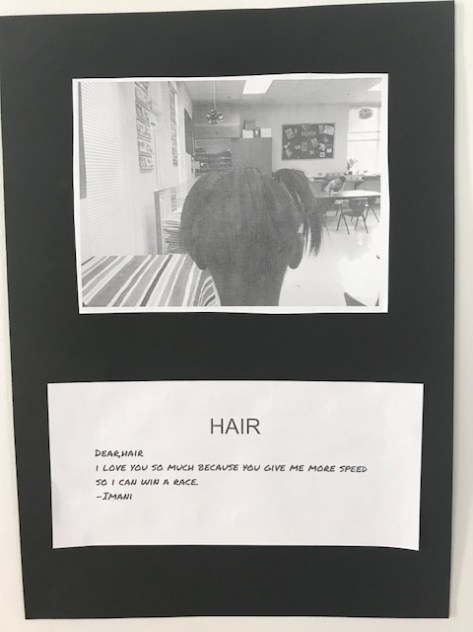
In response to Love and The Best Part of Me, students brainstormed about their own bodies and what they love. We encouraged students to think about body parts, favorite activities, and personality as they brainstormed. By the end of class, we wanted students to focus in on a particular aspect of themselves that they could photograph and write about.
Ms. Foretich continued this project in class by having students use iPads to take selfies of the favorite parts of themselves. Students also finished the writing and typed up their words. Ms. Foretich printed all of these to mount on black paper.
They are now displayed in the rotunda of our school. I love standing in the center of the rotunda and looking around at all of the student images and voices staring back at me. To see what each student loves about himself/herself is reassuring in a world that can sometimes seem mean and chaotic.
If you find yourself in our school, I hope you’ll take time to see (and be inspired by) their work too.
5th grade spent two days reading and creating two voice poetry. This project came about after I met with Mrs. Freeman to brainstorm ideas for her ELA classes. We were looking at this standard:
ELAGSE5RL6 Describe how a narrator’s or speaker’s point of view influences how events are described.
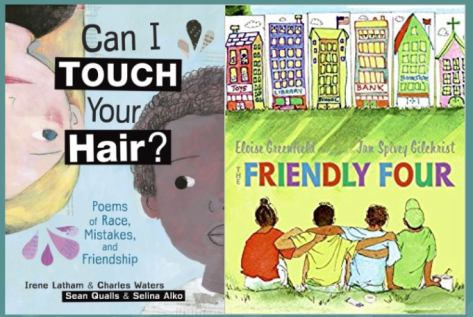
During our planning, we looked at books and poetry that featured multiple perspectives and decided that we would focus on poetry. I found several books to serve as mentor texts.
Messing Around the Monkey Bars by Betsy Franco
Can I Touch Your Hair? Poems of Race, Mistakes, and Friendship by Irene Lathan & Charles Waters
Seeds, Bees, Butterflies, & More by Carole Gerber
Joyful Noise by Paul Fleischman
The Friendly Four by Eloise Greenfield
This is Just to Say by Joyce Sidman
During the 2-day project, the students, Mrs. Freeman, and I read aloud examples of poems from each book and talked about the perspectives and style of the poem. Some were funny. Some were serious or about historical events. Some were sarcastic. We tried to showcase examples that would appeal to many different interests. Then, we set students up for their work session.
In pairs, students continued to read mentor poems from the featured books to get more familiar with how two voices could work together from two different perspectives.
When they felt ready, they moved to a brainstorming sheet. On the sheet, they thought of possible topics along with what two perspectives could talk about that topic in the poem. We encouraged students to choose two perspectives that would offer a different take on the chosen topic. We tried not to give too many examples, but if students were stuck, we made suggestions that might spark their own ideas: hot cheetos/hot takis, cell phone/landline, nintendo/xbox, school/home, twitter/instagram, etc.
Once they decided on the topic and perspectives they liked, they started trying out some lines of their poem. Many students looked back to the mentor poems for a structure or style of writing. Others picked topics like politics, where they needed to do some additional research in order to truly take on the perspective they were attempting.
Mrs. Freeman, Mr. Kinnaird (student teacher), Mrs. Mullins (collaborative spectrum teacher), Mrs. Kelley (special education teacher) and I all walked around and conferenced with writing pairs. We nudged them to expand their voice, use descriptive language, and practice their poem before publishing.
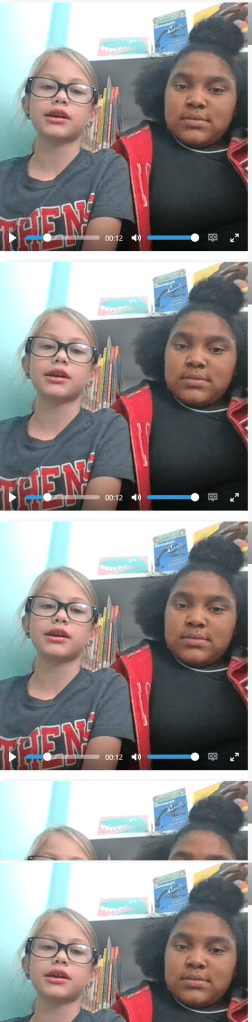
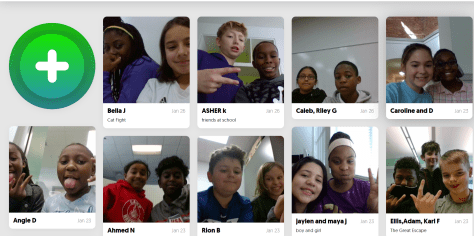
The work session spanned both days. Once students were ready to publish, they used their computers to record their poem on Flipgrid. This is a piece of the project that will continue in the coming days as students finish their poetry.
There were several moments where I paused and looked around at the whole group of students working. What amazed me was how engaged each pair of students was. Yes, students worked at different paces and some needed more support than others, but no student sat back and did nothing. They were focused on the task, and it made me wonder about this particular experience and what made all students engaged. Was it the choice? Was it the partnership? Was it the freedom of poetry? Was it interest? Was it the authentic audience on Flipgrid? I don’t have the answer, but what I do know is that I loved this experience and I hope I can continue to create these kinds of projects with teachers and students in the future.
Please take time to listen to the many student voices on this Flipgrid. You can leave students comments on this post or use the emoji reactions on each video to let them know how their poetry made you feel.
After 5th grade spent time, reading the book Love by Matt de la Pena & Loren Long, I silently turned back through each image in the book. We had spent time talking about some of the images as well as listening to Matt’s powerful words, but Ms. Foretich (art teacher) and I wanted them to have one more slow look at the images. Their goal in looking at the images for a 2nd time was to pick out an image that spoke to them in some way.
At tables, each 5th grader took a brainstorming sheet to reflect on some questions through writing or through sketching. The purpose of this sheet was to help them think more about an image from the book and to imagine a new symbol of love. We wanted students to think beyond just a universal symbol of love like a heart, but we didn’t exclude hearts if that was what students were most connected with.
At the end of the brainstorm, students had to think of what materials they might need in order to make a 3D sculpture of their symbol. Ms. Foretich went through these and helped group students with the materials that they might need.
During the 2nd class, some students worked in the art classroom and others came to the library. Students in the library worked on 3D design in tinkercad to prepare for 3d printing or they used materials from our makerspace such as duct tape and other crafting supplies.
Every class in our school has read the book Love by Matt de la Pena & Loren Long. In preparation for their visit later this month, every class has also created a piece of art in response to the book. These projects began in the library and continued in the art classroom with Ms. Foretich. I have loved the inspiration that the book has given her and the pieces of art that students have created with her. I’ll be sharing much of this student work in the next few blog posts.
Today, I want to focus on 2nd grade. Every 2nd grade class came to the library to hear Love before the holidays. When we read the book, I invited students to listen to Matt’s words and look closely at Loren’s illustrations for as many examples of love as they could find. Similar noticings emerged in each class, but there were also unique observations made that other students didn’t catch. We always paused on the 2nd spread that shows a park image with a cab, a hot dog stand, and a man on a bench. Students always talked about the boy in the wheel chair giving the man a hot dog. Sometimes they noticed the people making eye contact and talking in the cab. Sometimes they talked about the color of the balloon being a symbol of love. The important thing is that they always talked. Students were never silent on a page. They always found love even on pages that were hard like the one with the boy hiding under the piano. Even with all of the bad things happening in the picture, love was still there.
In the art room, we took apart the F&G version of Love and Ms. Foretich gave groups of students an image from the book to study more closely. Students were asked to think about what the image said about love. They had a brainstorming page to get some of their ideas down. They used this process to reimagine the version of love into a new image that connected with them personally.
Over the next class, students turned this into a watercolor image. Each student made a statement about their art that could be posted in a tweet or Instagram caption and wrote it onto their art. What message of love could students send out into the world? I loved the student voice that Ms. Foretich was giving students as she asked them about a short message of love that they could actually send out to the world via social media. She has been taking time to post these images and captions to her Instagram & Twitter account. If you don’t follow her, please take a moment to. You will be inspired by the many examples of student work that she posts.
For now, I’ll let the student work speak for itself through this series of Instagrams. Take a moment to leave students comments here on the blog or on Ms. Foretich’s Instagram posts. The students would love to hear how their messages have connected with you.
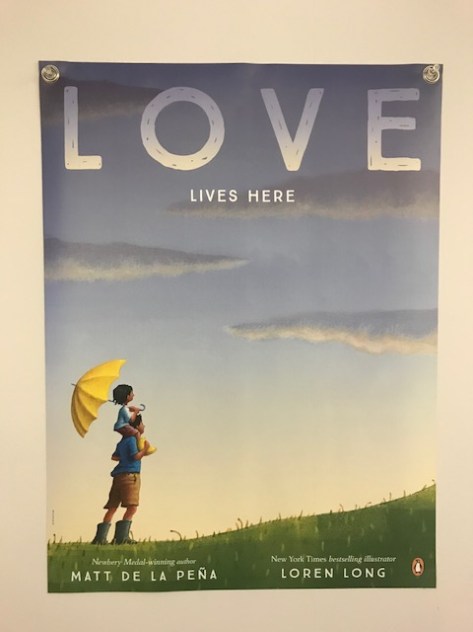
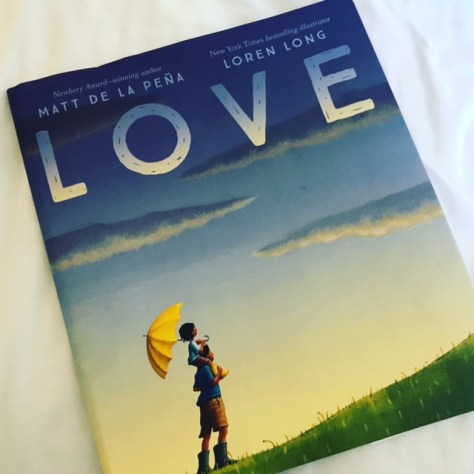
When I first saw the cover of Love by Matt de la Pena and Loren Long, I knew it was going to be something special. I couldn’t wait to peer inside the pages and hear Matt’s words and see Loren’s vivid illustrations. The first time I got to actually hear about what was inside the book was with the amazing John Schu while we presented at the Tennessee School Librarian Association Conference. In his masterful way of book talking, he made me want to read the book even more by gushing over the illustrations and how Matt brought the idea of “love” to life in many different ways.
I finally got to see a copy of the book in Phoenix at the American Association of School Librarians Conference, and I read the book multiple times in the Penguin Young Readers booth. Every single illustration from Loren Long is breathtaking. You can see something different each time you look at the pages. He takes Matt’s words and extends them into a visual masterpiece of how love lives in our world. Matt’s words take you well beyond the idea of love being a hug, a kiss, or an “I love you”. Love lives in music, in time spent with family, in the colors of the sky, in good deeds to those in need, and more. We’re in a time where it sometimes feels like love has been lost in our world. This book reminds us that love is everywhere, but we do have to take a moment to look closely in order to remind ourselves where it is.
I’m so happy that this book is finally out in the world. It’s the perfect book to start the new year as people consider their goals for the year. If you’ve found yourself in a hard place over the past year, pick up this book and reconnect yourself with the love in our world.
I knew that this book was one that I wanted to share with my entire school as soon as I saw it. Miraculously, while I was in Phoenix looking at the book for the first time, I got an email from Hannah DeCamp at Avid Bookshop. The email subject was “Pssst, we’re hosting Matt de la Pena and Loren Long in January”. My fingers couldn’t open the email and respond fast enough. As part of the extensive Love tour, Matt & Loren are stopping by our school in January. Also while in Phoenix, I scored an ARC of Love after standing in a long giveaway line.
Many times for these tour events, I don’t have a lot of time to prepare. This time we had almost 2 months notice. As soon as I got back to school from Phoenix, I started showing the book to teachers. One of the first was our art teacher, Ms. Rita Foretich. I love collaborating with her because so often we take a seed of an idea that blossoms into something grand. The book immediately got her creative wheels turning and she wanted to do something with every class in the school.
Over December and January, we have been reading the book to every class and creating an art piece that is inspired by the book. Every grade is doing something different. I’ll be sharing many of those projects in some posts over the next few weeks leading up to our author and illustrator visit.
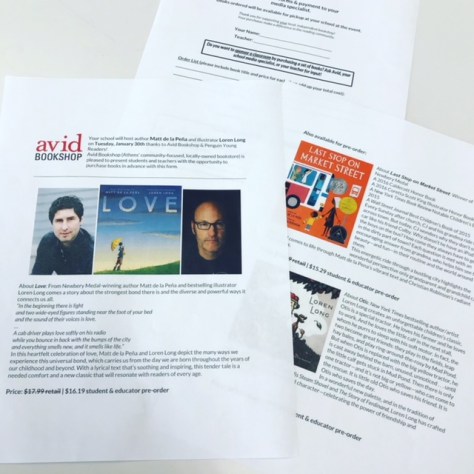
For now, go out and get this book at your local bookstore. Even better, order a copy from Avid Bookshop to have signed when Matt and Loren visit on January 30th. They will ship the book to you. See the beautiful in the world and give love.
Third grade studies rocks and minerals in science. Ms. Hicks, 3rd grade Spectrum teacher, is always dreaming up ways to extend and enrich the study. We have collaborated together many times, and I always love leaping into something new. In the past, we’ve Skyped with a jewelry studio and designed our own jewelry. We’ve thought about climbing wall design and how the hardness of different rocks and minerals would support the design. Students even 3D printed prototypes of their climbing walls. This year we once again worked together to add a new layer to this science unit.
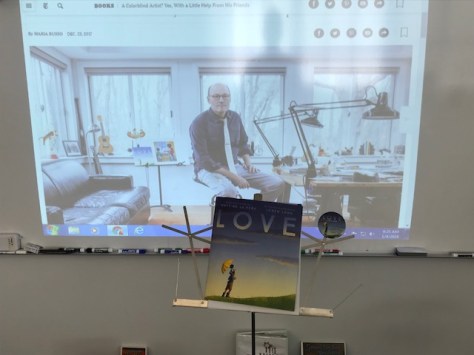
I’ve been watching lots of people getting involved in kindness rock projects locally and globally. The idea of these projects is to spread words of inspiration in the world through randomly placed rocks and inspire people to create good in the world.
Our local Athens Rock Project
I’ve found a few of these rocks myself and know that it gives you a bright moment in your day just to know that someone cared enough to create a piece of art intended for good.
Gretchen Thomas, UGA instructor, and I have been brainstorming the idea of weaving this project into makerspace, but we held off this semester. I passed the idea on to Ms. Hicks and we decided to give it a trial run.
We started by showing images of rocks and asking students if they had ever found a rock like these. I was surprised at how many stories were already in our small group of 15 kids. From a rock in a stream to a rock in the park, students had stories of words and images they had found on rocks.
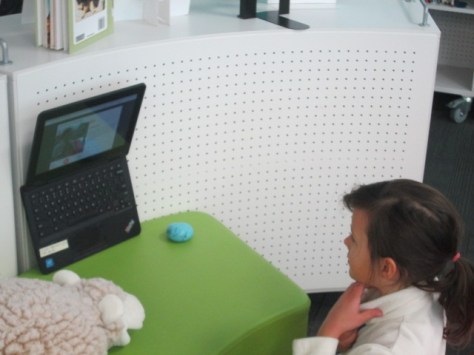
Then we watched this video to consider the meaning of a project like this.
We also read an excerpt from If You Find a Rock by Peggy Christian and Everybody Needs a Rock by Byrd Baylor. These books helped us think beyond a rock just being a rock but instead a symbol of something else.
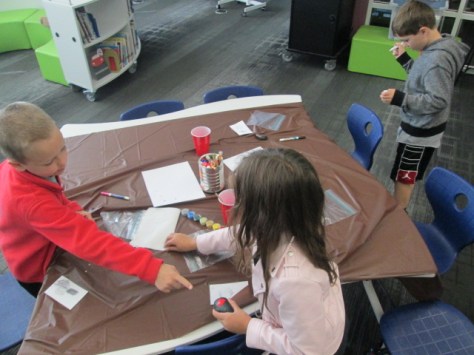
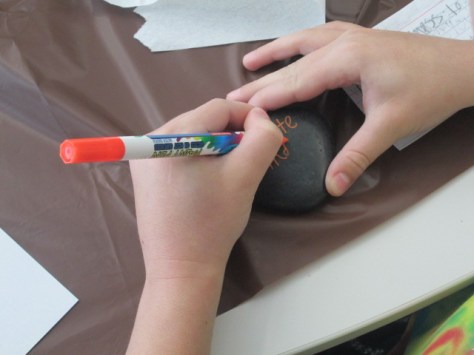
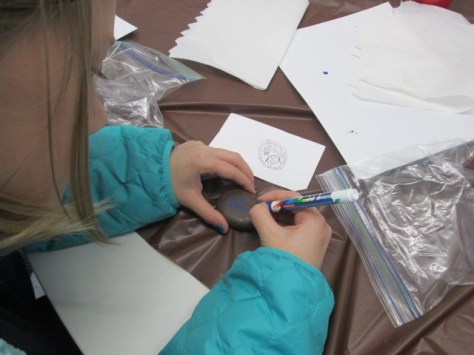
At tables, students used an index card to plan out their rock. We wanted them to really take their time in planning so that they chose their words with purpose, so Ms. Hicks and I conferenced with students as they worked. They chose a word or phrase, wrote a short explanation of their choice, and sketched a design for their art. Students also selected a rock. All of this took one class session.
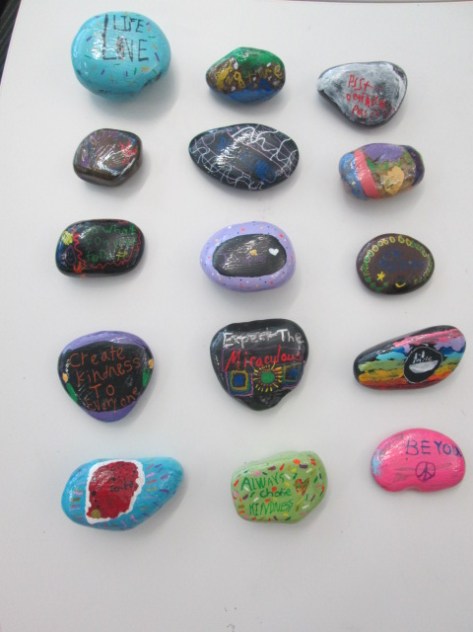
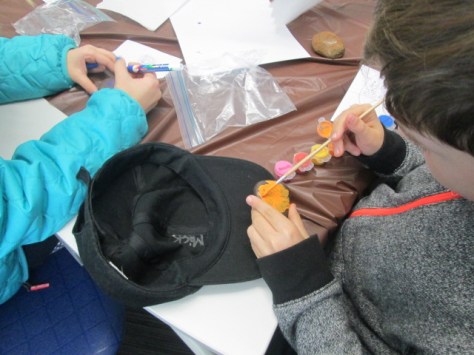
In the next session, students used paint pens and paint to design their rock. Most started by getting the word(s) onto the rock and then worked on design. If they finished early, they helped one another fan portions of rocks to get them dry enough to keep painting on.
My wonderful computer technician, Allie, added layers of Mod Podge onto the rocks before our 3rd session. Here’s where this project is taking a different turn that many of the kindness rock projects. We don’t really want to be random. We want the person who finds our rock to know a bit more about it.
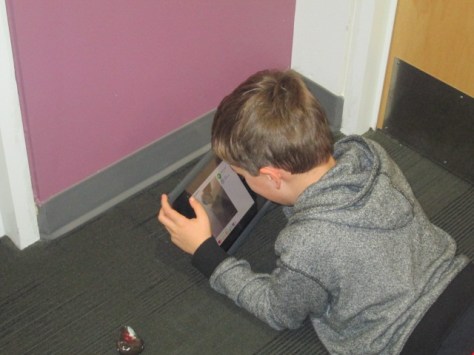
In our 3rd session, we used Flipgrid to record videos to tell the story of our rock. Students talked about the reason they chose their word and even why they designed it the way they did. We also brainstormed what someone would need to know in order to get to the video we recorded.
I took this brainstormed and turned it into an information card to put with our rocks.
Instead of randomly placing the rocks, we are putting them all in one container. We’ve talked with Avid Bookshop in Five Points and will be placing this container somewhere outside the shop. Our hope is that people will select a rock, take an information card, watch the accompanying video, and hopefully leave a response video to the student.
It’s all a big experiment, and I’ve tried to be very open with students about that from the beginning. Anything could happen. We of course want every rock to be taken and for every person to leave a response, but we also know that might not happen. Whatever happens, we’ll know that our rocks have gone into the world and caused at least one person to pause for just a moment and think about kindness.
Before our rocks go to Avid, we’re making a few more. If your’e in the area, keep your eyes open in Five Points for a clear acrylic container near Avid Bookshop sometime this week!
We are nearing the end of November, which means the close of Picture Book Month. In 2013, I started brainstorming with several dynamic librarians across the country a way for us to celebrate the close of the month. Jenny Lussier, Cathy Potter, Shawna Ford, Kathy Kaldenberg, and I created the very first Picture Book Smackdown which was held via Google Hangout on November 21, 2013. Authors Laurel Snyder and Ame Dyckman joined us as well. For one hour, we all shared as many picture book talks as possible. This was the beginning of an annual event that is now in its 5th iteration.
This year, our event will take place on November 30th from 1:30PM-2:30PM EST. We will feature students from:
David C. Barrow Elementary in Athens, GA (facilitated by Andy Plemmons)
Orchard School in South Burlington, VT (facilitated by Donna MacDonald)
Early Childhood Development Center in Corpus Christi, TX (facilitate by Julee Murphy)
We are also very excited to announce that we will be joined by author/illustrator Deborah Freedman. Her books include This House Once, Shy, The Story of Fish & Snail, and many more! You can learn more about her books here.
I’ve put together a Smore that puts everything you need in one place
Click the image to visit our Smore
What to expect:
A live broadcast via Youtube Live or archived to watch at a later time
Numerous student voices book talking their favorite picture books in 3 states
A short talk from Deborah Freedman about why picture books matter in the world
A list of the books we reference
What you can do:
Watch live with your class!
Host your own picture book smackdown in your classroom, library, or district
Share your favorite picture books on social media using the hashtags #pbsmkdwn and #picturebookmonth
Send students a shout out on Twitter using #pbsmkdwn
In Loving Memory of Dianne de Las Casas
We will of course continue reading and sharing picture books all year long, but we want to end November with this special event. This year’s Picture Book Smackdown is dedicated in loving memory of Dianne de Las Casas, founder of Picture Book Month. We lost Dianne this year in a tragic fire, but her legacy of advocating for the importance of picture books in our world lives on.
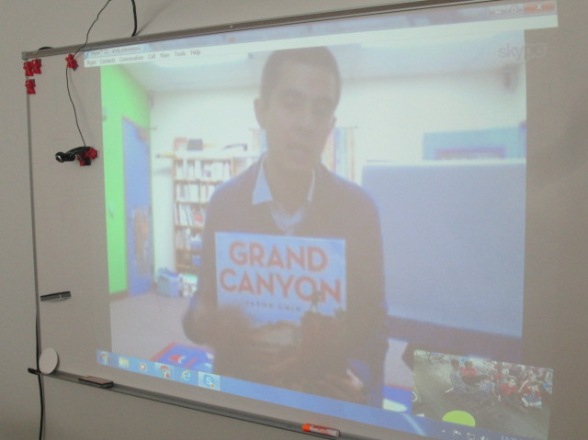
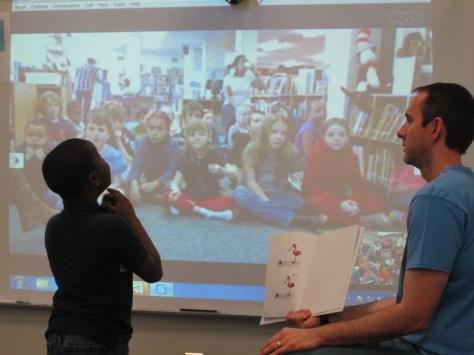
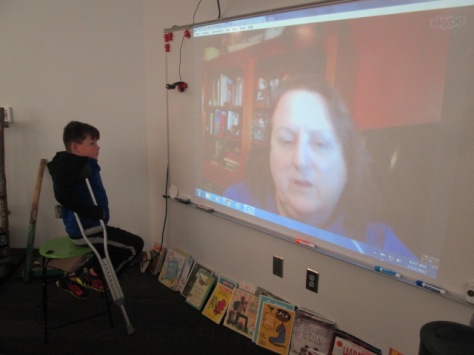
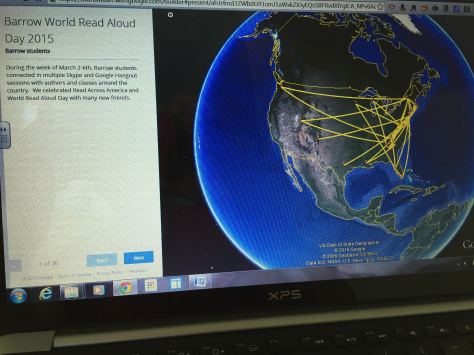
It’s time for us all to start making plans and building excitement for World Read Aloud Day 2018 with Litworld. This year, World Read Aloud Day takes place on February 1, 2018, but many of us will celebrate the entire week of January 29-February 2, 2018.
World Read Aloud Day “calls global attention to the importance of reading aloud and sharing stories.” When we connect our students through Skype, Google Hangouts, or other web tools, they experience the power of the read aloud and realize that they are connected with a bigger world that is both the same and different from them. By connecting our voices through reading aloud, we are reading on behalf of the 758 million people who cannot read.
Shannon McClintock Miller, Matthew Winner, and I invite you to start posting your schedules on our shared Google Doc.
This year, we’ve tried to organize the document by time zones to make it easier to find connections that work for you. If you don’t see your time zone listed, please add it as a heading.
When you share your schedule, be sure to include:
Your name
Your contact info such as social media, Skype, and/or email
Your role
Your school and grade levels
Your location
List your time zone when posting your available dates and times
After you post your own schedule, take a look at the other schedules and sign up on someone’s schedule to connect your students. We’ve found that it doesn’t matter if same grade levels connect with one another. Often times, an older grade can read aloud to a younger grade or younger grades can find parts of a books that they can read aloud to an older grade. There’s not just one way to connect. Part of the fun is meeting new friends, planning your read alouds, and seeing what magical things happen during your connection that you weren’t even expecting.
We have many ideas from previous years on our blogs. You can read more about previous World Read Aloud Day connections on Expect the Miraculous and The Library Voice. Litworld also has several resources for you to use in your planning and connections including:
We returned from fall break this year on Halloween. The kids were of course pulsing with energy as they awaited a night of trick or treating, so we held a special makerspace session to harness their energy and have some fun. Gretchen Thomas and I already wanted to try something a little different on Halloween for makerspace. When her group of UGA students started investigating Halloween and fall themed makerspace activities, they asked if they all could come instead of just one small group. So…half of her class came at 11:00 and half came at 11:30 and we added extra slots to our signup sheet. We had anywhere from 25-40 students who signed up for each session.
Students made 3-dimensional ghosts out of paper and launched them into the air by putting them onto the end of a straw and blowing. Many students adjusted their ghost design or tried different techniques for launching.
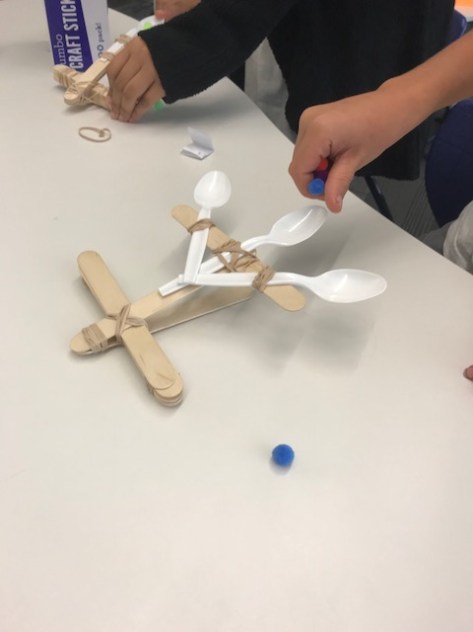
Catapults
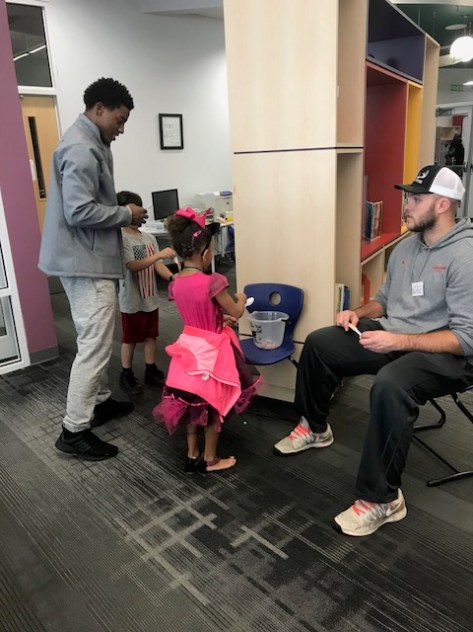
Students used Popsicle sticks, spoons, and rubber bands to create catapults that would launch pom pom balls into the air. A Halloween treat bucket was the target, but students also loved becoming the target themselves. This was a rowdy but fun center, and once again, we saw students adjust their designs for a better launch or even build catapults that would launch 3 pom poms at a time.
Leaf Chromatography
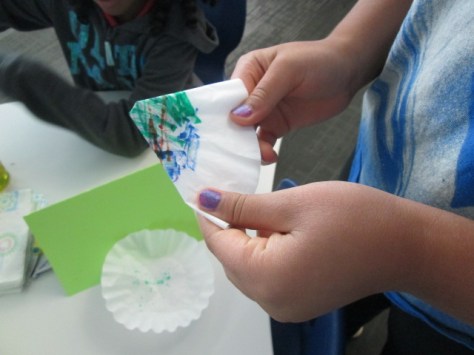
Students folded coffee filters into triangular shapes and colored them with markers to make a color pattern. Then, they dipped the filters into water to see how the colors would move across the coffee filter. This center needed a drying area since each filter was very wet after the activity.
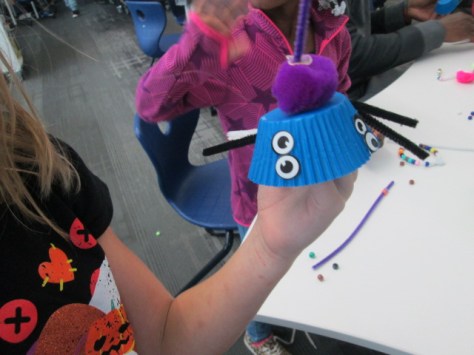
Students used a variety of supplies to design their own monsters. This included cupcake wrappers, pipe cleaners, eye stickers, pom poms, glue dots, and more. The thing I loved the most about this center was the character traits that each monster developed. Many students described their monsters in great detail as they worked and developed an impromptu story about each one. Again, students would look at their design and think about what they could add. Some even created parts of their monsters that moved so that they truly came to life.
Haunted House Construction
Students used Strawbees and straws to construct haunted houses. This center evolved as we went, and many students started building other things along the way too. For example, a student built a bird cage with a perch, but the bird was invisible because it was a ghost. Another student build a table-length monster and we talked about how he could have added paper onto his Strawbee skeleton to make a complete monster.
There was a lot of energy, noise, and fun during this makerspace, but it was so organized and focused. Students were engaged the entire time and had many options of what to go to. I wouldn’t run makerspace like this every time, but it was a great alternative to get more kids into the space and meet a variety of needs. Thank you Gretchen Thomas and UGA students for an awesome day of learning and fun.







 After 5th grade spent time, reading the book Love by Matt de la Pena & Loren Long, I silently turned back through each image in the book. We had spent time talking about some of the images as well as listening to Matt’s powerful words, but Ms. Foretich (art teacher) and I wanted them to have one more slow look at the images. Their goal in looking at the images for a 2nd time was to pick out an image that spoke to them in some way.












 Expect the Miraculous