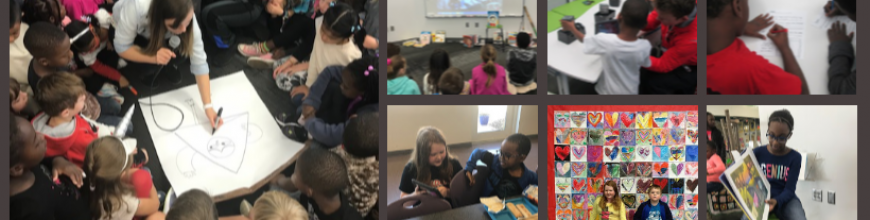
Student Book Budget: Meeting with Vendors

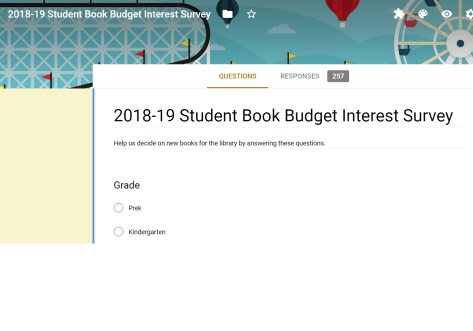
Our 2018-19 student book budget team is hard at work creating consideration lists of books for purchase. So far, they have created an interest survey, surveyed numerous students in our school, and set purchasing goals. I sent their goals to vendors and setup some appointments for vendors to meet with the team.
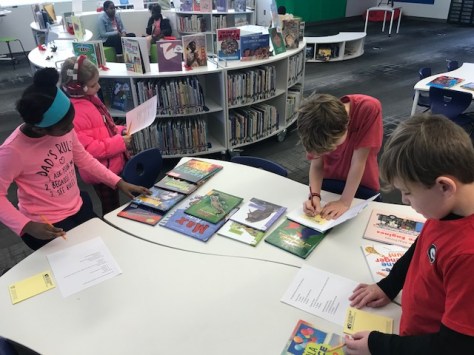
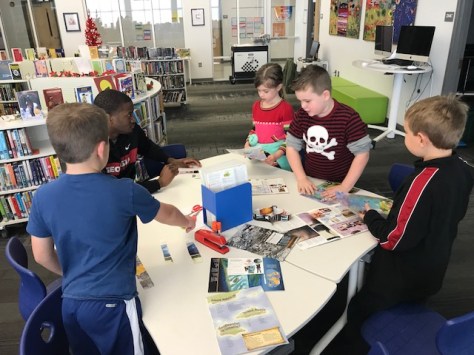
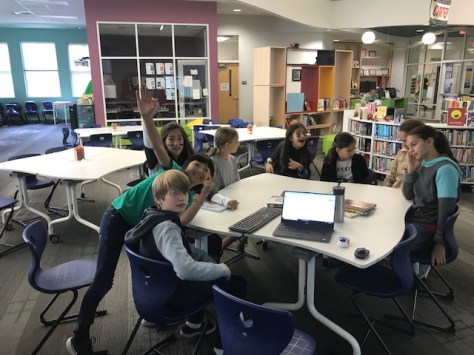
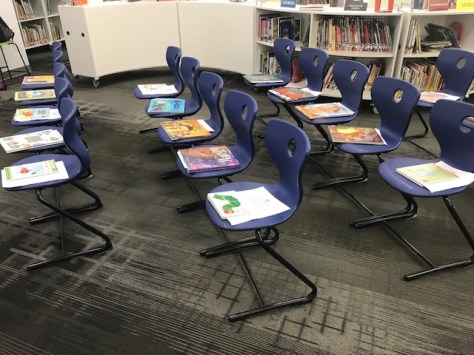
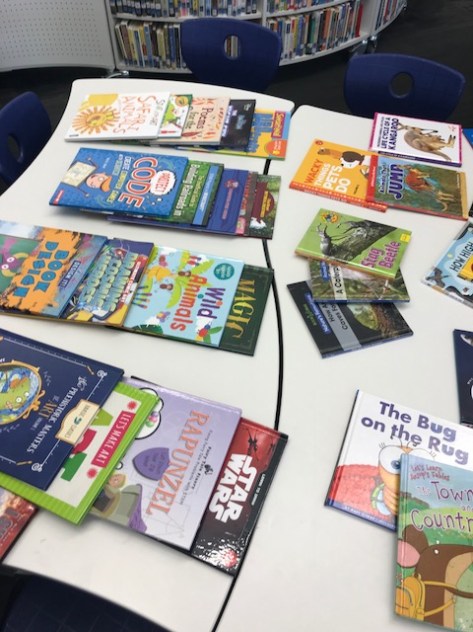
Our first vendor was Gret from Gumdrop Books. Gret brought in fiction and nonfiction and split them into separate groups on tables. She gave each student a pad of paper to write down item numbers for books or series they were interested in. They gave Gret each of their papers at the end of their time and then she put them into a consideration list in Excel. One of the things I love about what Gret does is that she has a printed list inside each book that shows other books in the series. Students can easily see if there are other books they are interested in.

Since Gret only had a sample of books to peruse, we had the Gumdrop website pulled up on the big screen so that Gret or students could search for books that weren’t represented on the tables. At the close of Gret’s time students in the 3 groups had made a list that totaled over $6,000! That’s not unusual for this group. It will become a good lesson later into how you get critical and purchase the very best of what you’ve found with the money you actually have.

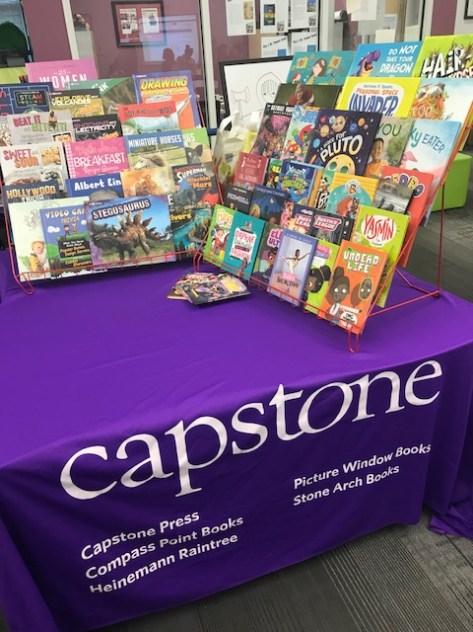
Our second vendor was Jim Boon from Capstone. Jim has worked with us since the very beginning of this project. He’s great at bringing in a variety of books in fiction and nonfiction and splitting them into 2 displays that students can easily access. He also has catalogs and pens shipped to the school prior to his visit so that students can look through catalogs for books that aren’t found in his displays. Jim does a quick overview of what he has brought, how to use the catalogs, and any promotions Capstone currently has. Then, he spends time assisting students in looking at books and finding specifics in the catalogs.

My favorite feature in the Capstone catalog is the barcode listed on each series. Students can scan the barcode and it pulls up the entire series on the screen. Then, students can check the books they want to add to the list.  It’s so much faster than having to write things down or bookmark pages in a catalog. Then, we can easily go into the list later to delete the books we don’t want.
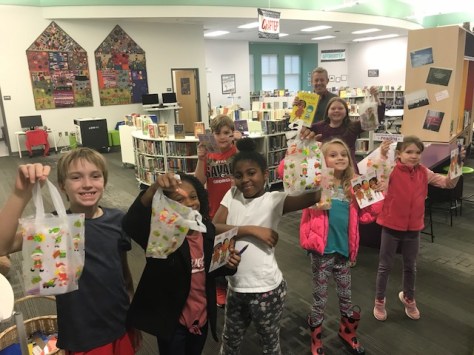
Jim gets right in with the students and helps them find whatever they are looking for. He’s so fun and keeps them laughing and shopping. He even brought them a special treat bag to go with their Capstone pen and bookmarks.

Now, students have a lot of work to do after the break looking through their Capstone catalogs and cutting books from their Gumdrop list. Then, we’ll meet with one more vendor before making final decisions.

I love watching this group work and seeing what stands out to them.
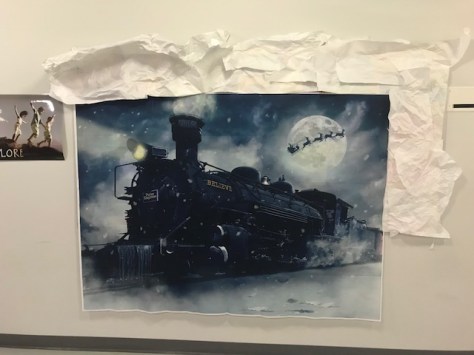
 

Polar Express 2018

Our Polar Express tradition continued this year in the library. Every year we host a Polar Express Day where every class comes to the library to enjoy hearing the story read aloud. Students and teachers get to wear their pajamas to school.

When they enter the library, they find hallways that have been transformed with special decorations thanks to a special team of elves (teachers) who come back to school at night to create some magic. In the library, the lights are turned off and our tables have been flipped on their sides to form a train that students board. The hot chocolate song comes on and a team of servers (parent volunteers) bring out hot chocolate for all.

A conductor (teacher) holds up the book while we listen to a recording of the story. At the close of the story, our parent volunteers come out and place a bell around each student’s neck and whisper “always believe” into their ears. Students receive a candy cane as they exit.

Many classes take a class photo together by the Barrow tree or with the new backdrop that Ms. Vaughn magically discovered.

This is a special day that takes so many people to pull off. It ends up being one of the many memories that students come back to again and again when they think about what they love about our school. We are so happy to continue this special tradition.

Thank you to:

  • Kim Ness, parent, who purchased bells, string, cups, marshmallows, hot chocolate, and candy canes. Thank you for also organizing our volunteers for the day and for organizing volunteers to prepare bells.
  • Families who donated their time to help the serve hot chocolate, punch tickets, and hand out bells.

  • Renee Williams, lunchroom manager, and the lunchroom superheroes who prepared our hot chocolate and let us borrow carts and trays.
  • Ellen Sabatini, principal, who created our schedule for the day.
  • Sarah Britton Vaughn, Phyllis Childs, Allyson Griffith, and everyone else who helped transform our halls
  • The team of parent volunteers who donated a morning to string over 600 bells.
  • Teachers for being on time, preparing students, turning pages, cleaning up spills, throwing away trash, and sharing your love with our students and families.
  • Katherine Byrne (family engagement specialist) & Lauren McElhannon (counselor) for organizing pajamas for students who didn’t have a pair to wear to school.
  • Our wonderful PTA for providing funds to purchase all of our supplies.
  • Anyone else I may have forgotten. If your name or job isn’t listed, it’s not intentional. This day takes so many hands. Please remind me and I’ll edit this post to include you.

Cloudy with a Chance of Meatballs Weather Reports

Back at the beginning of the year, I worked with first grade on weather reports using our green screen.  They learn lots of weather vocabulary, look at meteorologist reports, and create their own weather reports. When we were planning that idea, we talked about how it would be fun to look for books that feature some type of weather that kids could report on. Our minds were first on Cloudy with a Chance of Meatballs, but my mind continued to think of other books we could use as well. We ran out of time during quarter 1 to incorporate this idea, but the first grade team continued it into quarter 2.

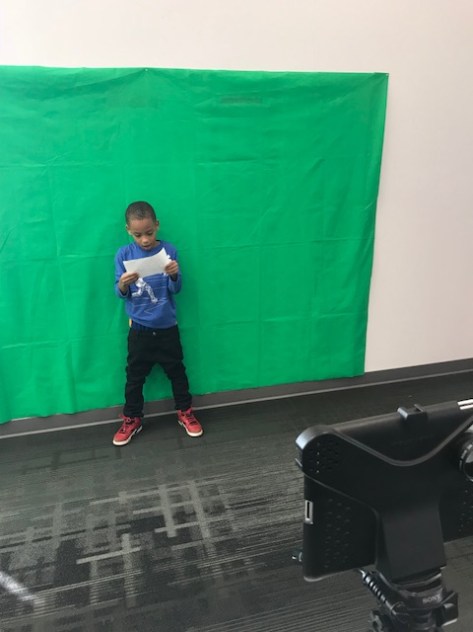
The teachers decided to focus on Cloudy with a Chance of Meatballs. Students created images featuring the weather of Chew and Swallow. Then, they wrote out a weather report for what was falling from the sky. In class, they practiced reading over their work before they came to the library to film.

My preference would be to film in small groups, but our limited time before the holidays prevented that from happening. Each class scheduled a 30-minute block. A collaborating teacher came with the class so that we could split the class up. I pulled 5 students at a time to take to the other side of the library to the green screen while the collaborating teacher read aloud some stories with the remainder of the class. As I finished with one group, the classroom teacher helped transition kids from green screen to storytime and bring a new green screen group.

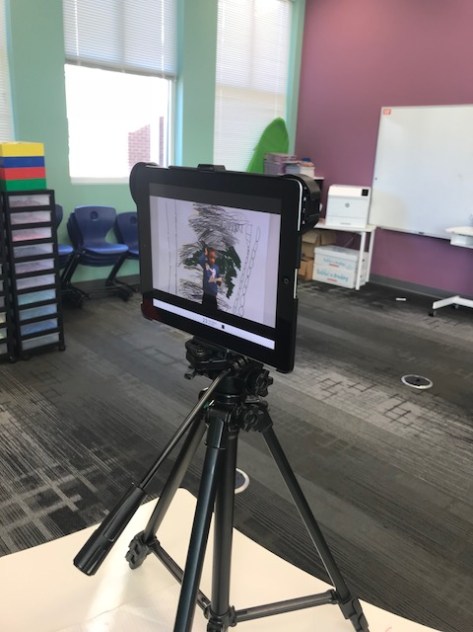
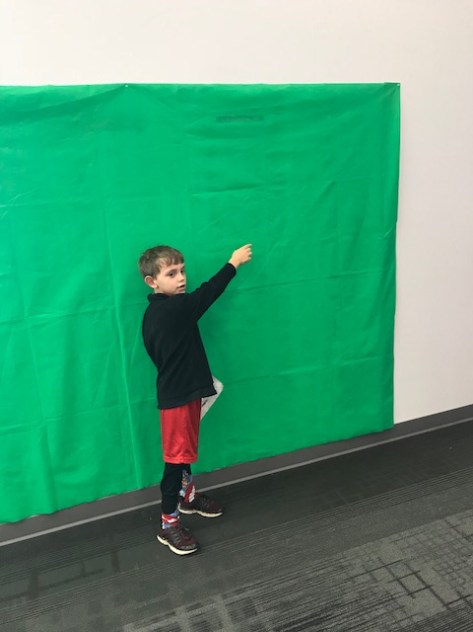
Our first step at green screen was to take a picture of each student’s artwork so that it could become the background image for the weather report. Next, students took turns coming to the green screen. We put their image as the background and faced the iPad toward them so they could see where various pieces of food appeared in their image.

They had practiced pointing to the parts of the weather as they reported, but some students forgot this piece while they were filming. We used the Do Ink green screen app on the iPad to film everything. Students left their piece of art with me so that I could use it to more easily add their names to the videos.

I plugged the iPad into the computer and uploaded each video to my Youtube page. I made a playlist for each class so that teachers could easily share the videos with families.

We have lots of room for improvement.  I would love to work more on the quality of the videos so students could be heard better. If we weren’t so rushed to film, then students could do a practice round and then film so that they could point to more parts of their images. I would also love to incorporate more books with weather instead of just focusing on one book. I’m so glad that the 1st grade team tried this out this year, and I can’t wait to see what we can add on next year.


Magazine Ornament Makerspace

Our open makerspace is taking a short break while our student book budget team works on new books for the library. We wrapped up our final makerspace session by hosting an ornament makerspace. Students signed up for this time with their teachers via a Google doc.

I have lots of old magazines that used to be in circulation but aren’t used anymore. I decided to pull them out and use them for our ornament materials as a way to promote reusing materials rather than throwing them out or putting them in recycling.

I wanted students to have a mixture of structure and freedom, so I selected 3 options for structured ornaments with a 4th option of designing your own.

Instructions for these 3 ornaments are found below.

Ornament 1 (top center):

  1. Cut 2 pages from a magazine and fan fold each page.
  2. Stack the 2 fan folds on top of one another and tie in the middle.
  3. If you want, trim the ends of the fan into a fancy design with craft scissors or regular scissors.
  4. Fan out each side and connect together to make a circle. Staple if low on time. Glue if you have time for drying.
  5. Use a hole punch to make a hole and tie a string.

Ornament 2 (bottom left):

  1. Cut multiple strips of the same length from a magazine page.
  2. Bring the ends of each strip together to form a loop.
  3. Repeat the process of bringing ends of strips together and begin adding the loops together.
  4. You might want to use a gem clip to hold the loops together if you have trouble holding them in your hand and folding paper at the same time.
  5. Staple the loops together at the top.
  6. Use a hole punch to create a hole and tie a string. (If you have added a lot of strips, it may be difficult to punch a hole)

Ornament 3 (bottom right):

  1. Cut 5 strips from a magazine page. 2 long, 2 medium, 1 short.
  2. Arrange the strips in this order: long, medium, short, medium, long.
  3. At one end of your stack, make sure the ends of the strips are even and staple them together.
  4. Starting in the center with the short strip, connect the two medium strips to the top of the short strip.
  5. Next, connect the two long strips to the short strip. Staple together.
  6. Use a hole punch to create a hole and tie a string.

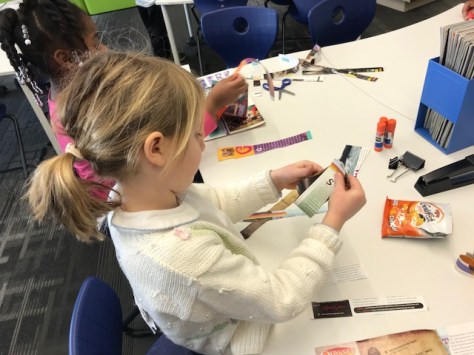
When students came to the makerspace session, I quickly showed them the 3 options which were all at their own table.  Then, I showed them a 4th table where they could design their own. Since a UGA class collaborates with us in makerspace, there was a UGA student at each table to assist students as needed with the directions. I also had a UGA student help with hole punching and string tying.

Students were welcome to make as many ornaments as they wanted. They could take them all with them, but they were also welcome to add them to our holiday area of the library. At the front of the library, I have pulled out all of our November/December holiday books and created displays to highlight those holidays such as Diwali, Thanksgiving, Hanukkah, Kwanzaa, Christmas, and New Year.

As with every makerspace time, I loved seeing how students took structured ideas and put their own creative spins on them. I also loved seeing what unique ideas students came up with on their own too. It’s always hard to decide how to balance structure with open-ended projects, but I think it’s important to offer both. We all learn in different ways. I’ve seen that some learners have high anxiety when given no structure and others have high anxiety when they have structure and think that their creation has to look exactly like the picture.

Several students did decide to add at least one of their creations to our tree in the library. It’s one more way that we can share ownership of our library.


2018-19 Student Book Budget First Steps

One of my favorite projects of the year has started. Our student book budget group is a group of 3rd-5th grade students who volunteer their time to decide on new books for the library.  This project has been a part of our library for several years. Each year, we make some adjustments to improve the process and make sure student voice is heard. Over the course of December and January, students in this group will survey the school on reading interests, develop goals, meet with vendors, develop consideration lists, place a book order that meets a budget, process new books, market new books, and enjoy reading the books they have selected.  It’s quite an undertaking, but something I cherish every year.

Step One

I created a Google form application that was emailed to all 3rd-5th grade students. In the application, I linked to a video that explained the project to students. Some teachers played this video for the whole class. Other teachers simply reminded students that applications were open. We made announcement reminders on our morning broadcast for students to apply.  Applications were only open for one week.

This year, I wanted students to make a commitment up front to stick with the project from beginning to end. I made this one of questions to help me decide who to accept into the group. I generally accept every student who applies, but if students weren’t willing to commit to the time the project takes, then I knew they might not be the best choice for the group. I knew I could at least talk in person with students who said no/maybe so that we could clear up expectations and requirements.

Step Two

Once students were chosen, I announced our team on the morning broadcast and communicated with them and their teachers via email. We have 25 students on this year’s team. Our routine schedule is to meet on Tuesdays and Thursdays at 11:00 for 3rd grade, 11:30 for 4th grade, and 12:00 for 5th grade. This time is taking the place of our open makerspace time during December and January.

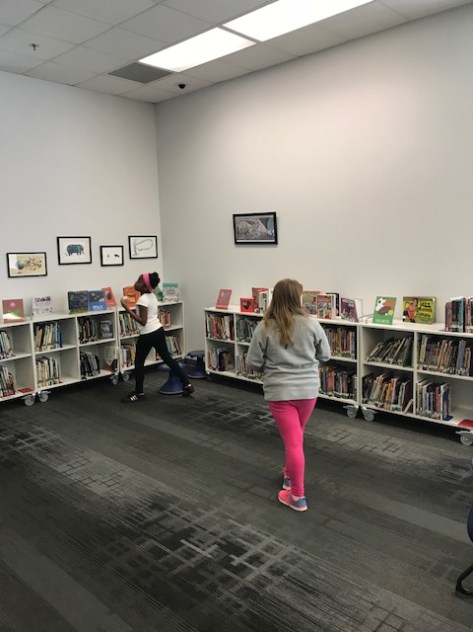
During our first meeting, students thought about what they might put on a survey about reading interests. They started by doing a walk around the library and seeing what they noticed about the shelves. For example, they saw how empty the dinosaur, fun facts, and ghost section was. They noticed that we have a lot more humor chapter books than they realized.  We used these noticings and last year’s survey to create a new survey.

In the end, they mostly kept the survey the same with a few small changes.

Step Three

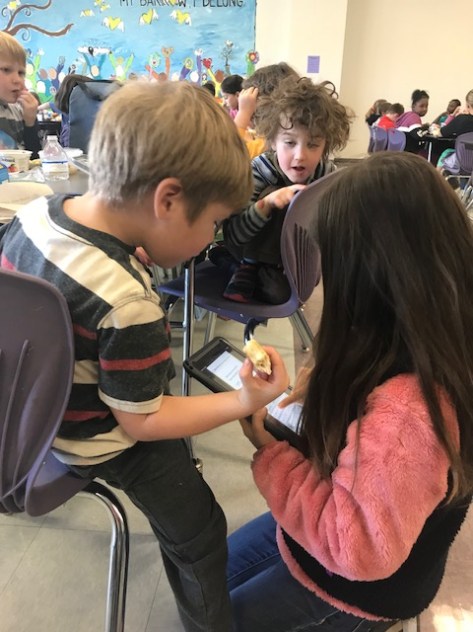
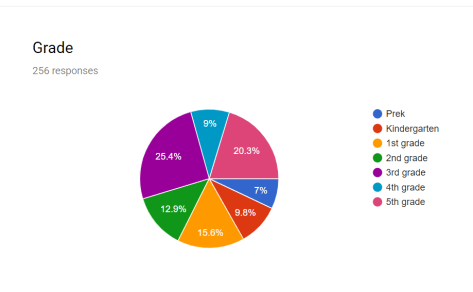
I emailed the survey to all 3rd-5th graders who have their own computer and let teachers know the survey was available. At our 2nd book budget meeting, each grade of students took iPads to the lunchroom and surveyed as many PreK-2nd grade students as possible.  Each time the survey was submitted, it sent the data to a spreadsheet and summary so that we could see which grade levels weren’t as heavily represented and we could begin to set goals for our purchasing.

Step Four

At our 3rd meeting, we checked in on our data to see what else we needed to do.  We noticed that we needed more 4th and 5th grader voices, so we surveyed some of them at recess and made a final plea to teachers to give them time to take the survey in class.

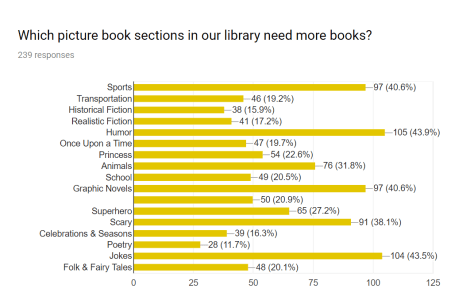
We also used the 3rd meeting to go ahead and notice what the data was telling us so far.  Each group noticed that in picture books the top requests were humor, jokes, graphic novels, and sports.  In chapter books, the top requests were humor, sports, and mystery. In informational, the top requests were fun facts, cooking, ghosts, and animals/dinosaurs.

Students compared these results with what they noticed in their walk around the library. They saw that things mostly matched, but the biggest difference was the humor chapter books.  People are asking for more, but we have so many that aren’t getting checked out. This is a point they are considering so that they really focus on what they think people will actually read.

Moving Forward

Now, we are wrapping up our survey and firming up our purchasing goals so that we can start meeting with booksellers.  We already have appointments with Jim Boon at Capstone and Gret Hechenbleikner at Gumdrop to look at their products. We’ll continue to update our progress along the way.


Our 2018 Picture Book Smackdown was a Success!

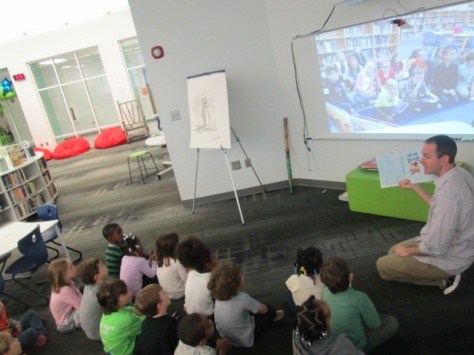
The 2018 Picture Book Smackdown was held on November 29, 2018.  This has been a yearly tradition since November became Picture Book Month.  During a smackdown, we hold a Youtube Live event where students and authors in multiple states book talk as many picture books as possible across 45-60 minutes.

This year’s smackdown featured students in 4 different grades in 3 different states, which included:

Andy Plemmons and students at David C. Barrow Elementary in Athens, GA

Donna MacDonald and students at Orchard School in South Burlington, VT

Julee Murphy and students at Early Childhood Development Center in Corpus Christi, TX

Ahead of the event, students selected a picture book to share, read the book, prepared a script, and practiced.  I also communicated with all the librarians at each site to make sure we all knew our roles during the hangout.

I made a Smore for us to advertise our event, and it’s really fun to see where people are viewing the smackdown from.

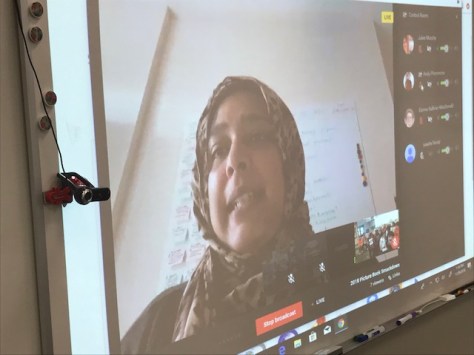
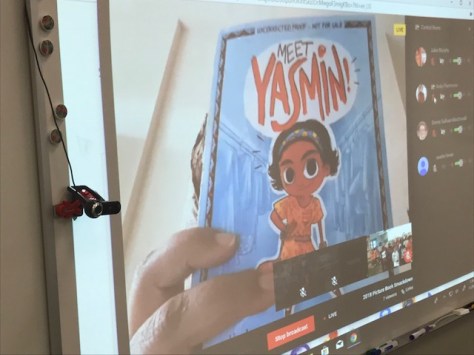
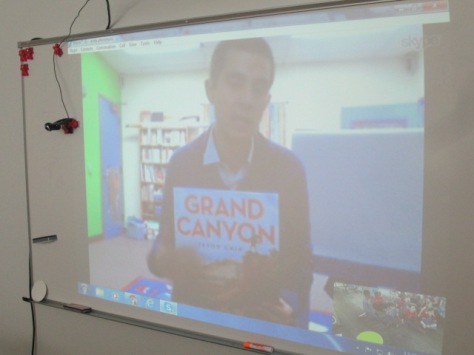
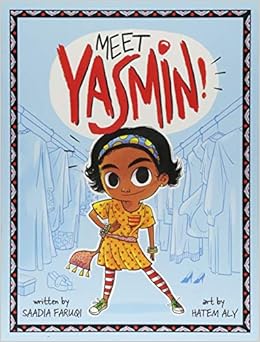
Donna MacDonald reached out to author Saadia Faruqi who agreed to kickoff our smackdown. She shared her Yasmin books as well as 3 favorite picture books featuring Muslim characters and stories.  We can’t thank her enough for speaking to our students. I know many of my students want to read all of the Yasmin books now.

During the smackdown, we had 5 students from each school step to the microphone, share their name, and tell about their book. We kept this rotation going until we ran out of students or time.

It was amazing to see that every student chose a different book, even though we didn’t plan that. We kept a list of all of our books so we could remember them for our own libraries and to share with all of you.

Saadia Faruqi closed out our hangout by encouraging students to continue to read picture books and create their own stories. She found it so encouraging to see so many students reading and also enjoying the books that she created herself.

You can watch the full smackdown here.

I encourage you to host your own, even if it’s just in your own school.  We are even thinking about doing a smackdown with other formats of books like graphic novels or chapter books.  Thank you to everyone who participated and watched.  We’ll see you next year for the 2019 Picture Book Smackdown.

It’s Time to Plan for World Read Aloud Day 2019

It’s time for us all to start making plans and building excitement for World Read Aloud Day 2019 with Litworld.  This year, World Read Aloud Day takes place on February 1, 2019, but many of us will celebrate the entire week of January 28-February 1, 2019.

wrad15-day-3-15

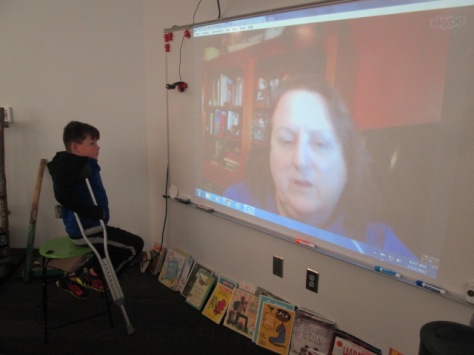
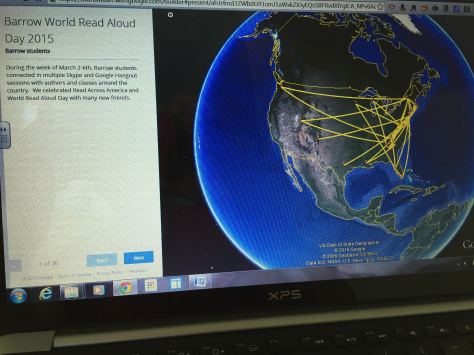
World Read Aloud Day “calls global attention to the importance of reading aloud and sharing stories.”  When we connect our students through Skype, Google Hangouts, or other web tools, they experience the power of the read aloud and realize that they are connected with a bigger world that is both the same and different from them.  By connecting our voices through reading aloud, we are reading on behalf of the 758 million people who cannot read.

Shannon McClintock Miller, Matthew Winner, and I invite you to start posting your schedules on our shared Google Doc.
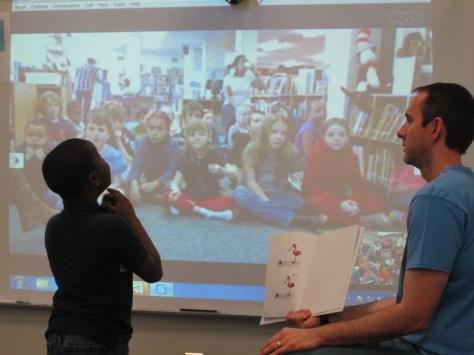
World Read Aloud Day 2019 Planning Document

This year, we’ve tried to organize the document by time zones to make it easier to find connections that work for you.  If you don’t see your time zone listed, please add it as a heading.

When you share your schedule, be sure to include:

  • Your name
  • Your contact info such as social media, Skype, and/or email
  • Your role
  • Your school and grade levels
  • Your location
  • List your time zone when posting your available dates and times

wrad-map

After you post your own schedule, take a look at the other schedules and sign up on someone’s schedule to connect your students.  We’ve found that it doesn’t matter if same grade levels connect with one another. Often times, an older grade can read aloud to a younger grade or younger grades can find parts of a books that they can read aloud to an older grade.  There’s not just one way to connect.  Part of the fun is meeting new friends, planning your read alouds, and seeing what magical things happen during your connection that you weren’t even expecting.

We have many ideas from previous years on our blogs.  You can read more about previous World Read Aloud Day connections on Expect the Miraculous and The Library Voice.  Litworld also has several resources for you to use in your planning and connections including:

wrad16-5

Please let us know if you have any questions.  Happy connecting!

Shannon McClintock Miller @shannonmmiller Matthew Winner @matthewwinner & Andy Plemmons @plemmonsa

Join Us for the 2018 Picture Book Smackdown

We are in the midst of one of my favorite months to celebrate in the library, Picture Book Month. In 2013, I started brainstorming with several dynamic librarians across the country a way for us to celebrate the close of the month.  Jenny Lussier, Cathy Potter, Shawna Ford, Kathy Kaldenberg, and I created the very first Picture Book Smackdown which was held via Google Hangout on November 21, 2013.  Authors Laurel Snyder and Ame Dyckman joined us as well.  For one hour, we all shared as many picture book talks as possible.  This was the beginning of an annual event that is now in its 6th iteration.

This year, our event will take place on November 29th from 1:30PM-2:30PM EST.  We will feature students from:

  • David C. Barrow Elementary in Athens, GA (facilitated by Andy Plemmons)
  • Orchard School in South Burlington, VT (facilitated by Donna MacDonald)
  • Early Childhood Development Center in Corpus Christi, TX (facilitated by Julee Murphy)

This year we are also very excited to announce that we will be joined by author, Saadia Faruqi. She is the author of Meet Yasmin!, Yasmin the Fashionista, Yasmin the Painter, Yasmin the Explorer, and Yasmin the Builder.  

I‘ve put together a Smore which will be a place holder for our live broadcast on Youtube Live.  Even if you can’t join us, you can watch the archive of our smackdown via the link on the Smore.

What to expect:

  • A live broadcast via Youtube Live or archived to watch at a later time
  • Numerous student voices book talking their favorite picture books in 3 states
  • A short talk from Saadia Faruqi about why picture books matter in the world
  • A list of the books we reference

What you can do:

  • Watch live with your class!
  • Host your own picture book smackdown in your classroom, library, or district
  • Share your favorite picture books on social media using the hashtags #pbsmkdwn and #picturebookmonth
  • Send students a shout out on Twitter using #pbsmkdwn

In Loving Memory of Dianne de Las Casas

We will of course continue reading and sharing picture books all year long, but we want to end November with this special event.  This year’s Picture Book Smackdown is once again dedicated in loving memory of Dianne de Las Casas, founder of Picture Book Month.  We lost Dianne in a tragic fire, but her legacy of advocating for the importance of picture books in our world lives on.

Happy Picture Book Month 2018

It’s November 1, which means the beginning of picture book month. We’ve been celebrating this special month since it was created back in 2011 by Dianne de Las Casas. Today, we launched our annual picture book challenge. The challenge has been a bit different each year.  Some years, students have earned stamps for reading a certain number of picture books. Other years, students have set their own personal goals for what to read whether it was reading a certain number, all the books by a specific author, every book on a certain shelf, etc.

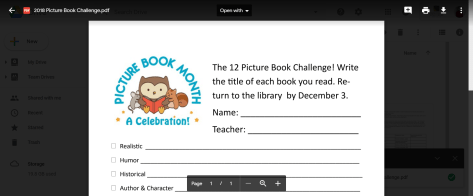
This year, I decided to focus on the genres of our picture book section.  I made a sheet that lists out each picture book genre/format in our library with a check box by each one. I also included a line. The goal is for students to read 12 picture books across the month of November, 1 book from each section. They simply write the title of the book on the line when they finish reading. At the bottom of the sheet, I asked students to list their favorite book they read for the challenge and tell why picture books matter in the world.

At the end of picture book month, we hold a picture book smackdown where we do a virtual hangout with authors and schools to book talk favorite picture books. I hope that the challenge will get some students prepped for the smackdown by already having a favorite book and a reason picture books matter.

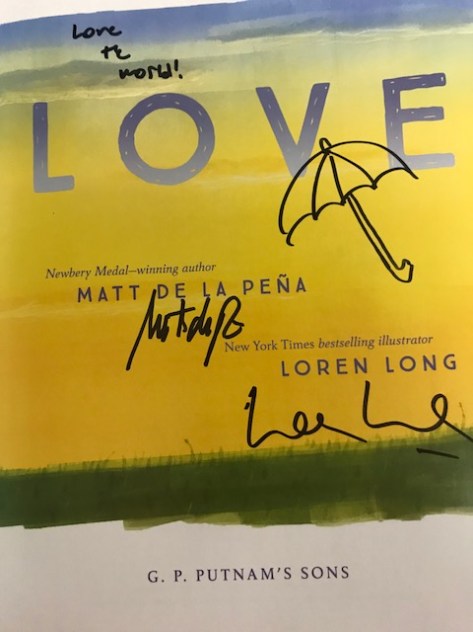
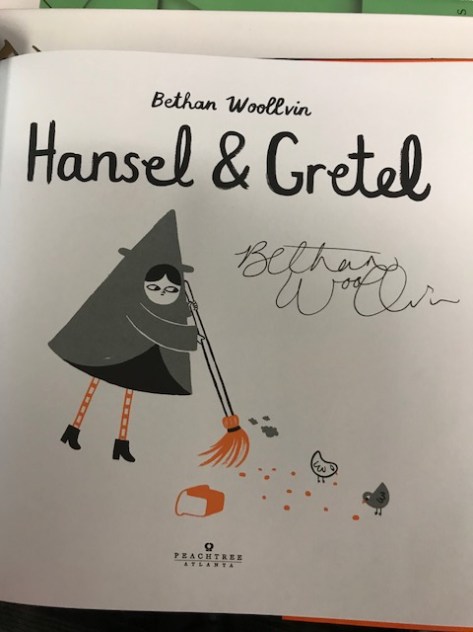
Today, we launched the challenge on our morning broadcast by going over the instructions and showing the sheet.  I’m also highlighting a diverse selection of books in my read alouds and encouraging students to think about windows and mirrors as they read for the challenge.Every student who finishes the challenge will get a certificate and a special bookmark. We will also announce their name on our morning broadcast. Each finisher will also have their name entered into a drawing for an autographed picture book. I try to get an extra autographed picture book each time we have an author visit or I go somewhere to hear an author. This year I’ll give away signed copies of More-igami, King Alice, Love, Last Stop on Market Street, and Hansel and Gretel. I showed each of these books on the morning broadcast too.

If you go to our school or want to take a look at our challenge sheet, you can download it here.

Punkin’ Chunkin’: A Halloween Makerspace Event

Our makerspace sessions this year have been following a month-long theme, but for Halloween, we decided to have a one-time special makerspace.  In the past, we’ve done a “design something spooky” challenge where kids designed haunted houses, ghosts, etc and used littlebits to give them lights, sound, and movement.

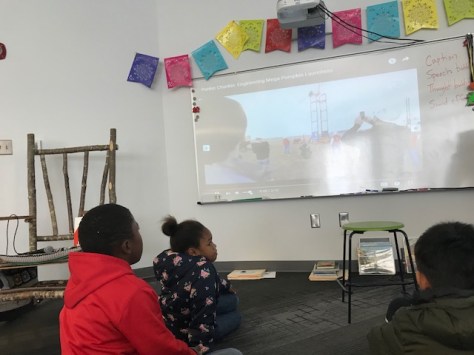
This year, Gretchen Thomas from UGA suggested pumpkin catapults, and it was the perfect suggestion. Ahead of the session, students signed up on a Google doc with their teacher for a 30-minute slot.  As students arrived, they checked in with a UGA student and sat on the carpet in front of the projector.  While we waited on arrivals, they watched a video of the Punkin Chunkin event in Delaware.

We chatted about observations. Many students noticed the different styles of catapults that were made and we wondered about how many times they had to work on their inventions before they worked the way they wanted them to.

Next, I muted a video showing students working on a smaller scale pumpkin catapult.

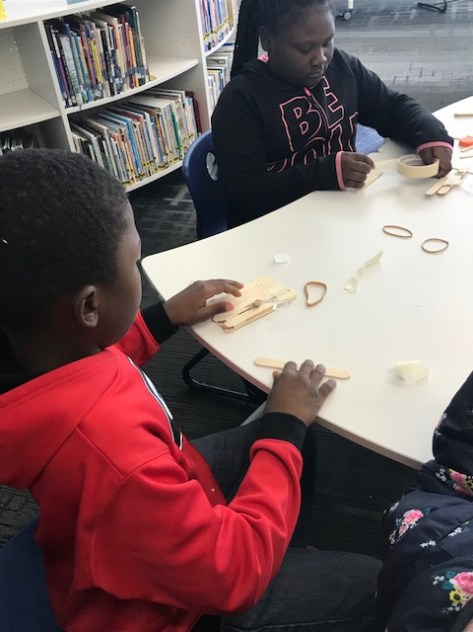
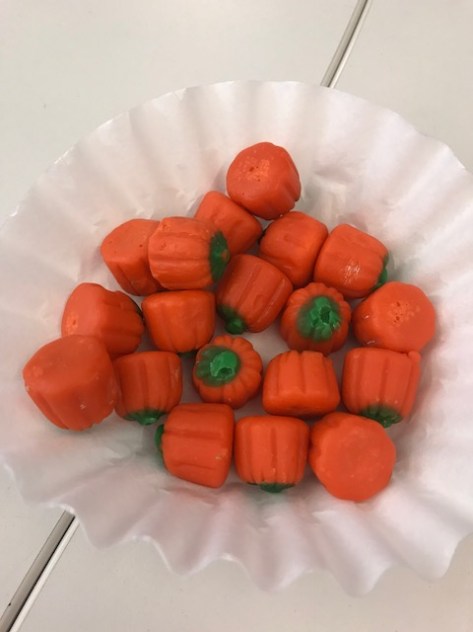
While the video played, we talked about the day’s challenge. Students were challenged to design a catapult that could launch a candy pumpkin across the library. They used the video to name some of the materials they would need: plastic spoon, popsicle sticks, rubber bands, tape, and a pumpkin. Students also saw in the video that there were many designs of catapults and that adjustments were constantly being made to improve the catapults.

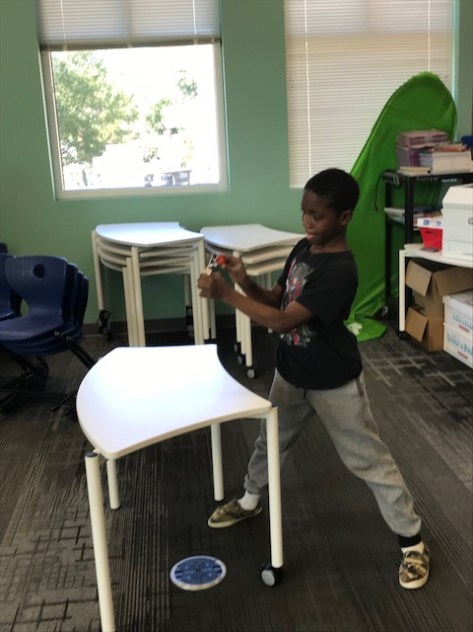
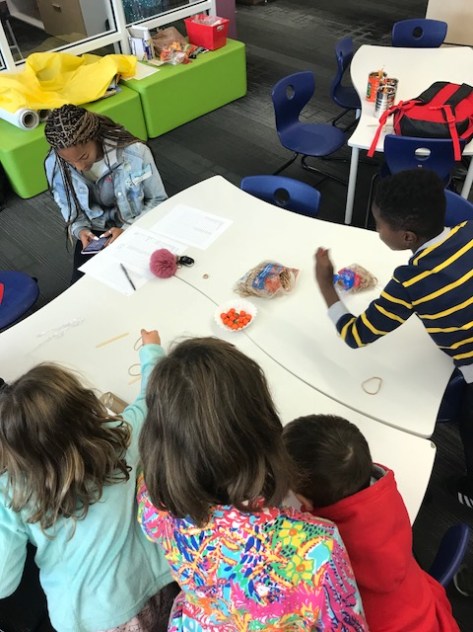
When they were ready to take on the challenge, students gathered their initial materials from a supply table and made their first attempt at a pumpkin catapult. Some jumped right in while others went back to watch the video again. Some chose to work together, while others chose to work alone.

As first attempts were finished, students picked up a candy pumpkin and moved to our launch zone. This was a crucial piece of the experience. I wanted a designated area for launching in order to contain the mess but also to keep students safe from flying projectiles. We launched pumpkins in the back of the library toward our green screen wall.

Most students had mediocre first launches, so we chatted with them about what they thought might improve their design.  Students went back and forth from the launch zone to the building areas.  UGA students spent most of their time at tables assisting students who were stuck or needed an extra hand. Some of them also helped with keeping students safe from flying pumpkins in the launch zone.

Even with pumpkins flying in the back of the library, this was a surprisingly peaceful makerspace. Students were very focused on their designs, especially as we moved higher in grades. Pairs of students worked well together and students were for the most part safe when launching pumpkins. I loved seeing the many different designs. Some were very simple and some attempted to make very elaborate catapults.

This experience could have many extensions if we had more time. I would love to add a measurement component to see which catapult threw pumpkins the farthest. We kept things very open-ended, but you could also establish some boundaries as to what elements of the catapult were required, how many materials could be used, etc.

With the time we had, this was the perfect setup. Students had plenty of time to make a catapult that had some type of success and they were able to take what they made with them to continue working on or exploring.