Student Book Budget: Meeting with Vendors

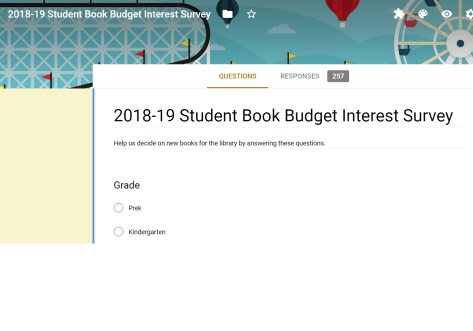
Our 2018-19 student book budget team is hard at work creating consideration lists of books for purchase. So far, they have created an interest survey, surveyed numerous students in our school, and set purchasing goals. I sent their goals to vendors and setup some appointments for vendors to meet with the team.

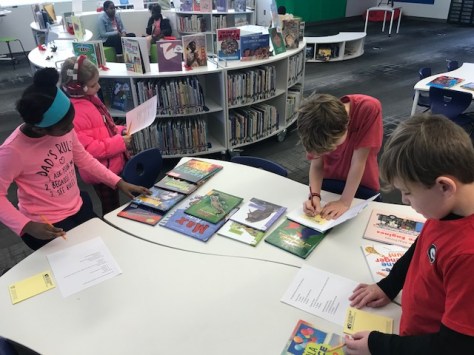
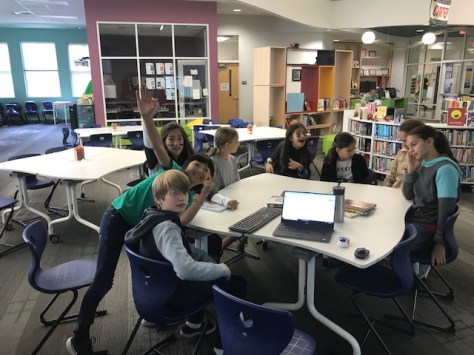
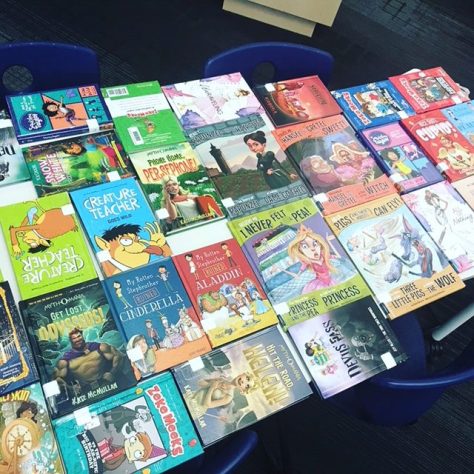
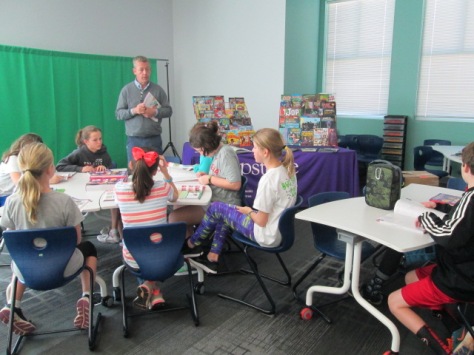
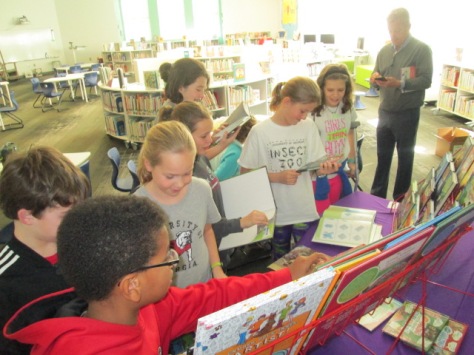
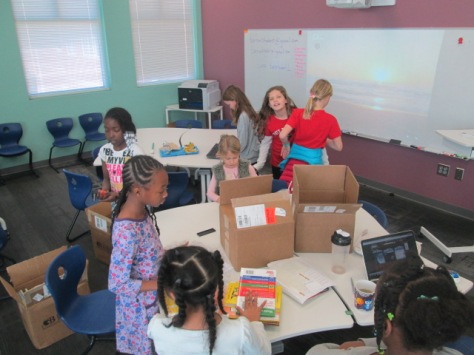
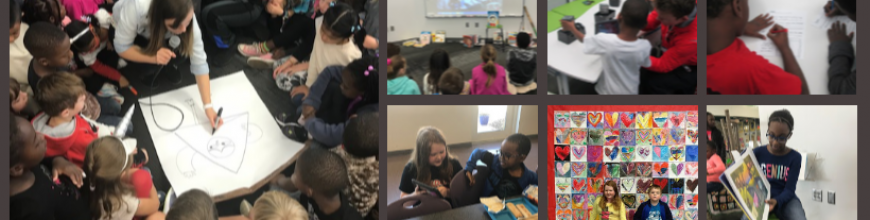
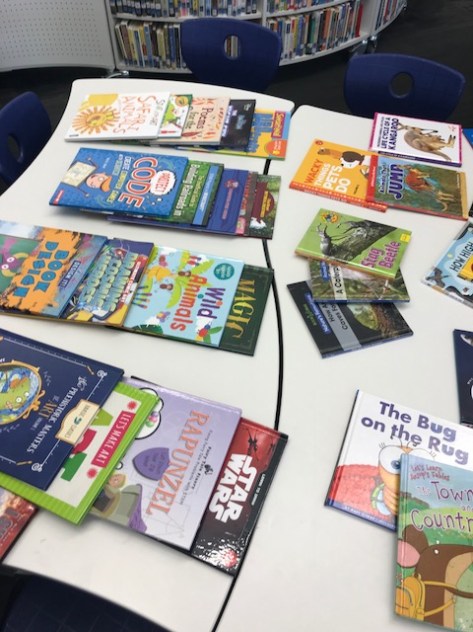
Our first vendor was Gret from Gumdrop Books. Gret brought in fiction and nonfiction and split them into separate groups on tables. She gave each student a pad of paper to write down item numbers for books or series they were interested in. They gave Gret each of their papers at the end of their time and then she put them into a consideration list in Excel. One of the things I love about what Gret does is that she has a printed list inside each book that shows other books in the series. Students can easily see if there are other books they are interested in.

Since Gret only had a sample of books to peruse, we had the Gumdrop website pulled up on the big screen so that Gret or students could search for books that weren’t represented on the tables. At the close of Gret’s time students in the 3 groups had made a list that totaled over $6,000! That’s not unusual for this group. It will become a good lesson later into how you get critical and purchase the very best of what you’ve found with the money you actually have.

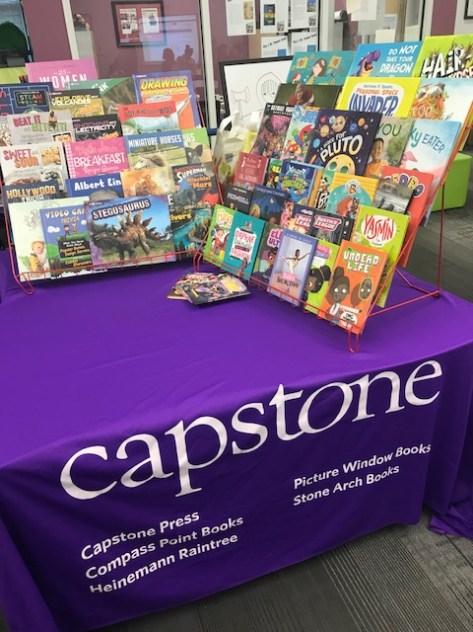
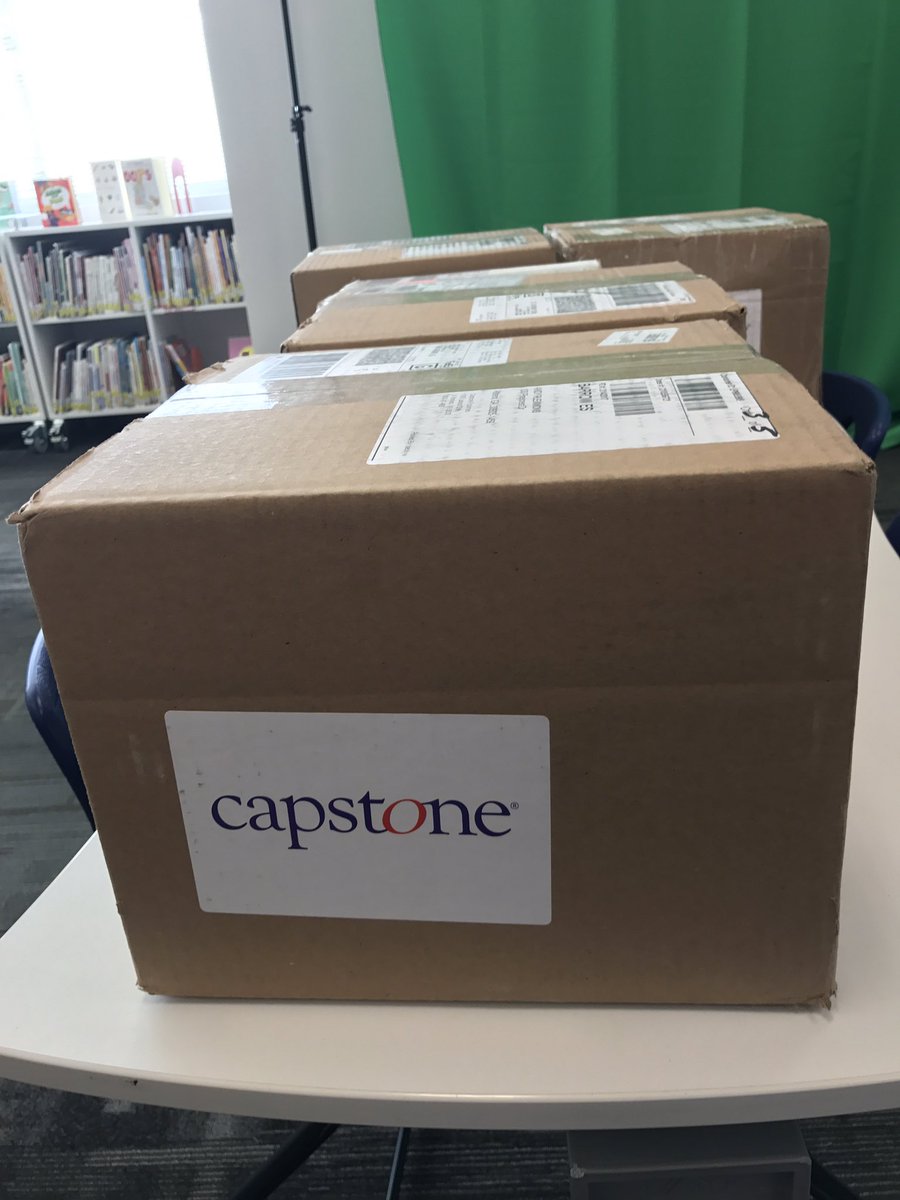
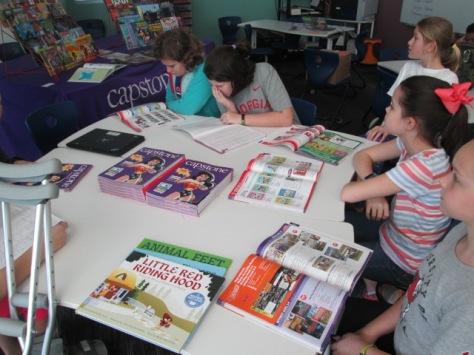
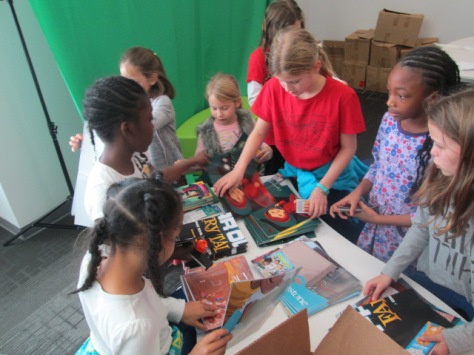
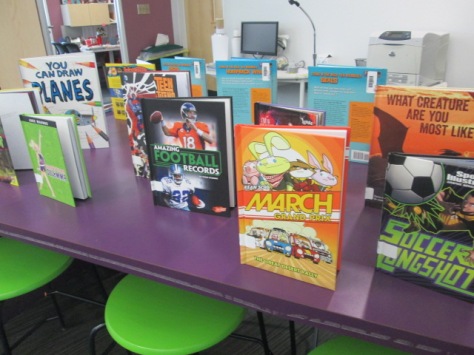
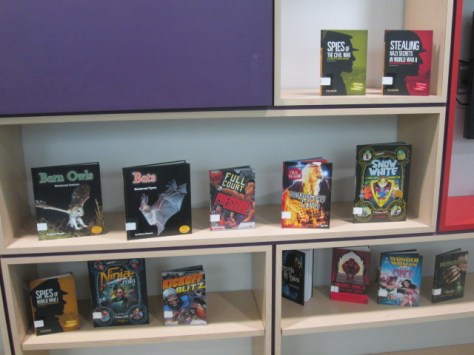
Our second vendor was Jim Boon from Capstone. Jim has worked with us since the very beginning of this project. He’s great at bringing in a variety of books in fiction and nonfiction and splitting them into 2 displays that students can easily access. He also has catalogs and pens shipped to the school prior to his visit so that students can look through catalogs for books that aren’t found in his displays. Jim does a quick overview of what he has brought, how to use the catalogs, and any promotions Capstone currently has. Then, he spends time assisting students in looking at books and finding specifics in the catalogs.

My favorite feature in the Capstone catalog is the barcode listed on each series. Students can scan the barcode and it pulls up the entire series on the screen. Then, students can check the books they want to add to the list.  It’s so much faster than having to write things down or bookmark pages in a catalog. Then, we can easily go into the list later to delete the books we don’t want.

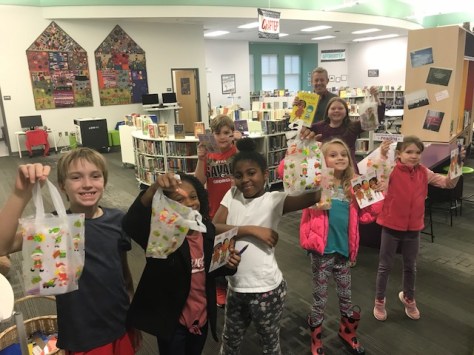
Jim gets right in with the students and helps them find whatever they are looking for. He’s so fun and keeps them laughing and shopping. He even brought them a special treat bag to go with their Capstone pen and bookmarks.

Now, students have a lot of work to do after the break looking through their Capstone catalogs and cutting books from their Gumdrop list. Then, we’ll meet with one more vendor before making final decisions.

I love watching this group work and seeing what stands out to them.


2018-19 Student Book Budget First Steps

One of my favorite projects of the year has started. Our student book budget group is a group of 3rd-5th grade students who volunteer their time to decide on new books for the library.  This project has been a part of our library for several years. Each year, we make some adjustments to improve the process and make sure student voice is heard. Over the course of December and January, students in this group will survey the school on reading interests, develop goals, meet with vendors, develop consideration lists, place a book order that meets a budget, process new books, market new books, and enjoy reading the books they have selected.  It’s quite an undertaking, but something I cherish every year.

Step One

I created a Google form application that was emailed to all 3rd-5th grade students. In the application, I linked to a video that explained the project to students. Some teachers played this video for the whole class. Other teachers simply reminded students that applications were open. We made announcement reminders on our morning broadcast for students to apply.  Applications were only open for one week.

This year, I wanted students to make a commitment up front to stick with the project from beginning to end. I made this one of questions to help me decide who to accept into the group. I generally accept every student who applies, but if students weren’t willing to commit to the time the project takes, then I knew they might not be the best choice for the group. I knew I could at least talk in person with students who said no/maybe so that we could clear up expectations and requirements.

Step Two

Once students were chosen, I announced our team on the morning broadcast and communicated with them and their teachers via email. We have 25 students on this year’s team. Our routine schedule is to meet on Tuesdays and Thursdays at 11:00 for 3rd grade, 11:30 for 4th grade, and 12:00 for 5th grade. This time is taking the place of our open makerspace time during December and January.

During our first meeting, students thought about what they might put on a survey about reading interests. They started by doing a walk around the library and seeing what they noticed about the shelves. For example, they saw how empty the dinosaur, fun facts, and ghost section was. They noticed that we have a lot more humor chapter books than they realized.  We used these noticings and last year’s survey to create a new survey.

In the end, they mostly kept the survey the same with a few small changes.

Step Three

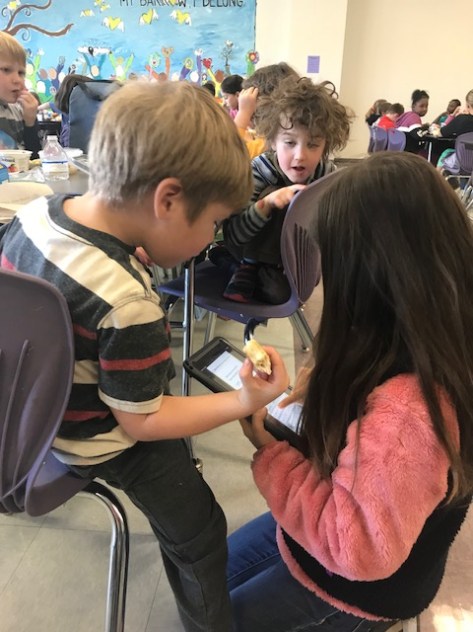
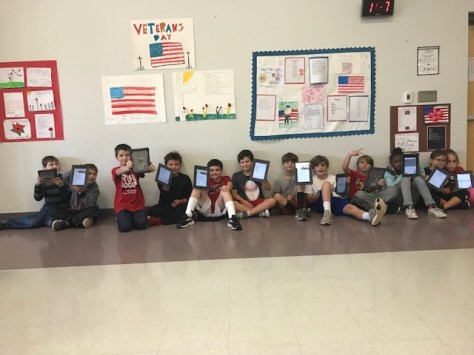
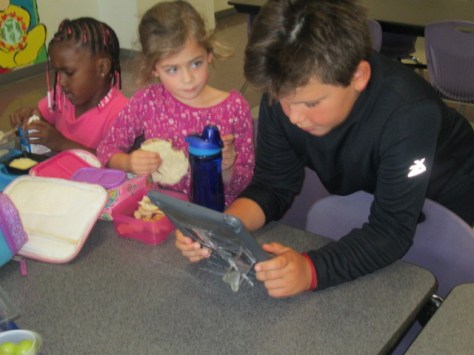
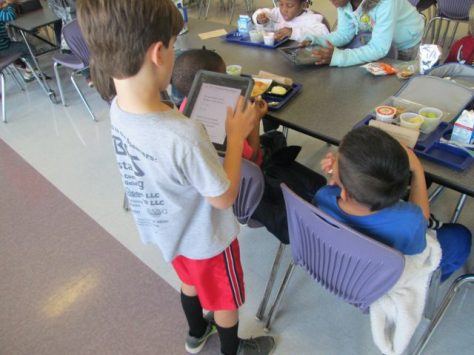
I emailed the survey to all 3rd-5th graders who have their own computer and let teachers know the survey was available. At our 2nd book budget meeting, each grade of students took iPads to the lunchroom and surveyed as many PreK-2nd grade students as possible.  Each time the survey was submitted, it sent the data to a spreadsheet and summary so that we could see which grade levels weren’t as heavily represented and we could begin to set goals for our purchasing.

Step Four

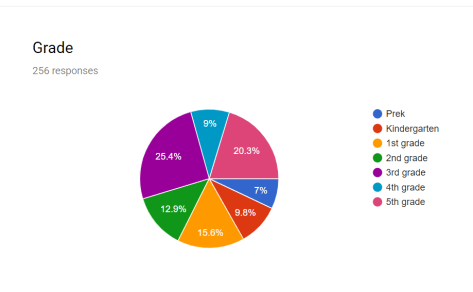
At our 3rd meeting, we checked in on our data to see what else we needed to do.  We noticed that we needed more 4th and 5th grader voices, so we surveyed some of them at recess and made a final plea to teachers to give them time to take the survey in class.

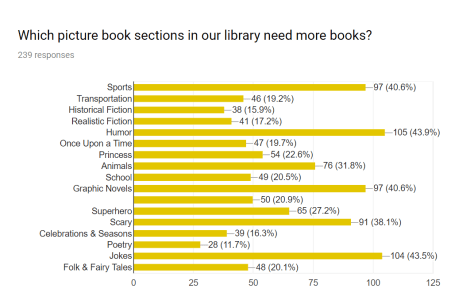
We also used the 3rd meeting to go ahead and notice what the data was telling us so far.  Each group noticed that in picture books the top requests were humor, jokes, graphic novels, and sports.  In chapter books, the top requests were humor, sports, and mystery. In informational, the top requests were fun facts, cooking, ghosts, and animals/dinosaurs.

Students compared these results with what they noticed in their walk around the library. They saw that things mostly matched, but the biggest difference was the humor chapter books.  People are asking for more, but we have so many that aren’t getting checked out. This is a point they are considering so that they really focus on what they think people will actually read.

Moving Forward

Now, we are wrapping up our survey and firming up our purchasing goals so that we can start meeting with booksellers.  We already have appointments with Jim Boon at Capstone and Gret Hechenbleikner at Gumdrop to look at their products. We’ll continue to update our progress along the way.


Student Book Budget: Let the Readers Read

The last group of books from this year’s student book budget group has arrived.  Our spring break slowed us down a bit, but our Capstone books are finally ready.

When the books arrived, students worked together to unpack the boxes and check the packing slip.  Next, students made decisions about what genres each book would go into and added the genre label to the spine. Finally, they scanned the books into each genre subcategory.

The books were put on display in the center tables of the library as well as in the library windows. As the team was setting up the books, students were already checking them out.

This project always amazes me because it allows so many high-interest books to be added to our collection.  I’m to the point now where I reserve much of our book fair profit to use on this project. This is combined with Capstone Rewards dollars which stretch our budget a bit further.

I’m also very grateful to Capstone for letting our book budget team members choose an additional book to add to the collection that is completely their choice.

This spring break, I traveled to Mankato, MN to speak to many of the Capstone employees about the work of students in my school.  The book budget team was a big part of what I shared.  After my talk, they even sent us some additional books to improve our fun facts section of the library since that was a category we focused on this year.

I was also able to go behind the scenes to see all of the steps an order goes through before it arrives at our school.  When the boxes arrived, I could tell the students about the many hands that went into creating the books as well as the people who helped with the order. Each book was gathered from the warehouse shelves by hand. The labels were lovingly placed onto each book by hand. Each book was hand-packed into boxes and prepared for shipping.

The experience of seeing all of the people behind the company is making me think more about next year’s group and what layers we might add on to our project.

Now, it’s time for the readers of Barrow to read the books that were carefully chosen based on the data we received.  We can’t wait to see readers checking out these books again and again.

Thank you Capstone for your generous support of our project.

2018 Student Book Budget: First Steps

It’s time for one of my favorite projects of the year: Student Book Budget. Every year, I reserve a part of the library budget that is under complete control by students. This budget comes from many places.  Sometimes it’s a grant and other times it is part of our regular budget.  This year their budget comes from the profit we made from book fair.  The book budget is their chance to make sure that books are added to our library that represent their interests.  They go through a long process to make sure that many voices are represented in their purchases.  Over the next few weeks, I’ll be sharing their process.  Here are some of the steps that are already happening.

First, I created a Google form application for students to apply to be in the group.  The form was available for one week for students in grade 3-5.  Every student who applied and had a genuine reason for being in the group was accepted.  Our group this year is 40 students strong and has a great mix of boys and girls.

Next, we held our 1st meetings. I met with each grade level group separately and answered all of their questions about the group. Then, in small groups or pairs, they brainstormed things that they thought we should ask on a reading interest survey for the whole school.

Then, I took their ideas and put them into a Google form survey.

I sent the survey to all of the students on the book budget team so that they could review it and decide if it matched their comments.  We made some minor adjustments and were ready for the school to be surveyed.

I sent the survey via email to our 3rd-5th grade students who each have their on device. The Student Book Budget Team was responsible for surveying Prek-2nd grade. On our 2nd meeting, we scanned QR codes to get to the survey on an iPad and went to recess and lunch to survey as many people as possible.

https://twitter.com/plemmonsa/status/931192938805252096

The students were so professional and I loved standing back and watching them work.  It truly was their project and they were taking it very seriously.

In just one day, we have already surveyed 216 students.  We will continue this process and then take the next step of looking at the results.  I love how we can check along the way to see which grades need to be surveyed more so that we have a somewhat even distribution of voices.

Be on the lookout for our next steps.  We are off to a great start.

The 2017 Student Book Budget Books Have Arrived!

Every year a volunteer group of students give their time to spend a budget on books for the library. This budget comes from grants, book fair profits, and rewards points and it is completely in their control. They create a survey, interview students throughout the school, analyze the results, set goals, meet with vendors, create consideration lists, narrow the lists to the final order, unpack the books, and display them for checkout.

This year’s book budget group purchased over 150 new books for our library from Capstone and Avid Bookshop.

When the books arrived, this year’s crew had a big additional step that previous crews didn’t have.

They had to sort the books into genre categories, label the books with their new genres, and scan them into those subcategories in Destiny.

Once the books were all ready, the students put them on display all over the tables of the library, and the excitement of check out began.

Because there were so many books, it was hard to put them all out at once. As books got checked out, we refilled the tables with new books.  Within the day that the books were put on display, almost all of them had been checked out.

Once again, the amazing Amy Cox at Capstone allowed our committee members to choose 1 book that was their personal choice for the library and these books were donated to us as a thank you.  Students got to put a personalized label on the inside cover to show that they were the selector of the book.

Student voice matters in the library, and every year I value this process of seeing students BE the process of collection development instead of just requesting books to be purchased.  When they take part in every step of the collection development process, they see the thought that goes into each book on our library shelves.

They see that their interests and requests matter because they immediately see those represented in the books on our shelves.  If the library is to be a true community, then I feel like one person can’t decide on all of the books in the collection. I certainly have a major role in collection development, but when my students work alongside me in this process, we all become members of our library rather than just a consumer.

Happy reading!


When Vendors Listen to Students

capstone-student-signs-1

Student voice is important to me. I love to find opportunities where students’ voices are listened to, and even more than that, acted upon.  Recently, during a student book budget meeting, we met with Jim Boon from Capstone.  Jim always listens to students and makes sure they have what they need in order to purchase books for the library.  He lets them guide the conversation and answers any questions they have rather than pushing certain titles that they aren’t interested in.

capstone-4

During his recent visit, he gave students posters at the end as a thank you, and Adaline, a 5th grade student book budget member, asked if there were ever any World War I posters.  Rather than just saying “no”, Jim listened to her reasoning that war and military books are popular in our school and that she had a personal interest in them herself. He suggested that she send an email to Amy Cox, Capstone Library Marketing Manager.

capstone-2

Adaline immediately crafted an email to Amy, and the conversation began.  Not only did Amy respond to Adaline, she also asked her follow-up questions and genuinely wanted to know the answers.  In the busy world of businesses, this kind of personal interaction says a lot to me about the vision and mission of a company.  Capstone isn’t just about selling books. They are community and customer focused and want to listen to the very people who they are trying to support.

capstone-7

Here’s how the conversation started:

Dear Amy Cox,
When Jim Boone came to my schools “Book Budget” we got posters with hedgehogs on them. While I was looking at the poster I had an idea! Since I like to read about World War 2 maybe you could make a World War 2 poster! If you take this into consideration please email Mr.Plemmons  so he can tell me! Thank You!
From,
    Adaline
Then Amy responded:

Dear Adaline,

We would be very happy to consider a poster with a World War II theme. When we make a poster, we try to have it do one of two things:

1)      They feature a specific series of books that we think students would like to know about so that they can read them, or

2)      Like the hedgehog posters, they don’t talk about a specific book but rather try to show how much fun it is to find something you like to read

Do you have any thoughts about which direction we should take for a World War II poster? I’m always happy to hear ideas from other people. When everyone shares ideas, the final project always turns out so much better.

I was so proud of Adaline continuing the conversation in addition to all of her other school responsibilities.

Dear Amy Cox,
I  think the books that the poster could be about could be the series Heroes of World War 2 !  I think that the poster should have something related to the Nazis or maybe even Anne Frank! And yes I have seen the new graphic novels! They look amazing!
                        Adaline
Amy moved the conversation to the Capstone team.

Dear Adaline,

Thank you for your response. I’m so happy that you like the Heroes of World War II books. I think those stories are fascinating.

The idea of World War II heroes got us thinking here at  Capstone—perhaps in a different direction than you would expect, but that is the fun of brainstorming, right? Give us several days and we’ll see if we can come up with something interesting. Can you search your library catalog and see if you already have this book? It has a tiny clue about our idea!

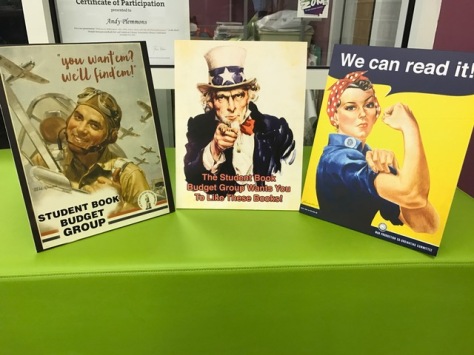
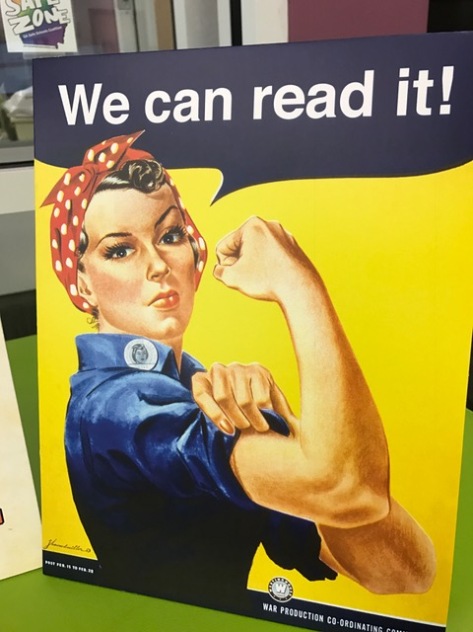
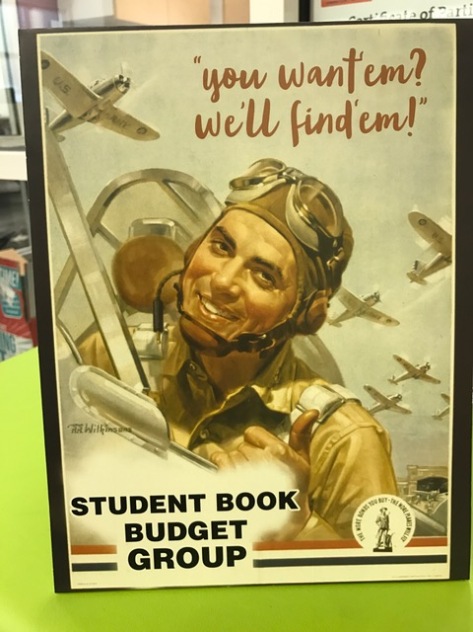
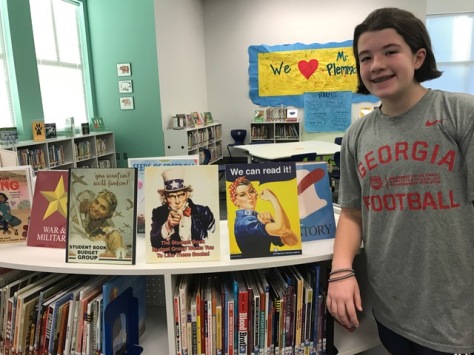
Finally, Amy let us know to expect something in the mail.  When the box arrived, I couldn’t wait to see what was inside.  To my surprise, Amy had sent 3 custom signs that incorporated history as well as the mission of the student book budget group to get the right books in student hands.

capstone-student-signs-4

capstone-student-signs-3

capstone-student-signs-2

I immediately sent a note down to Adaline so that she could come up and see how Capstone had listened to her ideas and given us something completely based upon her request.  She was all smiles.  I also loved that her grandmother was here to celebrate the moment with her.  Even though she might not want the attention, I think it’s important to celebrate this moment.  Now her efforts will be on display as our student book budget books arrive.  These signs will be a part of our student book budget display.

This is not the first time that Capstone has reached out and supported a specific student.  Last year, Amy supported Ajacea in her marketing interests.

I hope other students will see this as an opportunity to speak up and make their voices heard when they have an idea, and I hope educators and companies will see this as an opportunity to amplify student voice and make a difference in our world no matter how small.

img_7722

Thank you Amy Cox and Capstone for always supporting the student book budget project and always listening to (and acting upon) the voices of students.

Student Book Budgets: A Walk to Avid Bookshop

avid-bookshop-2

We are so excited to have the second location of Avid Bookshop just a few blocks from our school.  Avid was recently named one of the top 5 finalists for the 2017 bookstore of the year by Publisher’s Weekly.  Since our students have walking field trip forms on file, it was easy for this year’s student book budget group to plan a walking field trip to the new Avid.  This group of students has a library budget that they have complete control over.  Through surveys, they have set purchasing goals to buy new books for the library that kids want to read.

avid-bookshop-18

Ahead of our visit, I sent Hannah DeCamp, school specialist, a list of the major genres the book budget group is looking to purchase books for.  She pulled together some books to show us, found some “Best Books for Young Readers” magazines, and dug out some advance reader copies of books for students to review.

On the day of our walk, I met with 11 of our book budget team and reminded them about the purchasing goals we had set.  We also reminded ourselves that Avid would be open for business so we needed to stay out of the way of customers as well as keeping the store organized during our browsing.

It was a great morning for a walk and it only took us about 15 minutes to arrive.  Hannah greeted us and showed us how the store was organized.  She showcased a few books in each section and then allowed students to browse the store.

Since the store sells books for all kinds of readers, students really had to ask themselves if they were looking at a book that would best fit an elementary library.  Some books were of interest, but they were really more for adults.  As students found books that they liked, they came to me and we wrote the titles down in a notebook.  I originally wanted to type them as we worked, but I didn’t want to lug around a computer.

What I noticed right away was that when books were presented in smaller sections like the shelves in Avid, students noticed the books better.  There were several books our students got excited about that we actually have in our library, but they haven’t seen them. It made me start to wonder how to make books more visible to students.

When Hannah let students look through a stack of advance reader copies, they again got excited about many of the books. It reminded me that I need to get more students involved in perusing the ARCs that I get in the mail or pick up at conferences.  I can’t read them all, but students can help read and make decisions.

I kept sending students back to the shelves of Avid and making them take books off the shelves to read a few pages or at least read the back.  I feel like they spent a good amount of time digging through what was in stock.  In all, we spent about an hour browsing.

Several students brought money with them, so they made some purchases.  We gathered outside the shop for a bit and took time to look through the catalog that Hannah had given us.  Again, we added to our list before walking back to school.

avid-bookshop-14

Avid Bookshop is going to be such a great resource for us being so close to our school.  There were so many life skills and standards that we explored on this trip.  We learned about the publishing industry, independent bookshops, community helpers, budgets, adding money, and taxes.

avid-bookshop-6

Now, I am typing up the books that we loved, and students will make a final decision to send back to Hannah at Avid for a quote.  I know this is just the beginning of how we will utilize having Avid right here in our school community.

Building Home Libraries: A Community Collaboration

4reading

One of the goals of the Barrow Elementary Media Center is to support the reading habits and curiosities of students, teachers, and families.  During the school year, our library is a huge source of reading, but I often wonder what I can do to continue to support reading during the summer months when students are at home.  What do their home libraries look like? What can we do as a school to support the idea of building a home library?

Many schools in Clarke County are supported by an incredible program called Books for Keeps where every student in the school receives 12 books for summer reading. Our school will eventually be served by this organization, but at the moment, we are not. Since we can’t really raise enough money to buy books for every child in the school, I decided to start with 2 communities of students in our school.

This year, I am working with our community, writing grants, and raising funds to support families in building home libraries in their communities. The Junior League of Athens is purchasing 6 books for each student from the Bethel Homes community who attends our school.   These books are for the students to keep and share with their family. There will be a family day of learning about home libraries, creating a plan for a home library, and adding these 6 books to the home library.  We hope by taking this step, we are supporting a culture in each home of having a dedicated place to keep books that are purchased, borrowed, or donated.

Through First Book UGA, we have a $750 grant to replicate the Junior League’s program in the Parkview community. This will provide approximately 3 books per student through First Book.  In order to replicate the same program we are offering at Bethel, we needed to raise some additional funds.  After getting approval from our superintendent, I created a GoFundMe campaign to raise an additional $1,000. I began sharing the campaign through many avenues of social media as well as personal emails. Camilla Bracewell, a Barrow grandparent and huge library supporter, also shared the project through her own networks. In just over 24 hours, we raised the funds needed.

I’m notorious for jumping into a project before I really know exactly what it’s going to look like, but I always leap in with the faith of expecting the miraculous and knowing that things will work out. Now that the funds are in place, some logistics must be worked out.

Logistic 1:  If students are going to create home libraries, what will I actually use for the home library container?

I didn’t want to assume that every student had a home library at home or that they knew that a home library could be any place you keep books, so I wanted them to have a container to take home with their books. I started pricing containers at Walmart and Target and seeing what Dollar Tree had. Along the way, I posted Instagram pictures of my journey and invited people to chime in with suggestions.

People chimed in with ideas:

Then, my wife suggested that I contact Suki Janssen with the Athens Clarke County Recycling Division, so I did.  She invited me to come and check out the warehouse where the Teacher Reuse Store items are kept. This CHARM facility houses items that are difficult to recycle.  I met with Chris Griffin and he let me browse the building and see what I could find.
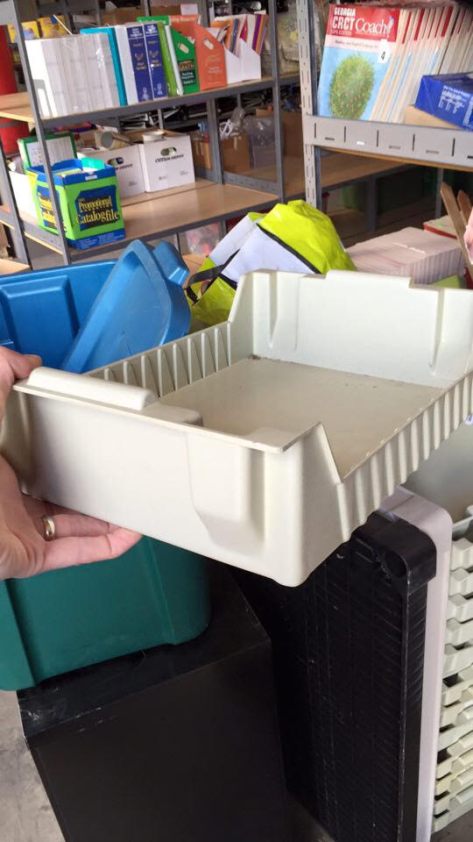
bins at recycling

Miraculously, I found  3 different stacks of trays in varying shapes, sizes, and conditions and was fortunate enough to take them all home with me.

Logistic #2: Getting all of these trays ready to become home libraries.

I took all of the trays home and started cleaning a few of them and brainstorming exactly what to do to the trays to decorate them.

Again, I reached out to the community for ideas. Gretchen Thomas, my collaborative partner from UGA, suggested lots and lots of spray paint.

I went out and bought some cans to do a paint test.

It was a time consuming process to clean and paint the trays and I quickly realized I couldn’t do it alone.

Logistic #3: Who can clean and paint all of these trays?

I brought all of the trays to school.

I called upon my wonderful volunteer coordinator Courtney Tobin as well as Gretchen Thomas to send out emails and ask for volunteers. Once again, the community didn’t disappoint. Camilla Bracewell came in along with Margaret Christ and her librarian mom came in to clean trays.

I also have volunteers scheduled to come in and start spray painting the trays outside.

Logistic #4: How will I order the right books for students?

Since we have a First Book account and grant, I can order books directly from First Book for a great price. I really wanted to go back to my student book budget model and give each student a certain amount of money to spend in the First Book marketplace.

However, I don’t think I have enough time to pull that off.  Instead, I created a short reading interest survey so that I can do interviews with each student and find out some of their interests in order to get the books they really want to read. Again, this isn’t something I can do alone since there’s 75 kids in this project, so volunteers are helping me interview students with printed copies of the survey.

Logistic #5: How will I get the order done?

As we interview students, I’m searching the First Book Marketplace for books that match what students are asking for. I’m adding these to a wish list that I can pull from when it’s time to order.  I’ve blocked off times on the library calendar next week to work on the actual order.  I plan to take each student survey sheet and personally search for books to meet the needs of the student request and age.  Then, I’ll use the donated funds and grant to pay the bill.

Logistic #6: How will students take ownership of the libraries?

Rather than just hand over the books and trays to students, I want them to have some investment in the project. In two weeks, we are going to hold some decorating sessions where students can come and decorate their libraries with personal touches. During that time, we’ll talk about what it means to have a home library as well as talk about sharing books between home libraries. Since these students are in the same community, there is an opportunity for students to be able to exchange books with one another if they want to.

I know that I have many more logistics to work out in this project, but it is amazing to look at where this seed of an idea has grown into a blossoming project.  I can’t wait to see where the project takes us, how it impacts students, and what we all learn about one another along the way. Having a community that pulls together around a common project makes such a difference.


Student Book Budgets and Real World Connections: Empowering Student Voice

Day 2 Unpacking (5)

We have continued to unpack our student book budget purchases this weeks thanks to generous funding from James Patterson. Each year, there are stories that rise to the surface about students who take a stand for other student requests, students who find a certain talent within the many pieces of book budgets, and students who suddenly find a real world connection through our project.

Day 2 Unpacking (1)

This year as we unpacked, I was taking pictures and videos as I always do. I just happened to be near Ajacea, 5th grader, when she was setting up displays of books for people to see. She would set up some books and then take them down because she didn’t like the way they looked. Then, she suddenly decided to start putting the books on the little ledge in the wall of windows that faces the hallway. She talked out loud about how the books should face out so that people would see them as they walked down the hallway. I snapped a few pictures of her inside the library and also through the windows and shared those on social media.

Immediately, I got a tweet back from Amy Cox at Capstone Press, one of the main companies we order from for our book budget project. Her comment started a chain of events.

https://twitter.com/capstonepress/status/686960767296393216

I loved that Amy used the word “marketing” when she tweeted back to us because it was a real-world connection to an actual career. Whether Ajacea knew what she was doing was called marketing or not, it was intuitive for her, and we were able to connect an interest she had to an actual career path that she might not have ever considered.

By the end of the day, I observed multiple students passing by Ajacea’s windows and stopping to look at the books. They were pointing, talking, and asking their teacher if they could come to the library. Most of the books were checked out from the windows in just about an hour. When I shared this, once again Amy from Capstone responded.

https://twitter.com/capstonepress/status/686996050956029952

Ajacea stopped by at the end of the day and I told her that Capstone was impressed with her work and wanted her to be a marketing intern.  She was beaming and said they should call her. I added this conversation exchange to my post about unpacking our books, and once again Amy Cox connected with us.

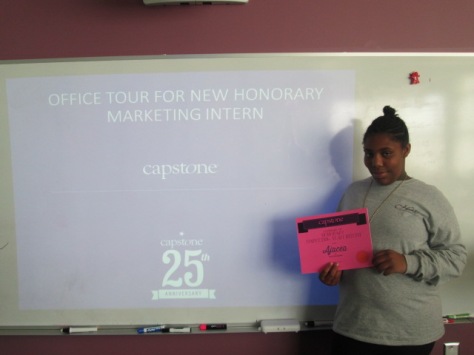
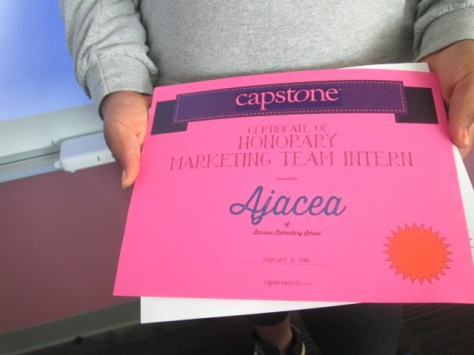
I had no idea what the email would contain, but I knew it would be something special and that Ajacea would love it. Right before Ajacea arrived to unpack and display more books, the email arrived. It contained an official “honorary marketing intern” certificate as well as a personalized tour of Capstone to see just what a marketing intern would do and where she would go.

Before I presented Ajacea with the award, I was showing her places in the library where students had been displaying books while she was gone. Some of the books had been placed on tables in the center of the library. She immediately started analyzing the situation and decided that the tables were just not going to work.  “People need to use those tables,” she said. I explained that the rest of the day’s classes were working in different parts of the library. Her response, “Well what about tomorrow?” She was right of course. The next day I needed all of the tables, so she started moving some of the books to new places.

Day 2 Unpacking (15) Day 2 Unpacking (14)

Before our time ran out, I asked Ajacea to come over to the tables to see something awesome. I told her about all of the response from Capstone and that they sent her some things to see.  I presented her with her award and let her know that the Capstone team put together an official tour of the Capstone offices in the event that she became an intern with them. “They seriously did that for me?” was her response. We put the tour up on the big screen and sat together and chatted about what we saw.

Ajacea saw what it would look like if she walked in the front door of Capstone. She also got to see her desk, which she was very happy with. It was so big a spacious.

The presentation continued on with explanations of the types of jobs she would do as a marketing intern such as work on the Capstone catalog and analyze the data of PebbleGo users. She saw meeting rooms and offices of the CEO and other employees. When she saw the CEO office, she said, “I would not want to go in there. It’s scary.” We had a great conversation about what it’s like to go into the office of your boss and the nervous feelings you get even when it’s usually for something that you did that’s awesome.

Day 2 Unpacking (12) Day 2 Unpacking (13)

As we ended our time, we talked about what she was thinking about doing when she grew up. She told me how she wants to be a designer, any kind of designer. She loved the bookshelves on the wall at Capstone and said maybe she wanted to design spaces like that. She talked about clothes and the possibility of designing fashion. Her wheels were turning and it was so much fun to see and learn a student story that I had not heard before. It reminded of me of how much I was I had more time where I got to hear individual students stories and what I need to do to make sure I have more time to do that.

Capstone is filled with amazing individuals, and I can’t thank them enough for taking time out of their day to put this together for one student. You can tell that they are a company that is constantly reminding themselves about why they do the work that they are doing.


The Student Book Budget Books Have Arrived!

book budget unpacking (41)

After almost two months of working on the 2015-2016 student book budget project, the books are rolling in to the library, and the excitement is brewing. This year’s budget was made possible thanks to a grant from James Patterson. Students had $5,000 to spend on books. They created a survey, surveyed the school, analyzed the results, set goals, met with vendors, compiled wish lists, cut lists to match our budget, and helped order the books.

Now the books are arriving, so students are meeting once again to go through the process of unpacking, inspecting, and marketing the books.

We have many more books than usual, so it is taking a bit longer to unpack the books. So far, we have books from Capstone and Gumdrop. Students came in by grade level for 30-minute shifts. Each company required a different process. This was mainly because we opted to not have full processing on Gumdrop books so that they would ship faster. I’m sort of regretting that decision, but it’s giving students an additional experience.

For Gumdrop, students had to apply the barcode, spine labels, and label protectors. This was tedious work for them to locate the correct labels for the correct books, and they passed this job off as often as they could since it was so time consuming. This process is still not complete, so no Gumdrop books have gone out to readers yet. We need to finish labels and check books off of the packing slip.

For Capstone, our books were already processed and ready to go. All students needed to do was unpack them, check them off the packing slip, and stamp them with the library stamp.

Additionally, Capstone let each book budget member choose one book that was their personal pick. They also sent us labels that could be put into the front of these books so that students could write their names to remind readers who selected those books.

The crew loved locating their books and applying the labels. As an added treat, they were the first to check out these books.

One student took it upon herself to start displaying the books while everyone else worked on all of the other tasks. Ajacea cleared out spaces in  the front of the library and started standing up books. If she didn’t like the way it looked, she took it all down and started over. I saw her do this more than once.

Finally, she had the idea of maximizing display space by putting books in the windows of the library facing out to the hall. There was room to put a top level and bottom level of books. She also used some of our library cushions, tables, and counter space.

It was a prime time for setting up a display because many classes were leaving lunch and walking right by the library. I saw many conversations happening in the hall about the books, and it wasn’t long before those same students were rushing back to the library to checkout what they saw.
There were moments of frantic grabbing when a whole class ended up coming to check out. The books were only on display for a little more than an hour and I would say at least half of the displayed books were checked out.

Students will come once again tomorrow to finish the books we have, and then they will reconvene when our order from Avid Bookshop arrives. I’m always inspired by how proud students are when they see their hard work pay off on unpacking day. They realize that the time they sacrificed was worth it to add more books to the library. They love getting the first look at the books, and they are amazed when the books fly off the shelves.

Ajacea stopped by at the end of the day to see what happened to her display. She had told me earlier in the day that her job would be ongoing because she would need to refill the empty spots. Her mouth dropped when she saw just how empty the windows were at the end of the day.

Our friend Amy Cox with Capstone Press followed along with our day on Twitter, and Ajacea was so proud when Amy said that she would be a great marketing intern.

https://twitter.com/capstonepress/status/686960767296393216

Ajacea’s response? “Tell her to call me.” I love the real world implications of this project and how many times it has given an opportunity to students to explore their interests and realize that their voice is heard and matters. Bravo student book budget team!