The 2019 Student Book Budget Orders Have Arrived!

After surveying our entire school, analyzing data, setting goals, meeting with vendors, creating consideration lists, and narrowing down orders to meet their budget, the hard work of our student book budget team has paid off.  All books from our 3 vendors have arrived and it’s time to get these books out into the hands of readers.

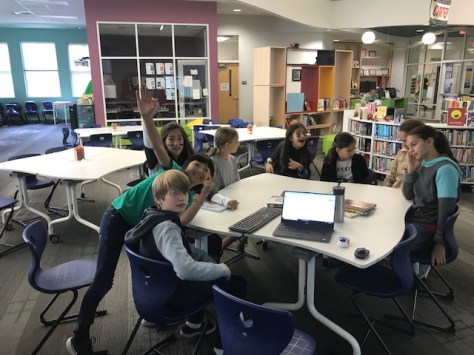
The book budget team met to unpack the books. Across 90 minutes, all of our books from Capstone and Gumdrop were checked on the packing slip, sorted into genres, labeled with genre stickers, and scanned into subcategories in Destiny. Every student on the team took a role in the process and I walked around to assist with questions and tricky genre decisions. I also helped students make sure they were sorting books into the right categories such as chapter book, picture book, or informational book.

Our books from Avid had to be cataloged so I “volunteered” to do this step for the students and some of our library volunteers have helped with getting the barcodes and plastic wrap on the books.

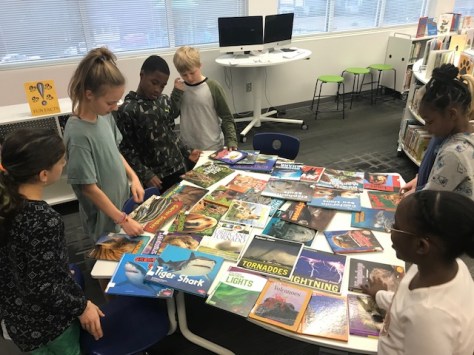
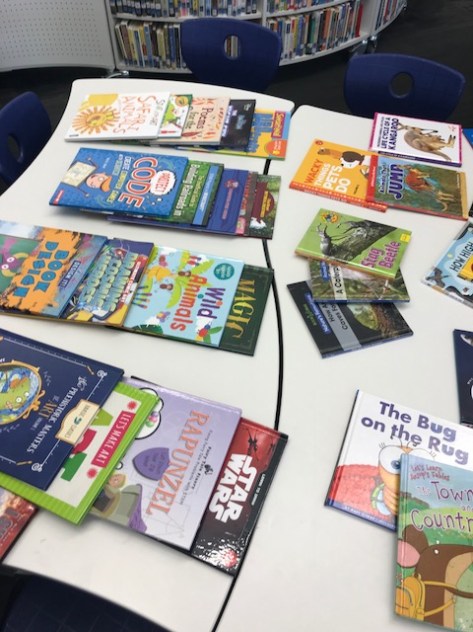
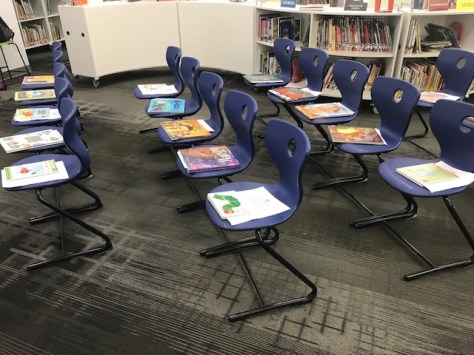
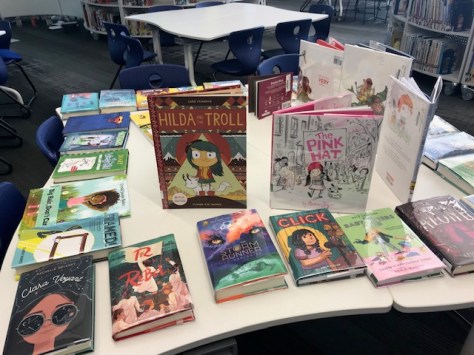
The book budget team met one final time to display the books for readers to see. It was hard for us to find a time to meet to get the books displayed so we all came one morning right after morning broadcast before our school day started. Students worked efficiently to get all of the books displayed in the windows, counters, and tables in the library. It was amazing to see all of the books out together and see all of our hard work pay off.

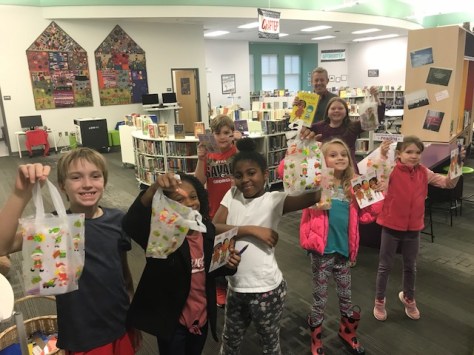
The real payoff comes when the book budget students get to check out some of the books and then see the rest of the school pour in to the library to check out books. It doesn’t take long for the tables full of books to be reduced down to a couple of tables and then a single table. These books are always popular with readers and I love knowing that our library collection truly is “our collection”. We build it together.

Bad Kitty Kitten Trouble: A Visit with Nick Bruel

We’ve been purring with excitement for the past few weeks as we geared up for an author/illustrator visit with Nick Bruel. Nick is currently touring to promote his newest installment in the Bad Kitty series: Bad Kitty Kitten Trouble.

Prior to his visit, we held an art contest in the library. Students in any grade could enter. Their task was to name a new Bad Kitty book and create a cover for that book. Winners in the contest received an autographed copy of Bad Kitty Kitten Trouble and honorable mentions received a blind bag Hatchimal.

Once again, students amazed us with their creativity in both titles and covers, so it was hard to narrow down to just a few top winners. All student artwork was displayed in the library windows to welcome Nick to our school.

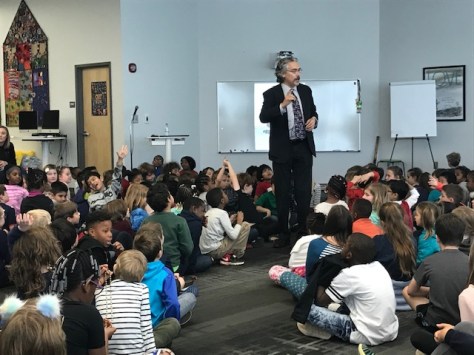
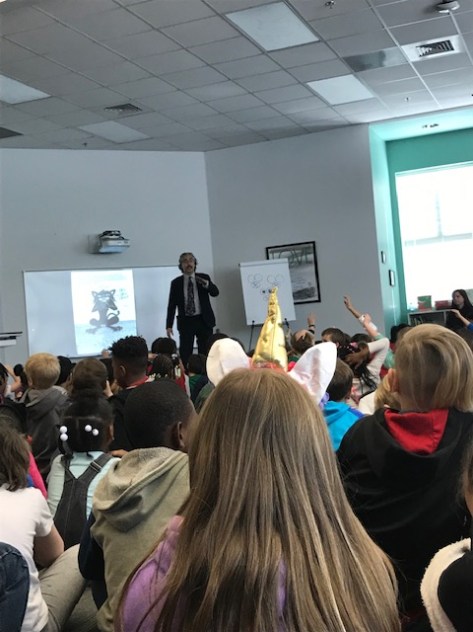
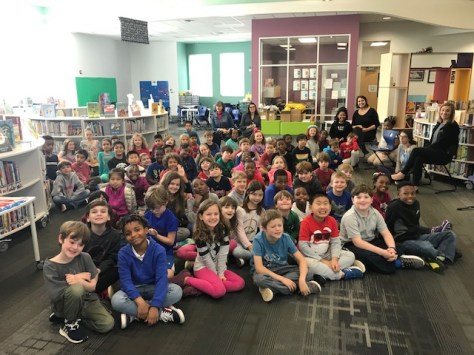
Our 1st, 2nd, and 4th grade packed into the library to hear Nick talk about Bad Kitty. In the beginning, he introduced us to the newest book: Bad Kitty Kitten Trouble. He made the connection for students that it was inspired by the global issues around refugees and how we welcome them into our communities around the world (or not). Even though this Bad Kitty addresses a global topic, it is still a Bad Kitty book at heart with plenty of humor along the way.

Nick read aloud the first couple of chapters of the books, and it was fun to hear students chime in with the repeating lines that they quickly noticed.

Rather than go through his whole writing and creating process with students, Nick took a different approach. He made sure we divided the audience in half as they were being seated and he had each side think of pieces to an entirely new story. One side thought of a character, while the other side thought of an emotion. Then, he picked students to share their thoughts. Our story title became “The Happy Cockroach”.

With this title, Nick began asking questions to each side of the room. With each question, more of the story developed and more questions emerged. Why was the cockroach happy? ….because he was in a hotel full of food.  What problem might that cause?….he ate too much.

The questions and answers continued until we had created a story from beginning to end. Nick took time to retell the story from memory using every answer that students had given.

This brought us to the learn the secret of writing.

This was a perfect setup for students and teachers to take back to the classroom to continue writing workshop. Nick even gave them some activities they could try when they returned.

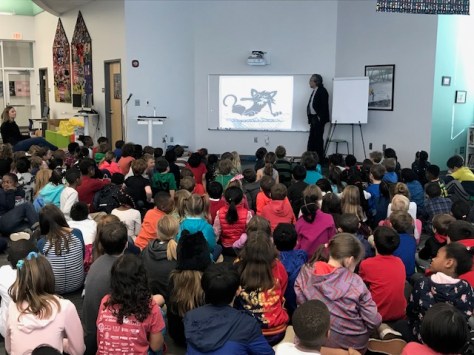
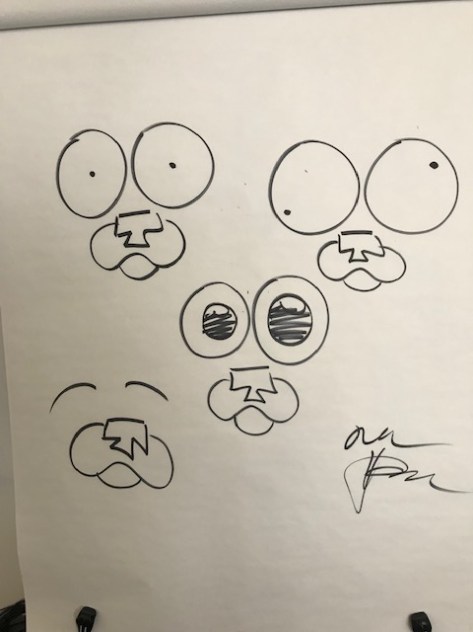
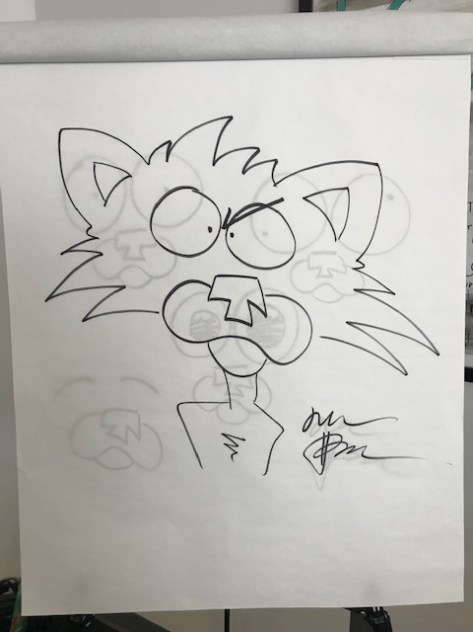
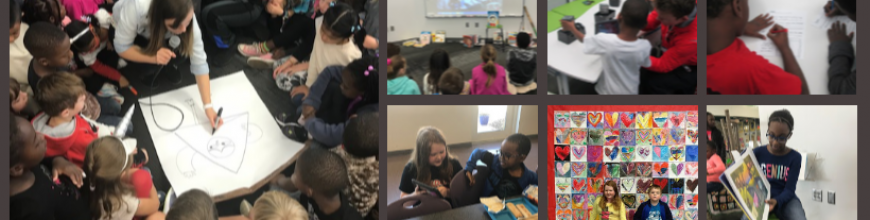
Students always love to see an illustrator draw, so Nick of course drew Bad Kitty for us. After that, he took time to reinforce the idea that simple changes to the same drawing can give your character different emotions. He did this by just drawing the eyes, nose, and mouth of Bad Kitty and making changes to show surprise, adorable, and crazy.

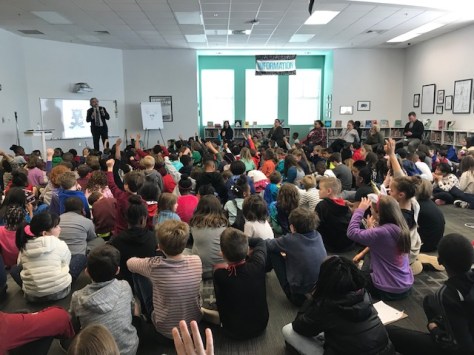
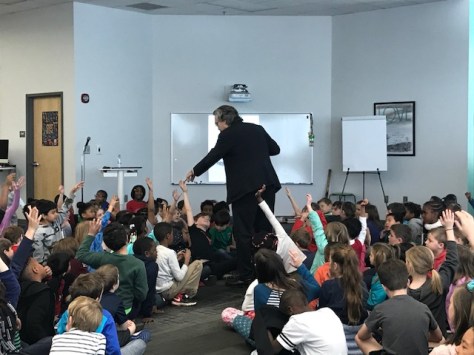
He finished up his time by letting students ask questions, and he even got some questions he had never been asked before. One of those questions came from a 4th grader: “On a scale from 1 to 10, how would you saw your writing and illustrating has improved since the first Bad Kitty?”  This question took some thought, and even though he didn’t have a number to assign, he did talk about how his work had grown both in writing and illustrating.

Before he left he signed pre-ordered books for students. Our PTA bought a copy of Kitten Trouble for each homeroom class library.  We also now have 6 copies in the library for checkout.  Thank you to Avid Bookshop for bringing another author to our school to inspire our reader and creators. Thank you to MacMillan Kids for continuing to send authors on tour to bookshops and schools.

This was our 4th author/illustrator visit this year, and each one brings a new piece of learning and inspiration to us all.

These visits connect us with a real person that creates just like we do in our classrooms and homes. These visits build excitement for books that some students may not have engaged with yet, and they create a shared experience that we can all continue to talk about throughout this year and in the future.


A Rock Exploration: Researchers, Photographers, and Poets

Our 3rd graders study rocks every year as a part of their science curriculum. This year, we brainstormed some new ideas to support this study and scheduled two 45-minute sessions for each 3rd grade class.

Session one focused on facts and observations. To begin, I asked student to put themselves in the shoes of a researcher and consider what someone researching rocks might do. They named things such as reading books, talking to experts, doing experiments with rocks, going outside and looking for rocks, and visiting websites and videos. For this session, students rotated between 3 stations. Each station lasted for approximately 10 minutes.  I didn’t want them to be slowed down by writing down facts, so this day was just an exploration to mentally gather as many facts as they could. Some students still chose to write things down but most took my advice of making mental notes.

Center 1: Books

I gathered multiple books from our nature section of library. Prior to this center, I reminded students how they might dive in to multiple books without reading entire books. We reviewed the table of contents, index, and captions. As students explored this station, the teachers and I noticed students talking about photographs that caught their attention so we jumped in to the conversation by directing students to text or captions that supported the conversation. So often, I see students chat about photographs and forget to read the text, so we tried to gently intervene to make sure the conversation was based in fact rather than speculation.  One of the biggest hits at this stations was learning about birthstones and making a personal connection to gemstones.

Center 2: Rocks

When I was growing up, my grandmother and grandfather took me to Cherokee, North Carolina to visit ruby and gem mines. My grandmother would save her money all year and then buy multiple bags of dirt containing gems and we would spend hours sifting through the dirt in a water trough. I saved the rocks from all of those trips and now they have become a part of my educator collection.

At this station, students used this mix of rocks to make observations and sort rocks in different ways. I included to large circles that students could use as a Venn diagram and compare and contrast rocks based on texture, size, shine, and more. All students worked together to sort as many rocks as time allowed.

Center 3: Websites and Videos

Amethyst is February’s birthstone and also Georgia’s state gem. This station focused on exploring amethyst through websites and videos using a Symbaloo. One of our favorite sites is Gem Kids because it allows students to see gems under a microscope, on a map of the world, and see photos of gems with captions full of info. Students also loved watching the Jackson’s Crossroads video from Georgia to see what amethyst looks like when it is found.

Day 2 of our exploration focused on creativity. We read the book A Rock Can Be… by Laura Purdie Salas and Violeta Dabija. At the conclusion of this poetic book, it says “go a discover what else a rock can be”. This invitation brought us to our next explorations. This time rather than rotating every 10 minutes, students rotated as they finished each step.

Center 1: Artistic Creations
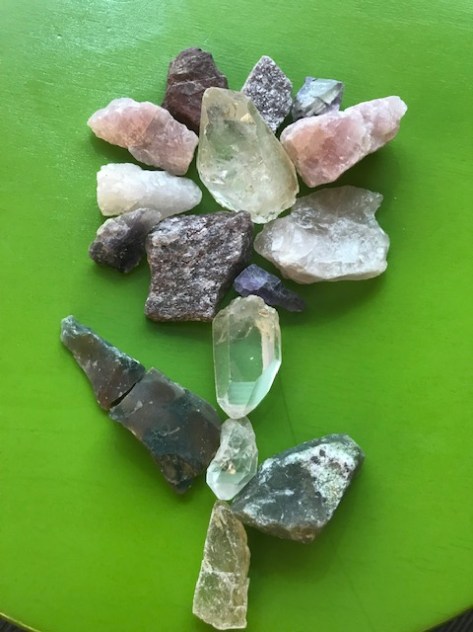
Students once again found boxes of rocks that they could observe. However, this time, their goal was to use the rocks to create something new. They could create a word, shape, object, or anything their creativity sparked. Once they made this creation, they used an iPad to snap a photograph.

This center was fun to watch because every student had a different way of making something. Some had an object in mind already like a football, and they used the rocks to make that shape. Others found one rock that inspired them and they used that rock to form what came to their mind. This was also the station where we saw so many students shine. I loved that whether a student had an English barrier, a reading challenge, etc, this was a visual station that allowed so many voices to be heard in a strong way.

Center 2: Poetry

As students finished photography, they moved to writing in another part of the library. If students had a poem already forming in their mind, they could use a blank piece of paper to create it. However, if students needed some extra support, they used A Rock Can Be… as a mentor text. I had a simple organizer with a structure already formed for them with “a rock can be” and some blanks to create two-word lines in their poem.
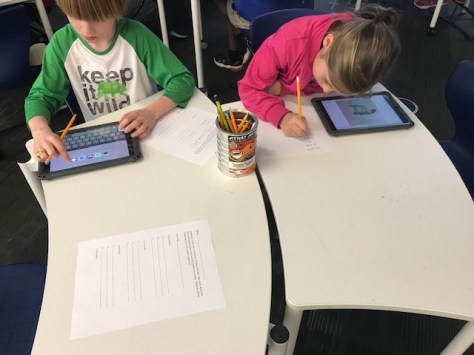
The teachers and I did a lot of conferencing at this station to help students focus on the photograph that they created. Most students had their photograph pulled up on their iPad as they wrote. Some chose to focus more on rocks in their poem while others focused on whatever shape they had created.

Center 3: Recording

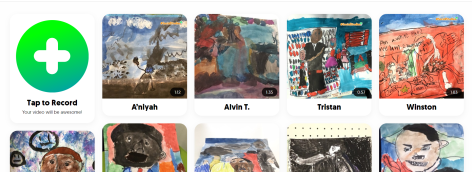
Students moved to quiet space in the library to put all of their creativity together in Flipgrid. I setup our grid to have a guest code so that students could scan a QR code, enter their first/last name, and start recording. They could record their face on the video or flip the camera and record their poem. During the final step, students imported the photograph of their creation and then used the Flipgrid stickers to add another layer of artistic expression. This final step was tricky because it was tempting to add lots of the fun stickers. However, I encouraged the students to think about what stickers added to their photograph and brought their rock to life. I loved seeing what some of the students chose from the sticker assortment.

Going into these 2 days, I was really unsure of how it would all connect together, but once I saw the flow, I really like what happened. I especially enjoyed day 2 and the creativity that came from our students. I need to do a bit more thinking about day 1. I think it was a great mix of modalities, but I do wonder about what I could do to keep the students more focused in the centers, especially the reading center. It might be as simple as drawing out a card that says “pick a word from the index to read more about” or “flip to a random page and read a caption”.

All in all, I’m excited about the creations we made. I invite you to visit our Flipgrid and view and like the student poetry videos.
The Winner of the 2019 Barrow Peace Prize Is…

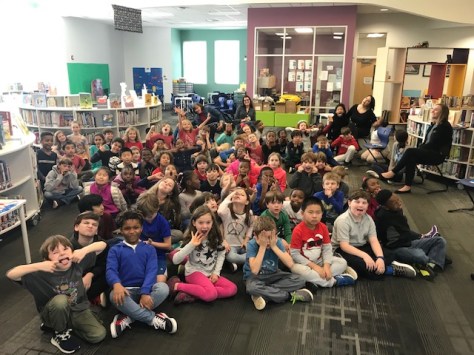
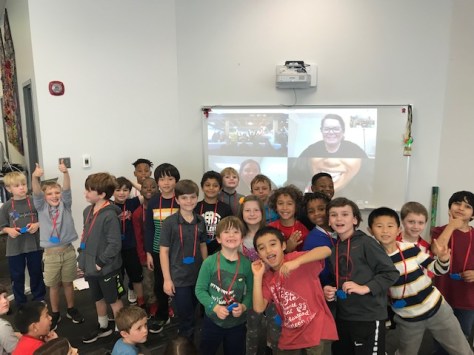
Our 2nd graders gathered in the library for the 6th annual announcement of the Barrow Peace Prize. During this special ceremony, we connect with the team at Flipgrid. Each year, the Flipgrid team grows, and this year we connected with them at their headquarters in Minnesota and also in other locations where team members were working. The kids loved seeing their many faces on the screen celebrating their work.

Before our Skype, I showed students a map of places their voices were heard around the world. They were amazed by the pins in over 110 different locations and counting.

During our ceremony, we started with some introductions and greetings from the Flipgrid team. Then, we took time to hear some special stories from the project. Every year, we get comments on social media about the project which I share with the students. They love having a personal connection with people who have heard their voices.

This year, I had a message exchange with an individual from Canada. She messaged me through our library Facebook page, so I shared her message with the students.

Marion Hodges from Canada says: “greetings from Canada. For the kids who chose Jackie Robinson they might be interested to know that he started his pro career in Montreal with the Montreal Royals. He endured a lot of the same treatment but also a lot of respect. After that he went on to play with the Dodgers. For the kids who chose Rosa Parks – there is a lady named Viola Desmond who did something very similar in Nova Scotia in the 1940s as she refused to leave the “white-only” section of the cinema. She was a successful beautician and entrepreneur and you can see her picture on the Canadian 10 dollar bill.”

Next, we launched into awards. Each teacher selected 3 students to receive one of three awards:

  • Prolific Persuader: For using your persuasive techniques to encourage an authentic audience to vote for your civil rights leader.
  • Outstanding Openers: For using a creative hook to capture your audience’s attention from the very beginning of your persuasive writing.
  • Dynamic Designers: For creating an inspiring piece of art to accompany your persuasive writing and visually engage your audience.

Christine, Marty, and Sindy from Flipgrid announced these student winners. This is one of my favorite parts of the ceremony because the kids erupt in applause for their classmates as they walk up to receive the award. The Flipgrid team applauded each group of students and we took a quick picture with the screen.

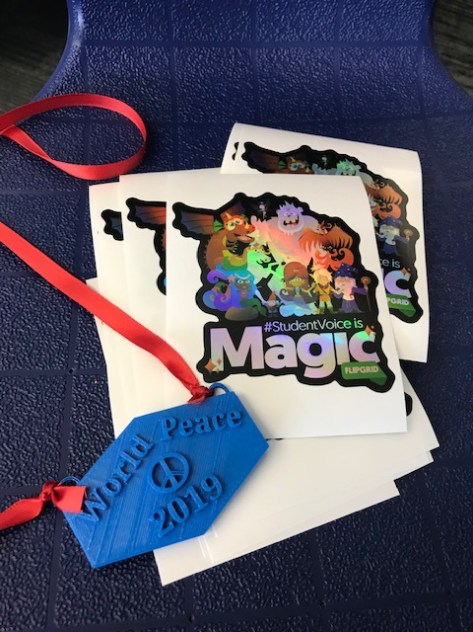
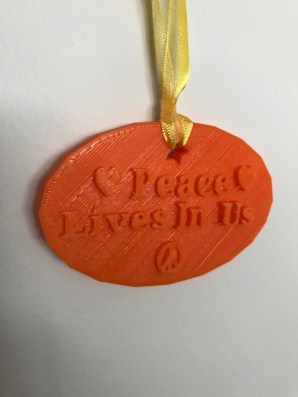
Another tradition we have thanks to a former Barrow student is having students design the Barrow Peace Prize. This year, students applied to design the peace prize by submitting sketches or ideas for what it might look like. Six students were chosen. We met together in the library and found ways to combine our ideas into one prize. The design was created in Tinkercad and printed on our Makerbot 3D printer. Each of the designers received a medal. Every student who researched the winner of the 2019 Barrow Peace Prize also received a medal. Finally, each classroom received a medal for students to take turns wearing. Even though we have one winner of the prize, this is a project that we are all contributors to.

Finally came the moment kids have been waiting to hear. The Flipgrid team announced the winner of the 2019 Barrow Peace Prize.

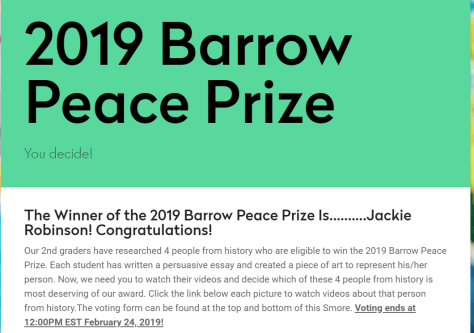
Jackie Robinson received the 2019 Barrow Peace Prize. Kids once again erupted with cheers and applause.

All of the researchers of Jackie Robinson came up to received their medals and take a picture. As soon as students left, I updated our Smore page.

Once again, I was reminded of how special this project is. There are so many ways for students to get engaged with the content whether their strength is art, writing, reading, speaking, designing, or something in between. I love that it gets our student voices out into the world in a positive way and shows our students how far their voices can travel.

Thank you to all of our students and teachers for their hard work on this project. Thank you to all who voted. Thank you Capstone for getting us kicked off each year in our research with PebbleGo. Thank you Flipgrid for amplifying our student voice with your product and celebrating our work each year. We look forward to next year.


Who Will Win?: A Research Lesson with 5th Grade

Killer Whale vs. Great White Shark. T-Rex vs. Velociraptor. Scorpion vs. Centipede.  These topics grab the attention of so many readers in our library.

When the 5th grade language arts teachers, Ms. Freeman & Ms. Hinkle, asked me to brainstorm some lessons ideas about the following standard, my mind immediately jumped to these popular books.

ELAGSE5RI8: EXPLAIN how an author uses reasons and evidence to support particular points in a text, IDENTIFYing which reasons and evidence supports which point(s).

I began to think about how students might create their own quick versions of these stories using books from our informational section.  Ms. Hinkle and Ms. Freeman scheduled each of their language arts classes to come to the library for 45 minutes.

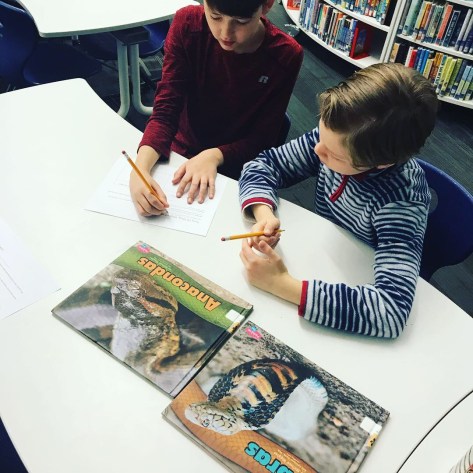
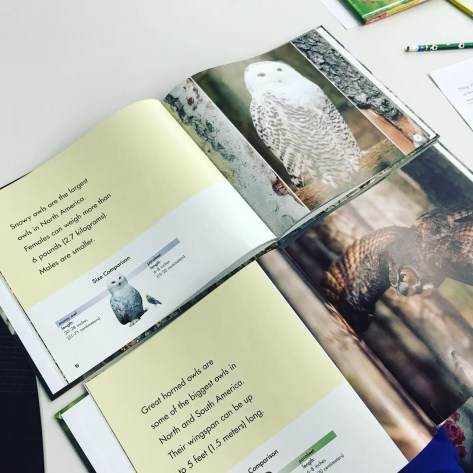
We began our time together on the floor and took time to look at a selection of books from the Bug Wars, Dinosaur Wars, and Who Would Win series. I asked students how an author might go about comparing two animals who might not actually meet in real life. We brainstormed a list of categories that an author might use to compare animals: size, speed, abilities, classification, etc.

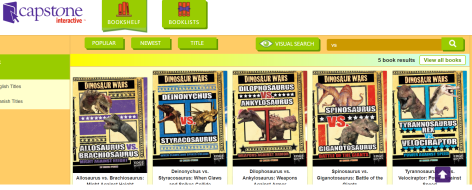
Next, we took a look at an interactive ebook from Capstone called Tyrannosaurus Rex Vs. Velociraptor from the Dinosaur Wars series. We looked at the structure of the book and how the author used size, speed/agility, weapons, and attack style to compare the two dinosaurs. In addition to the summaries at the top of the page, we saw how the author gave several pieces of evidence to backup the point of which dinosaur was superior to the other in a particular category.

This set us up for our work session. Ahead of time, I pulled multiple animals books from our library as well as a few other things that could be compared like weather events and landforms. When I pulled the books I considered which animals I might pair together if I was choosing, but I wanted students to have the choice of whichever pairings they wished to have.

With a partner, students selected two “things” to compare. This was a bit of a frenzy as students tried to quickly pair two animals or other things together before resources started to disappear to other partners.

Then, they used a brief graphic organizer to decide on 4 categories to compare the two things. I encouraged them to look at the index in the books to help them think about comparisons they might make.

Their goal was to find evidence for each thing in each category and then decide on a winner for that category based on the evidence.

After looking at the evidence for all 4 categories, students decided on the overall winner. Sometimes students couldn’t decide an overall winner, so I encouraged them to create some “what if” scenarios that might help them think about when one of the particular animals or things might come out on top. If time allowed, students could create a Flipgrid video explaining their comparisons.

The teachers and I circulated between the pairs of students and conferenced with them on their categories and pushed them to look for evidence. What we saw as we conferenced was that most students were excited and engaged.

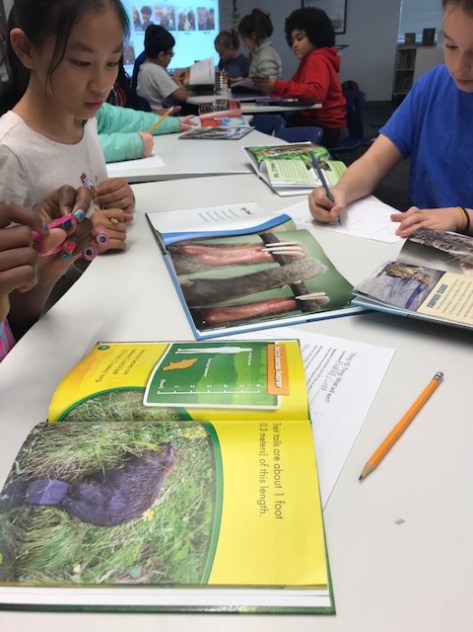
They were really searching for information and putting books side by side to make comparisons. They were having critical conversations to determine which animal would actually win in each category based on the evidence they found.  They were even asking to see additional resources like websites and other books because they weren’t finding the info that they were looking for.

This project gave me lots to think about. The concept of competition between “things” was motivating for students. I didn’t give them a detailed graphic organizer with a bunch of pre-written questions they had to find answers to. They determined the categories and looked for the answers. I was surprised by how many students started asking for additional resources because they wanted to find the answer they were looking for rather than trying to make one resource work for everything as I’ve seen in other research projects.

Of course, everything wasn’t perfect and some students didn’t stay focused the entire time. However, I saw an engagement that I don’t always see. I saw students excited about diving into books without too many complaints that we weren’t researching on the computer. We also didn’t really have enough time for most students to record. The teachers are going to try to give time back in class to finish recordings.

I want to unpack this a bit more in my mind and think about implications for future projects. I definitely think that this project could be expanded to something much bigger. It was obtainable in a day, but it could be so much better with a little more time.

The students who were able to record so far would love for you to take a moment to watch their videos. If you decide to try this out with your students, I would love to hear how it goes and what modifications you made.


Our Students Need Your Help to Decide the 2019 Barrow Peace Prize

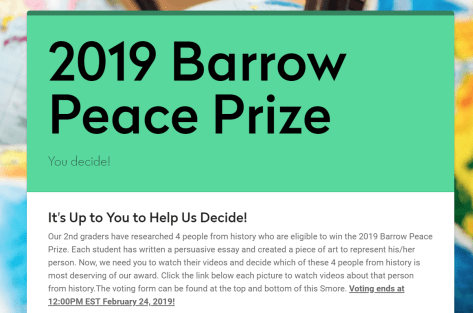
Every year our Barrow 2nd graders embark on a month-long project to research 4 people from history and decide which person is most deserving of a peace prize that we named after our school. This project has gone through many changes over the years and is a project that we keep coming back to because so many standards are woven into it.

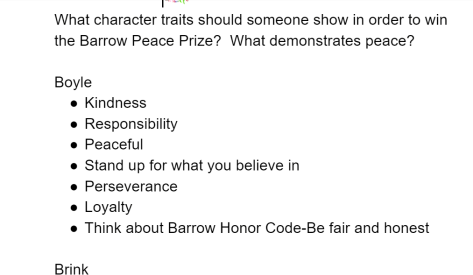
Our project begins with a Google Hangout with all 4 second grade classes. This year, we read Malala’s Magic Pencil and discussed her character traits. We also learned about the Nobel Peace Prize that Malala won. We used this information to create a list of character traits someone should show in order to be deserving of our peace prize.

Then, students researched 1 of 4 people from history using Pebble Go, Encyclopedia Britannica, and websites found in Destiny Discover. They gathered facts onto a Google doc shared with them in Google Classroom.

In art, students created an image of their person using watercolors.

In writing, students used their facts to craft a persuasive piece of writing to convince an audience to vote for their person from history.

Finally, students recorded their artwork and writing using Flipgrid so that it could be viewed by a worldwide audience.

That’s where you come in. Our 2nd graders want you to hear their voices. They want you to listen to videos about each of the 4 nominated historical figures and decide which person should win the 2019 Barrow Peace Prize. You can access all of the videos on this Smore.

At the top and bottom of the Smore is a Google form where you can cast your vote. Voting starts now and will end on February 24 at 12:00PM EST. We will announce the winner of the Barrow Peace Prize when we Skype with the Flipgrid team in Minnesota in early March.  Every student who researched the winning historical figure will be awarded a 2019 Barrow Peace Prize medal created on our 3D printer.

We hope you will watch and vote. We also hope you will share this project with your own students, networks, or people in your community. Anyone can vote. The students love seeing where people have viewed their projects and how many votes were cast.

Who will win? You decide! Click here to start.


Kindergarten Exploring How Books Are Made: Authors, Illustrators, Editors, & Publishers

Kindergarten has launched into an exploration of “how-to” writing. In class, they’ve been thinking a lot about the steps it takes to make something. They’ve been taking these steps and writing their own “how-to” books.

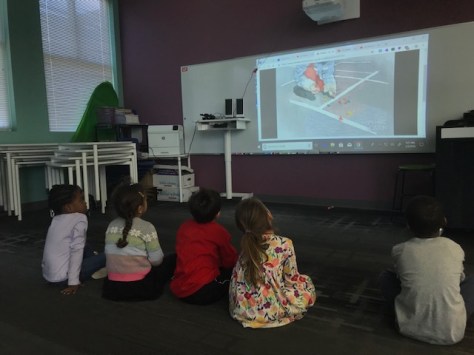
As a part of this exploration, they are also exploring how books are made. The teachers each scheduled 2 sessions in the library. During the 1st session, we split the class into 3 groups to rotate through centers related to how books are made. Since this was Kindergarten, we had me, the classroom teacher, and the classroom paraprofessional to lead the centers that I planned.

Center 1: Read Aloud

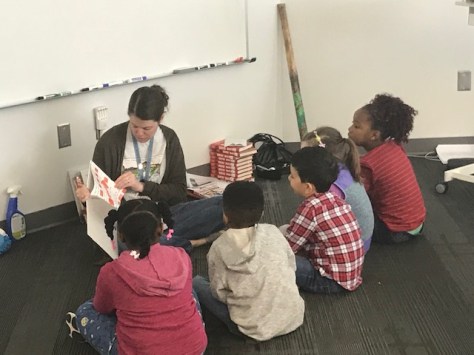
We used How This Book Was Made by Mac Barnett and Adam Rex. In true Mac Barnett form, this book is filled with humor that was a little bit above the heads of some Kindergarten friends, but there’s a lot of great info on the process that a book goes through to end up in our hands. The book goes over the role of the author taking an idea and turning it into a draft. It also hits home the idea of writing multiple drafts of a book and getting feedback from an editor that is sometimes hard to receive.  Next the book takes us through the illustrator’s role of creating pictures for the author’s words. It shows students how the book is printed and put together before it is shipped to the shelves to await a reader.

To me, one of the best lines in this book happens at the end when Mac writes, “a book can have words and pictures and paper and tigers, but a book still isn’t a book, not really, until it has a reader”.

Center 2: Video

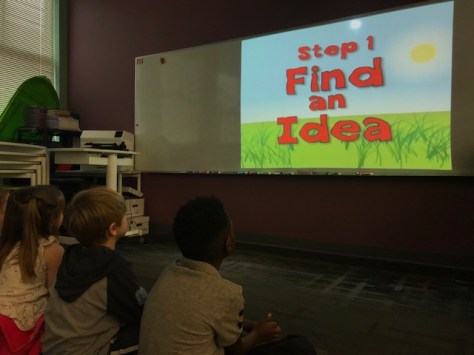
I pulled together a variety of videos so that we could pick and choose pieces of videos to play and discuss with students. One video from Capstone walks through the process of making a book from an idea to the printing.

If students were really interested in how a book is actually put together, we spent more time with this Discovery video.

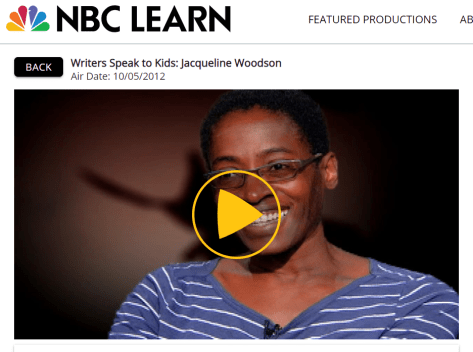
I also wanted students to hear from some authors. There are many options to choose from, but I pulled an interview with Jacqueline Woodson. She shares more details about ideas, characters, and rewriting.

Since students are exploring how to make their own books, I also wanted them to see some different options than what we might have in our library. They watched just a bit of this video showing elaborate pop-up books by Robert Sabuda.

We could pause the videos along the way and let kids make noticings or ask questions about how books are made.

Center 3: Writing & Illustrating

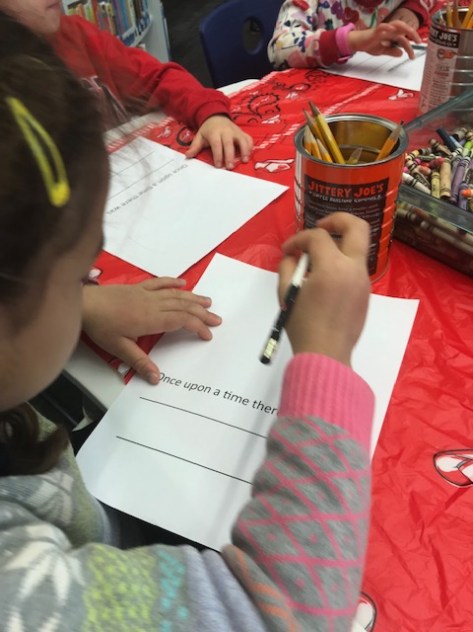
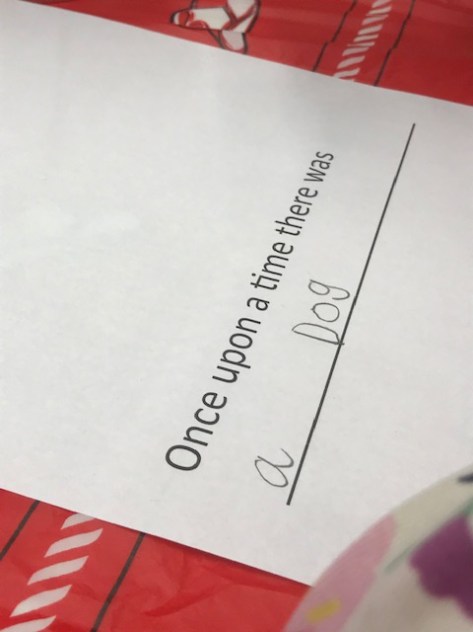
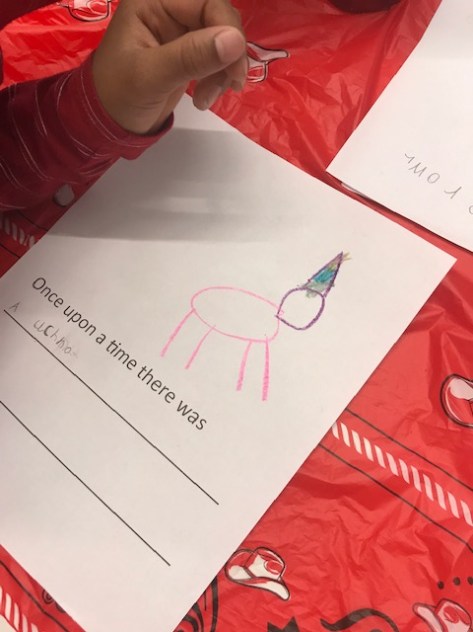
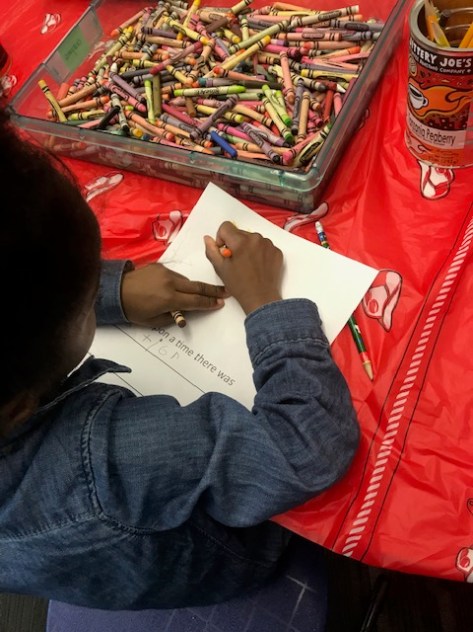
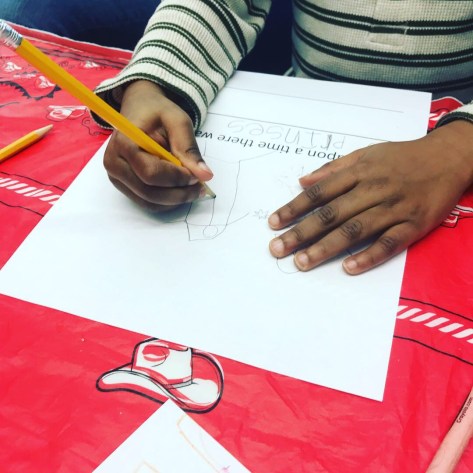
At this writing center, students put themselves in the shoes of an author and illustrator. Since our time was limited, we weren’t writing a full story. Instead, students finished the stem “Once upon a time there was….”.  Students filled in whatever they wanted to as the author.

We talked about how often an author and illustrator don’t meet in person. The publisher might assign a text to an illustrator and the publisher is the one who communicates with that person. To mimic this, students sent their writing to someone else at the table. That person read the text and created an illustration to go with the text.

This was a challenge for some students because they saw that the illustrator didn’t always draw things the way they had pictured it in their mind. We used this “conflict” to connect with what published authors and illustrators sometimes face.

Closing:

We came back together after our 3 experiences and took a glance around the library as the books sat on the shelves around us. We talked about how every book on our shelves has gone through a journey to make it to our shelves. Students shared some of the journey that they remembered from the various centers.

Next up, students will be working in the art classroom to make their own bound book.  Then, they will return to the library to explore the “how-to” books.


Student Book Budget: Meeting with Vendors

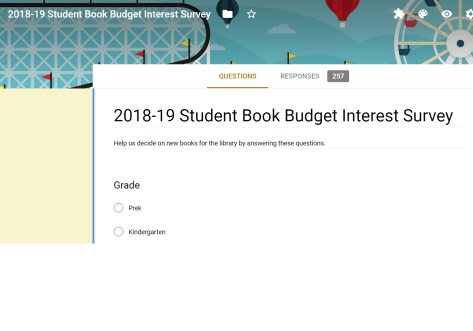
Our 2018-19 student book budget team is hard at work creating consideration lists of books for purchase. So far, they have created an interest survey, surveyed numerous students in our school, and set purchasing goals. I sent their goals to vendors and setup some appointments for vendors to meet with the team.

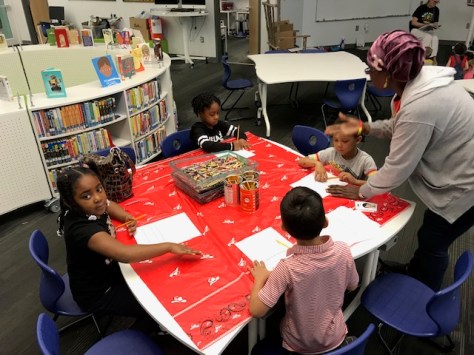
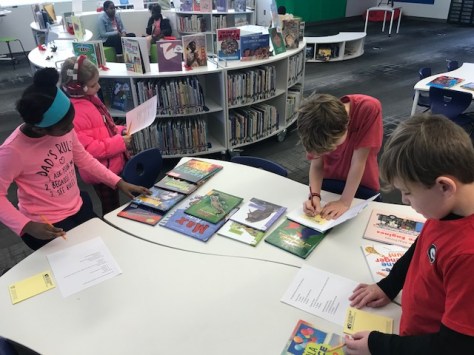
Our first vendor was Gret from Gumdrop Books. Gret brought in fiction and nonfiction and split them into separate groups on tables. She gave each student a pad of paper to write down item numbers for books or series they were interested in. They gave Gret each of their papers at the end of their time and then she put them into a consideration list in Excel. One of the things I love about what Gret does is that she has a printed list inside each book that shows other books in the series. Students can easily see if there are other books they are interested in.

Since Gret only had a sample of books to peruse, we had the Gumdrop website pulled up on the big screen so that Gret or students could search for books that weren’t represented on the tables. At the close of Gret’s time students in the 3 groups had made a list that totaled over $6,000! That’s not unusual for this group. It will become a good lesson later into how you get critical and purchase the very best of what you’ve found with the money you actually have.

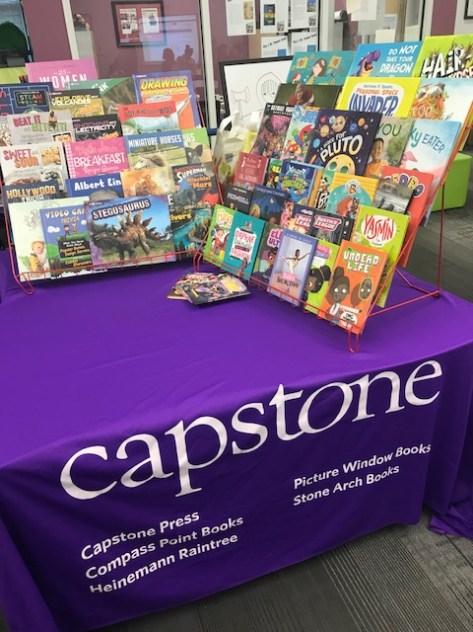
Our second vendor was Jim Boon from Capstone. Jim has worked with us since the very beginning of this project. He’s great at bringing in a variety of books in fiction and nonfiction and splitting them into 2 displays that students can easily access. He also has catalogs and pens shipped to the school prior to his visit so that students can look through catalogs for books that aren’t found in his displays. Jim does a quick overview of what he has brought, how to use the catalogs, and any promotions Capstone currently has. Then, he spends time assisting students in looking at books and finding specifics in the catalogs.

My favorite feature in the Capstone catalog is the barcode listed on each series. Students can scan the barcode and it pulls up the entire series on the screen. Then, students can check the books they want to add to the list.  It’s so much faster than having to write things down or bookmark pages in a catalog. Then, we can easily go into the list later to delete the books we don’t want.

Jim gets right in with the students and helps them find whatever they are looking for. He’s so fun and keeps them laughing and shopping. He even brought them a special treat bag to go with their Capstone pen and bookmarks.

Now, students have a lot of work to do after the break looking through their Capstone catalogs and cutting books from their Gumdrop list. Then, we’ll meet with one more vendor before making final decisions.

I love watching this group work and seeing what stands out to them.


2018-19 Student Book Budget First Steps

One of my favorite projects of the year has started. Our student book budget group is a group of 3rd-5th grade students who volunteer their time to decide on new books for the library.  This project has been a part of our library for several years. Each year, we make some adjustments to improve the process and make sure student voice is heard. Over the course of December and January, students in this group will survey the school on reading interests, develop goals, meet with vendors, develop consideration lists, place a book order that meets a budget, process new books, market new books, and enjoy reading the books they have selected.  It’s quite an undertaking, but something I cherish every year.

Step One

I created a Google form application that was emailed to all 3rd-5th grade students. In the application, I linked to a video that explained the project to students. Some teachers played this video for the whole class. Other teachers simply reminded students that applications were open. We made announcement reminders on our morning broadcast for students to apply.  Applications were only open for one week.

This year, I wanted students to make a commitment up front to stick with the project from beginning to end. I made this one of questions to help me decide who to accept into the group. I generally accept every student who applies, but if students weren’t willing to commit to the time the project takes, then I knew they might not be the best choice for the group. I knew I could at least talk in person with students who said no/maybe so that we could clear up expectations and requirements.

Step Two

Once students were chosen, I announced our team on the morning broadcast and communicated with them and their teachers via email. We have 25 students on this year’s team. Our routine schedule is to meet on Tuesdays and Thursdays at 11:00 for 3rd grade, 11:30 for 4th grade, and 12:00 for 5th grade. This time is taking the place of our open makerspace time during December and January.

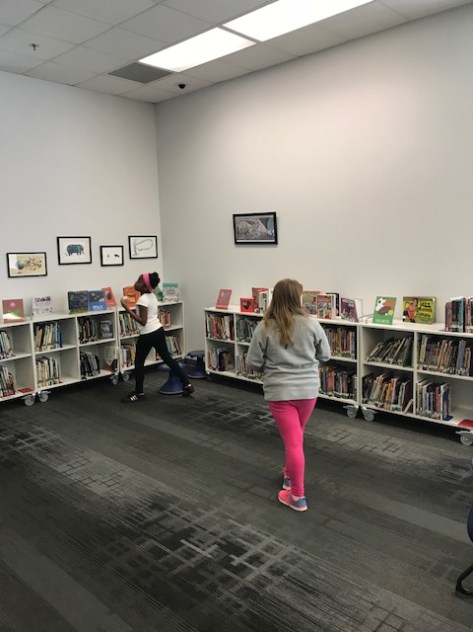
During our first meeting, students thought about what they might put on a survey about reading interests. They started by doing a walk around the library and seeing what they noticed about the shelves. For example, they saw how empty the dinosaur, fun facts, and ghost section was. They noticed that we have a lot more humor chapter books than they realized.  We used these noticings and last year’s survey to create a new survey.

In the end, they mostly kept the survey the same with a few small changes.

Step Three

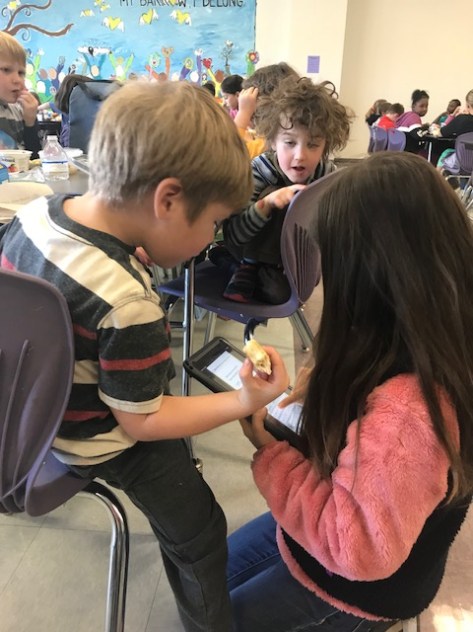
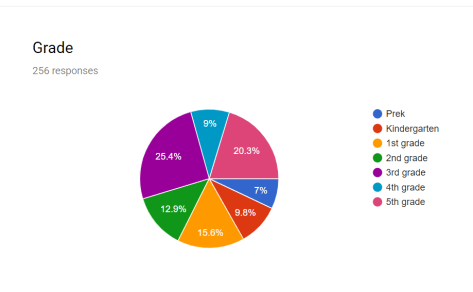
I emailed the survey to all 3rd-5th graders who have their own computer and let teachers know the survey was available. At our 2nd book budget meeting, each grade of students took iPads to the lunchroom and surveyed as many PreK-2nd grade students as possible.  Each time the survey was submitted, it sent the data to a spreadsheet and summary so that we could see which grade levels weren’t as heavily represented and we could begin to set goals for our purchasing.

Step Four

At our 3rd meeting, we checked in on our data to see what else we needed to do.  We noticed that we needed more 4th and 5th grader voices, so we surveyed some of them at recess and made a final plea to teachers to give them time to take the survey in class.

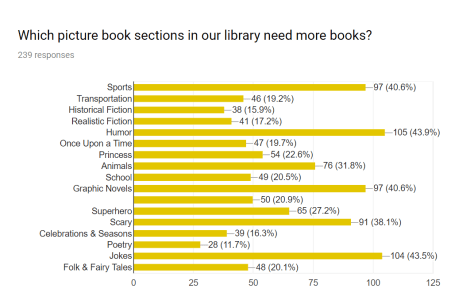
We also used the 3rd meeting to go ahead and notice what the data was telling us so far.  Each group noticed that in picture books the top requests were humor, jokes, graphic novels, and sports.  In chapter books, the top requests were humor, sports, and mystery. In informational, the top requests were fun facts, cooking, ghosts, and animals/dinosaurs.

Students compared these results with what they noticed in their walk around the library. They saw that things mostly matched, but the biggest difference was the humor chapter books.  People are asking for more, but we have so many that aren’t getting checked out. This is a point they are considering so that they really focus on what they think people will actually read.
Moving Forward

Now, we are wrapping up our survey and firming up our purchasing goals so that we can start meeting with booksellers.  We already have appointments with Jim Boon at Capstone and Gret Hechenbleikner at Gumdrop to look at their products. We’ll continue to update our progress along the way.


Our 2018 Picture Book Smackdown was a Success!

The 2018 Picture Book Smackdown was held on November 29, 2018.  This has been a yearly tradition since November became Picture Book Month.  During a smackdown, we hold a Youtube Live event where students and authors in multiple states book talk as many picture books as possible across 45-60 minutes.
This year’s smackdown featured students in 4 different grades in 3 different states, which included:

Andy Plemmons and students at David C. Barrow Elementary in Athens, GA

Donna MacDonald and students at Orchard School in South Burlington, VT

Julee Murphy and students at Early Childhood Development Center in Corpus Christi, TX

Ahead of the event, students selected a picture book to share, read the book, prepared a script, and practiced.  I also communicated with all the librarians at each site to make sure we all knew our roles during the hangout.

I made a Smore for us to advertise our event, and it’s really fun to see where people are viewing the smackdown from.

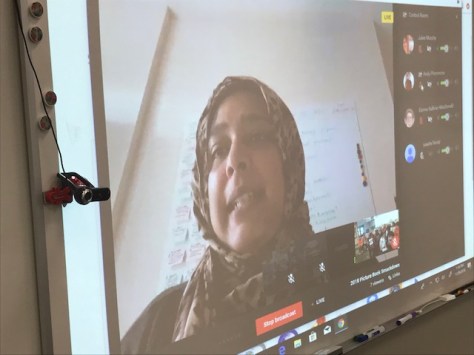
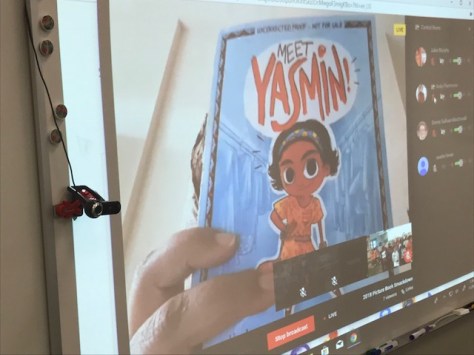
Donna MacDonald reached out to author Saadia Faruqi who agreed to kickoff our smackdown. She shared her Yasmin books as well as 3 favorite picture books featuring Muslim characters and stories.  We can’t thank her enough for speaking to our students. I know many of my students want to read all of the Yasmin books now.

During the smackdown, we had 5 students from each school step to the microphone, share their name, and tell about their book. We kept this rotation going until we ran out of students or time.

It was amazing to see that every student chose a different book, even though we didn’t plan that. We kept a list of all of our books so we could remember them for our own libraries and to share with all of you.

Saadia Faruqi closed out our hangout by encouraging students to continue to read picture books and create their own stories. She found it so encouraging to see so many students reading and also enjoying the books that she created herself.

You can watch the full smackdown here.

I encourage you to host your own, even if it’s just in your own school.  We are even thinking about doing a smackdown with other formats of books like graphic novels or chapter books.  Thank you to everyone who participated and watched.  We’ll see you next year for the 2019 Picture Book Smackdown.